Using national EMS data, we observed over 900 additional obstetric-related emergency activations in the first three months following the Supreme Court’s Dobbs decision. The majority of this increase occurred in states with protective abortion policies.
https://t.co/tWSgxTzVJx
📣 Check out our article showing disparities in neonatal outcomes by sexual orientation, now out in @greenjrnl. (1/3) https://t.co/chJScc4s7l
#epitwitter#QueerEpi#LGBTQHealth
.@DeptPopMed's @_payalc & team recently sought to estimate disparities in gestational diabetes & hypertensive disorders of #pregnancy by sexual orientation.
Read what they found in Paediatric and Perinatal Epidemiology: https://t.co/NTe4Fz2QDO
LGB+ people continue to face discrimination and social inequities, impacting their reproductive health. Addressing the mechanisms (e.g., structural barriers and healthcare needs) underlying these disparities is critical. (6/6)
📣 Our team’s article, “Sexual orientation disparities in gestational diabetes and hypertensive disorders of pregnancy,” was just published by @PPE_journal!
Article 👉 https://t.co/yIXeZ0JzqT
#epitwitter#HealthEquity#QueerEpi#LGBTQHealth (1/6)
Because LGB+ people experience many sources of social inequities, these disparities may be due to multiple mechanisms. Future work in reducing these disparities (e.g., addressing structural barriers & healthcare needs) is critical for achieving reproductive health equity. (5/5)
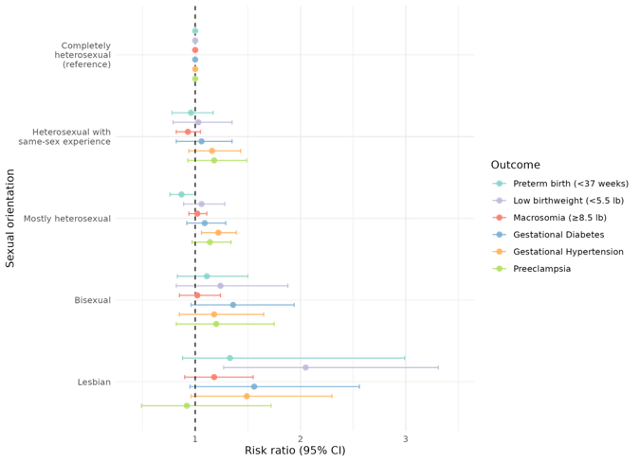
We found that LGB+ people may be at higher risk of gestational hypertension, preeclampsia, and low birthweight. However, inequities differ across LGB+ subgroups. (3/5)
For example, pregnancies to mostly heterosexual people are at 22% higher risk of gestational hypertension & offspring of lesbian people are at >2 times the risk of low birthweight. Bisexual & lesbian people experience a high burden of almost all 6 outcomes. (4/5)