Millions of GGUF downloads later, those same llama.cpp checkpoints can now run in 🤗 transformers.
Same models, more ways to use them, and fast local inference on Mac powered by ggml kernels!
Blog: https://t.co/AiD8iBRYmx
ggml kernels: https://t.co/tkR5RraSbf
My summer project is done! A 20 video, free course on post-training to accompany my book is all on YouTube with slides open for modification & re-use.
~12 hours of content covers the core foundations and some research areas I think will grow in importance. It was a fun time to review all the fundamentals again, as it is clear in the next 1-3 people the amount of people wanting to learn post training will likely 100X again from today, as we have already 100X'ed from two years ago.
As AI agents get increasingly capable at coding and discussing these fundamentals (see the code exercises accompanying the book that I am refining with the community) I think developing clear intuitions for how models work and why is one of the most important skills going forward in AI. Still, learning the post-training math is the best way to battle test them. I personally just in this course am starting to master how forward/reverse KL relates to post-training topics.
Thanks to all my viewers, and I'm happy to answer questions in the book discord or understand how to better teach the various reward models, on-policy distillation, new RL algorithms, etc.
Plus, the book is 50% off right now with the code PBLambert on Manning to celebrate the launch.
I'll share the relevant links below.
Who's going to make this course for pretraining?
Announcing Discovery Loop!
I am very excited to announce that, along with my longtime friends and collaborators @Sanjay_Ghemawat, @OriolVinyalsML and @quocleix, we are founding Discovery Loop (@DiscoLoopAI), a Public Benefit Corporation whose mission is to automate machine learning, science, and engineering to accelerate discoveries and progress. The four of us have worked together for 14 to 30 years, and have helped build some of the world’s most used products, infrastructure and AI models, and we’re excited to turn our attention to this ambitious endeavor.
♾
Learn more at: https://t.co/Rv3LMdLluK
The Art of Debugging Open Free book is now available in pdf/epub and finally sports a book cover
https://t.co/NPgds6WpOW
While a lot of the focus is on Unix/Python/Pytorch, the methodology chapter is applicable to any Software Debugging.
It currently sports 161 packed pages in 5 solid chapters and more coming...
My time at Ai2 / @allen_ai has come to an end.
Ai2 is a wonderful place. The last 2.5+ years building Olmo, Tulu, and other projects will be one of the peaks of my entire career. I'm extremely thankful for my teammates and the open community who made this work possible.
For me, it's time to try something different. I will still be working in the open model & open science spaces (more news on that soon). In the meantime I'll be spending a few months learning, chatting with a broader network, getting married (!!) and most importantly recharging from pouring my soul into this place.
I've attached the note I shared with the team and some fun photos from our time together. I'll keep cheering for Ai2 and am excited to see what you build next.
How to make your engineering job application stand out (from the perspective of someone looking at hundreds of resumes):
1. Your resume should be one page. If you really need more space, link to a website. You don't need 10+ bullets for each job.
2. You will immediately stand out >90% of applications if you link a personal website that has some intentionality behind it.
3. If you are going to link your X, you might want to clean up your posts? Seems obvious but... people post some wild stuff.
4. You should link your GitHub. Please avoid doing a profile README that looks like a MySpace profile with the badges and images. I'm trying to look at code and your ability to build interesting ideas.
5. You should try to customize your application to the company. If you're applying to a startup, the courses you took in college probably don't matter as much. Maybe more if you're trying to make it through the ATS screening for FAANG.
6. I'm seeing a surprising number of resumes which don't talk about AI or agents at all. Software engineering is changing and it's a pretty fair assumption that you will be expected to learn or understand coding with AI for your job. That should be reflected on your resume and projects (and I'm not just saying this because I'm at Cursor).
7. Take your LinkedIn seriously. Most devs are here hanging out on X but surprisingly still most people will send around your LinkedIn internally.
8. Find ways to show your unique strengths/tastes/interests. It's nice to see people are smart, well-rounded, and thoughtful. Maybe this is a collection of books you enjoyed and why. Or some writing you've done. Or films you liked. At the end of the day, people want to work with other people they like and respect. If nothing else, it will be a good conversation starter ("oh I love [book] as well!").
9. Do not use AI to write your cover letter or resume text. It's incredibly obvious, especially if you are applying to an AI company. You can still use it to ideate on ideas or phrases, but write it by hand (don't fall victim to the overused in-the-distribution-AI-phrases). See: /humanizer skill.
10. No photos on resumes. Save those for whatever you link out to.
11. Quality over quantity. 3 really good, thoughtful, detailed, interesting projects versus a wall of 27 AI-slop ones.
Remember that hiring managers / recruiters are getting hundreds or thousands of applications for a role. They're not going to spend 20 minutes on every single application. You need to cut the cruft and get to the point. I hope this helps you stand out!
Introducing the context course: a free course on doing ML with agent context.
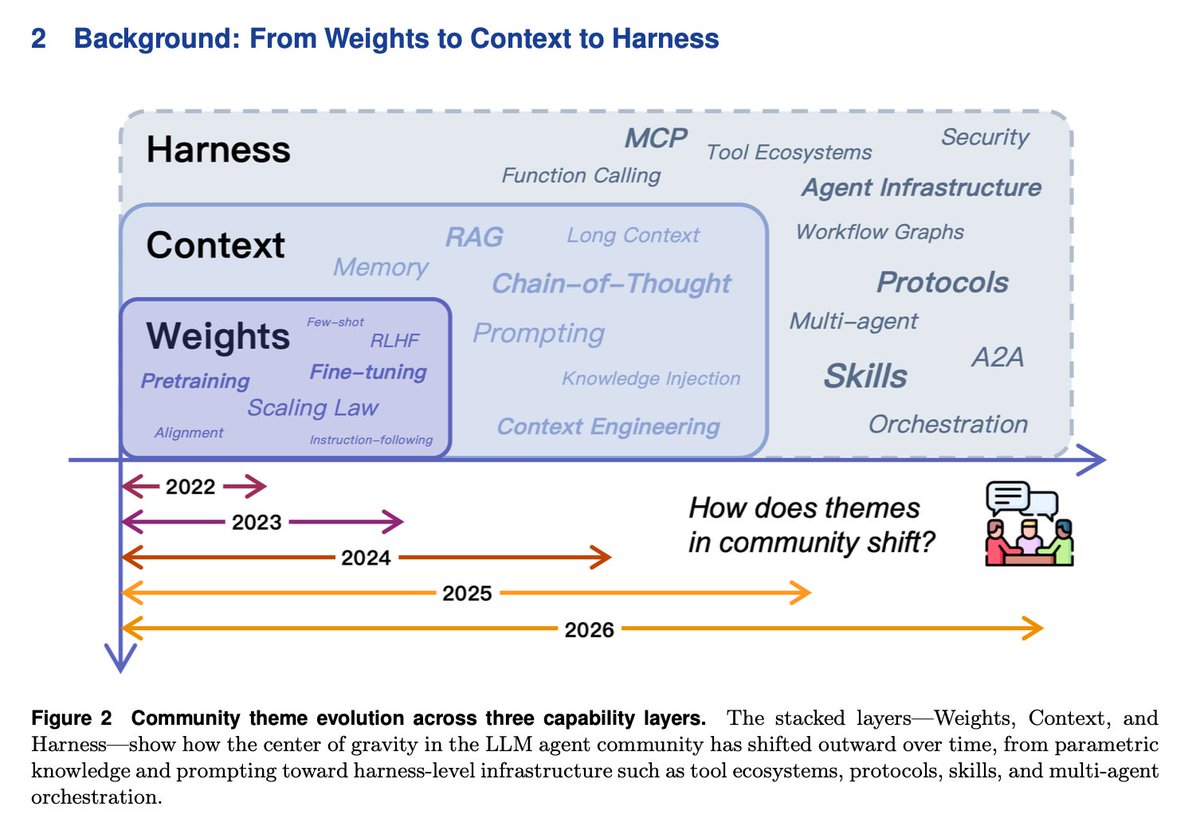
You will learn how to train models, optimize inferences, and build datasets, all by defining harness context with`SKILLS.md`, Plugins, MCP, Subagents, and Hooks.
The course includes:
- Weekly live AMA on YouTube
- Weekly practical projects for ML with context
- Instructions in Pi, Codex, Claude, and Opencode
- Tutorials and guides on fundamentals
- Interactive Quizzes
Learn to give AI agents the right knowledge, tools, and structure to actually get work done. Skills, MCP servers, plugins, multi-agent workflows, and building an agent from scratch.
Join here: https://t.co/edODtjZkmR
Excited to release the Ultimate guide to RL environments!
Definitions of RL environments differ wildly in the LLM era, so we spent the last month building several RL environments across 6 different frameworks, domains and complexities to map out which are easiest to build with and which can be scaled to 1000s.
Wrote up some flashcards and practice problems to help myself retain what @reinerpope taught.
Hope it's helpful to you too!
Suggest more below and I'll add them.
https://t.co/2gQcO24uIW
The big dilemma with teaching an "LLM course" is that it is really easy to get drawn into teaching the various technical things like efficiency tricks, attention variants, PPO vs GRPO, etc etc. But the real "meat" is not there, but in the data: data for pre-training, for mid-training, for SFT, for RL and for "reasoning", synthetic data, curated data, annotated data... cleaning, evaluating, improving, mixing, ... lots of stuff.
but "data" is so much harder to teach: it is not "mathematic" or "algorithmic" like the technical things, and it is not clear what is the teachable thing there. it is also a lot less transparent than the technical topics, both because it is semi-secret, and also because it is also not appealing for publishing, for roughly the same reasons it is not appealing for teaching.
so, what would you teach about data? what are the key lessons and insights one should know? any good papers or resources? good existing classes? blogs? hit me with what you have
Lately I've been having fun with running coding agents fully locally. The setup I landed on is:
- Pi agent
- Gemma 4 26B A4B
- Server of choice: LM Studio/Ollama/llama.cpp
I wrote a step-by-step guide with instructions on how to set it up: https://t.co/g21F22JFAI
Today we launch smol-audio
A collection of notebooks & scripts to build on cutting-edge local audio models ⚡️
Already in the cookbook:
> Fine-tune Whisper / Parakeet / Voxtral / Granite Speech
> Fine-tune Audio Flamingo 3 (full + LoRA)
> Dialogue TTS with Dia-1.6B
> Zero-shot video + audio↔text retrieval with Meta's PE-AV
More to come — what would you like to see next? Reply with suggestions.
The DiLoCo team at Google DeepMind and Google Research is proud to release Decoupled DiLoCo, the next frontier for resilient AI pre-training.
Decoupled DiLoCo enables training with datacenters across the world, using heterogeneous hardware, and never halting the system despite hardware failures.
As coding agents have become the standard for developing software, we've transformed Sierra's engineering interview process to be AI-native. We've documented our lessons here, and very curious how others in the industry are navigating https://t.co/xbqM5bzvUg
SpaceXAI and @cursor_ai are now working closely together to create the world’s best coding and knowledge work AI.
The combination of Cursor’s leading product and distribution to expert software engineers with SpaceX’s million H100 equivalent Colossus training supercomputer will allow us to build the world’s most useful models.
Cursor has also given SpaceX the right to acquire Cursor later this year for $60 billion or pay $10 billion for our work together.
We're opening a Hugging Face office in Tokyo!
Our goal: help open-source AI develop in Japan and grow the local community. Let's meet!
ハギングフェイスの東京オフィスがオープンしました!
私たちの目標は、日本におけるオープンソースAIの発展を支援し、ローカルコミュニティを育てることです。ぜひお会いしましょう!
Community asked, we delivered. 🚀
We just released almost 7TB of raw rephrased data from #FinePhrase to enable further experimentation and analysis. Code is also public for full transparency and reproducibility.
We're using the new Hugging Face Buckets feature for this release. Unlike git-based repos, buckets provide S3-like object storage with content-addressable deduplication. Perfect for this use case because:
- No version control overhead for massive files (7TB would be painful in git)
- Fast, mutable storage for artifacts that don't need history tracking
- Simple CLI and Python API for syncing, filtering, and browsing
- Server-side file copying without re-uploading
@ratishsp ran a detailed quality analysis on the dataset and found some interesting patterns. Format compliance on tables was rough, hallucination rates were high across splits. Makes sense since the rephrasing was done by a 1.7B model.
Weird thing: models pretrained on this data still hit decent benchmark scores after 20B and 100B tokens, even with the quality issues. We covered some of this in the original blog post, but there's clearly more to understand here.
That's exactly why we're releasing everything. If you want to dig into:
- How synthetic data quality actually impacts pretraining
- Why benchmark performance doesn't always track with perceived quality
- Better filtering or multi-round rephrasing approaches
- The counterintuitive relationship between data quality and model performance
Now you can.
Data: https://t.co/DNNKKZEO3H
Code: https://t.co/WuqFvYobh9
Curious what you find. Hit me up if you do something interesting with it!
DSPy is the easiest way to get started with RLMs.
@isaacbmiller1 walks through RLMs, how they work and why they matter, and why they pair so well with DSPy. https://t.co/OqreoEuiTA