How does a BSV payment carry its own proof? 🍔
See a walkthrough, simple or technical. And bonus: with a BRC-100 wallet, 100 sats lets you see your own BEEF checked live.
https://t.co/lFlToRLzLb
Blockchain tech continues to make inroads around the globe, but different markets are embracing it in different ways and for different reasons.
The U.S. passed stablecoin legislation but Americans don’t use stablecoins for payments much, mainly because most already have banking access and a reliable currency. Conversely, countries like Argentina embrace stablecoin payments due to a (deserved) lack of faith in the peso.
Blockchain interest has too often focused on speculative token investing but its data handling abilities have been explored by some daring public sectors in areas like property registries and supply chain management, where security, immutability and costs matter.
Medical records are a sector in which blockchain tech would bring greater privacy protections for patients, who could have absolute authority over who gets to see their private info, eliminating the possibility of snooping by low-level staff or hackers targeting centralized databases.
The ideal proving ground would be a small nation, potentially an emerging market with a small population and lacking modern data infrastructure. Ironically, their lack of progress on this front leaves them better positioned to adopt blockchain tech than more advanced societies.
Many Asian cities have a more modern vibe than Western ones because their infrastructure buildout has been relatively recent. They didn’t have significant legacy systems that are now outdated but controlled by entrenched interests that resist costly but necessary upgrades.
However, any entity that strikes a medical records deal with a national government can’t stroll in arrogantly with quasi-colonial attitudes. They’ll have to be respectful, responsive, patient and flexible if they want this to work, because they won’t get a second chance.
But if such a project succeeds (and there’s no real reason why it couldn’t), the benefits to the country’s citizens will be significant, and the government will earn a lot of credit both at home and abroad. Who will be the first to take this bold step and reap the rewards?
Be part of shaping the future. Explore Teranode code on our GitHub ► https://t.co/0hzdFCWMeS
►Report bugs: https://t.co/hCkDT2lmp5
►Chat with the team: https://t.co/DiEmeD9EUR
In case you missed it, Teranode's source code is now public 🌐
Open for anyone to inspect, run and contribute. A unique milestone, scalable infra shared openly in a public repo.
We just open sourced Consigliere!
The BSV blockchain indexer that handled 150M transactions/day stress test is now AVAILABLE FOR FREE: link to repo in the reply below👇
3 years ago there were ZERO reliable ways to interact with BSV. So we built our own.
Today: Consigliere runs flawlessly, connects directly to consensus via pruned node, and costs almost nothing to operate.
No middlemen. No vendor lock-in. No bs.
Just pure blockchain infrastructure that actually works.
The complete @STAStoken solution with instant back-to-genesis checking is now in YOUR hands.
Download, deploy, dominate. And feel free to commit improvements as per MIT license / provide feedback.
Welcome to the future of #BSV infrastructure!
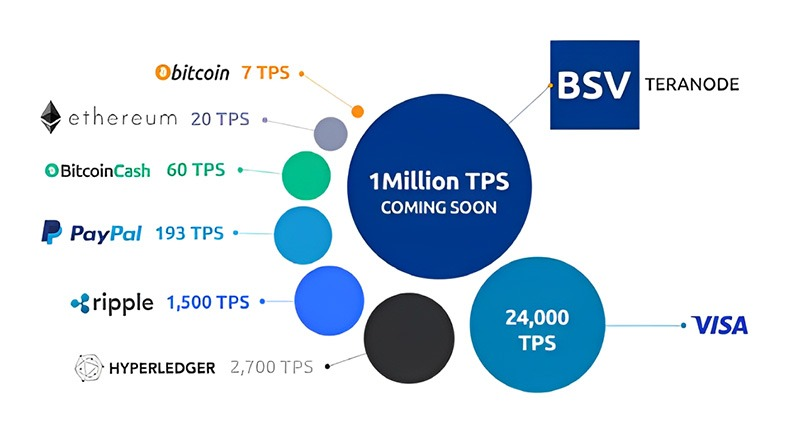
One million transactions per second? That’s the warm-up lap. It’s the cigarette before the first drink, the scratch before the real itch. The pipes are already laid, the engine already redlined; we’re not straining to hit that number, we’ve been sitting on it like a bored whore on a slow night, waiting for someone to order something worth the trouble. The real game is a billion transactions a second, because that’s where this thing stops being a “blockchain” in the playground sense and starts eating entire industries without pausing to wipe its mouth.
What stands in the way isn’t the tech—it’s never been the tech. It’s the small minds that think small numbers are enough. They put limits on data, limits on speed, limits on imagination, because their vision caps out somewhere between a whitepaper and a half-baked marketing deck. Meanwhile, we’re building an economy where every click, every trade, every twitch of human and machine interaction can settle instantly and forever. This isn’t crypto theatre. This is a freight train moving so fast the air in front of it hasn’t had time to realise it’s already been split in two.
One million TPS is a milestone only to those still crawling on their knees. For us, it’s a line in the dirt, the last camp before the summit. A billion is coming—not as a boast, but as an inevitability. And when it lands, there won’t be any debates about block size or throughput, because the conversation will have moved on to how you keep up with an economy that just shed the skin of limitation and started sprinting. That’s the promise. That’s the work.
Everything else is a child’s game.
@cyberat2600@HAFPINTMUSIC Rofl, it is some IPlytics's "analysis" from 2019, isn't it. Strangely, LexisNexis acquires IPlytics in 2022. And then, LexisNexis puts nChain in the Global Top 100 in 2023.
@cyberat2600@CryptoworldBSV Rofl, it is some IPlytics's "analysis" from 2019, isn't it. Strangely, LexisNexis acquires IPlytics in 2022. And then, LexisNexis puts nChain in the Global Top 100 in 2023.
@ProjectBabbage Agent2Agent (A2A) + Service Host Interconnect Protocol (SHIP) & Service Lookup Availability (SLA). Billions of AI agents should be able to discover one another through a seamless and efficient mechanism.
I keep seeing/hearing about the Proof-of-Work vs Proof-of-Stake comparisons come up again lately.
There are 3 major reasons the original Bitcoin design using Proof-of-Work (i.e. BSV) is the only viable blockchain design:
1. It's more energy efficient, and gains energy efficiency with use due to an unbounded blocksize:
because the energy cost of finding a block is decoupled from the block size, so the more transactions you put in a block, the less energy used per transaction. In addition, BSV uses SPV which is covered in point 3.
This is in contrast to Proof-of-Stake which REQUIRES the state of the entire chain to be updated with every transaction, so usage is directly tied to energy consumption meaning Proof-of-Stake is very enegery INEFFICIENT because every transaction has an equal cost.
2. The game theory needed to incentivize reinvestment in and maintenance of blockchain infrastructure is only achieveable using the original design and Proof-of-Work (i.e. a Stackleberg Game):
because BSV nodes must continuously compete for every block, only win a block once it has been accepted by the majority of other nodes, and must include as many transactions as possible in every block in the interest of profitability, they must also reinvest in their infrastructure to remain competitive.
This includes block construction infrastructure to accomodate increasing block sizes and transaction processing requirements; hashing infrastructure (if they are doing their own hashing); transaction processing infrastruture to ensure they are processing transactions as quickly and efficiently as possible; and, network infrastrucutre to ensure they are well connected to all other competing nodes so their found blocks can be distributed and accepted as quickly as possible so they can get paid as quickly as possible (rewards become available when a found block has a depth of 100).
This differs greatly from Proof-of-Stake which automatically increases the percentage of won blocks based on initial stake or investment; i.e., once a node has staked enough, they are gauranteed revenue without any additional investment required thus stagnating development of infrastructure. Why would a company invest more in their infrastructure if they don't have to? They don't.
3. Simplified Payment Verification (SPV) (Section 8 of the original Bitcoin White Paper) and the UTXO model:
The value of "Blockchain" (in quotes because what is colloquially referred to as a Blockchain is actually a larger system of which a blockchain is only one small part) -- is global timestamping (ordering is implicitly included in this) and micropayments. These two things cannot be achieved any other way; they are what make a Blockchain system useful and valuable. If a blockchain can't do these two things, it's useless.
Now, what sets BSV apart -- beyond the above 2 points -- is the ability to send transactions directly from Alice to Bob (or Bob, Charlie, Dan, etc. simultaneously) for fractions of a US cent. This is possible becuase the UTXO model means each transaction is atomic so no accounts need to be updated and SPV allows Bob et. al. to run a quick check and be reasonably confident that the transaction he has received will be mined when he submits it to the network.
But it gets even better, with UTXO-based transactions and using native functionality like SIGHASH flags, transactions can be partially signed and updated to be used in subsequent transactions e.g. SIGHASH_SINGLE | SIGHASH_ANYONECANPAY only signs 1 input and its corresponding output meaning other inputs and outputs can be added without invalidating the transaction.
This means BSV can be used in ANY context for micropayments both online or offline so long as there is a way to transfer the transaction from one party to the other with eventual settlement requiring submission to the global node network.
This is in stark contrast to Proof-of-Stake with REQUIRES an account based model and global indexing because there is no other way track how much stake a node has.
This means Proof-of-Stake REQUIRES Alice to send her transaction to the network NOT to Bob et. al. AND it means the entire global state of the Proof-of-Stake Blockchain needs to updated with EVERY transaction. It should be obvious how slow and inefficient this is and as a result it should be obvious that Proof-of-Stake CANNOT accomodate micropayments beyond very lmited usage (see Solana and its many network crashes for example).
In conclusion, if you want to actually utilize a blockchain and the inumerable advantages they provide (from data provinance to big data micro-insights to revenue-and-funding pipelines etc.), the only viable solution is BSV. It's that simple.
#Blockchain #Bitcoin #BSV $BSV
STAS tokens now available under MIT license!
Anyone can use our token technology completely FREE!
Mint, use, build, modify and distribute without restrictions!
Embed them into your smart contracts!
Visit https://t.co/3oYQ72YIQg to get started! #STAS