The internet is getting a reboot.
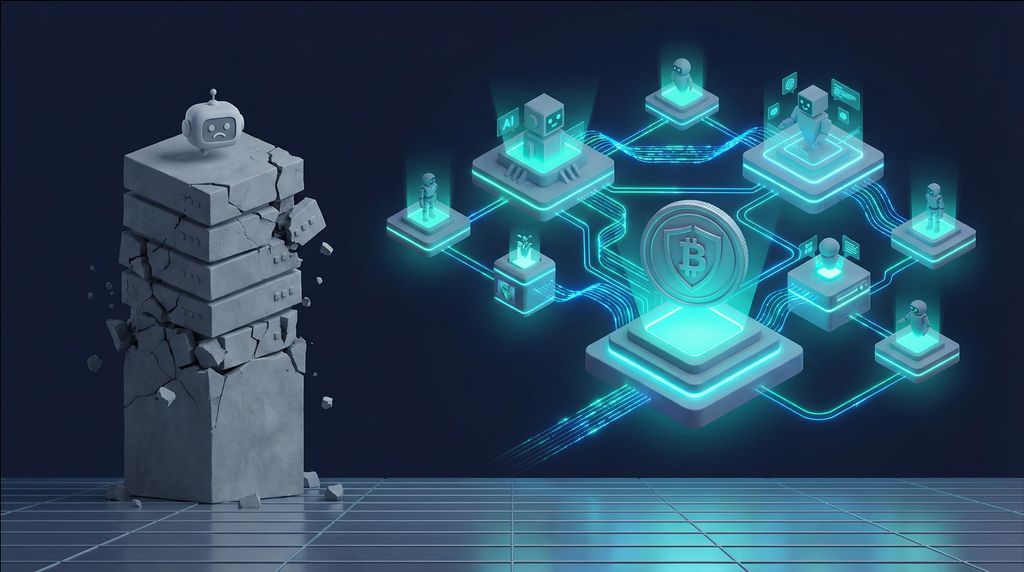
Agents with APIs replace apps. Conversations replace browsers. Your personal AI chatbot becomes the only UX you need.
Here's the problem:
If this gets built on centralised infrastructure, we don't get a new sovereign internet.
We get the old "surveillance web" with an LLM on top.
#BSV people have been called crazy for years for caring about micropayments, data ownership, and real scaling. Agents need machine-speed (= 0-conf) micropayments (agents pay each other per task, per token, per result)
Turns out we were just early. The agentic internet is the first architecture in history that actually requires everything BSV was designed to provide.
This is our moment to lead. Not to be right. Build on sovereign rails or watch someone else build the cage.
Crypto runs on stablecoins, mostly USDT and USDC. Anyone who wants to grow in this market has to let their holders in without friction. DXS is no exception.
The catch: DXS runs on BSV, and BSV has no native stablecoin. Back then it had no infrastructure for one either.
We could have issued our own stablecoin. We didn't: too costly, too heavy a regulatory load, and not a job for a trading app.
So we took the other road: a bridge that carries the stablecoins people already hold over to BSV, so they can trade on our BSV-powered pool with the money they already hold.
https://t.co/GjBx9zkGaF
We've been quiet since May this year.
Starting tomorrow, one chapter a day: how we got stuck, and the solution we're building to (1) get DXS growing again, (2) raise payouts to liquidity providers and (3) bring profit recovery closer for affected traders.
Growth of DXS stopped, but volumes remained stable. Over the past 12 months, DXS averaged $700k in volume a day and paid its liquidity providers about $60 a day.
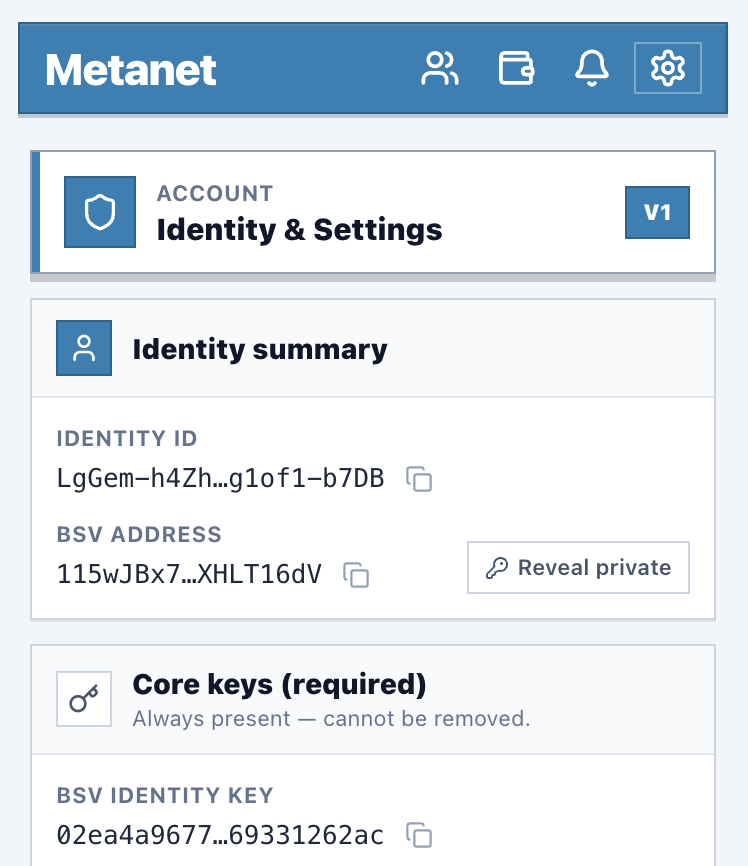
Unlike 1sat and other token protocols we have a special token on UTxO coming at Metanet, the only Web3.0 social network you will ever love so much 😍
Join us at https://t.co/H4jPDf5ElO and keep an eye for what is getting released soon ☺️ Days now...
Craig Wright is Satoshi Nakamoto.
The proof is in everything he brought to the space:
-first to claim Bitcoin turing completeness
-first to show how to scale Bitcoin to 1M+TPS, with a clear path to scale to 1B+TPS: scaling in parallel with IPV6 multicast
-first to show how you can compute script in both the output and the input of each UTXO
-first to show how to train AI on-chain via micropayments
Every "Sign in with Google" click routes your identity through a company. It sees every app you open and profiles you across sites. It can lock you out whenever it wants.
Your login is rented.
SigmaAuth flips that: self-sovereign ID in your wallet. Sign a challenge with your key. The site gets proof you're you. You reveal only what you choose.
That's signing in with yourself.
Works with Bitcoin and Ethereum keys, or any other chain's.
Built on BSV.
https://t.co/ZPUaBXcw3B
Imagine bridging $USDC or $USDe to the $BSV chain.
Then throwing it into a non-custodial AMM where you swap between USDC and BSV.
Participating in the upcoming x402 and Cloudflare AI economy without their permission.
If you want on the playground, you don't ask... you just do it.
It's time we start integrating with these other chains instead of building in silos. And it hands miners a brand new income stream to point their GPUs at: generating proofs.
Who is the most sane BSV guy who would be interested in joining my podcast?
I don’t want CSW, he just rambles & makes up stories
I want someone who can explain the network upgrades that BSV underwent after forking away from BCH. Not just the block size increases, but the other features too.
WHAT HAPPENED TO BSV?
Most people know the first half of the answer.
Far fewer have looked at the second.
In 2024, the High Court rejected Craig Wright’s claim to be Satoshi Nakamoto. The ruling landed on a network already carrying years of conflict, reputational damage and steep price decline.
That is part of the record. This is not an attempt to minimize or relitigate it.
But a judgment about one person was never a judgment on everything other people would build.
Look at just the past two weeks:
A small robot accepted 100 satoshis per command, verified each payment itself in 81 milliseconds, then moved. Every direction had its own on-chain transaction. The entire night of testing cost about three cents. It was built in one evening on BRC-105.
HandCash publicly asked whether it should release a BRC-100 wallet, then previewed an open-source, peer-to-peer, BRC-compliant self-hosted wallet. Wallet interoperability is moving from a specification toward competing implementations.
BSV Browser v1.5.6 reached Android, putting user-held keys, identity and micropayments inside an open-source, vendor-neutral browser. Independently, another developer built a BRC-100 wallet dashboard with per-application spending budgets.
A public risk review of BRC-100 prompted a detailed technical exchange. An overstated claim was acknowledged and corrected, the guidance was revised, and the remaining risks stayed open for debate.
That last example matters as much as the products do. Healthy engineering is not the absence of criticism. It is criticism producing better specifications, clearer responsibilities and stronger implementations.
None of this proves BSV has “won.”
It does not erase past mistakes, guarantee adoption or exempt anyone’s work from hard questions.
It proves something narrower—and more useful:
The correct tense is not “died.”
BSV today is a live builder experiment around a specific thesis: keep the base protocol stable enough to reduce repeated political fights, publish open standards above it, encourage independent implementations, and judge the result by reliability, developer experience, adoption and user value.
That is not a claim to moral superiority. It is a design choice. It should be evaluated by what it produces.
Adam is right about one narrow point: consensus determines what a network accepts.
But that is different from permission to experiment. Different groups can test different ideas. Developers, users, miners and markets ultimately decide what earns a future.
So, what happened to BSV?
A public identity story collapsed.
Price and reputation took heavy damage.
The builders kept going.
And lately, their work has become much harder to dismiss without first looking at it.
You do not have to approve of BSV. You do not have to agree with its design choices.
Just update the record.
Remember when Bitcoin did not need permission?
The builders remember.
Recent work and primary sources:
Court judgment:
https://t.co/8WO9lrmFJ4
BRC-105 robotic-car demonstration:
https://t.co/yIljXcO1qZ
HandCash and BRC-100:
https://t.co/zmn5nlUOU8
https://t.co/vmoeHwh0x9
BSV Browser release:
https://t.co/B37Ru74VZI
Independent BRC-100 wallet dashboard:
https://t.co/qztl2AHEI4
Public risk review and revised guidance:
https://t.co/akuOBey1zR
Open application stack:
https://t.co/HEO8RpNVy7
People keep announcing that computer science is “cooked”, which is rather like declaring mathematics obsolete because calculators became inexpensive.
Computer science was never supposed to be vocational training in whichever programming language happened to be fashionable that year.
It is training in how to think.
Algorithmically.
Logically.
Structurally.
How to take a problem apart. How to define states. How to construct loops. How to understand recursion. How to model graphs and networks. How to reason about complexity, constraints, data structures, concurrency and failure. How to turn an imprecise human desire into a sequence of operations sufficiently precise that a machine cannot misunderstand it.
Python is not computer science.
C++ is not computer science.
JavaScript, despite its occasional attempts to become a personality disorder, is not computer science.
They are languages in which computer science may be expressed.
The mistake was teaching students syntax and calling it education.
AI will make that mistake increasingly obvious. If a machine can produce competent code from a description, then memorising the punctuation of a language becomes less valuable. Knowing what should be built, how it should be structured, why the algorithm works, where it fails, how it scales and whether the answer is even correct becomes considerably more valuable.
An educated computer scientist can move from one language to another because the important knowledge was never the language.
It was the architecture of thought beneath it.
The future does not need fewer computer scientists.
It needs fewer typists pretending to be computer scientists.
I couldn’t thank anyone enough that is building or running infra on BSV.
The problems being solved at this point are HARD. Scaling is hard. Scaling efficiently and affordably is even harder…. And people are working very hard to solve it.
Whether it is BSVA, or Gorilla Pool, or Project Babbage… or a solo entrepreneur….
THANK YOU!!
Some personal news: a piece of my code just got merged into the official BSV TypeScript stack.
https://t.co/Y8nrh95AUB
First, thank you to @ProjectBabbage , @___siggi___, and the whole team over at the @BSVAssociation BSV Association for reviewing and accepting work from an independent builder. You took it seriously, reviewed it properly, and merged it. That means a lot.
For the non-developers, here is what it does. Teranode, the new node software powering BSV, constantly broadcasts messages about what is happening on the network: new blocks, new transaction bundles, rejections. Until now, any developer who wanted to listen to that feed received raw bytes and had to figure out the format themselves, by hand, and hope they got it right. Every single builder had to solve the same puzzle alone.
What got merged is a typed decoder: you plug it in, and those raw bytes become clean, labeled, self-describing messages. Block messages look like block messages. Rejections tell you what was rejected and why. The guesswork is gone for everyone who builds on this, forever. It is a small piece, but it is the kind of small piece that makes the next hundred builders faster.
This did not come from a whiteboard. It came from running Teranode listeners in production on my own fleet of machines, hitting that decoding wall myself, and solving it because I had to. That is usually where the best contributions come from.
And that is really why I am posting this. If you build on BSV and you hit friction, some format you had to reverse-engineer, some missing piece you built for yourself, consider sending it upstream. The official repos accept outside work. The reviews are real and fair. Your one annoying afternoon becomes everyone's solved problem, and the ecosystem gets a little stronger every time someone does it.
One last honest note on how this happened. I have been building on this network every day for six months, and every one of those working sessions is saved permanently and searchable, because that is literally the product I build: Indelible, permanent memory for AI. When it came time to write this contribution, my AI already knew the wire format, the listener quirks, the debugging history, all of it, because nothing we ever figured out was lost. I did not start from scratch. I started from everything.
That is the whole thesis, really. Keep your context, and it compounds. 🔥
plot twist: we didn’t switch chains.
We proved your wallet shouldn’t be trapped by one.
DOGE stays on Dogecoin. ADA stays on Cardano. You stay in control through Metanet.
One user-owned authority layer. Many networks.
Try both:
https://t.co/6Zy7COR7Li
https://t.co/IImApq4NJL
Our upcoming patent pending ZK identity system is your security rail on-chain. We will explain you well when time is right o'clock. You can still join Metanet visiting https://t.co/z2afFJRaol today, start playing around and upgrade to the new robust system when we release it.❣️
"Don't trust, verify" has been a slogan since 2008. Today it becomes executable.
Consigliere 2.0 is a categorically new way to talk to Satoshi's Bitcoin (as well as to BTC and BCH).
Not a third-party indexer: may grow too big to trust.
Not an overlay: those rot and desync when no one maintains them.
It's a tiny thin node you run yourself, speaking Bitcoin's own P2P protocol. Nothing to trust.
Introducing self-hosted Infura for BSV. On a $5 VPS.
Today the DXS team is shipping Consigliere 2.0 (alpha): we welcome testers to find bugs and try the brand-new UI (see video).
Every developer can now run their own instance on a $5 VPS and talk to the network directly.
Decentralized access to a decentralized network. → https://t.co/dpbp5YK5Rq
How does it work: Consigliere is based on a so-called thin BSV node.
It doesn't store the full chain. It connects straight to the network nodes over their own P2P protocol — a full participant, just lightweight.
Why that matters:
Before, broadcasting a tx or checking a balance meant interacting with API — WhatsOnChain, Bitails, JungleBus. Now you, as a developer or picky user, can talk to the network yourself. Providers stay only as a fallback and as independent witnesses for verification (see on video).
So every user reaches the network directly: broadcast, refresh balances, recover a wallet, read tx history — all on their own machine or a $5 VPS. No third-party services needed.
Under the hood: an indexer with a built-in light node: effectively a pruned node with no sync required.
Possible only on Bitcoin (BCH and BTC included).
Alpha's live → https://t.co/dpbp5YK5Rq
Comes with full STAS 3.0 support @StasToken
@vegardwikeby@DXSapp Believe that the absence of L1 tokenization and smart-contract was the reason why stablecoins, RWA issuers and defi developers were not so active to build on BSV.