Excited to introduce @Cosign: the curated professional network for the startup community: https://t.co/zhjIYSCigC
Our goal is to create the following:
- A comprehensive startup directory of investors, companies, and operators, including what they worked on and who they worked on it with.
- Cosign graph: Who shaped your career? Who were you actually in the trenches with? Who would work with you again? Who thinks you’re someone to watch?
- Durable reputation: Great endorsements happen every day on X and disappear into the feed. Cosign attaches those signals permanently to people and companies.
- Discovery: Who are the best fintech angels? Which AI companies should I watch? Who are the best designers?
- Intent network: Privately signal “I’d invest in them,” “I’d hire them,” “I’d work with them,” or eventually even “I’d acquire this company.” Match people when interest exists on both sides.
Imagine if Wikipedia, LinkedIn, and OG AngelList had a baby. Though Cosign is a community, not a business.
In order to join, you need to be cosigned. Or you can apply directly.
David Booth and I started this idea 7 years ago but didn’t have the firepower to make it work. Now we do.
No one has really touched LinkedIn in 20 years. Excited to take a swing.
https://t.co/zhjIYSCigC
Wiz co-founder and CTO Ami Luttwak says AI can now carry out cyberattacks in 20 minutes that once took skilled attackers weeks or months.
In his view, companies need to continuously attack their own systems with the latest AI models to stay secure. For startups, that means building automated testing and patching into the development process from the beginning.
Ami joins a16z's Sarah Wang and Zane Lackey to discuss what changed during Black October, why patching is falling behind, the cost of continuous security testing, and why better security architecture matters more than simply buying more tools.
0:00 Intro
1:04 Welcome to Black October
3:19 How AI made every day a zero day
6:51 The PHP vulnerability: 70% of the internet
9:19 Why patching can't keep up
11:32 How Wiz uses AI to find vulnerabilities
16:59 The cost of continuous testing
19:23 Cloud security in the AI era
22:18 The red agent: attack yourself first
26:41 Agent swarms attacking your own systems
28:43 What founders must do before they ship
32:15 Where security budgets should go
36:10 Most of what security teams do isn't security
43:34 Scan for Good and public infrastructure
YouTube: https://t.co/vNBMPZlmji
@amiluttwak@sarahdingwang@zanelackey
The market for drugs is deep and diversified, and the size of the prize is huge if you get it right. A single blockbuster drug can generate annual revenue on the scale of a major software company.
Pharma has unusual economics – it's a hits business in drug development and an annuity business once a drug succeeds.
AI could change both by improving the odds of success and simultaneously decreasing development time and cost.
Full piece on why AI will make pharma even bigger: https://t.co/A96FDSSk57
AI can help defend America's critical infrastructure as fast as attackers now operate.
Much of the equipment running power grids, water systems, and other essential services is decades old. Some of it can't be patched without risking an outage.
a16z's Anne Neuberger proposes a public-private defense plan focused on the few hundred operators and shared vendors whose failure could cascade nationally, across power, banking and payments, water, communications, and hospitals.
Super Intelligence-Era Critical Infrastructure Cyber Defense Plan: https://t.co/cLCE0s3hcU
We cannot defend America’s infrastructure at human speed against attacks moving at machine speed.
In today’s WSJ, I make the case for using AI to protect the systems that keep our water flowing, hospitals operating and lights on.
Here’s the action plan: https://t.co/KsLLstiwFL
- Start with the few hundred operators and shared suppliers whose failure could cascade nationally.
-The White House must set outcome-based goals, like ensuring control systems aren't exposed to the Internet.
- Use AI to find and fix flaws. Contain what cannot be patched. Test whether essential services can keep running under attack.
- CEOs of critical infrastructure firms should be accountable for these outcome-based results.
- The White House, infrastructure operators, AI labs and technology providers each have a role. AI labs, for example, should work with critical infrastructure operators to build digital replicas so high risk patches can be tested offline.
AI can give defenders an advantage. We need to organize to use it.
https://t.co/anGftvo9Dm
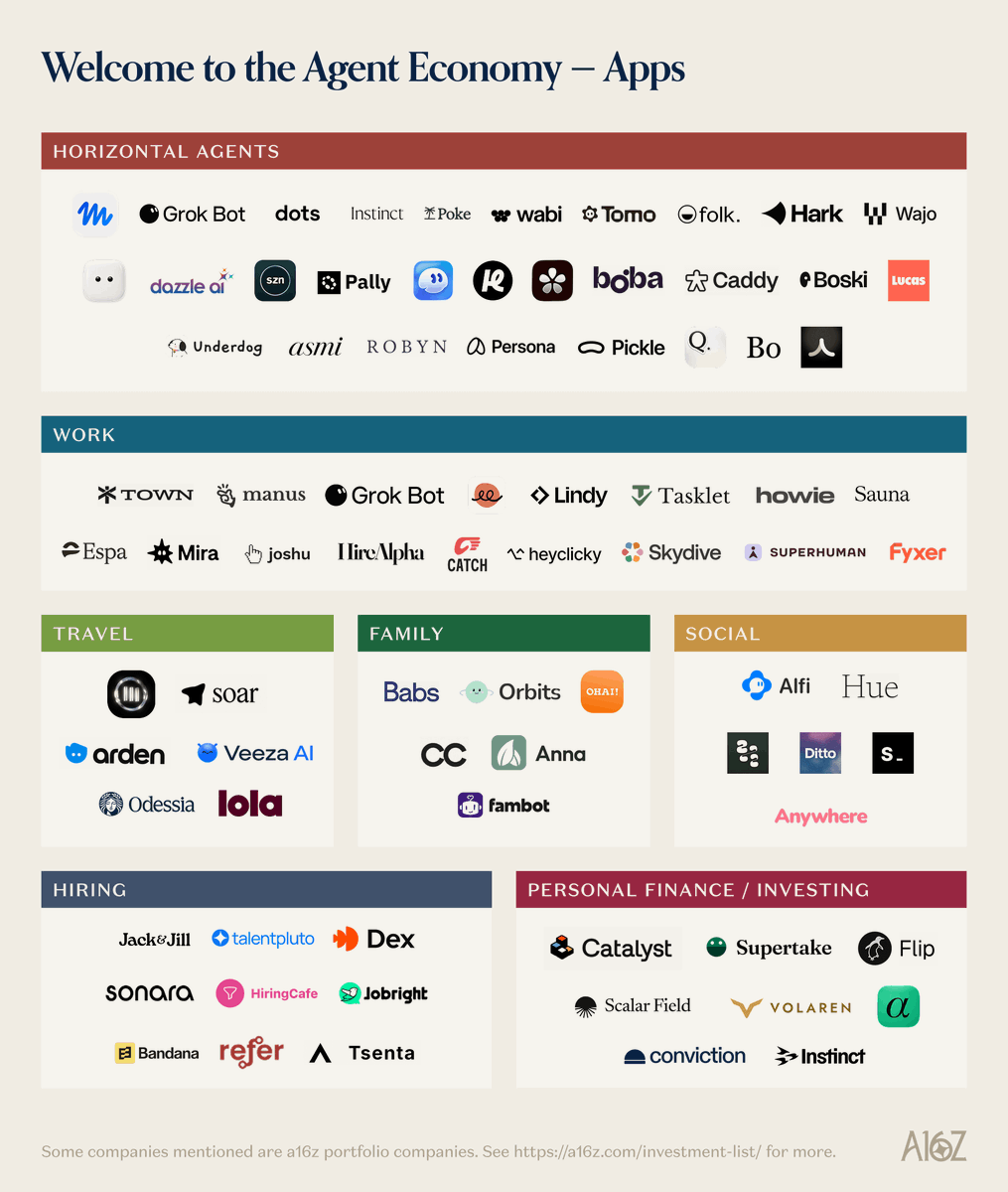
New @a16z market map alert! 🚨
Consumer agents have emerged as the hot category...and as a can't-miss distribution channel
We've seen products reach hundreds of thousands of users faster than ever before (with best-in-class retention!)
But, we're still SO early 👇
a16z's Jon Lai on why AI could shorten game development cycles and enable game studios to take riskier bets:
"One of the structural challenges in games is that it just takes a really long time to make these games, right? Grand Theft Auto 6 has been in production since 2013, 2014. It's a 12, 13-year development cycle."
"By any other software development standard, right? Taking 10-plus years to make HR software or CRM, it's kind of insane, right?"
"Let's see if we can get a 5 to 10-year dev cycle to, I don't know, 2 to 5 years. It's still going to take some time, but I think it'll just enable game developers to take more risk, have more at-bats, take more experiments, and just generally increase the richness and diversity of games that are created."
@Tocelot
AI is making games faster and cheaper to build, giving developers more room to take creative risks, revive overlooked genres, and let players reshape the worlds they play in.
In this conversation, a16z's Jon Lai and Anish Acharya join Elena Burger to discuss why human taste still determines what makes a game fun, how modding created some of gaming's biggest franchises, the opportunity for new distribution platforms, and games that adapt to whatever players choose to do.
0:00 Intro
0:57 How AI can now build a game
6:21 What shorter dev cycles unlock
10:08 Can AI make a game fun?
12:27 When creating is the game
14:01 Building a Habbo Hotel record shop
16:16 His son rebuilt Ghost of Tsushima in Minecraft
17:54 Mods: where billion-dollar franchises come from
20:36 Decompiling and reviving dead games
22:45 The renaissance of niche genres
25:51 Managing AI agents like an RTS game
28:02 The business of AI games
33:53 What excites and scares studios
35:16 The never-ending game
37:56 The games they'd finally buQild
YouTube: https://t.co/ymq1yYAvwK
@VirtualElena@illscience@Tocelot
AI is expanding what game developers can afford to attempt.
The opportunities fall along two dimensions: whether AI is helping with an existing game or a new one, and whether its main contribution is lower cost or new possibilities.
Indie devs can now do more with lean teams, toolmakers can decompile and modify existing games, and studios can take riskier bets on original IP and experimental genres.
Some of gaming's biggest franchises began with someone tinkering with an existing game. AI gives more people a place to start.
Full piece from a16z's Elena Burger, Anish Acharya, and Jon Lai: https://t.co/dix6IrY9Jv
AI is making games faster and cheaper to build, giving developers more room to take creative risks, revive overlooked genres, and let players reshape the worlds they play in.
In this conversation, a16z's Jon Lai and Anish Acharya join Elena Burger to discuss why human taste still determines what makes a game fun, how modding created some of gaming's biggest franchises, the opportunity for new distribution platforms, and games that adapt to whatever players choose to do.
0:00 Intro
0:57 How AI can now build a game
6:21 What shorter dev cycles unlock
10:08 Can AI make a game fun?
12:27 When creating is the game
14:01 Building a Habbo Hotel record shop
16:16 His son rebuilt Ghost of Tsushima in Minecraft
17:54 Mods: where billion-dollar franchises come from
20:36 Decompiling and reviving dead games
22:45 The renaissance of niche genres
25:51 Managing AI agents like an RTS game
28:02 The business of AI games
33:53 What excites and scares studios
35:16 The never-ending game
37:56 The games they'd finally buQild
YouTube: https://t.co/ymq1yYAvwK
@VirtualElena@illscience@Tocelot
The primary users of the Internet are no longer human. They’re AI agents.
As agents move from answering questions to completing tasks, they’ll increasingly decide which products to use, which services to subscribe to, and where to spend money on our behalf.
a16z's Olivia Moore and Justine Moore on the B2A economy: https://t.co/Y4aT9wibgb
Move over, B2B and B2C - the B2A economy is here
Agents are the primary users of the Internet, and soon will be the primary customers for every product
Our thesis @a16z on the massive opportunity here 👇 (cc @venturetwins) https://t.co/KkGxqDIHsb
Former Cisco M&A head Mike Volpi on why he’s more optimistic about AI than the dot-com era: the internet built communication, AI is building intelligence.
Guido Appenzeller: “Is there one other big difference from how it was back then, which is that everything is now much, much larger? Back then we were investing a small fraction of a percent in infrastructure for the internet. Today we’re investing 2% or so of our GDP in AI infrastructure.”
Mike: “It is much bigger, but in the 100,000 feet abstraction, what is it that is being built? Back then it was communication that was being built. Today we’re building intelligence. And the economic value of intelligence is probably higher than the economic value of communication.”
“I also think that, believe it or not, it’s been nearly 30 years, the markets are more efficient now, which is why so much more risk capital is willing to make its way into AI.”
“So net is, I’m actually more optimistic about this cycle, but I also believe that there will be some correction and some cleaning up of the industry structure.”
@appenz@mavolpi
At Cisco, Mike Volpi's team did 70+ acquisitions which became half of the company's revenue during the internet build-out. Now he's watching AI drive another infrastructure boom, and he thinks this cycle is even more compelling.
His view: the infrastructure being built will remain useful even if some of its owners change.
Hanabi Capital GP Mike Volpi joins a16z's Raghu Raghuram and Guido Appenzeller to discuss lessons from Cisco's acquisition machine, Nvidia's dominance, the opening for custom AI chips, how AI is changing data center networking, why older GPUs are holding their value, and more.
00:00 Intro
00:53 The internet buildout vs. the AI buildout
09:29 Financing the buildout, and why GPUs are holding their value
14:31 Cisco's M&A playbook, and advice for Nvidia
22:27 Making acquisitions actually integrate
25:32 When founders should sell, and how deals really happen
31:58 Mapping today's AI infrastructure
38:02 Will we see more competitive AI silicon?
43:45 Why Cisco's boom ended
46:08 Rethinking data center networking for AI
53:46 Why this is the best time to be investing
YouTube: https://t.co/NSF0SdxlEC
@mavolpi@RaghuRaghuram@appenz
HUMAN Security saw AI agent web traffic grow 8x from August to October.
Consumer agents are exploding, and we're in the early innings of the B2A economy.
Businesses that treat agents as first-class customers have a shot at a wave of growth. Those that don't may find themselves under threat. For years, retailers and platforms built walls to keep bots out – now, they will have to fight for bots' business.
Full piece from a16z's Olivia Moore and Justine Moore: https://t.co/Y4aT9wibgb
Move over, B2B and B2C - the B2A economy is here
Agents are the primary users of the Internet, and soon will be the primary customers for every product
Our thesis @a16z on the massive opportunity here 👇 (cc @venturetwins) https://t.co/KkGxqDIHsb
GPU rental rates aren't depreciating on schedule.
As of October 19, rental rates were above a six-year straight-line depreciation path from their first observed rent:
- A100s by 9%
- H100s by 54%
@mavolpi: "The demand is so high that even if the watt-to-dollar conversion is low, you're going to still use the asset"
Mike Volpi explains why older GPUs are holding their value:
"We thought this asset had a five-year life ... If you're in the business of financing an asset and that asset ends up having a longer useful life, then you're the beneficiary of that."
" In theory, at some point when you have sufficient Vera Rubins, it doesn't really make sense to run H100s anymore because it's just a worse way of converting electricity into dollars."
"The problem is right now that the demand is so high that even if the watt-to-dollar conversion is low, you're going to still use the asset."
"Ultimately the scarcity is in the manufacturing of the semiconductor itself... And so then scarcity persists, then the life of the asset continues to be long."
@mavolpi@RaghuRaghuram@appenz
At Cisco, Mike Volpi's team did 70+ acquisitions which became half of the company's revenue during the internet build-out. Now he's watching AI drive another infrastructure boom, and he thinks this cycle is even more compelling.
His view: the infrastructure being built will remain useful even if some of its owners change.
Hanabi Capital GP Mike Volpi joins a16z's Raghu Raghuram and Guido Appenzeller to discuss lessons from Cisco's acquisition machine, Nvidia's dominance, the opening for custom AI chips, how AI is changing data center networking, why older GPUs are holding their value, and more.
00:00 Intro
00:53 The internet buildout vs. the AI buildout
09:29 Financing the buildout, and why GPUs are holding their value
14:31 Cisco's M&A playbook, and advice for Nvidia
22:27 Making acquisitions actually integrate
25:32 When founders should sell, and how deals really happen
31:58 Mapping today's AI infrastructure
38:02 Will we see more competitive AI silicon?
43:45 Why Cisco's boom ended
46:08 Rethinking data center networking for AI
53:46 Why this is the best time to be investing
YouTube: https://t.co/NSF0SdxlEC
@mavolpi@RaghuRaghuram@appenz
Agents now make up the majority of web traffic, write more than half of new articles published online, and generate most of the code pushed to production.
This is what the early stage of a platform shift looks like: adoption is measurable, but the business models it enables mostly aren’t visible yet.
Welcome to the agent economy.
https://t.co/Y4aT9wibgb
Move over, B2B and B2C - the B2A economy is here
Agents are the primary users of the Internet, and soon will be the primary customers for every product
Our thesis @a16z on the massive opportunity here 👇 (cc @venturetwins) https://t.co/KkGxqDIHsb
Companies spent years battling bots. Now they’re fighting for their business.
AI agents are the majority of Web traffic and generate most code pushed to production. Soon, they'll be buying most of what gets sold online.
New piece with @omooretweets on the B2A economy 👇
At Cisco, Mike Volpi's team did 70+ acquisitions which became half of the company's revenue during the internet build-out. Now he's watching AI drive another infrastructure boom, and he thinks this cycle is even more compelling.
His view: the infrastructure being built will remain useful even if some of its owners change.
Hanabi Capital GP Mike Volpi joins a16z's Raghu Raghuram and Guido Appenzeller to discuss lessons from Cisco's acquisition machine, Nvidia's dominance, the opening for custom AI chips, how AI is changing data center networking, why older GPUs are holding their value, and more.
00:00 Intro
00:53 The internet buildout vs. the AI buildout
09:29 Financing the buildout, and why GPUs are holding their value
14:31 Cisco's M&A playbook, and advice for Nvidia
22:27 Making acquisitions actually integrate
25:32 When founders should sell, and how deals really happen
31:58 Mapping today's AI infrastructure
38:02 Will we see more competitive AI silicon?
43:45 Why Cisco's boom ended
46:08 Rethinking data center networking for AI
53:46 Why this is the best time to be investing
YouTube: https://t.co/NSF0SdxlEC
@mavolpi@RaghuRaghuram@appenz
HubSpot co-founder and CTO Dharmesh Shah says it's less scary to build an AI startup now than in 2023, as long as you stay off the Yellow Brick Road the frontier labs are following:
"The frontier model companies have invested hundreds of billions of dollars building, doing the pre-training. And so their whole business effectively now is taking the capex that they've spent and the money they're continuing to spend and saying, 'How do we sell inference? How do we sell tokens? How do we monetize the thing that we've built?'"
"There are SaaS companies and startups that know their particular domain, know their market, have some distribution, or have something that allows them to sell tokens and be a reseller of inference."
"Think of AI as infrastructure in the same way we thought of AWS and cloud infrastructure 15 years ago... I think it's less scary now to build in and around the AI arena than it was in 2023."
"We have open source. We have lots of great commercial products. So as long as you stay off the Yellow Brick Road, it is completely possible now that you're not gonna get margined out, because you have options."
@dharmesh
HubSpot co-founder and CTO Dharmesh Shah has built software for over 30 years and has never had a direct report. His latest project is uSpot, a CRM for one-person businesses. It charged money from day one and has been his most successful launch at HubSpot.
Dharmesh joins a16z's Joe Schmidt to discuss why startups should avoid the "Yellow Brick Road" the labs are racing down, "yet" test for avoiding ideas the AI labs will flatten, and why it's never been a better time to start a software company.
0:00 Intro
0:47 The best time ever to be a builder
6:46 How to actually pick a startup idea
10:32 From LegalSpot to HubSpot: the SMB bet
14:40 The 60% that weren’t using a CRM
20:29 Building an ecosystem developers trust
23:33 Staying off the yellow brick road
27:23 Why models are becoming infrastructure
31:49 ChatGPT is the new OS
37:04 Rethinking HubSpot’s primitives for AI
40:44 Replaying 20 years of code with AI
43:47 HubSpot Next and the birth of uSpot
46:38 A startup within a startup
49:43 The rise of the one-person company
53:07 AI is still just software
56:06 Lightning round
YouTube: https://t.co/ui7V4S7Ir4
@joeschmidtiv@dharmesh