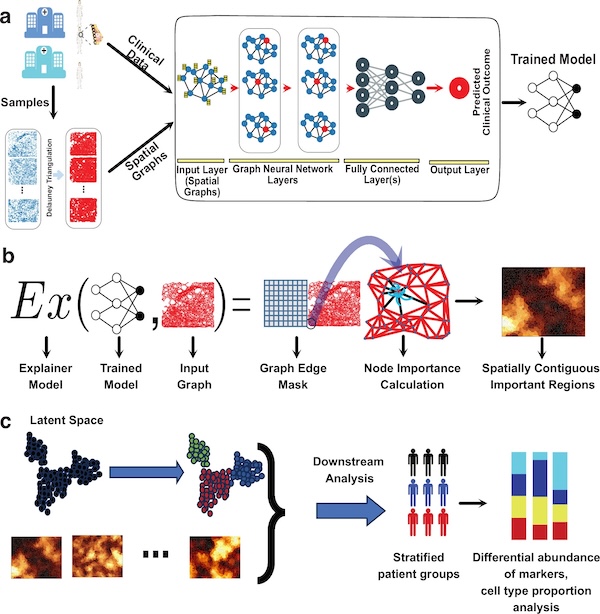
So happy to see this out! SpaCEy was my first interpretable AI project during my Erasmus internship in 2022. It's also where I first learned Shapley values, and that way of thinking has stuck with me since. Thanks @ahmet_rifaioglu, @tanevski, @JulioSaezRod, and Deniz!
Spatial omics is moving beyond mapping tissues toward discoveries that advance biomedicine and ultimately benefit patients. For us, the route there is tissue representation learning and the discovery of spatial biomarkers 🧵
https://t.co/J3iZ0GF7vY
Spatial omics is moving beyond mapping tissues toward discoveries that advance biomedicine and ultimately benefit patients. For us, the route there is tissue representation learning and the discovery of spatial biomarkers 🧵
https://t.co/J3iZ0GF7vY
Many drugs work by binding to a specific target in the body and blocking or changing what it does. An important first step in the drug development process is designing a molecule that can bind tightly to its target. Traditionally, that's meant weeks or months of expert work per target, sifting through a large number of candidates to identify the few that work.
We wanted to test if Claude could successfully design novel protein binders from scratch (also called de novo design). With a protein design prompt written by a human expert, Claude autonomously designed protein binders against 14 out of 15 targets.
We then worked with Adaptyv Bio and Twist Bioscience, who independently built and tested the proteins Claude designed.
SpatialClaw
NVIDIA drops a training-free spatial reasoning agent that uses code as its action interface. A VLM writes Python in a persistent kernel, composes perception tools, inspects results, and revises its plan—no fine-tuning needed. +11.2 points over prior agents on 20 benchmarks.
Excited to finally introduce Topological Neural Operators (TNOs) [https://t.co/V0yJbo9lIf], lifting operator learning to topological domains (cell complexes), where pyhsical quantitites live on their natural supports and interact via the language of Discrete Exterior Calculus. 🧵
LLMs learn by predicting tokens. World models (JEPA, data2vec) learn by predicting their own abstractions. Which needs more data? For data with hidden hierarchy, we prove the gap is exponential. https://t.co/r2uuX0lBCu
For over a decade, we’ve accepted that end-to-end backprop is the only way to train deep networks. But holding the entire network in memory all at once is why AI training is hitting a resource wall.
We found a new way to break the network into blocks and train them independently. The trick? Treating the network’s forward pass like a diffusion model denoising a signal.
This reinterpretation slashes the memory needed to train deep models. In our #ICLR2026 paper (https://t.co/PK5h0mqQSo), we matched end-to-end performance across ViTs, DiTs, and LLMs. We did this while training just one isolated block at a time.
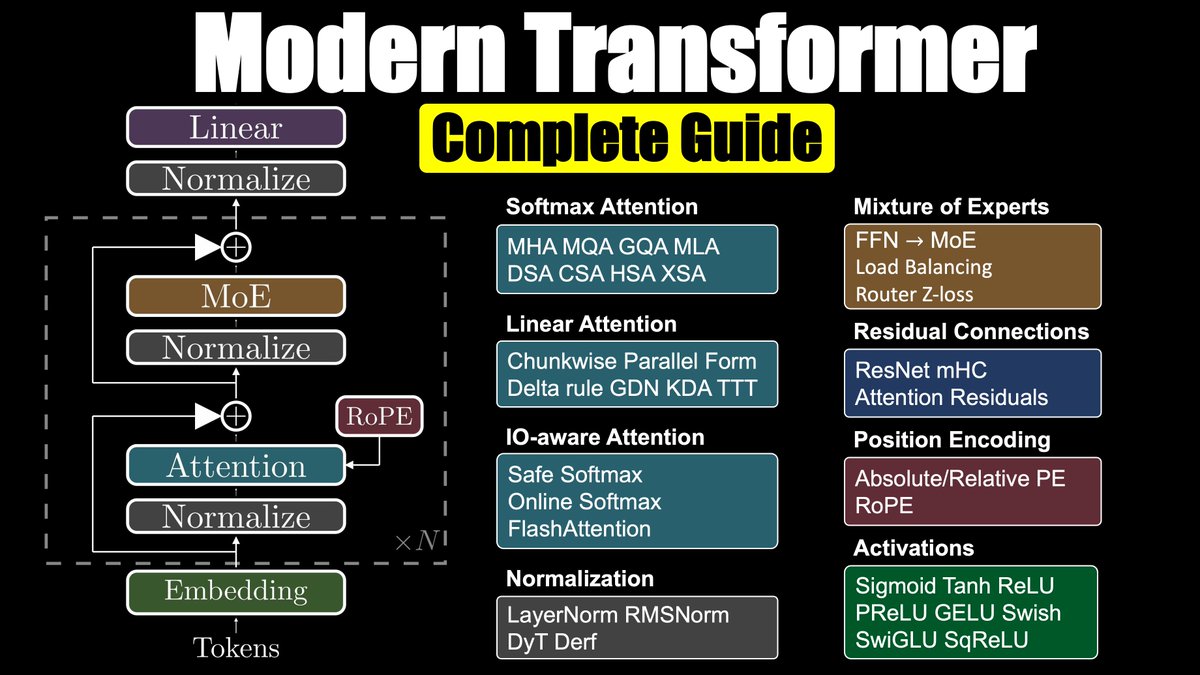
Modern Transformer - Complete Guide
Interested in learning the recent advances in transformers?
After 13 videos, I've finally completed this series!
🥳🥳🥳
Check out the course here:
https://t.co/CsujxlWigC
Attention @arxiv authors: Our Code of Conduct states that by signing your name as an author of a paper, each author takes full responsibility for all its contents, irrespective of how the contents were generated. 1/
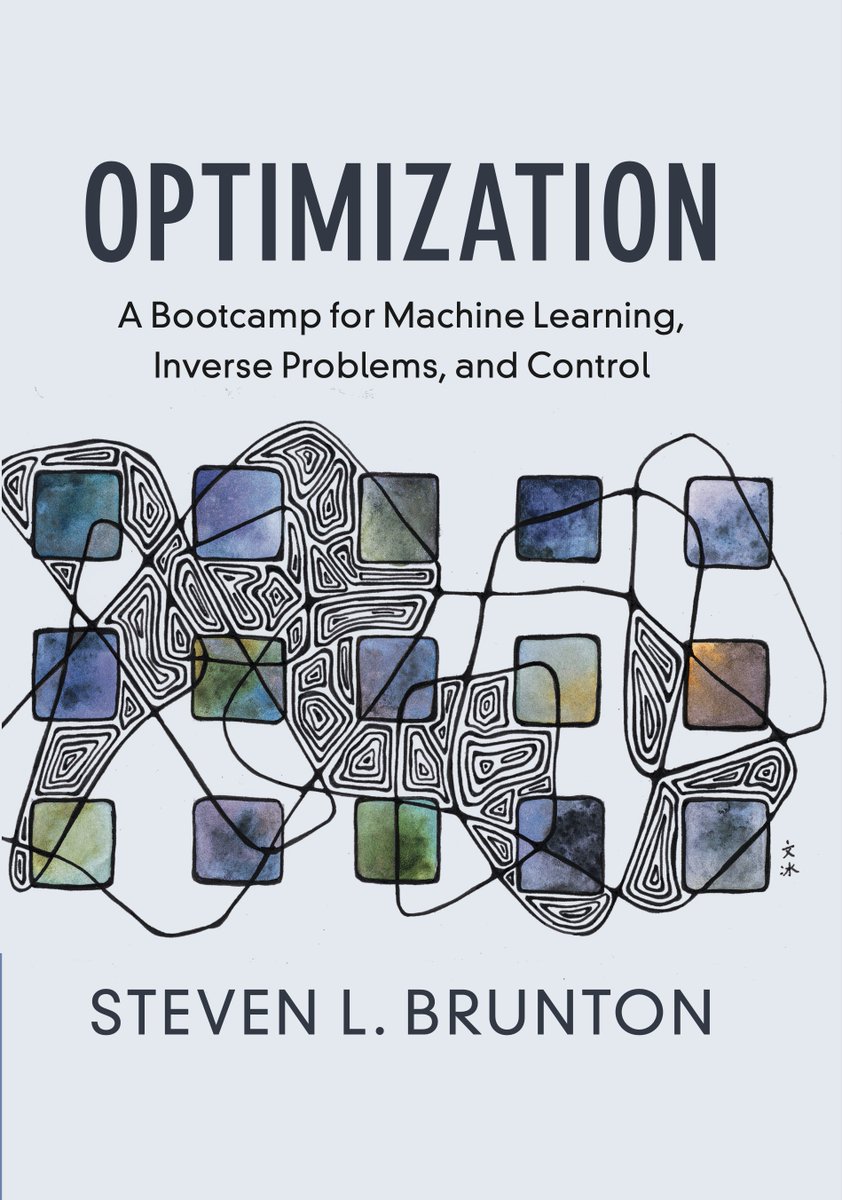
I Wrote a New Book!!!
Optimization: A Bootcamp for Machine Learning, Inverse Problems, and Control
Pre-Order Now (July 31)
https://t.co/EoDMFapUUf
Coming Soon:
* Free PDF on website
* YouTube Videos for entire book
* Python code on GitHub
PyTorch 2.12 introduces major updates across compilation, export, distributed training, and accelerator support.
Highlights include up to 100x faster batched linalg.eigh on CUDA, the new torch.accelerator.Graph API, Microscaling quantization support in torch .export.save, and fused Adagrad.
The release includes 2,926 commits from 457 contributors since PyTorch 2.11.
Have questions? Join @AndreyTalman (@Meta), @albanDesmaison (@Meta), and @joespeez (@reflection_ai), moderated by @Chris_AI_HPC (@Meta), on May 20 at 10:00 AM PT for a live Q&A covering the release and answering questions from the community.
🔗 Read the release blog and register for the webinar: https://t.co/lSkHPD3FQR
#PyTorch #OpenSourceAI #MachineLearning #AIInfrastructure
1,000+ tokens per second. 10x faster than autoregressive models. On standard GPUs.
@StefanoErmon and @volokuleshov break down where that speed matters most: voice agents, coding, and production agent systems where latency compounds across every call.
Our founder series with @timt at @MenloVentures.