Team Lead of PSIRT and Threat Research, TXOne Networks. Speaker at Black Hat USA, CODE BLUE, DEFCON, HITB, HITCON, S4, SECTOR. Author of Windows APT Warfare
[VXCON 2026] Celebrating 16 Years of Hacking: Deep-Dive into Exclusive Offensive Security & AI Tracks (Register Now!)
Dear Cybersecurity Professional,
The wait is over. VXCON is returning for its landmark 10th Anniversary edition this November 28–29, 2026, in Hong Kong.
Since our journey began in 2010, VXCON has dedicated the last 16 years to building an elite community of white-hat hackers, malware analysts, reverse engineers, and offensive security researchers.
To celebrate this milestone, we are bringing together global trail-blazers who frequently speak at Black Hat, DEF CON, and HITCON. They will break down live vulnerabilities, exploit pathways, and hardware weaknesses you won’t see anywhere else.
Secure your seat today to learn from the best in the industry: https://t.co/MovmNTWLgu
Featured Keynotes & Technical Briefings
Our 2026 lineup features exclusive research spanning OS kernels, automated AI hacking agents, automotive systems, and critical infrastructure.
🛡️ Windows Kernel & Browser Exploitation
• Angelboy (MSRC Top 100) covers cross-component vulnerabilities in the Windows Ancillary Function Driver (AFD), detailing transport-layer gadgets and sandbox escapes via Zoom.
• MinJeong Kim explores variant hunting in WebKit by tracing patches to root causes and introduces the AI-driven WebKit Weekly framework.
🤖 The Frontier of AI & Automation in Security
• Wonyoung Jung debuts a hybrid LLM and program analysis framework to automate patch diffing and N-day PoC generation.
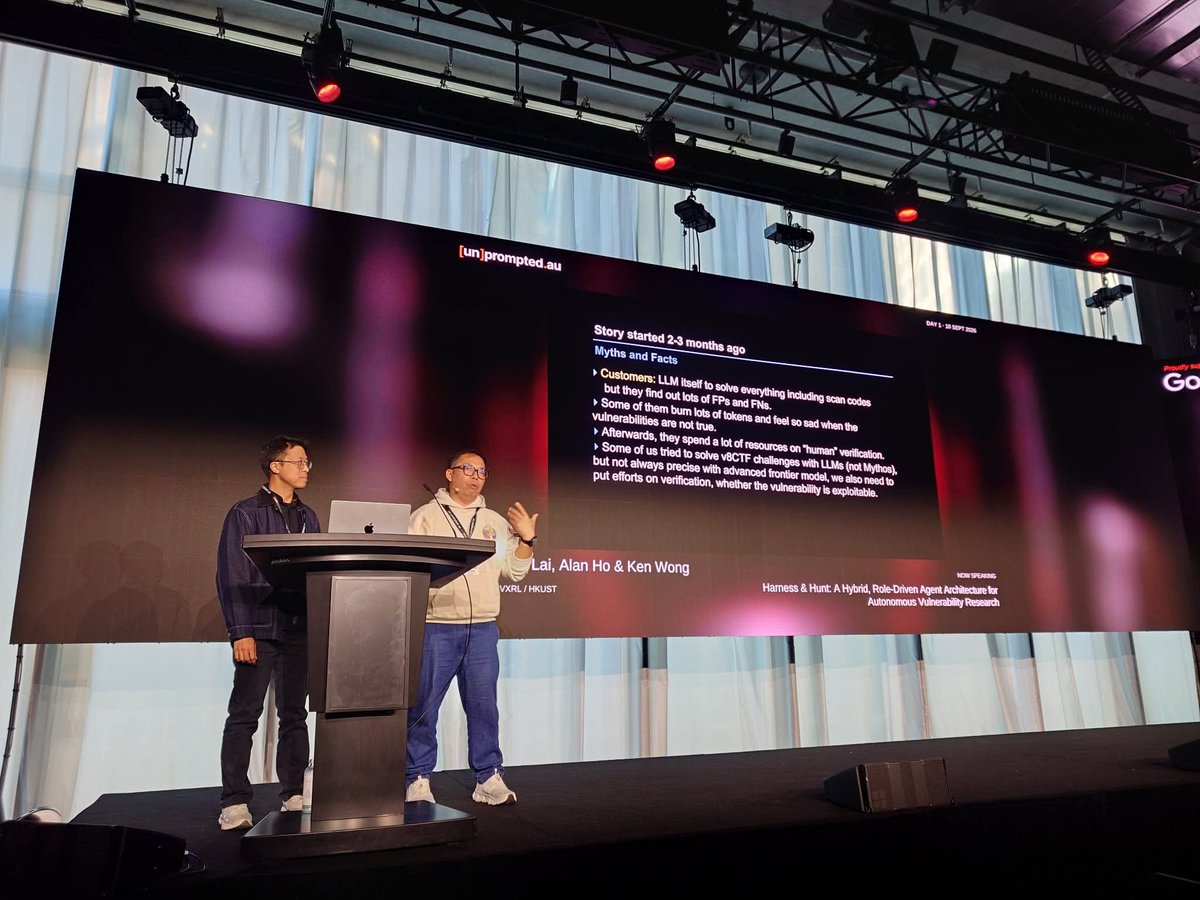
• Donghyeon Kim & Prof. Insu Yun (KAIST Hacking Lab) break down an autonomous agent that tackled CODEGATE 2026 challenges.
🚗 Automotive, Hardware, & Infrastructure (OT) Security
• Dr. Camille Gay & Alina present exclusive car hacking and vehicle network research.
• Edward Lee (OPCIA) demonstrates how to extract operational tags from proprietary OT traffic and detect unauthorized PLC modifications.
• Iceman dives into signaling vulnerabilities, RFID exploitation, and new analysis hardware.
Day 2: Hands-On Interactive Workshops
• Bootrom Dumping: xenocidewiki (Secret Club) leads a hardware workshop on dumping encrypted pet firmware from a Tamagotchi Paradise via UART/SWD analysis.
• Hardware & RFID: Led by Iceman.
• Car Hacking: Led by Dr. Camille Gay & Alina.
Event Logistics & Venues
• Day 1 (Nov 28, 2026): Main Briefings at Marco Polo Hongkong Hotel (https://t.co/q9BwpLlDjZ) (Centenary Room II-III), including a network buffet lunch.
• Day 2 (Nov 29, 2026): Workshops & Village (10:00 - 18:00) at JobsDB by SEEK (https://t.co/HnwHgwLJVA), PCCW Tower, Quarry Bay.
Registration Details
Seating is limited. Secure your pass at https://t.co/MovmNTWLgu.
For inquiries, contact [email protected]
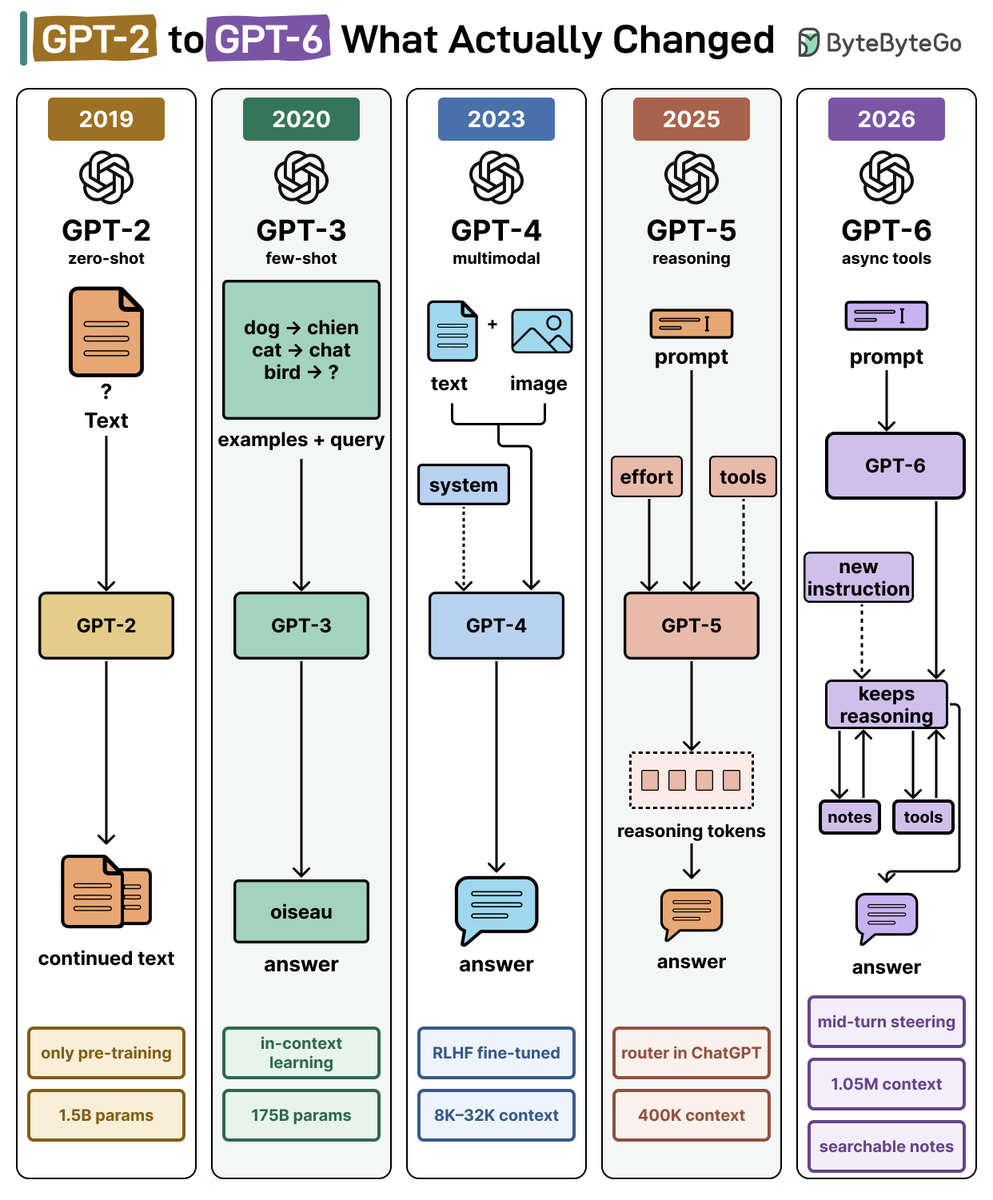
It's been 7 years from GPT-2 to GPT-6, and a lot has changed.
The diagram below shows each generation and its key highlights, based on the public information we know.
GPT-2 (2019): More like a prototype to validate the potential of the decoder-only transformer. This was a 1.5B-parameter model that only went through pre-training with next-token prediction. The trained model was only capable of continuing text, not answering questions.
GPT-3 (2020): The same recipe as GPT-2, just much bigger and trained on more data to test how far scale alone could go. GPT-3 had 175B parameters, more than 100 times the size of GPT-2, and still only went through pre-training. The scale allowed it to show in-context learning capabilities. When shown some examples, the model could follow them.
GPT-4 (2023): On top of pre-training, OpenAI fine-tuned it with RLHF (reinforcement learning from human feedback), so it was not just a completion model but could actually answer questions. It was also multimodal, meaning that it could process input images as well as text, and it handled up to 32K tokens of context.
GPT-5 (2025): The first GPT generation with built-in reasoning. Given a prompt, tools, and an effort level, the trained model could generate reasoning tokens before the answer. Its context window grew to 400K tokens, with a router in ChatGPT to decide when a prompt needed thinking mode.
GPT-6 (2026): This new model has a bigger context window (1.05M), supports async tool calling, and is generally safer. An interesting feature, called mid-turn steering, is that it can take a new instruction while it's thinking.
Astra (launch day) vs Astra (Today).
Same prompt. Today's result looks off.
The photo realism is gone. It clearly looks nerfed.
GPT-5.6 Sol is unusable for me right now too.
Everyone is running someone else's harness.
Kerness is the kernel underneath harness: provider transport, tool dialects, the turn loop, access control, memory, compaction, resume.
You write the Markdown saying how yours behaves. 60 seconds, not 6 weeks.
Written in rust with python binding.
https://t.co/o7hFHuD3WF
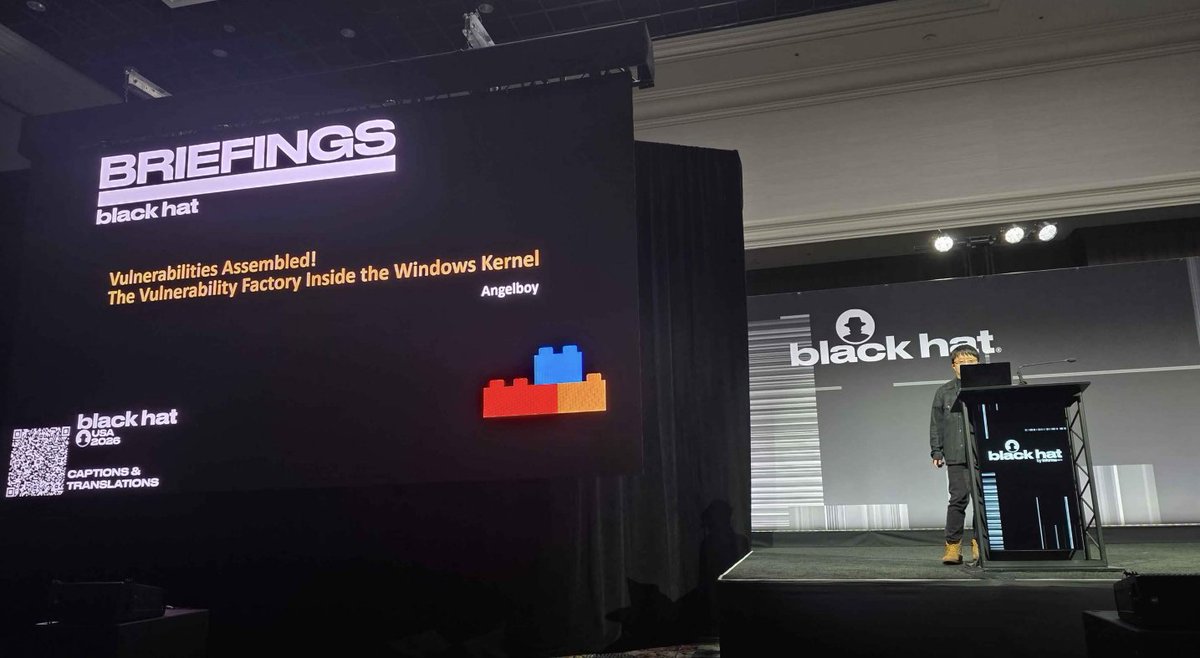
We're excited to highlight 2026 Microsoft Most Valuable Researcher Angelboy (@scwuaptx), who presented at Black Hat USA this week.
Drawing on years of Windows security research, Angelboy shared how vulnerabilities can emerge from unexpected interactions between drivers, transports, and system components, even within attack surfaces that have been studied extensively. His talk discussed a new way of thinking about vulnerability discovery, demonstrating how researchers can uncover overlooked paths to privilege escalation and sandbox escape by examining systems across layers rather than in isolation.