🌟¡NUEVO ARTÍCULO!
🧬 ¿Sabías que tu mezcla genética particular puede influir en la efectividad de algunos medicamentos?
Les invitamos a leer: “SiteCELL enables on-site PBMCs purification and cryopreservation for immune single-cell profiling of underrepresented ancestries”
🧵1/3
New paper by members of the lab is now published in iScience!
"SiteCELL enables on-site PBMCs purification and cryopreservation for immune single-cell profiling of underrepresented ancestries" https://t.co/HbIjrRYLIE Congrats @aaron_jaimee@JAntonioCorona@Octavirus23
🧬 4 fully funded #PhD scholarships are available at HT through the #SEMM PhD Programme in Systems Medicine.
🔬 Join international teams working across computational biology, functional genomics, and population and medical genomics.
Apply by 10 June 👉 https://t.co/KhDNo2H0kn
Rojas-Hidalgo et al. developed ‘The Single Cell Notebooks’, an open-access training suite for single-cell and spatial transcriptomics data analysis, comprising 13 modules (in English, Portuguese and Spanish).
https://t.co/rL7OhvCfqn
#SingleCell#SpatialBiology
Please check this wonderful initiative supporting Mexican students through short internships abroad. Thanks to @DavidPosner13 and @CarlosMMinutti for this incredible effort to support Mexican science.
https://t.co/gOaGFWsIRn
🚨 Check out our new paper in Nature!
In our new study, we sequenced 128 high-coverage genomes from Indigenous peoples across Latin America and uncovered their unique genetic diversity and history. 👇🧵
https://t.co/Y9t0N9VfEs
AlphaGenome is out in @nature today along with model weights! 🧬
📄 Paper: https://t.co/1fHzSPiY1x
💻 Weights: https://t.co/z6JWLT4Mpv
Getting here wasn’t a straight path. We sat down @googledeepmind to discuss the story behind the model, paper & API: https://t.co/cT8CiXfnxQ
2026 has just begun and we are looking forward to welcoming you to EMBL for another year of groundbreaking science.
Our programme now features even more events, check it out ➡️ https://t.co/6UEBlAc3rI
Full Genome Annotation and Visualization in <1 minute!
Upload a FASTA and see how SeqHub enriches your data with HMMs and other functional annotations.
Annotate a genome → https://t.co/QXdOb1Olbb
🤖 ¡Reserva la fecha!
Del 1 al 3 de diciembre de 2025 se realizará el AlphaFold Education Summit México (#AFESMX25) 🇲🇽
📍 CICESE · Ensenada
💻 Híbrido (presencial + virtual)
Un evento internacional que fortalecerá el uso de AlphaFold (Nobel 2024) en investigación y enseñanza.🏅
🔍🦎 Gecko: Tu aliado de código abierto para encontrar los artículos más relevantes.
📝Optimiza la revisión de literatura y descubre nuevos hallazgos científicos de forma fácil y rápida. 🚀✨
https://t.co/N1h6NRZQ6W
📢 Recruitment for the EMBL International PhD Programme is officially open!
At EMBL, we train young scientists to become skilled and creative future leaders in academia and other sectors. Join us and get a head start on your career in life sciences!
https://t.co/wlj1i614ey
Genomics job opportunities in Sweden! Our infrastructure has an open position for a postdoc with a focus on long-read sequencing, and a permanent (!) bioinformatician position in ancient DNA. Cutting-edge tech, great environment, work-life balance, nice country. Please RT!
I spent 1.5 years at MIT designing a new undergraduate program in Genetic Engineering.
One of our theses in designing that program (which I’ll share more about soon; I'm writing a long essay about it) was that undergraduate students could be trained to be excellent genetic engineers, in part, because the complexity of these tools had decreased sufficiently so as to be learnable by anyone.
I think that a new study, published this week, lends support to this idea.
Writing in Nature Biomedical Engineering, Le Cong’s group at Stanford University report “CRISPR-GPT,” an AI agent system that automates the design and data analysis of gene-editing experiments.
CRISPR-GPT takes a given task, like “Knock out these four genes in this particular cell line,” and then works step-by-step to make it happen. The agents select which CRISPR protein to use (and there are, like, hundreds of them to choose from), designs the guide RNAs, designs the gene sequences, and even analyzes the experimental data once it is complete.
In other words, now literally anyone can easily design, perform, and analyze CRISPR gene-editing experiments.
Cong’s group used CRISPR-GPT to successfully knock out four genes with CRISPR-Cas12a in human lung cells, and then epigenetically activate two genes using CRISPR-dCas9 in a human melanoma cell line. For the former experiment, a “junior researcher” exactly implemented the designs from CRISPR-GPT and achieved ~80% editing efficiency across all four genes, as confirmed by next-generation sequencing.
Now, finally, I’m not bashing these AI agent papers when I say this, and I'm certainly not bashing this paper in particular, but I do think this is becoming a bit of a “genre” in the biotechnology literature writ large. There is now a whole slew of papers that report AI agents to automate common tasks. Just a few days ago, another paper reported how a quorum of agents could design nanobodies against SARS-CoV-2, many of which worked well.
The gist is that anything that is commonly done in biology — analyzing flow cytometry data, running gene-editing experiments and, perhaps soon, designing entire multi-gene circuits that actually execute precise behaviors in living cells — can and will be automated soon.
One of the next frontiers, then, is in building GUIs and easy-to-use tools that enable researchers without computational chops to actually use these tools!
While working on a startup idea, I interviewed a few dozen scientists about which AI tools they use, and the overwhelming majority of biologists said that they just have an OpenAI subscription and use that for everything.
We can, and should, build much better and user-friendly software for biologists to leverage these new computational tools. It should not be absurdly difficult to set up these multi-agent systems, or to even use common tools like ESM or AlphaFold. Let’s push for ease-of-use.
La violencia en razón de género es real en todo el mundo y se han creado leyes y programas para erradicarla, en México no es la excepción. Tristemente vemos últimamente como leyes creadas con la mejor intención están siendo utilizadas para censurar la crítica y el cuestionamiento de los ciudadanos y periodistas, por ello, como una manera de protesta y de visibilizar la violencia real, Mariel y Carolina, dos mujeres conocedoras y comprometidas con esa causa han iniciado una colecta para pagar la multa que me fue impuesta injustamente y para visibilizar la verdadera violencia. Porque eso es lo que debemos visibilizar y no la cara de los políticos en espectaculares y propaganda.
Me informan que el monto de la multa ya se llegó a la meta y que el resto de lo que se recaude se donará con total transparencia a asociaciones que se dedican a ayudar a mujeres que sufren violencia; agradezco mucho a todos los que han apoyado, yo donaré la parte de la multa también.
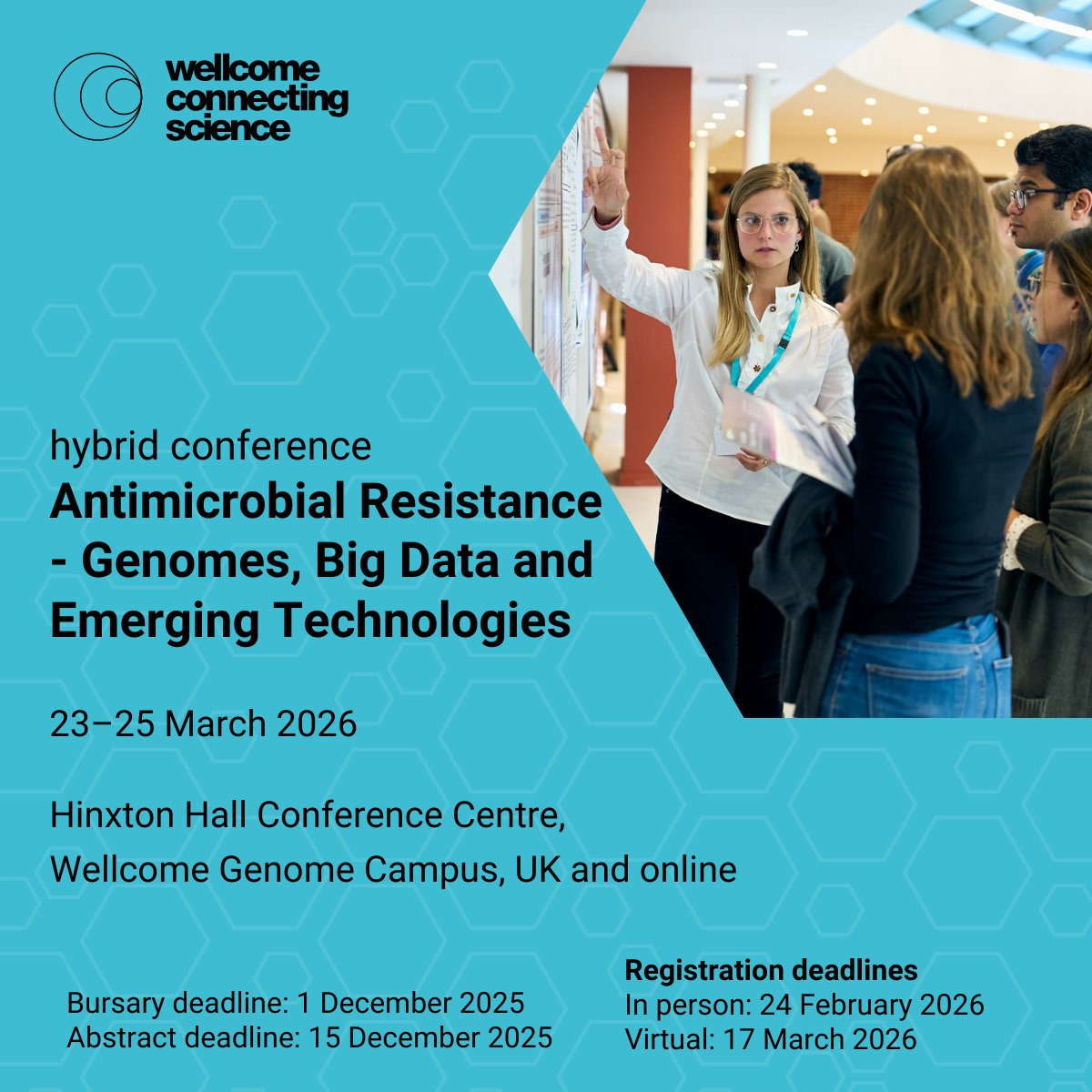
Explore the important role of #genomics and data-driven technologies for accelerating advances in global #AMRresearch, at our Antimicrobial Resistance conference! #AMR2026
🗓️ 𝗦𝗮𝘃𝗲 𝘁𝗵𝗲 𝗱𝗮𝘁𝗲: 𝟮𝟯–𝟮𝟱 𝗠𝗮𝗿𝗰𝗵 𝟮𝟬𝟮𝟲
📎 https://t.co/5oD3Uj7ZZg