We worked super hard to build a technology that enables a whole new type of DCS modernization project - one without the downtime and with 40% less cost. @DeltaV IO.CONNECT is a big deal! #PAuto https://t.co/vJolxynWij
Personal update: I've joined Anthropic. I think the next few years at the frontier of LLMs will be especially formative. I am very excited to join the team here and get back to R&D. I remain deeply passionate about education and plan to resume my work on it in time.
The older I get, the more I realize intelligence is overrated. Intelligent people are more likely to overthink, overplan, and overanalyze. They hide behind motion that doesn't create progress. They fear the judgment of others if they're proven wrong.
The truth is that intelligence is abundant. Courage is not. The people you admire are the ones who had the courage to act. They aren’t more talented than you. They aren’t smarter than you. They just took action when you didn’t.
I often wonder how many extraordinary people wasted their entire lives waiting for permission that never came. Permission isn't granted. It's taken. You get to tap yourself in whenever you want. You can just do things.
Courage beats intelligence.
claude cowork is making me think maybe we’ll look back and it’ll be obvious that humans were never meant to spend their lives working behind a screen. we’ll see it as inevitable that computers do everything for us on computers and the future of work is cooler than we can imagine
September 1997. Steve Jobs stands before Apple employees and tells them he's been up until 3am finishing an ad. He's been back at the company for eight weeks. Apple lost $1 billion that year. Three months earlier, WIRED put Apple's logo on its cover, wrapped in barbed wire, with the word "Pray."
He starts by saying what he's found since coming back. He couldn't figure out Apple's own product line. He spent weeks trying to understand which model was which and how they fit together. He talked to customers. They couldn't figure it out either. He cut 70% of the product roadmap. People whose projects were canceled were, in his words, "three feet off the ground with excitement" because, for the first time in years, someone told them where the company was going.
Then he says something about marketing that changed how every tech company thinks about advertising.
He says Nike sells a commodity. They sell shoes. But when you think of Nike, you feel something different than a shoe company. Nike never talks about their products in ads. Never tells you why their air soles are better than Reebok's. "They honor great athletes. And they honor great athletics. That's who they are." He compares it to the dairy industry spending 20 years trying to convince people milk was good for them, failing, and then running "Got Milk," which doesn't even mention the product. Focuses on its absence.
He says Apple spends a fortune on advertising. "You'd never know it."
Then he fires the ad agency. Not just fires them. Apple was running a competition with 23 agencies. He scrapped the whole thing and hired Chiat/Day, the agency he'd worked with a decade earlier on the 1984 Macintosh commercial that advertising professionals voted the best ad ever made.
The question they asked themselves: "Our customers want to know who is Apple and what is it that we stand for?"
His answer: "Apple at its core, its core value, is that we believe that people with passion can change the world for the better. And that those people who are crazy enough to think they can change the world are the ones that actually do."
Then he plays the ad. In this room. To Apple employees. For the first time.
"Here's to the crazy ones. The misfits. The rebels. The troublemakers."
He says almost none of these people had ever appeared in an advertisement before. He personally obtained Yoko Ono's permission to use John Lennon. He says the estates and living subjects agreed because of their feelings toward Apple. "I don't think there is another company on Earth that could have done this campaign."
The ad broke that Sunday during the network premiere of Toy Story on ABC. Two 60-second spots. Newspaper ads in the Wall Street Journal, New York Times, and USA Today. Billboards in major cities. Buses in five cities featuring Rosa Parks. Painted walls. The whole thing.
Apple's stock was around $0.10 split-adjusted when this meeting happened. The company is worth $3.68 trillion today. Think Different ran for five years. Every product that came after, the iMac, iPod, iPhone, iPad, was built on the identity this campaign established by a guy who'd been back at the company for eight weeks and finished the ad at three in the morning.
Video: Steve Jobs internal staff meeting at Apple, September 1997. This is the first time the Think Different campaign has been shown to employees. Jobs had been back at Apple for eight weeks. Footage leaked from an internal recording.
@richroll So important to talk about this. Your followers all believe in “natural” remedies but there is a place for surgery and pain meds. In the end, much more inspiring to see you return to form than to continue to struggle w your back.
I have been screaming for this for YEARS. I tell anyone who will listen: “The entire software development industry needs to go one full year without adding ANY new features, and dedicating 100% of its resources to bug fixes & optimizations.”
As I am learning more about the PLC world, I'm starting to wonder why the things that should be easy aren't, and how we are conditioned to accept that.
https://t.co/waSiOPKbqy
New media runs on speed.
@pmarca on the OODA loop:
"Speed wins."
"If you can have a sustainably faster OODA loop processing cycle than the next guy... then if you think about what happens — let's say it takes an hour to figure something out."
"It takes the other guy two hours to figure something out. Think about what happens is: you start out on even playing field. You both start your decision making cycles."
"You make your decision within an hour. The other guy is still say, is inside his own OODA loop when you make your decision, right?"
"He's only halfway through his process, he now has to start his process over, right — because you've changed the landscape. You've changed the parameters of what's going on. So he now has to go back and re-serve and reorient and start over."
Observe, orient, decide, action.
Steve jobs absolutely cooked with this:
"It's not a faith in technology. It's faith in people. Technology is nothing. What’s important is that you have a faith in people, that they’re basically good and smart, and if you give them tools, they’ll do wonderful things with them."
another era of product intuition leading the way…
“the rarest version of this person sits at the intersection of culture & deep technology. someone genuinely bilingual. they know what's technically possible & they know which cultural currents are real vs. ephemeral.”
the most underrated hire right now is a great product person.
when i say product person i'm def not talking about a product manager. perhaps i think there has to be somewhat of a new role. i don't have a good name for it yet but maybe something like "product thinker".. someone with an intuitive grasp of the product as it exists, where it's soft, where it sings, & how to iterate it toward something even sharper. in some sense, this person has to cohesively hold in their head where this product should be 2 years from now & work backwards from that.
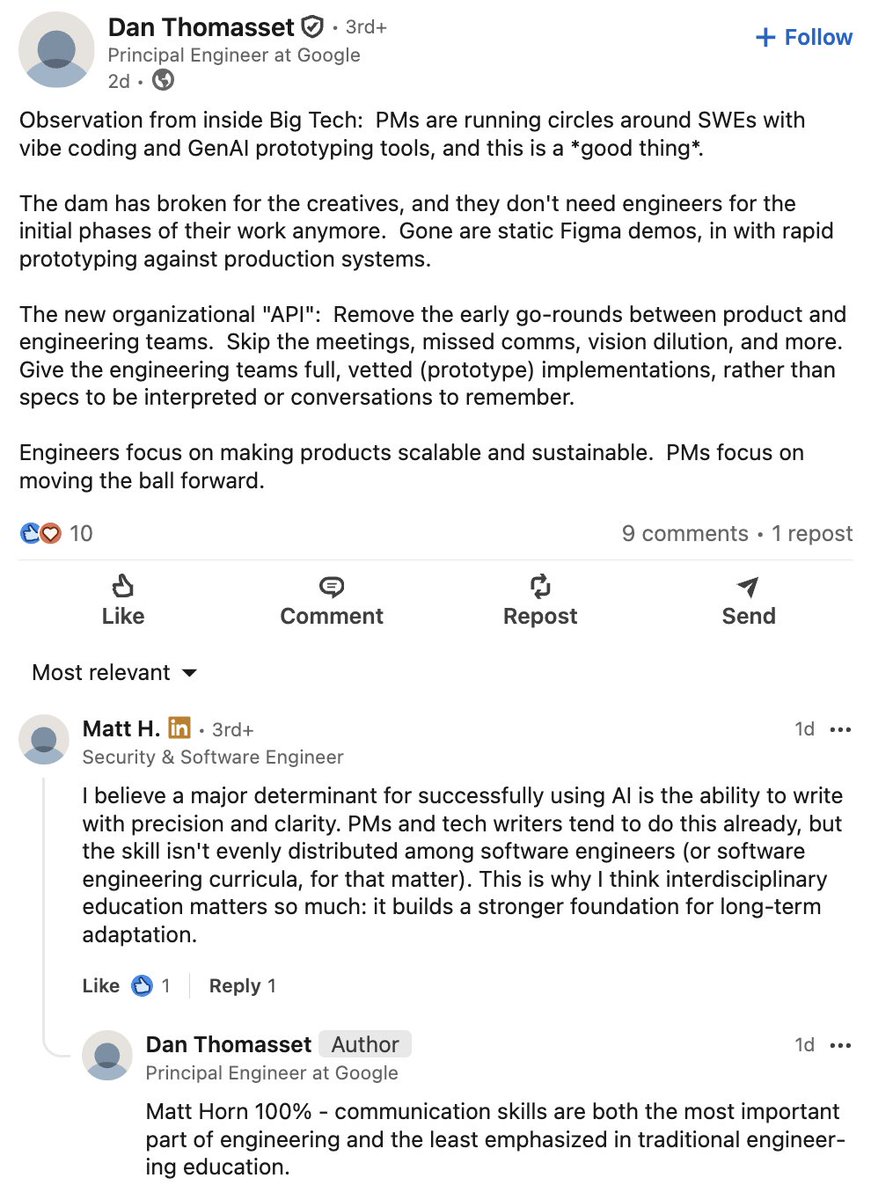
i say this cuz when building was hard, engineering was the bottleneck & the status hierarchy often reflected that. building is no longer hard. which means the variance in outcomes has shifted almost entirely to judgment on what to build, how to sequence it, & how to talk about it.
& the story matters as much as the thing. internally, it organizes the team around a shared model of why. externally, it shapes the interpretive frame users bring to their first experience. you can't retrofit narrative onto a product & expect it to land, it has to be load bearing from the start.
the rarest version of this person sits at the intersection of culture & deep technology. someone genuinely bilingual. they know what's technically possible & they know which cultural currents are real vs. ephemeral. that combo is what separates products that feel inevitable from products that feel assembled.
before ppl clap back with this person has always been valuable, i know.. i am just saying now they might be the most *important* person in the room. their value compounds like never before.