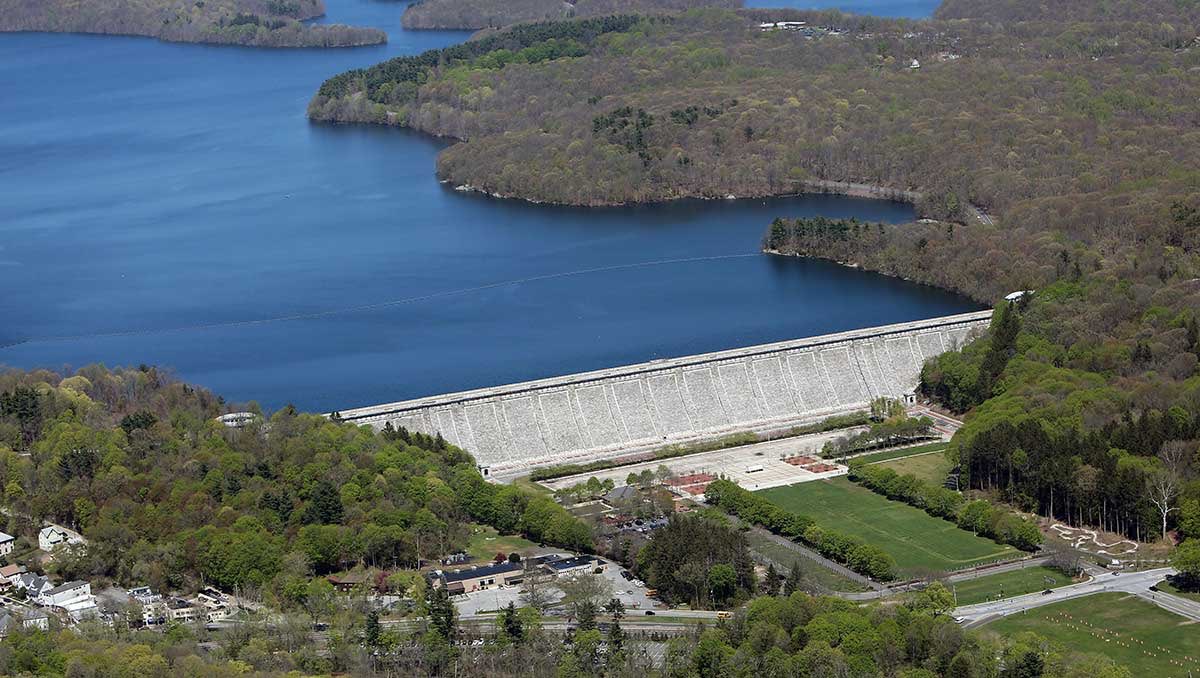
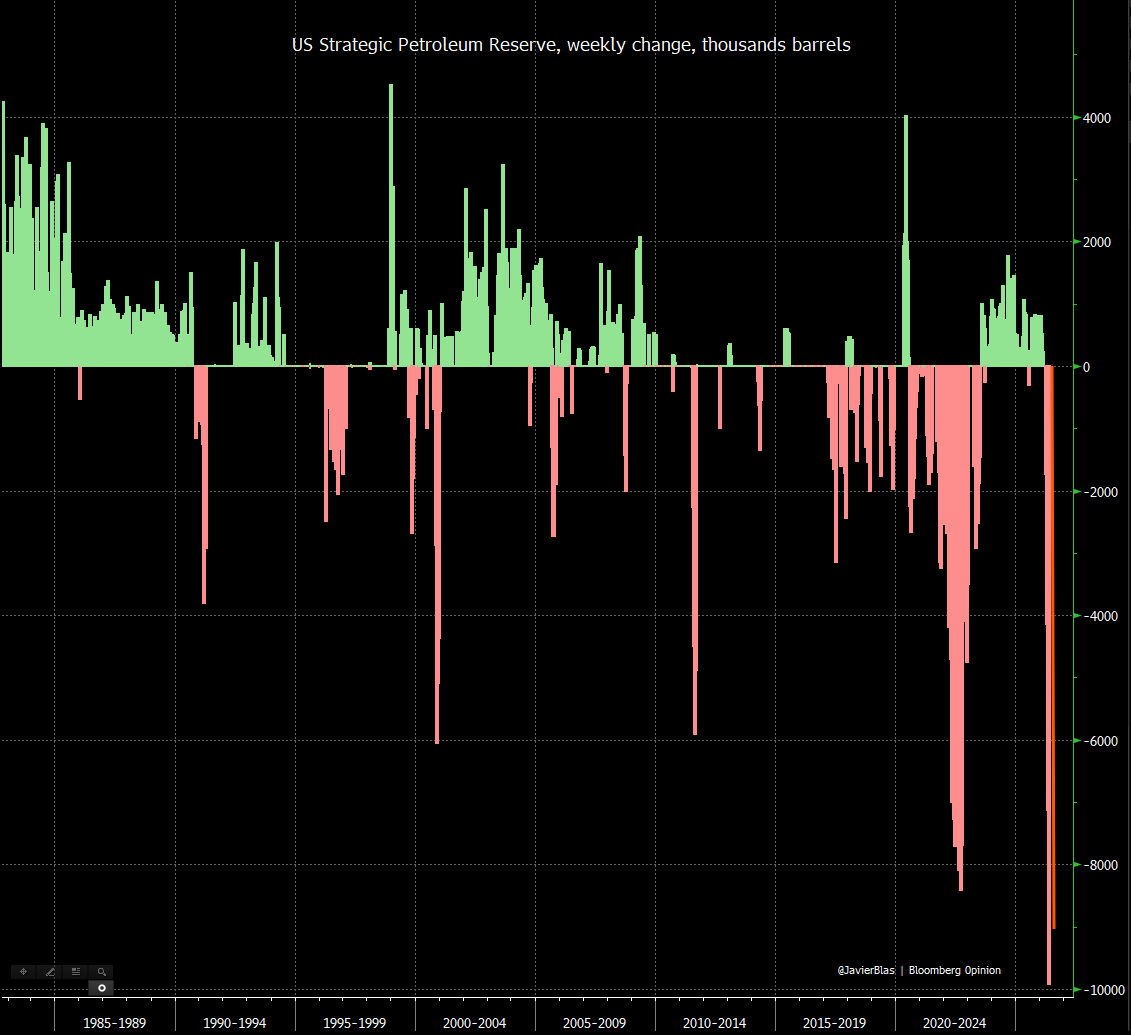
Some of the "new" oil market watchers will look at this chart and say "there's 5M more barrels!" . . . this is what tank bottoms look like folks, it doesn't go to -0-
I doubt the barefoot hike. I'm no fan of the Christopher Columbus complex, and I happen to admire elites who develop a country rather than exploit one. So let me explain what is actually going on here.
I did, among others, property across Eastern Europe during my years at Babcock & Brown, and I spent the better part of a decade fighting a court case in Romania against people who tried to defraud my land title. I won. And here is the lesson I paid for: the one thing that separates an investable Eastern Europe from an uninvestable one is European Union membership. It is the guardian of the rule of law in an otherwise wild East, the easiest place in the world to lose your money.
That is the lens through which I read what is happening on Sazan Island.
You see, there was a time when Western elites saw themselves as custodians of institutions, rules and the places they touched. That instinct is fading. What remains too often is the Columbus reflex: arrive by yacht, "discover" land that people already know perfectly well, and treat the rules as obstacles reserved for everyone else. And then have the wisdom to go on camera and brag about it. Jesus. No wonder Albanians are now on the streets in their thousands.
"We were on a friend's boat and stopped for a swim. That's how we found it. We swam to the island. We went on a hike, barefoot all the way up to the top, and we were just captivated."
What she "found" has been there for millions of years, in the Adriatic, not "the Mediterranean." It has a name. Sazan Island sits where the Adriatic meets the Ionian: a former military base, Italian and then Cold War, including a Soviet submarine base, inside a protected national marine park that has been open to the public since 2017 via boat tour from Vlorë. An island crawling with snakes, including the nose-horned viper, Europe's most venomous. So much for the barefoot hike.
Nothing was discovered, and nothing justifies any entitlement. Quite the contrary.
What actually happened is that Jared Kushner set out to cash in on his father-in-law's temporary power as President of the United States. That status means precisely nothing in Switzerland, with its seven centuries of direct democracy and institutions no outsider can buy. But it means everything to a weak man like Albania's prime minister, Edi Rama, cornered at home, courting Washington, and now under criminal investigation for how his government handed this deal away. Kushner understands that asymmetry perfectly. And he wants to exploit it. Period.
In Albania, he can. Albania is chronically bureaucratic, the long tail of its communist heritage, a home-grown Stalinism so absolute it broke even with Moscow and sealed the country off from the world. That legacy is the same one that ran, and still runs at times, from Sarajevo to Tirana, from Bucharest to Belgrade: decades of one-party rule that hollowed out the courts, the press and property itself, and left a vacuum filled by the personalised, strongman power of a connected few. It is the soil in which corruption flourishes, and Albania's greatest vulnerability.
And on that soil, in one of Europe's poorest countries, the island's protected status was suddenly changed in December 2024, in the weeks between Trump's election victory and his inauguration. Just like that. The public-tender rule was bypassed. "Strategic Investor" status went to a Kushner-linked SPV before the inauguration: no business plan, no feasibility study. Wonderful. Because Ivanka "discovered it". Right? Wrong.
A country vulnerability like that can be met in two ways. A responsible investor sticks to the rules and ties his fortunes to the country's long-term development, because that is what makes returns durable in the first place. And that will take a lot of time and upfront investment, with a highly uncertain reward. That's called risk-taking.
A powerful one, on the other hand, willing to bend the rules, as this deal suggests the Trump family is content to do, sees only something to exploit.
The subsequent damage runs far deeper and longer than a few harmless bungalows built without a proper concession. What is happening here is that Kushner is becoming part of the problem that corrodes Albania's path into the European Union. That is the real issue here. Just like the issue when JD Vance travelled to Europe and openly campaigned for illiberal politicians while lecturing Europeans about democracy. Who do these people think they are? Guardians of democracy?
Consider what the Albanian path actually looks like right now. The Balkans, like much of post-communist Europe, are chronically corrupt. But they are also full of people fighting to turn their countries toward something better, and EU accession is the single most powerful tool they have. It forces the one thing that actually develops a country: predictable rules, secure property, contracts that hold, and the credible belief that the same rules apply to everyone.
That belief is what brought the great wave of investment into Poland. Its absence is why Romania and Bulgaria remained under special monitoring for years after accession. The rule of law that eventually held in that Bucharest courtroom, and saved me, exists because membership forced it into being. Brussels learned the lesson. Today enlargement runs on a "fundamentals first" basis.
Which is exactly where Albania stands.
Last month it became only the second candidate after Montenegro to clear those rule-of-law benchmarks, with the EU's own enlargement commissioner describing SPAK, the very prosecutor now investigating this deal, as the country's "most trusted institution." The concession lands squarely on the chapters that decide membership: the judiciary, justice and public procurement. So this is not a side issue to Albania's European future. It is a direct test of it.
And that is why this does not help. It does the opposite. A single family connected to the presidency of the United States showing that the rules bend on demand corrodes the one asset a poor country cannot afford to lose: the belief, hard-won and easily lost, that the rules are real.
Then those same people have the chutzpah to complain about corruption in Eastern Europe and lecture the world about American exceptionalism. It is all so deeply wrong. And make no mistake, it erodes our democracies too, ever so slightly.
The thousands in the streets of Tirana understand all of this instinctively. They are not protesting a resort. They are defending the only thing that gives their country a future and hope: the rule of law applied equally to all.
And make no mistake about who the brave ones are. They are not on a yacht. They are on the street of Tirana and inside SPAK, because in Albania, stepping on the toes of the powerful is done in the knowledge that the danger is real. Confronting entrenched corruption in the Balkans has cost prosecutors, judges and journalists their their lives. That is the issue here, ladies and gentlemen!
I doubt Ivanka loses any sleep over any of this. Her concern is closing the deal while her father remains in office. And on a timeline that tight, a public tender, one they may well have won fairly, becomes an inconvenience rather than a safeguard.
That is the difference between a custodian of capitalism and democracy like Warren Buffett and the late Charlie Munger and a primitive land-grabber without any moral compass and integrity.
Another mammoth SPR release last week, with a flow equal to ~1.3m b/d (nearly 9.1 million barrels over the week).
The weekly release is the **second highest on record**, just a notch below the all-time high set the previous week of 9.9 million barrels.
I estimate at least for crude about 2.8 billions barrels of linefill and tank bottoms. This is from known pipeline infrastructure and measurable inventories.
That inventory is unavailable for commerce and can't be drawn.
This is from GEM data and @Kayrros
A Lithuanian farmer discovered a church bell buried for 82 years while working his field.
Cast in 1908, locals buried it in 1942 to protect it from Soviet forces who melted church bells into weapons. It came out of the ground perfectly preserved.
@noetic_healing Definitely get the PET scan if you can. The cancer industry is a swarming with people trying to milk the system for money. Not saying this doc is, but it definitely sounds like something is off. Then if you’re really up against cancer look into methylene blue.
Things are about to get very exciting over the next few weeks, and truth will become so incontrovertible that reality will finally have to be reflected in price:
BREAKING: US total crude inventories fell last week ~17.8 million barrels (that's commercial and SPR stocks combined). On that basis, it's the largest weekly fall since data is available starting in 1982.
The world is losing oil, fertilizer, and sulfuric acid simultaneously. The market priced only the oil.
Per The Wall Street Journal, citing Argus pricing data and the US Geological Survey, sulfuric acid prices in China rose roughly 1,150% in May compared with two years earlier. Middle Eastern sulfur prices surged 750%. Chile, the world’s largest sulfuric acid importer, saw prices jump 230%.
Sulfuric acid converts phosphate rock into fertilizer. It processes copper. It manufactures batteries. It fabricates semiconductors. The Persian Gulf supplies roughly half of global sulfur exports. The chemical that touches food, electric vehicles, and chip fabs is breaking simultaneously.
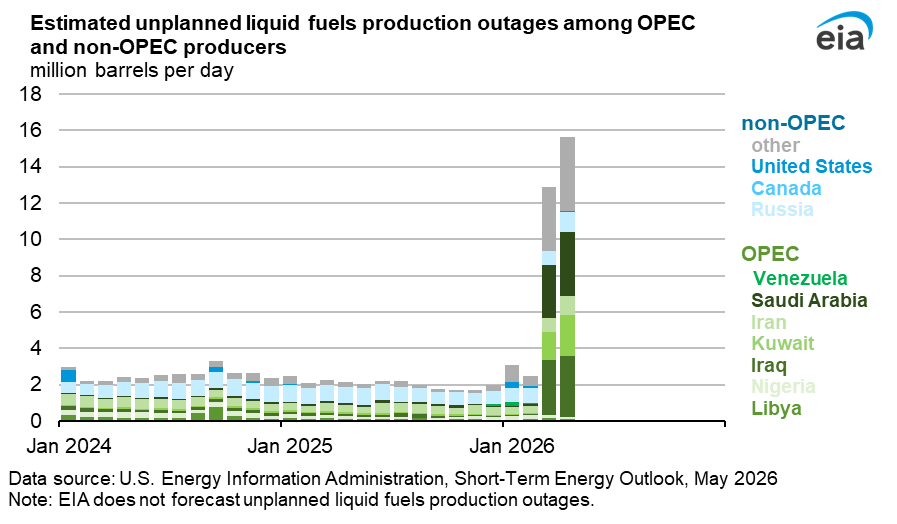
Saudi Aramco CEO Amin Nasser told investors Monday this is “the largest energy supply shock the world has ever experienced.” Per CNBC, the world has lost one billion barrels of oil supply, net 880 million after east-west pipeline reroutes and strategic reserve releases. Two to five ships now pass Hormuz daily, down from seventy before the war. Around 240 ships are waiting outside. The market loses 100 million barrels per week the Strait stays closed. If disruption persists past mid-June, normalization runs “into 2027.”
The Wall Street Journal reports US crude inventories including the Strategic Petroleum Reserve have fallen for four consecutive weeks and risk reaching their lowest level since 1982. Per Bloomberg, the IEA coordinated the release of 400 million barrels of emergency reserves. The United States has released only 79.7 million of the 172 million it pledged.
JPMorgan head of global commodities Natasha Kaneva warned OECD oil inventories could reach “operational stress levels” by June and “fall to minimum operating thresholds by September.”
This is the energy story.
Per the United Nations Food and Agriculture Organization, roughly one-third of global fertilizer trade transits the Strait of Hormuz. Qatar Fertiliser Company, which supplies 14% of global urea single-handedly, has declared force majeure. Major fertilizer plants across the Gulf have reduced or suspended production. Three to four million tonnes per month of fertilizer is stalled.
Per CNBC, urea FOB Egypt has risen from $400 pre-war to $700 per tonne. Per Reuters, Brazil’s urea imports have fallen 33% year over year. Bangladesh has shut four of five fertilizer factories. India has cut output at three urea plants. The United States is running 25% short of fertilizer supply for spring planting.
The World Food Programme projects 45 million people could enter acute hunger within months. The 2022 Ukraine crisis pushed 70 million into hunger over 18 months. This onset is faster.
This is the food story.
Aluminum, helium, and sulfur markets are all in supply shock. Helium is essential to semiconductor manufacturing. Indonesia sulfur prices are up over 80%, prompting nickel producers to cut output for EV batteries.
This is the industrial story.
President Trump rejected Iran’s response Monday as “totally unacceptable” and “a piece of garbage.” He said the ceasefire is “on massive life support.” A US Navy Ohio-class nuclear-armed submarine arrived in Gibraltar Sunday.
Trump arrives in Beijing on May 14 and 15.
A 1,150% sulfuric acid move in China. A 45-million-person acute hunger projection. A US strategic reserve approaching 1982 lows. An OECD inventory cliff in June. A fertilizer famine in three months. A market at all-time high.
The market priced one shock. There are three.
The summit two days away decides which of them gets resolved first.
https://t.co/xmK0gJ0TfI
@KarelMercx The oil market still thinks this is a temporary oil shock – but it’s a hydrocarbon shock and every extra day the strait remains closed the downside case gets stronger, broader and deeper.
https://t.co/fvNNa9eTM3






![Rory_Johnston's tweet photo. A brief [updated] history of presidential oil market jawbones through the Hormuz crisis. https://t.co/8FUFdfywtO](https://pbs.twimg.com/media/HIydSgOW4AAb59Q.jpg)