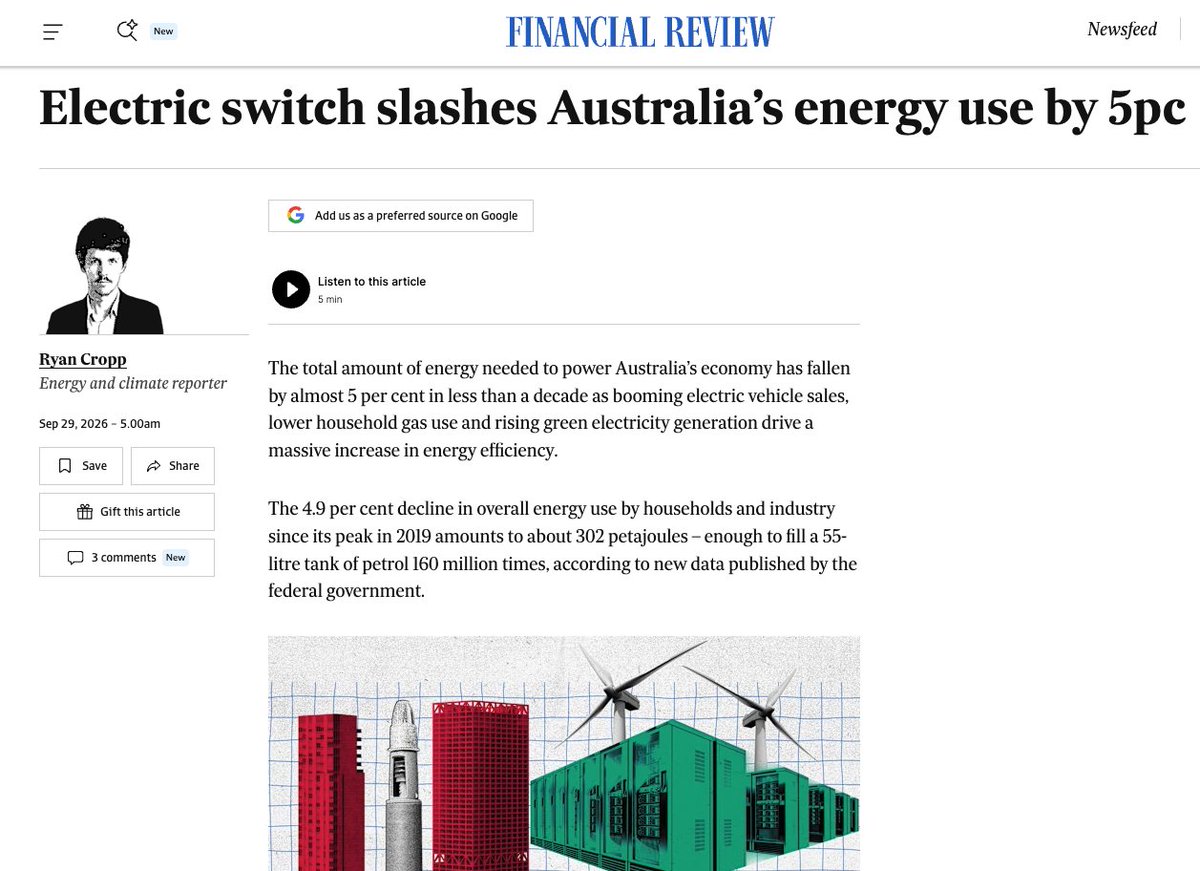
"The 4.9% decline in overall energy use by households and industry since it's peak in 2019"
coincides with:
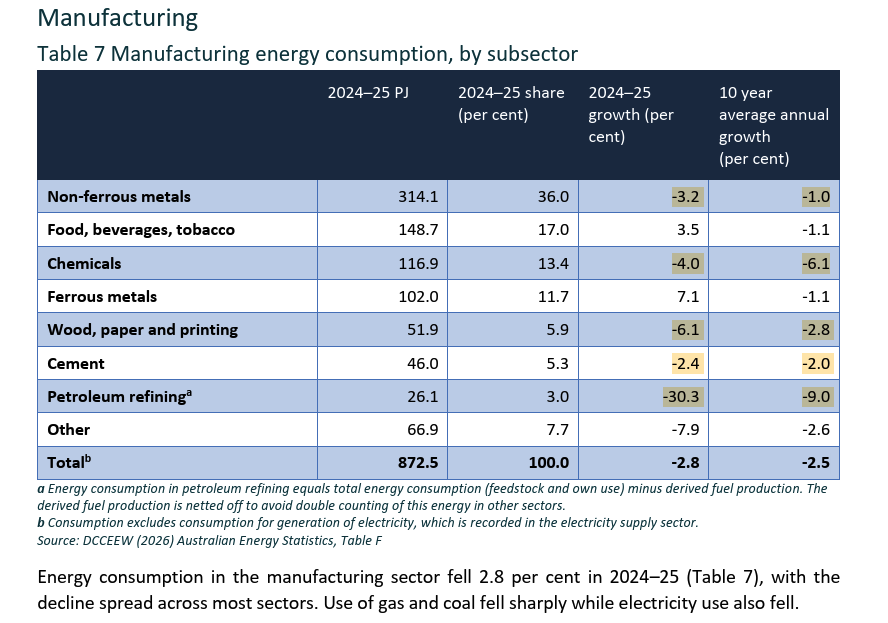
Closing two oil refineries
Closing the nickel industry
Closing an alumina refinery
Stopping producing fertiliser
Stopping producing glass
Stopping producing plastic resin
Stopping producing paper
Also in that period productivity going backwards, per-capita income in decline...
And new gas connections and some appliances being BANNED in our coldest state.
But this journalist, @ryan_cropp spins the latest figures as a good news story about the success of electrification, and gets quotes from Grattan, The Clean Energy Council, and Chris Bowen.
The column-inches are filled with cliches about electric vehicles being more efficient, and the sun not going through the Strait of Hormuz.
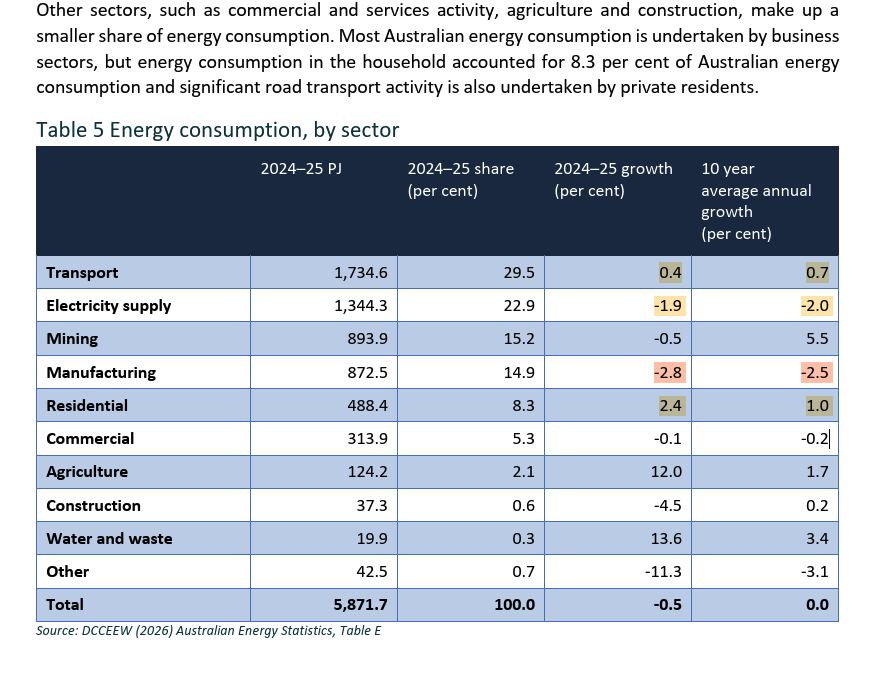
The report itself puts those into proportion. Electrification of vehicles and household heating/cooking isn't driving the decline, in fact energy consumption for households and transport have still increased, as one would expect, with a rising population.
The only thread of merit in the renewables/electrification claim is that renewable energy requires less 'energy' because the equivalent to heat-losses in combustion exhaust in fossil fuels occur on the surface of the solar panel, or vortices and turbulence off the back the turbine blades, which never get measured. So we ignore the inefficiencies in solar and wind, and claim that it captures 100% of the energy potential, which is just the electricity it produces. A meaningless game of process boundaries.
Overwhelmingly the proper reading of the facts is a story about industrial and manufacturing decline. But that's just not the story that Ryan chooses to write.
Not a single quote from an industry representative or a former employee who's lost their job. No mention of manufacturing at all.
Just all back-slaps for renewables and electrification.
Very frustrating. This is terribly biased reporting from @FinancialReview.
https://t.co/LwO9ydiQRw
Hughesy, quick one.
We've got a small restaurant in Perth. Paid our staff super every quarter for five years, in full, never missed.
Turns out the ATO counts it as paid when it hits the employee's fund, not when it leaves your account. Clearing house takes five days. We paid on the due date. So it landed five days late.
Five days late = the whole quarter counts as never paid. Then 10% interest a year on the full amount, backdated to 2021, ignoring the fact we paid.
Bill came in at $140k. Thats interest on money that's been sitting in our staff's super accounts earning for them the whole time.
Best part is there was no way to check. No report exists. You can't even get a login to the clearing house. I asked. They said employers don't get one.
Accountant says he's got other clients the same. Feels like half the small venues in the country are sitting on this.
Anyway, on a payment plan, still open, still cooking. Just gonna work a whole year and all profit goes to the ATO. Cheers
Is this fair ATO?
Milton Friedman: “I am not a conservative. I’ve never been a conservative. Hayek was not a conservative.”
“We are liberals in the true meaning of that term: concerned with freedom. We are not liberals in the current distorted sense—those liberal with other people’s money.”
In response to the clip going around with the African lady saying 'WHAT WHITE CULTURE!?!'
Because I can explain it in more detail than anyone else... here are the main things that create western civilisation.
The principle, the law of nature that is an adaptation to and what operation it creates in our civilisation.
THE WESTERN CIVILISATION STACK
Western civilisation can be understood as a set of adaptations to the laws of nature that allow millions of people to cooperate, solve problems and innovate together.
1. SOVEREIGNTY — Let people act.
Law of nature: Knowledge and ability are distributed among individuals.
No ruler or institution can know everything everyone knows. Sovereignty gives people freedom to choose, experiment and solve problems for themselves. That creates millions of independent problem-solvers instead of waiting for one authority to find the answer.
2. RECIPROCITY — Don’t impose your costs on others.
Law of nature: Cooperation survives when it benefits both sides.
Freedom cannot mean freedom to steal, defraud, injure or force others to carry your costs. Reciprocity means pursuing your interests while respecting the same right in others. It turns conflict into cooperation and makes peaceful life among strangers possible.
3. RESPONSIBILITY — Make people accountable for consequences.
Law of nature: Every action produces consequences.
Freedom works when the person making a decision also bears responsibility for its results. When people can keep the benefits of their choices while forcing the costs onto others, cooperation breaks down. Responsibility reconnects choice with consequence.
4. PROPERTY — Make control and consequences clear.
Law of nature: Resources are scarce and cannot satisfy every competing use at once.
Property establishes who controls something, who may use or exchange it, and who bears the consequences of those decisions. That reduces conflict, encourages people to improve what they possess, and makes investment and long-term planning possible.
5. TRUTH — Correct error faster than reality punishes you for it.
Law of nature: Reality does not change because we believe something false.
Truthful testimony, open criticism and evidence allow people to discover mistakes before those mistakes become catastrophes. A civilisation that can criticize and correct itself can learn faster than one that protects comforting falsehoods.
6. CONTRACT — Make cooperation possible across time.
Law of nature: Cooperation requires predictable future behaviour.
Promises backed by reputation and law allow strangers to trust one another enough to cooperate. Contract lets one person invest today because another can credibly promise performance tomorrow. That makes enormous networks of specialization, trade and investment possible.
7. RULE OF LAW — Replace arbitrary power with predictable rules.
Law of nature: People have conflicting interests, and power creates opportunities for predation.
Law provides a common procedure for resolving disputes without violence or personal rule. When rulers and citizens are both constrained by known rules, people can cooperate, invest and experiment without constantly fearing arbitrary interference.
8. DUE PROCESS — Test accusations instead of trusting authority.
Law of nature: Human beings are biased, mistaken and sometimes dishonest.
An accusation is not proof. Evidence, defense, confrontation, impartial judgment and appeal create an adversarial process for discovering error. Due process protects both society from wrongdoing and individuals from arbitrary punishment.
9. DECENTRALISATION — Let many solutions compete.
Law of nature: No one knows in advance which adaptation will work best.
Families, firms, towns, institutions and governments can try different solutions to different problems. Failures can remain local while successful solutions spread. Decentralisation therefore turns society itself into a continuous experiment.
10. MARKETS — Let reality select among competing solutions.
Law of nature: Evolution advances through variation, selection and retention.
Markets allow people to try different products, services and ways of organising resources. People select among them through voluntary choice. Successful solutions attract resources; unsuccessful ones disappear or improve. Markets turn millions of choices into continuous social learning.
11. SPECIALISATION — Let differences become advantages.
Law of nature: People differ in knowledge, ability, resources and circumstances.
Instead of everyone doing everything badly, specialization lets people become exceptionally good at different things and exchange the results. Cooperation converts human differences from a source of conflict into a source of increasing productivity.
12. SCIENCE — Institutionalise error correction.
Law of nature: A false model eventually fails when tested against reality.
Science turns doubt into a productive institution: observe, propose, test, criticize, replicate and correct. Knowledge therefore does not have to depend upon authority or tradition. Every generation can discover where the previous generation was wrong and build upon what it got right.
13. CAPITAL — Preserve successful adaptations.
Law of nature: Progress compounds only when successful adaptations survive.
Tools, businesses, infrastructure, institutions and knowledge allow yesterday’s successful experiments to become tomorrow’s starting point. Each generation does not begin again from zero. It inherits accumulated solutions and adds another layer.
14. EDUCATION — Transfer accumulated knowledge between generations.
Law of nature: Individuals die; knowledge does not have to.
Writing, schools, apprenticeships and universities allow discoveries to survive their discoverers. Instead of every generation rediscovering mathematics, engineering, medicine and law, it begins with thousands of years of accumulated learning.
15. COMMONS — Build things that make everyone more capable.
Law of nature: Cooperation can produce benefits no individual could produce alone.
Courts, roads, standards, security, scientific knowledge, infrastructure and trustworthy institutions multiply everyone's ability to act. A successful civilisation does more than protect private interests: it continually creates shared capital that makes future cooperation cheaper and more productive.
THE RESULT
These principles form a system:
Sovereignty creates experimentation.
Reciprocity makes it peaceful.
Responsibility makes it sustainable.
Property makes interests clear.
Truth corrects error.
Contract creates trust across time.
Law suppresses predation.
Decentralisation preserves alternatives.
Markets select successful solutions.
Specialisation multiplies productivity.
Science accelerates discovery.
Capital preserves what works.
Education transmits it.
Commons multiply everyone's capabilities.
That is the deeper logic of the Western stack:
Stable rules + distributed freedom + relentless error correction = cooperation at scale and accelerating innovation.
For the first time ever, EVs outsold ICE vehicles in Australia 🇦🇺
Model Y was the #1 vehicle & Tesla the #3 best-selling brand overall for the month of August
https://t.co/4gPzTnYx46
@SawyerMerritt A team of teachers to draft content and learning for my kids, software Devs to hand module prompts to grok build, a team of ui interrogation from different POV creating a free open source growing home school tool that visualises and maybe gamifies learning k-12
Bureaucracy has already throttled space exploration, and this article proposes creating a UN-affiliated 'Planetary Stewardship Council'? As a species, there are few things we actually agree upon here on Earth, so how could this possibly advance progress in space?
No. The authors incredible accomplishments aside, as a society we need fewer bureaucrats regulating tethered caps on plastic water bottles and more doers if we want to see even a glimpse of that exciting future so many of us imagined as children.
When the capabilities are there to send NASA astronauts back to the Moon and on to Mars, we will go. We will do so thoughtfully, as we always have, and we will do so for all mankind.
Whether Elon’s @elonmusk behaviour is right or wrong does not rest on the number of people who like or loathe him. 🤔
That’s her argument - and he rightly says ‘he doesn’t care’.
It is precisely because politicians (across the political spectrum) try to be popular, rather than doing what is right, that we have poor decisions made.
Leadership requires backbone.
If we are unable to accept lower housing prices as a trade off for a more robust per capita economy that benefits us in the long term
How can we choose a better path for our children, one where they struggle less and have more freedom of choice with questions like having kids.
BREAKING: The Trump administration is offering $17.5 billion in low-cost loans to help finance the construction of 10 new Westinghouse AP1000 nuclear reactors across the U.S.
"A NSW high school history teacher said some teachers had decided not to teach the Holocaust after the October 7 terrorist attacks on Israel because of heightened tensions."
Guess why?
If the Diary of Anne Frank offends a certain group in Western Sydney, the problem isn't education. It's immigration.
@skcd42 I'm seeing a bug where my pay-as-you-go limit is set and I can't top up to use grok build more. Specifically after changing the limit the page reverts to the same $50 cap. Please help.
For the past 3 weeks, I have been trying to get an op-ed published at the ABC. The suspicion has long been that the ABC is ideologically captured but when the editorial director assured Senators during the recent Estimates that ABC does publish diverse views, I said let’s see…
The median woman falls within the range considered ideal by the median man.
The median man is an inch short of what the median woman calls ideal.
n = 414k.