Liftoff.
The Artemis II mission launched from @NASAKennedy at 6:35pm ET (2235 UTC), propelling four astronauts on a journey around the Moon.
Artemis II will pave the way for future Moon landings, as well as the next giant leap — astronauts on Mars.
Karena Bulan Ramadan telah selesai Setan yang dibelenggu akhirnya dibuka kembali untuk merebut hati manusia. Maka dari itu mari kita berkenalan dengan tulisan yang menceritakan keberadaan hantu di tanah Jawa. Ada teks yang mencatat nama-nama penguasa hantu di seluruh tanah Jawa
You’ve never actually touched anything in your life. 🤯
At the atomic level, nothing ever truly touches. That feeling you get is just your brain interpreting electromagnetic repulsion between electron clouds. The object is real, but the contact is a constructed illusion.
🚨: After traveling more than 9 years and covering 3 billion miles, the New Horizons spacecraft was rewarded with this breathtaking view of distant Pluto glowing with a majestic, layered atmosphere against the void. 🌑
Confused about the 2026 engine & aero rules? 🤔
Can't miss my simulation-driven breakdown!💡
(And discover why the power drop off prevents them from exceeding 400 km/h!)
⬛️Internal Combustion Engine (ICE): 620 kW ('25) → 400 kW ('26)
🟦ERS: 120 kW ('25) → 350 kW ('26)
However, ERS power drops off from 290 km/h, reaching 0 kW at 345 km/h.
Drivers within 1s can use 'Overtake' (🟦dashed line) to keep max ERS until 340 km/h, and some power up to 355 km/h. Still ICE-only above that
Engine power must overcome 🟥Drag, which drops on straights as wings open (dashed line). The top speed (Engine power = Drag power) I've computed (~359 km/h) would NOT be impacted by Overtake mode... as the ERS power is 0kW above 355km/h anyway!
The top speed computed (Engine power = Drag power) is ~359 km/h, and Overtake doesn’t change it (0 kW above ~355 km/h)
Final (and wild) stat: with drag at ~half today's level, ICE's 400 kW (545 hp) is enough for ~360 km/h.
With unlimited ERS (400+350 kW)? They’d hit ~440 km/h!
Aero data used:
Rho: 1.225 kgm-3 (air density)
CdA: 0.77 m2 (Closed) vs 0.66 m2 (Open wings)
Kudos to @brakeboosted for giving me this idea and suggesting some very reasonable CdA values! #F1
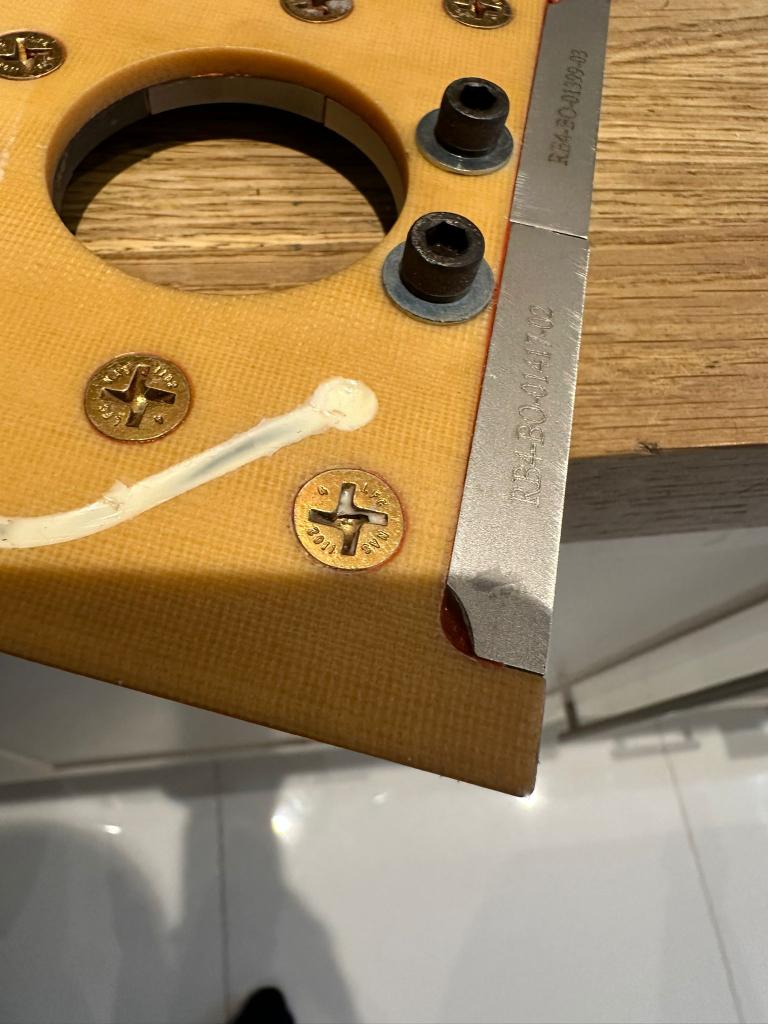
Lots of talk about #F1 plank wear, but how do teams know how much it's worn?
As with tyres, you can't directly measure it, but with a temperature sensor, you can estimate it
They put sensors in the titanium skid blocks & log the temp
Prolonged high readings indicate wear
#F1tech
R24 #F1#AbuDhabiGP 2024
FP3 telemetry analysis
🟧 vs 🟦 vs 🟥 vs ⬛️
Suffice to say - McLaren leaves everyone in the dust! In this case literally dusting off the track in S3 with supreme traction 🤯
T12-13-14 are simply a cruise in McL38, the car exhibits stellar levels of traction and cornering speeds. These are driven at apex speed of 150+ kmh, so aerodynamics is already alive and kicking in that range
As we know, McLaren adopted Red Bull's diffuser kick approach to provide peak aerodynamic downforce levels in that area. By the looks of things, McLaren is able to combine this strong rear end with tyres in the perfect window to propel the car through T12-13-14 at uncatchable pace.
On the 2nd screenshot, taken from @f1_tempo_ you can see that Piastri actually prefers an early apex into T12 and this allows him the floor it into T13 before anyone else. There are minor data errors concerning Hamilton's lap (and possibly Verstappen's, not sure) which skew the comparison of his lap. Nonetheless, McL38 is head and shoulders above the rest in S3 and it doesn't look like it will lose it come Q3
Can anyone threaten McLaren front-row lockout, what's your opinion? 🤔
I’ve spent the whole season analysing the telemetries of each #F1 session📊
I have a clear idea of the strengths and weaknesses of each car: here is my summary! What's your opinion? 👀
Read the thread for a more detailed discussion, and check my profile for daily F1 analyses!👇
Piastri is braking earlier than both Ferrari drivers into turn 8. This means he is using less pedal saturation. At Ferrari, they communicate this by telling the driver to improve “peak and release”, meaning he is not pressing the brake pedals as hard. That allows him to carry more apex speed (+6kph). This is considered the preparation for the exit, where most of the gains over the Ferrari drivers are.
Another advantage, and where most of the gains for Piastri are, is on the exit of 8. That improved peak and release allows him to get the car rotated a bit earlier, meaning he can open the throttle earlier. That's a gain of almost. 1.5 tenths.
Turn 10 Leclerc does the same thing and Sainz takes the Piastri approach. Leclerc loses time, Sainz gains time. Since the corners are in very quick succession at that point of the track, it's very easy for losses to compile, as messing up one corner quickly leads into messing up the next one.
Turn 8 was one of the corners where Ferrari bled time to McLaren. This is also applicable to turn 1, but by no means does this mean it is replicable by our drivers. Not that turn 1 & 8 are both combined braking zones. Seeing as both Ferrari driver are doing it, it suggests that it might be a limitation or a setup choice making them drive like this.
That is a 3 tenth gain from simply optimizing the approach to two corners. It's a very small change in approach, probably a lot harder to execute than simply pointing it out like I am doing.
Terima kasih atas sambutan yang luarbiasa yang telah diberikan kepada saya. Semoga Tuhan memberkati kalian dan membuat kalian terus bertumbuh dan bertahan dalam kedamaian dan kasih persaudaraan.