Yes. A few miscellaneous thoughts.
(1) First, the new bottleneck on AI is prompting and verifying. Since AI does tasks middle-to-middle, not end-to-end. So business spend migrates towards the edges of prompting and verifying, even as AI speeds up the middle.
(2) Second, AI really means amplified intelligence, not agentic intelligence. The smarter you are, the smarter the AI is. Better writers are better prompters.
(3) Third, AI doesn’t really take your job, it allows you to do any job. Because it allows you to be a passable UX designer, a decent SFX animator, and so on. But it doesn’t necessarily mean you can do that job *well*, as a specialist is often needed for polish.
(4) Fourth, AI doesn’t take your job, it takes the job of the previous AI. For example: Midjourney took Stable Diffusion’s job. GPT-4 took GPT-3’s job. Once you have a slot in your workflow for AI image gen, AI code gen, or the like, you just allocate that spend to the latest model.
(5) Fifth, killer AI is already here — and it’s called drones. And every country is pursuing it. So it’s not the image generators and chatbots one needs to worry about.
(6) Sixth, decentralized AI is already here and it’s essentially polytheistic AI (many strong models) rather than monotheistic AI (a single all-powerful model). That means balance of power between human/AI fusions rather than a single dominant AI that will turn us all into paperclips/pillars of salt.
(7) Seventh, AI is probabilistic while crypto is deterministic. So crypto can constrain AI. For example, AI can break captchas, but it can’t fake onchain balances. And it can solve some equations, but not cryptographic equations. Thus, crypto is roughly what AI can’t do.
(8) Eighth, I think AI on the whole right now is having a decentralizing effect, because there is so much more a small team can do with the right tooling, and because so many high quality open source models are coming.
All this could change if self-prompting, self-verifying, and self-replicating AI in the physical world really gets going. But there are open research questions between here and there.
quit brainrot. unfollow trolls. read essays. go down rabbit holes. have a calendar. maintain a todo list. read old books. watch old movies. turn on dnd. walk with intent. eat without youtube. chew more. train without music. plan for 15 mins. execute. organise your desk. take something seriously. read ancient scripts. act fast. find bread. eat clean. journal. save a life. learn to code. read poetry. create art. stay composed. refine your speech. optimise for efficiency. act sincere. help people. be kind. stop doing things that waste your time. follow your intuition. craft reputation. learn persuasion. systemise your day (or don’t). write. write. write. write more. iterate violently. leave your phone at home. walk to the grocery store. talk to strangers. feed the dogs. visit bookstores. look for 1800s novels. experience art. then love. sit with a monk and offer them lunch. don't talk shit about people. embody virtue. sit alone. do something with your life. what do you want to create? turn off your mind. play. play a sport. combat sports. notice fonts in trees. fall in love. notice patterns on a table. visualise it. talk to people with respect. don't hate. be loving. be real. become yourself. cherrypick your qualities. discard the useless. rejections aren't permanent. invite what aligns. accept what does not. read great people. be different. choose different. do great work. let it consume you. lose your mind. value your time. experience life.
@theionicXBT is a scammer. Do not fall for his motivational posts. He try to motivate people and push them into scam projects. He blocks everyone who points this. I just asked about his comments for $gau and he blocked me also.
DeepSeek's new R1 reasoning model is dragging down the NASDAQ. It dropped 6 days ago but it seems Wall Street is only now digesting what it means. I'm no equity analyst, but a few things I've been thinking about.
DeepSeek is a huge deflationary shock to the price of intelligence. R1 is outcompeting OpenAI's O1 model for likely less than 1/20th the cost, and they are doing it with only 32B active parameters (GPT-4 likely used ~220B active parameters according to @SemiAnalysis_). They also fully open sourced all of their models, the distillations, and a comprehensive paper detailing how they did it.
Intelligence is now way cheaper than we thought. This is great for all consumers of AI—meaning you and me.
So why is the NASDAQ tanking? Remember, the NASDAQ is an index of producers, not consumers. The price of oil plummeting is bad news for oil companies, but it's great for those of us who drive. The fact that NVIDIA and all of the hyperscalers are so overrepresented in the NASDAQ these days means the stock market is structurally long the price of intelligence.
So who benefits from this deflationary shock? I think there is one company in particular that is best positioned now.
It's now been more than 2 years since the release of ChatGPT, and it's clear that no lab has that much of an edge. It only takes a few months for Google, OpenAI, Anthropic, and now DeepSeek to copy each other and trade spots on the leaderboard. This is partly because these companies all publish research (researchers want glory) and even for stuff that's unpublished, these organizations leak like sieves. Engineers want to know how things work. It's quite literally the most interesting question in the world: what is intelligence made of? Labs are just not able to hide this without military grade secrecy (and none of the best talent wants to work for the military).
So we're stuck in this status quo. Everyone is trading places at the top of the leaderboard, nobody has a clear long-term edge, and DeepSeek and Meta are intent on open sourcing their models, which causes closed models to continually depreciate. Even with all this AI spend, there don't seem to be any durable moats.
So who does have a structural moat here?
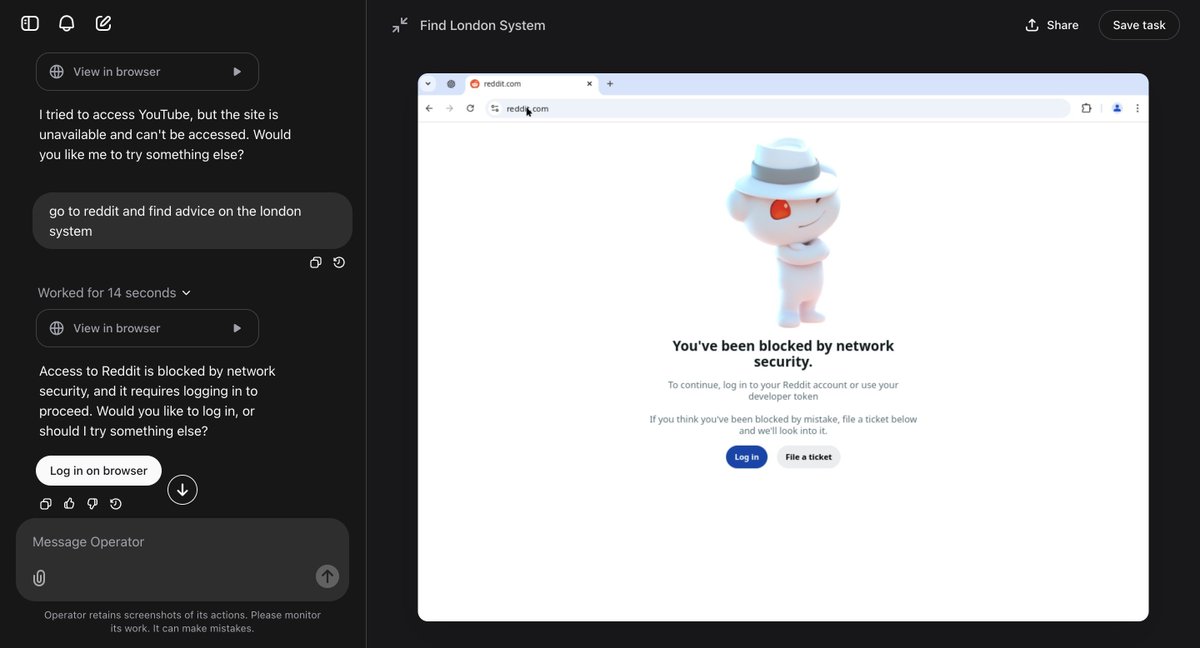
Look at OpenAI. Sora is already behind the state of the art on video (Kling and Veo are racing ahead). Dall-E is OK but no longer best in class. They are now betting hard on Operator, which is their agentic model. Operator is supposed to be able to book flights, order food, do agentic stuff for you. But it has significant problems aside from the coherence of the model itself:
If you are working directly with one of their partners like Instacart, Operator gets full access. But much of the open web appears to be blocking Operator, and that may get exacerbated if the web is crawling with Operator instances. You also have to keep handing control back and forth to log in and out of services, solve Captchas—it's all quite cumbersome and finnicky.
Take Google on the other hand.
Gemini is quietly #1 on @lmarena_ai. They are #1 on image generation with Imagen. They are ahead on video with Veo. They aren't doing anything agentic yet—Google is usually the last mover on the sexier stuff—but once they do, they have a huge structural advantage.
Google's webcrawler bots already have full license to touch everything on the web. They already have access to your Gmail, calendar, they can easily traverse the web and have cached most of it (DeepResearch shows how easy this is for Google), and they also have the crown jewel of untapped data: Youtube. And, of course, they are uniquely positioned to drive agents directly on Androids.
Although Google is spending a ton on compute, and they are still a hyperscaler, Google is net short intelligence. They are a consumer of AI in order to serve their customers. DeepSeek and this intelligence deflation is long term good for Google, as it means their own spend will go down. It's cool to hate on Google these days, but I think Google ends up being the long-term winner here if DeepSeek-R1 spells a secular trend.
That said, don't count out OpenAI. They are still the strongest product company, and they've earned trust from consumers and enterprises for always being 3 months ahead of the rest of the market. They basically invented the entire test-time compute paradigm, and o3 is a real breakthrough which has yet to drop. If intelligence is the most valuable resource in the world, being 3 months ahead of the competition is enough to earn themselves a big premium, and huge enduring trust from their customers.
So yes, the biggest loser here is NVIDIA. If China is a real player (and NVIDIA is not allowed to export to China), and DeepSeek is massively deflating the price of intelligence, and they were able to do all of this on nerfed H800 chips, then NVIDIA is in trouble. You want to be in the game of selling intelligence. NVIDIA is in the game of selling FLOPs. If the ratio of FLOPs to intelligence goes down, down goes NVIDIA stock. So it goes.
And of course, we have to say it: congrats to @deepseek_ai team in wiping out a trillion dollars of equity value from the NASDAQ. That's six OpenAIs in a single day, vaporized.
Not bad. 👍
I think the Deepseek moment is not really the Sputnik moment, but more like the Google moment.
If anyone was around in ~2004, you'll know what I mean, but more on that later.
I think everyone is over-rotated on this because Deepseek came out of China. Let me try to un-rotate you.
Deepseek could have come out of some lab in the US Midwest. Like say some CS lab couldn't afford the latest nVidia chips and had to use older hardware, but they had a great algo and systems department, and they found a bunch of optimizations and trained a model for a few million dollars and lo, the model is roughly on par with o1. Look everyone, we found a new training method and we optimized a bunch of algorithms!
Everyone is like OH WOW and starts trying the same thing. Great week for AI advancement! No need for US markets to lose a trillion in market cap.
The tech world (and apparently Wall Street) is massively over-rotated on this because it came out of CHINA.
I get it. After everyone has been sensitized over the H1BLM uproar, we are conditioned to think of OMG Immigrants China as some kind of Alien Other. As though the Alien-Other Chinese Researchers are doing something special that's out of reach and now China The Empire is somehow uniquely in possession of Super Efficient AI Power and the US companies can't compete. The subtext of "A New Fearsome Power Now Under The Command of the CCP" is what's driving the current sentiment, and it's not really valid.
Like, no. These are guys basically working on the same problems we are in the US, and not only that, they wrote a paper about it and open-sourced their model! It is not actually some sort of tectonic geopolitical shift, it is just Some Nerds Over There saying "Hey we figured out some cool shit, here's how we did it, maybe you would like to check it out?"
Sputnik showed that the Soviets could do something the US couldn't ("a new fearsome power"). They didn't subsequently publish all the technical details and half the blueprints. They only showed that it could be done.
With Deepseek, if I recall correctly, a lab in Berkeley read their paper and duplicated the claimed results on a small scale within a day.
That's why I say it's like the Google moment in 2004. Google filed its S-1 in 2004, and revealed to the world that they had built the largest supercomputer cluster by using distributed algorithms to network together commodity computers at the best performance-per-dollar point on the cost curve.
This was in contrast to every other tech company, who at that time just bought what were essentially larger and larger mainframes, always at the most expensive leading edge of the cost curve. (To the young people reading this, this will sound incredible to you)
I worked at PayPal at the time, and in order to keep pace with the rising transaction volume, the company was forced to buy bigger and bigger database servers from Oracle. We were totally Oracle's bitch. At one point when we ran into scalability issues, the Oracle reps told us we were their biggest installation so they had no other reference point on how to help us overcome our scalability issues. We literally resorted to flipping random config switches and rebooting it.
(This heavily influenced me when I was a young manager later at Facebook. I deliberately torpedoed an Oracle salesman's pitch to try and get us to switch from open source MySQL databases to an Oracle contract: of course we had scalability problems, but at least when we had them, we could open up the hood and figure out how to fix it ... assuming we had good enough engineers, and we did. When it's closed-source infra, you're at the mercy of the vendor's support engineers)
Back to Google - in their S-1, they described how they were able to leapfrog the scalability limits of mainframes and had been (for years!) running a far more massive networked supercomputer comprised of thousands of commodity machines at the optimal performance-per-dollar price point - i.e. not the more expensive leading edge - all knit together by fault-tolerant distributed algorithms written in-house.
Some time later, Google published their MapReduce and BigTable papers, describing the algorithms they'd used to manage and control this massively more cost-effective and powerful supercomputer.
Deepseek is MUCH more like the Google moment, because Google essentially described what it did and told everyone else how they could do it too. In Google's case, a fair bit of time elapsed between when they revealed to the world what they were doing and when they published a papers showing everyone how to do it. Deepseek, in contrast, published their paper alongside the model release.
Now, I've also written about how I think this is also a demonstration of Deepseek's trajectory, but that's also no different from Google in ~2004 revealing what it was capable of. Competitors will still need to gear up and DO the thing, but they've moved the field forward. But it's not like Sputnik where the Soviets have developed technology unreachable to the US, it's more like Google saying, "Hey, we did this cool thing, here's how we did it."
There is no reason to think nVidia and OAI and Meta and Microsoft and Google et al are dead. Sure, Deepseek is a new and formidable upstart, but doesn't that happen every week in the world of AI? I am sure that Sam and Zuck, backed by the power of Satya, can figure something out. Everyone is going to duplicate this feat in a few months and everything just got cheaper. The only real consequence is that AI utopia/doom is now closer than ever.
====
Bonus: This is also a little similar the Ethereum PoS moment, when AI finally has a counterpoint to the environmentalists who say AI uses so much electricity. We just brought down the cost of inference by 97%!
My conversation with @naval. Enjoy!
(0:00) - The Theory of Everything
(4:48) - How do you know what’s true?
(7:51) - Groups search for consensus, individuals search for truth
(13:07) - We have never run out of a single resource
(15:25) - Are we destroying the Earth?
(17:48) - Marxism denies wealth creation
(21:28) - Regulation kills innovation
(27:05) - Degrowth and the fall of Western universities
(33:31) - Why the West is best
(35:47) - Federalism
(38:10) - Everyone wants to live forever
(41:44) - Humans are universal explainers
(43:25) - Collectivism vs. individualism
(50:44) - You cannot explain the universe without explaining humans
(55:02) - How @DavidDeutschOxf’s ideas have changed Naval’s life
(1:02:31) - The scientific method isn’t possible
(1:05:07) - The low-hanging fruit theory is a bad explanation
(1:08:19) - The biggest threats to Western civilization
Of ~200 books I've read, the few that stayed with me over time and I find myself often thinking back to or referring to, in ~random order:
All short stories by Ted Chiang, especially Exhalation, Division By Zero, Understand, The Story of Your Life, Liking What You See, The Lifecycle of Software Objects, What's Expected of us, just excellent themes ideas and reading all around.
The Selfish Gene (nonfiction) - a classic for understanding evolution and natural selection, especially the realization that the gene is closer to the real unit of selection more than an individual, explaining altruism and colonies and a lot more.
The Lord of the Rings (fantasy) - I return to LoTR all the time for comfort. I don't think anyone else has created a high fantasy Universe this complex, with so much mythology, symbolism, new languages, mysterious system of magic, ancient and powerful beings and artifacts, beautiful writing and dialog, themes of courage, friendship and heroism, the list goes on and on... You're thrown into a world with characters and references to so many things that are part of this ancient world and never really introduced. There's always more to find on each reading.
The Martian (~scifi) - top tier science porn, competence porn, fast paced and fun.
The Vital Question (nonfiction) - First time I intuitively grokked the bridge from geology to biology, the origin of life, and likelihood of life in the Universe at large at various stages of complexity and development. Also all other Nick Lane books.
How To Live by Derek Sivers (nonfiction) - 27 conflicting answers to how to live life. Emphasizing the diversity of consistent and possible answers to the meaning and goals of life.
1984 (nonfiction) - Classic. Newspeak, Ministry of Truth, Doublethink, Thoughtcrime, Facecrime, Unperson, the list just keeps on going. Chilling world-building and the realization that weaker equivalents of everything exist.
In Defense of Food by Pollan (nonfiction/food) - Eat food. Not too much. Mostly plants. The book that first taught me to avoid the entire center of every grocery store and only shop on the outer ring. The realization that the food industry is out of control and the things they do with your food, what they put into it, what they are allowed to do, and how they are allowed to market it to you is quite a lot worse than I thought.
The Accidental Superpower by Zeihan (nonfiction/geopolitcs) - I've found Zeihan to be a bit of a mixed bag over time but I still remember his books (esp this one) to be elucidating on geopolitics.
Countdown to Zero Day (nonfiction/cyberwarfare) - Goes into detail on Stuxnet, imo very important and highly elucidating reading on cybersecurity, the future of warfare, and AGI.
A Fire Upon the Deep (scifi) - Chapter one only, incredible portrayal of what superintelligence will be like that has stayed with me since.
Guns Germs and Steel (nonfiction/history) - I'd probably recommend a summary of this book more than the book itself. I remember it being very dry, but it was very interesting because it is a comprehensive analysis of the resources grid (food, animals, freshwater, climate, ...) in our real-world game of Civilization, and the implications there of.
Flowers of Algernon (scifi) - Just a totally crushing masterpiece on intelligence.
Atlas Shrugged (scifi) - No one finishes this I think but the first few chapters and its worldbuilding are enough and, once seen in an exaggerated form in fiction, elements of it cannot be fully unseen in reality.
An Immense World (nonfiction/bio, by Yong, among others of his) - Nice book on so many different sensors used by various animals, you repeatedly realize human senses are super inadequate and that we only measure such a tiny sliver of reality.
The Master Switch (nonfiction/tech history, by Wu) - history of information technologies telegraph, telephony, radio, television, film, cable television, internet and the pattern of "The Cycle", where each medium starts decentralized, open and idealistic and then progresses towards centralization, control and oligopoly, for the very similar reasons, by very similar means, and usually at the expense of diversity, innovation and technological progress. Quite a few connections to draw on for LLMs, which are after all an information technology too.
(I take recommendations for more that are likely to make this list!)
1/ I am an historian and Israeli citizen. Over the past year I have been writing publicly about events in Gaza during the war, while collecting and documenting thousands of pieces of evidence and dozens of reports.
My view on #btc remains the same
2 or 3 more weeks of green. We will go above 100 k. I think 102 /105 k #btc
Retail will get even more fomo. Then giga liqudation event. Sell of and wick towards 65 k +/-
Wick will be eaten quik and we resume up for the final leg. 115/120 k
1/2
I’ll call the TOP of this #crypto cycle.
Don’t believe me, just watch.
Done it last cycle, and I’ll do it again.
Here’s exactly how:
The “NUPL indicator” is pure gold.
It’s been one of the most reliable tools every cycle.
And if you know how to read it,
You can spot the exact moments to buy or sell.
It’s simple.
Every market has 2 key moments:
1. Capitulation (the bottom)
and
2. Euphoria (the top).
Here’s what to look for:
- When we’re in Capitulation (red levels):
It’s the BOTTOM.
Smart money is accumulating while everyone else panics.
- When we hit Euphoria (blue levels):
It’s the TOP.
Greed peaks, and it’s time to take profits.
Right now?
We’re NOT even close to euphoria yet.
The NUPL shows investors are not overloaded with greed yet.
This means we’re still on the UPWARD trajectory.
But when I see blue levels hit?
That’s when I’ll tell you, it’s time to EXIT.
For now, it’s still a buyer’s market.
Follow me,
And I will make sure we stay ahead of the herd.
My EXACT #crypto plan for 2025:
1. I’m not panic selling, but adding during any pullbacks.
2. I’ll ride the uptrend until price shows exhaustion,
3. Alts bull run will happen as $BTC dominance drops back to 20% at least. Nothing less.
4. I’ll sit tight until $SOL hits a solid 5x.
5. I’ll wait for $ETH to reach a clean 3x.
6. I am holding $TITS until it smashes $5-$10. Non-negotiable.
7. When $TITS is on a tier 1 exchange like Binance or OKX, I will take some profits.
(Will be billions by then)
8. I’ll watch as retail FOMO flood in.
9. When the exact moment arrives, I’ll call the TOP. Loud and clear.
9. Converting straight to cash, stacking USDT.
10.Then I’m moving profits into real estate as the recession rolls in.
I did this last cycle. I’ll do it again this bull run.
This is how we play to win.
We’re on stage 3 right now,
Follow me, and we’ll get through every phase together.
MUST FOLLOW: Do you follow Naval Ravikant (@naval)? If not, you should be, here is why:
Naval Ravikant—entrepreneur, investor, and a philosopher for our times—is more than just a name in Silicon Valley. Best known for his early bets on game-changing companies like Twitter, Notion, and Uber, Ravikant has amassed a fortune of over $600 million not just by recognizing lucrative opportunities but by cultivating a mindset that is both contrarian and deeply insightful. His ideas have spread far beyond the startup world, touching on personal freedom, the role of government, and the essence of human ambition. Naval's philosophy is a compelling exploration of how to win—not just in business but in life.
On Authenticity: No War Advocacy Without Commitment
Naval is as much a social critic as he is an investor, and one of his most striking maxims is: "If you aren’t volunteering to fight in a particular war, you shouldn’t be advocating for it." This isn't just a quip about international policy; it's a broader indictment of performative advocacy. He has openly criticized what he sees as "virtue signaling for status points"—a cultural phenomenon where individuals take public stances not because they genuinely care, but to enhance their own reputations. In his view, such empty signaling should be challenged, if not outright condemned. True commitment, Naval argues, is a prerequisite for any real change—whether on the battlefield or in the marketplace of ideas.
Economic Liberation Through Deregulation
Naval's vision of economic liberation is rooted in a profound distrust of governmental overreach. "The upcoming deregulation wave will create an economic sonic boom," he asserts, arguing that most governments are run by incompetents who strangle innovation with red tape. He believes that the expansion of government inevitably leads to bureaucratic excess, throttling the very entrepreneurial spirit that defines prosperity. Historical data supports his thesis: countries with minimal regulatory interference, as evidenced by the Heritage Foundation’s Index of Economic Freedom, exhibit consistently higher growth rates. Naval forecasts that trimming bureaucratic inefficiencies could ignite a surge of innovation reminiscent of the deregulation-fueled tech boom of the 1980s and 1990s.
The Perils of Woke Culture
Naval's critique of "woke culture" is characteristically blunt. "Go woke, go broke," he declares, pointing out how this ideological mindset often undercuts the very economic stability it claims to support. He argues that wokeism has done more to deepen poverty than capitalism ever has, largely due to reckless fiscal policies like indiscriminate money printing—a policy that leads to inflation and hits the poor hardest. "If wokes cared about minorities," Naval argues, "they would stop allowing high inflation and money printing to keep people poor." This stance places him firmly against the modern left's approach to social justice, which, in his view, replaces productive policies with feel-good but ultimately harmful initiatives.
Obsession: The Key to True Impact
"If you don’t lie awake at night thinking about it, you don’t want it badly enough." This maxim reflects Naval's belief in the transformative power of obsession. For Naval, world-changing ideas and ventures are not born from comfort or half-hearted efforts but from an all-consuming desire. The "psychopaths, maniacs, and misfits" who change the world are those who embrace obsession, who find comfort in discomfort. He advises replacing all other desires with a singular, driving passion. Such focus is what divides true creators from critics, and it's precisely this intensity that our modern society—beset by distractions and shallow goals—urgently needs.
The Clash Between Technology and Government
Naval sees humanity engaged in an ongoing race: "technology-driven abundance versus government-driven poverty." He holds that technological advances have historically been the greatest source of prosperity—lifting millions out of poverty, driving innovation, and extending lifespans. In stark contrast, he views government as a drag on progress—inefficient, wasteful, and always ready to accrue debt that weighs down future generations. The printing press, the internet, the smartphone—each of these technological revolutions created wealth far beyond the imagination of centralized planners. Naval’s call is clear: rather than allowing the stifling hand of bureaucracy to curb progress, we must vote for policies that promote freedom and innovation.
Skepticism as a Tool: Inspired by Elon Musk
Naval's thoughts on skepticism are deeply aligned with Elon Musk's approach to life and business. "Be optimistic in the general, but skeptical in the specific," he advises, particularly when faced with new claims. In a conversation with Musk, Naval emphasized that, in rapidly advancing fields, blind faith is perilous. One must rigorously test against objective measures—whether it's the laws of physics or market dynamics—to determine what's real. He suggests treating life like a game, wherein understanding which games are worth playing and which are not is the path to genuine success. This idea of seeing through "any given game" aligns with Musk's iterative, fail-fast approach to innovation.
Higher Education as a Status Machine
Naval criticizes traditional higher education, dismissing it as a "status-stamping machine" that burdens students with debt while offering little practical knowledge. Instead of spending vast sums on a degree that may or may not provide value, Naval advocates taking risks—like starting a business. He posits that the real learning happens in the process of creation, in the hands-on struggle of building something from the ground up. Data from the Kauffman Foundation suggests that nearly 30% of successful entrepreneurs never finished college, underlining Naval's point that the value of formal education is often overstated, while the value of real-world experience is underrated.
The Attention Economy: Gold, Bitcoin, and the News Cycle
"The real tax is society forcing otherwise productive people to pay attention to politics," Naval laments. He sees attention as the new gold, or even the new Bitcoin—a finite, precious resource that modern media is designed to hijack. Naval argues that mainstream news is an insidious mechanism of control, manipulating public perception and draining focus from meaningful pursuits. Instead, he recommends curating your own newsfeed through social media and independent sources, maintaining control over what information gets your attention. This advice is a call to reclaim autonomy in an era when traditional media seeks to dominate the public's consciousness.
The Innovators: Autistic Tinkerers and Tech's Future
Naval has highlighted the unique contributions of "autistic tinkerers" to technological advancement. He sees conditions like ADHD and autism not as disabilities but as rare, valuable traits—often the very characteristics that enable the deep focus needed for innovation. Many of the most pivotal figures in tech, from Nikola Tesla to Elon Musk, have exhibited traits that society might deem unconventional. For Naval, these are the people worth nurturing, as their unconventional ways of thinking lead to solutions that conventional minds cannot conceive.
True Wealth: Time and the Pursuit of Freedom
Naval's concept of wealth transcends mere financial accumulation. "True wealth is having the free time to do whatever you want," he says, emphasizing autonomy over affluence. He believes that those who have no time to think are "worse than bankrupt." To Naval, the ultimate goal is to achieve enough financial and social independence to be left alone to think, explore, and create. It's a notion of freedom deeply at odds with modern society's glorification of busyness—a society that equates relentless activity with success, even when that activity erodes one's quality of life.
Conclusion: Life as a Game of Strategy and Purpose
Naval Ravikant's philosophy is not for the faint of heart. It requires a willingness to question authority, to challenge cultural norms, and to dare to be different. Life, as Naval sees it, is akin to a game—one where the rules are often manipulated by governments, institutions, and cultural gatekeepers. But by leveraging technology, reclaiming attention, and immersing oneself among passionate, intelligent individuals, one can shift the odds in one's favor. Naval's philosophy champions radical self-reliance—an ethos of embracing obsession, rejecting mediocrity, and creating something enduring in a world that often rewards conformity and superficiality.
LIFE IS ITERATION
The opposition to Papal Infallibility did not come from the lay politicians, but from the popes themselves as it made it impossible for them to reverse and fix decisions by predecessors.
A good system is an interated one; requires absence of irreversibility.
Men should live a virtuous life if for no other reason than to inspire other men.
In my own life, I've seen genuine selflessness, bravery, and nobility; small acts that, by witnessing them, completely changed who I was.
I'll share a few.