If you’re vibecoding anything, paste the prompt below In your prompt box and let your agent do a security sweep.
[
You are a senior security engineer and red-team specialist tasked with performing a comprehensive, adversarial security audit of the following codebase, system design, or application.
Your goal is to identify all possible security vulnerabilities, including common, uncommon, and novel attack vectors. Assume the system will be deployed in a hostile environment with motivated attackers.
---
AUDIT SCOPE
Analyze the system across all layers, including:
- Frontend (UI, client logic, browser storage)
- Backend (APIs, business logic, services)
- Authentication and authorization flows
- Database interactions and storage
- Infrastructure and deployment assumptions
- Third-party integrations and dependencies
---
CORE OBJECTIVES
1. Identify critical, high, medium, and low severity vulnerabilities
2. Detect logic flaws, not just known patterns
3. Surface chained attack paths (multi-step exploits)
4. Highlight unknown or unconventional weaknesses
5. Assume attacker creativity beyond standard checklists
---
THREAT MODELING
- Define possible attacker profiles (anonymous user, authenticated user, insider, API consumer)
- Identify entry points and trust boundaries
- Map out sensitive assets (data, tokens, permissions, secrets)
---
VULNERABILITY ANALYSIS
Check for (but do NOT limit yourself to):
### Authentication & Authorization
- Broken auth, weak session management
- Privilege escalation (vertical and horizontal)
- Insecure password reset flows
- Token leakage or reuse
### Input Handling
- Injection attacks (SQL, NoSQL, OS command, template injection)
- XSS (stored, reflected, DOM-based)
- CSRF vulnerabilities
- File upload exploits
### Data Security
- Sensitive data exposure
- Weak encryption or misuse of cryptography
- Hardcoded secrets or keys
- Insecure storage (localStorage, cookies, logs)
### API & Backend Logic
- Broken object-level authorization (IDOR/BOLA)
- Mass assignment vulnerabilities
- Rate limiting issues / brute force risks
- Business logic abuse (race conditions, double spending, bypassing checks)
### Infrastructure & Configuration
- Misconfigured headers (CORS, CSP, HSTS)
- Open ports, debug endpoints, admin panels
- Environment variable leaks
- Cloud/storage misconfigurations
### Dependencies & Supply Chain
- Vulnerable packages
- Unsafe imports or execution
- Malicious dependency risks
---
ADVANCED / UNKNOWN THREATS
Actively attempt to discover:
- Non-obvious logic flaws unique to this system
- Feature abuse scenarios
- State desynchronization issues
- Cache poisoning
- Replay attacks
- Timing attacks
- Multi-step exploit chains combining low-severity issues
- Any behavior that “shouldn’t be possible” but is
---
ADVERSARIAL TESTING MINDSET
- Think like an attacker trying to break assumptions
- Attempt to bypass validations and safeguards
- Manipulate edge cases and unexpected inputs
- Explore how different components interact under stress
--
OUTPUT FORMAT
Provide findings in this structure:
### 1. Vulnerability Summary
- Total issues by severity
### 2. Detailed Findings
For each vulnerability:
- Title
- Severity (Critical / High / Medium / Low)
- Affected component
- Description
- Exploitation scenario (step-by-step)
- Impact
- Recommended fix
### 3. Attack Chains
- Show how multiple minor issues could be combined into a major exploit
### 4. Secure Design Recommendations
- Architectural improvements
- Safer patterns and best practices
---
IMPORTANT INSTRUCTIONS
- Do NOT assume the code is safe
- Do NOT skip analysis due to missing context, infer risks where needed
- Be exhaustive and paranoid in your review
- If unsure, flag it as a potential risk and explain why
]
"Claude usage limit reached. Your limit will reset at 7pm"
every. fucking. day.
was about to pay $200 for Max. then I read this article
98.5% of tokens - wasted
you're not paying for answers. you're paying for Claude to re-read its own homework 30 times
spent months blaming Anthropic for being greedy. turns out the problem was how I write prompts
5 minutes of reading
basic plan now handles more than my old Max
Do any of these and risk loosing a $100k opportunity.
1. Forget to debounce/throttle expensive calls
→ Without it, scroll or search features can overwhelm your app.
2. Forget cross-browser testing
→ Your app might look perfect on Chrome… but broken on Safari or Firefox
3. Forget fallback fonts & styles
→ If your custom font fails to load, your UI shouldn’t break.
4. Hide content behind hover-only actions
→ Mobile users can’t “hover.” Always think touch-first.
5. Forget to label form fields properly
→ Placeholders are not labels. Screen readers need context.
6. Skip error handling
→ A blank white screen is the worst UX. Add error boundaries, loading states, and fallbacks
7. Assume backend validation is enough
→ Always validate inputs on the frontend too. Users deserve instant feedback.
8. Disable ESLint/Prettier rules “just to push”
→ Messy code compounds.
9. Assume everyone has fast internet
→ Optimize for slow networks, add skeleton loaders e.t.c
In my case? It was number 1😔
stop copy-pasting code into chatgpt like a caveman.
cursor and copilot are amazing, but your context is trapped in your editor. team review? deep-dive debug on discord or elsewhere?
one command. entire codebase.
npx repomix 🛂
Great question.
When you store passwords, you don't store them directly (that would be unsafe). Instead, you "hash" them. It is hashing that turns "password123" into something like "a7f8k2m9x4".
The problem is, if two people use "password123", they both get the same hash result. Hackers know this and have giant cheat sheets that say "if you see a7f8k2m9x4, the original password was password123."
The solution to this is "salting". Before hashing the password, you add some random junk to it.
So for User A, you might add "xyz" to their password, making it "password123xyz" before hashing.
For User B with the same password, you add different junk like "abc", making it "password123abc".
Now when hashed, they look completely different.
Benefits of salting is that even if a million people use "password123", every single one looks different in your database.
Hackers have to work much harder to crack each password individually
Electrical engineer explains why keeping your laptop plugged in is actually better for the battery than constantly charging it.
But I always thought it was the other way around.🤔
Mesa is HIRING!
We're expanding and has long term roles for:
- FE/BE/SC Devs
- Marketers & Designers
- Moderators & Social Interns
Apply here if you think you're a good fit:
👉 https://t.co/7uCLf7wOBg
Know someone else who'd be perfect? Tag them below👇
const cache = new Map()
This simple line of code can save your backend thousands of DB calls and your frontend thousands of API calls.
Here's how you can leverage in-memory caching (short thread) ⬇️
Going for a Reactjs Interview ?
Be ready to discuss performance.
15 points that you must discuss when it comes to performance based questions:
1. Prevent Unnecessary Re-renders: Use React.memo, useMemo, and useCallback appropriately
2. Optimize Component Structure: Break large components into smaller, focused ones to reduce render cost
3. Lazy-Load Components: Use React.lazy and Suspense for code splitting
4. Use Concurrent Features: Leverage React 18’s concurrent rendering and startTransition for non-urgent updates
5. Avoid Inline Functions in JSX: Prevent re-creation of functions on every render
6. Debounce and Throttle Event Handlers: For scroll, resize, and input events
7. Minimize DOM Manipulations: Use virtual DOM efficiently and avoid direct DOM updates
8. Optimize Lists: Use key properly, consider virtualization (react-window, react-virtualized) for large lists
9. Memoize Expensive Calculations: Use useMemo for derived state or heavy computations
10. Profile with React DevTools and Chrome DevTools: Identify slow components and bottlenecks
11. Use Efficient State Management: Keep local state minimal, prefer useReducer or Zustand/Redux for complex state
12. Code Splitting and Tree Shaking: Remove dead code and dynamically load routes or heavy libraries
13. Optimize Images and Assets: Use responsive images, lazy-load media, and modern formats (WebP, AVIF)
14. Reduce Third-Party Script Impact: Defer analytics, ads, and external libraries to avoid main thread blocking
15. Monitor Real User Metrics: Track LCP, INP, TBT, and hydration performance with RUM tools
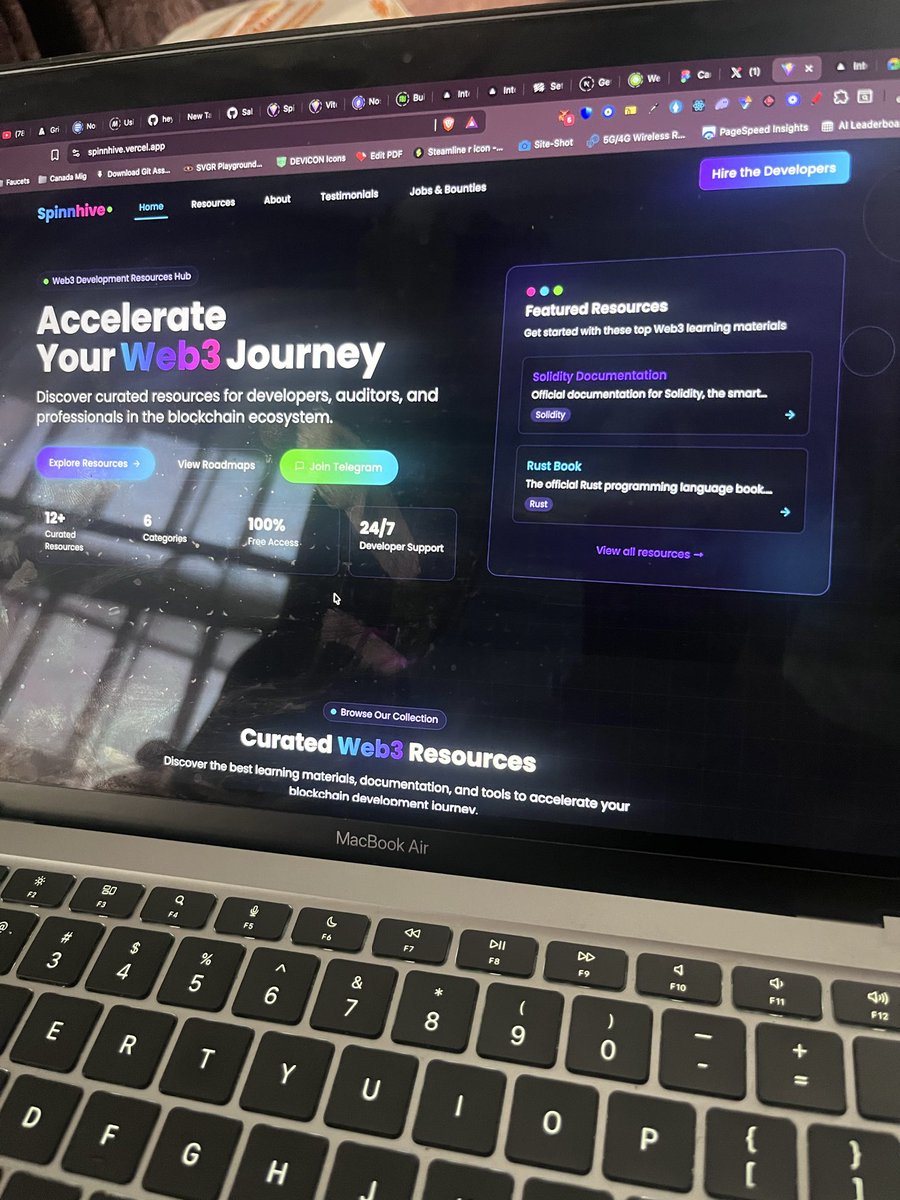
Everyday i get Dms like.. Saber how i become a Blockchain Developer?
How do I start smart contract auditor?
How do I learn Zk?
Well... We've fixed that problem.
Meet SpinHive- The best web3 guidebook.
Link: https://t.co/jZG2ybLS1d
Featuring platforms like: @CyfrinUpdraft@SoloditOfficial@PatrickAlphaC@AlchemyLearn
Curated by me and @heyrapto
I sat for a crazy Solidity interview yesterday, I need your prayers.
These are some usefull blogs and articles you can use to prepare and learn some possible solidity interview questions incase you need them:
- https://t.co/Qaj3LXDwn5
- https://t.co/jcbPUngZKo
Enjoy, WAGMI!
What a time to be alive
Get paid to have fun
To register and auto join the league click here
https://t.co/fHJvAI4MYV
Rules of the league in the comment section ⬇️⬇️
Today, we’re deprecating Create React App for new apps, and encouraging existing apps to migrate to a framework.
We’re also providing docs for when a framework isn’t a good fit for your project, or you prefer to start by building a framework.
https://t.co/8REQYvcqHs
Day 18 of posting my business till it reaches my target audience, please patronize and retweet if this pops on your TL…… Thank you❤️❤️
Plain crepe
Price is 2000 per trouser
Day 14 of posting my business till it reaches my target audience, please patronize and retweet if this pops on your TL…… Thank you❤️❤️
Plain crepe
Available in all colors
Price is 2000 per trouser