Express Investigation:
A fund meant for India’s top athletes was used to upgrade sports facilities for bureaucrats - by bureaucrats.
🏊 Heated swimming pools
🎾 Tennis courts
🏸 Officers’ clubs
All funded through National Sports Development Fund (NSDF).
https://t.co/kZRYaLa6ug
The more enterprises I talk to about AI agent transformation, the more it’s clear that there is going to be a new type of role in most enterprises going forward. The job is to be the agent deployer and manager in teams. Here’s the rough JD:
This person will need to figure out what are the highest leverage set of workflows on a team are (either existing or new ones) where agents can actually drive significantly more value for the team and company.
In general, it’s going to be in areas where if you threw compute (in the form of agents) at a task you could either execute it 100X faster or do it 100X more times than before. Examples would be processing orders of magnitude more leads to hand them off to reps with extra customer signal, automating a contracting review and intake process, streamlining a client onboarding process to reduce as many straps as possible, setting up knowledge bases than the whole company taps into, and so on.
This person’s job is to figure out what the future state workflow needs to look like to drive this new form of automation, and how to connect up the various existing or new systems in such a way that this can be fulfilled. The gnarly part of the work is mapping structured and unstructured data flows, figuring out the ideal workflow, getting the agent the context it needs to do the work properly, figuring out where the human interfaces with the agent and at what steps, manages evals and reviews after any major model or data change, and runs and manages the agents on an ongoing basis tracking KPIs, and so on.
The person must be good at mapping the process and understanding where the value could be unlocked and be relatively technical, and has full autonomy to connect up business systems and drive automation. This means they’re comfortable with skills, MCP, CLIs, and so on, and the company believes it’s safe for them to do so. But also great operationally and at business.
It may be an existing person repositioned, or a totally net new person in the company. There will likely need to be one or more of these people on every team, so it’s not a centralized role per se. It may rile up into IT or an AI team, or live in the function and just have checkpoints with a central function.
This would also be a fantastic job for next gen hires who are leaning into AI, and are technical, to be able to go into. And for anyone concerned about engineers in the future, this will be an obvious area for these skills as well.
Another week on the road meeting with a couple dozen IT and AI leaders from large enterprises across banking, media, retail, healthcare, consulting, tech, and sports, to discuss agents in the enterprise.
Some quick takeaways:
* Clear that we’re moving from chat era of AI to agents that use tools, process data, and start to execute real work in the enterprise. Complementing this, enterprises are often evolving from “let a thousand flowers bloom” approach to adoption to targeted automation efforts applied to specific areas of work and workflow.
* Change management still will remain one of the biggest topics for enterprises. Most workflows aren’t setup to just drop agents directly in, and enterprises will need a ton of help to drive these efforts (both internally and from partners). One company has a head of AI in every business unit that roles up to a central team, just to keep all the functions coordinated.
* Tokenmaxxing! Most companies operate with very strict OpEx budgets get locked in for the year ahead, so they’re going through very real trade-off discussions right now on how to budget for tokens. One company recently had an idea for a “shark tank” style way of pitching for compute budget. Others are trying to figure out how to ration compute to the best use-cases internally through some hierarchy of needs (my words not theirs).
* Fixing fragmented and legacy systems remain a huge priority right now. Most enterprises are dealing with decades of either on-prem systems or systems they moved to the cloud but that still haven’t been modernized in any meaningful way. This means agents can’t easily tap into these data sources in a unified way yet, so companies are focused on how they modernize these.
* Most companies are *not* talking about replacing jobs due to agents. The major use-cases for agents are things that the company wasn’t able to do before or couldn’t prioritize. Software upgrades, automating back office processes that were constraining other workflows, processing large amounts of documents to get new business or client insights, and so on. More emphasis on ways to make money vs. cut costs.
* Headless software dominated my conversations. Enterprises need to be able to ensure all of their software works across any set of agents they choose. They will kick out vendors that don’t make this technically or economically easy.
* Clear sense that it can be hard to standardize on anything right now given how fast things are moving. Blessing and a curse of the innovation curve right now - no one wants to get stuck in a paradigm that locks them into the wrong architecture. One other result of this is that companies realize they’re in a multi-agent world, which means that interoperability becomes paramount across systems.
* Unanimous sense that everyone is working more than ever before. AI is not causing anyone to do less work right now, and similar to Silicon Valley people feel their teams are the busiest they’ve ever been.
One final meta observation not called out explicitly. It seems that despite Silicon Valley’s sense that AI has made hard things easy, the most powerful ways to use agents is more “technical” than prior eras of software. Skills, MCP, CLIs, etc. may be simple concepts for tech, but in the real world these are all esoteric concepts that will require technical people to help bring to life in the enterprise.
This both means diffusion will take real work and time, but also everyone’s estimation of engineering jobs is totally off. Engineers may not be “writing” software, but they will certainly be the ones to setup and operate the systems that actually automate most work in the enterprise.
Stripe is worth $159 billion now. Like Bezos and Buffett, the Collison 'way of building a business' will create trillions in value and is worth studying.
800-word post on:
1. Craft & Beauty
2. Humility
3. Hiring
4. Culture
5. Decisions
1. On craft & beauty,
You can work on something you're not proud of for 2 years. You can't do it for 30.
Beauty has a practical function most people miss. When we go to a city or building that's beautiful, there's generosity in that construction. You never meet the architect, but it's a gift they've bestowed on us. Products are no different.
And craft has another function that might matter even more: it's the single best way to attract extraordinary people. The best people consider themselves craftspeople, and above almost all else, they want to work alongside other craftspeople.
Put bluntly: really good people don't enjoy working on shitty things.
2. On founder humility,
Think carefully about what's cool and what's high status, and then make sure not to do that.
Once you're succeeding, the real danger begins. Success breeds complacency. Other people are studying what you built and looking to replicate it. You can always be a month away from losing your business.
The antidote is simple but uncomfortable: stay close to reality. Every week at Stripe's leadership meeting, they hear directly from a customer. It's not an A-plus scorecard every time. That's the point. It prevents you from getting delusional.
And when you see a smart person holding a view that's different from your own, rather than figuring out how they're wrong, try to figure out how they're right.
3. On hiring,
Think like a value investor. You're not looking for the best resume. You're looking for human capital the market has significantly underpriced.
It took Patrick and John a full year to get to four people. No group will ever shape your company more than your early hires. When hiring anyone, ask: will I like the 50 people they hire?
Prioritize rate of learning over everything. Over a decade, fast learners obliterate credentialed hires. It's not even close.
For senior hires, one question: can they get you where you need to be in four years, in two?
4. On culture,
Stripe's moat isn't technology or process or perks. It's that the people there genuinely care about solving the problems they say they're solving. That's rarer than it sounds.
Care for the customer's problem, executed with craft and rigor. A culture that prizes small details and careful abstraction.
And an operating rhythm that keeps it honest: micro pessimism, macro optimism. Everything is terrible today. Total conviction it'll be fantastic in two years.
That tension is what keeps generational companies from getting comfortable.
5. On decisions,
Make twice as many decisions at half the precision. That's almost always better than the alternative. You'll never have perfect information and you don't need it. Make the call, move forward, course correct if you're wrong. You pay a far larger price for paralysis than for mistakes.
For co-founder disputes, one simple rule: whoever cares more carries the decision. Deeper conviction wins.
These ideas have shaped how we build Gamma and 1000s of others.
@patrickc@collision
The elephant in the room is that the public (educated or otherwise) expects this kind of loutish & extortive behaviour from investigative agencies in India. There is a reason it works so well here. Cos those we expect to protect us are the most exploitative. The scale of this loot is actually a comment on our agencies and people's trust in cops, its not a comment on the general public.
India's most horrifying picture 👇
Policemen rape small tribal girls, then kill those girls and dress them in Naxalite uniforms and earn applause.
This video has come from Bastar. Must read the report of social worker Himanshu Kumar
“The policemen kept small tribal girls with them day and night for several days and made them sleep among them. They tried to gain fake applause in the country by killing him by dressing him in Naxalite uniform. After the coming of BJP government in Bastar, Chhattisgarh, suddenly the process of killing tribals has started.
BJP is trying to tell the country that a lot of work is being done to eliminate Naxalites. But the reality is that innocent tribals are being caught while plucking tendu leaves or women at home while threshing paddy, taken to the forest, raped and shot.
Tribal social activist Soni Sori says that BJP has appointed tribal Chief Minister in Chhattisgarh only for show. In reality, its aim is to destroy the tribals and allow the capitalists to take over their lands.
@abhisar_sharma@vinodkapri@bainjal@_sayema@dhruv_rathee
The good thing about the clever, kinda well read, kinda successful & kinda well spoken Indian sophisticates is their belief they're 'self made'. If it wasn't for social access most of us including me would be sitting in a waiting room hoping for an interview. Self made is a myth
🚨BRAINWASH ALERT🚨
BJP has nothing left to offer to people so they are trying hard to scare us Indians by spreading multiple fake news -
❌Congress will implement Sharia Law - CM Adiyanath
❌ Congress will redistribute your wealth to minorities - PM Modi
❌ Congress will bring inheritance tax - HM Amit Shah
*All these claims are 100% fake.*
BJP’s top leadership is not just trying to confuse or distract you anymore—they are straight-up LYING to you. Congress manifesto mentions none of this. Lets have a look at what Congress Manifesto actually promises us-
✅Congress will provide jobs by filling up 30 lakh vacancies in govt posts. (Page 30 of Manifesto)
✅Congress will not increase any tax on middle class throughout its term (Page 31 of Manifesto)
✅Congress will support small businesses so all the nation’s resources don’t get sold to billionaires like Adani (Page 28 of Manifesto)
You can read the manifesto yourself and check it. It is in fact Modi’s policies like Electoral Bonds which have stolen the wealth from people of India and given it to billionaires. That’s why you will not find any similar promise in BJP’s manifesto.
Do not get BRAINWASHED
☑️ Share this message with all your friends and family so they can make an informed decision.
Jai Hind 🇮🇳
Is this not a loot ?
21,000cr in the name of minimum balance
8000Cr rupees in the name of Additional ATM transaction
6000Cr rupees have been collected from the general public in the name of SMS service
It was a matter of bringing black money,Wasn't about robbing white money
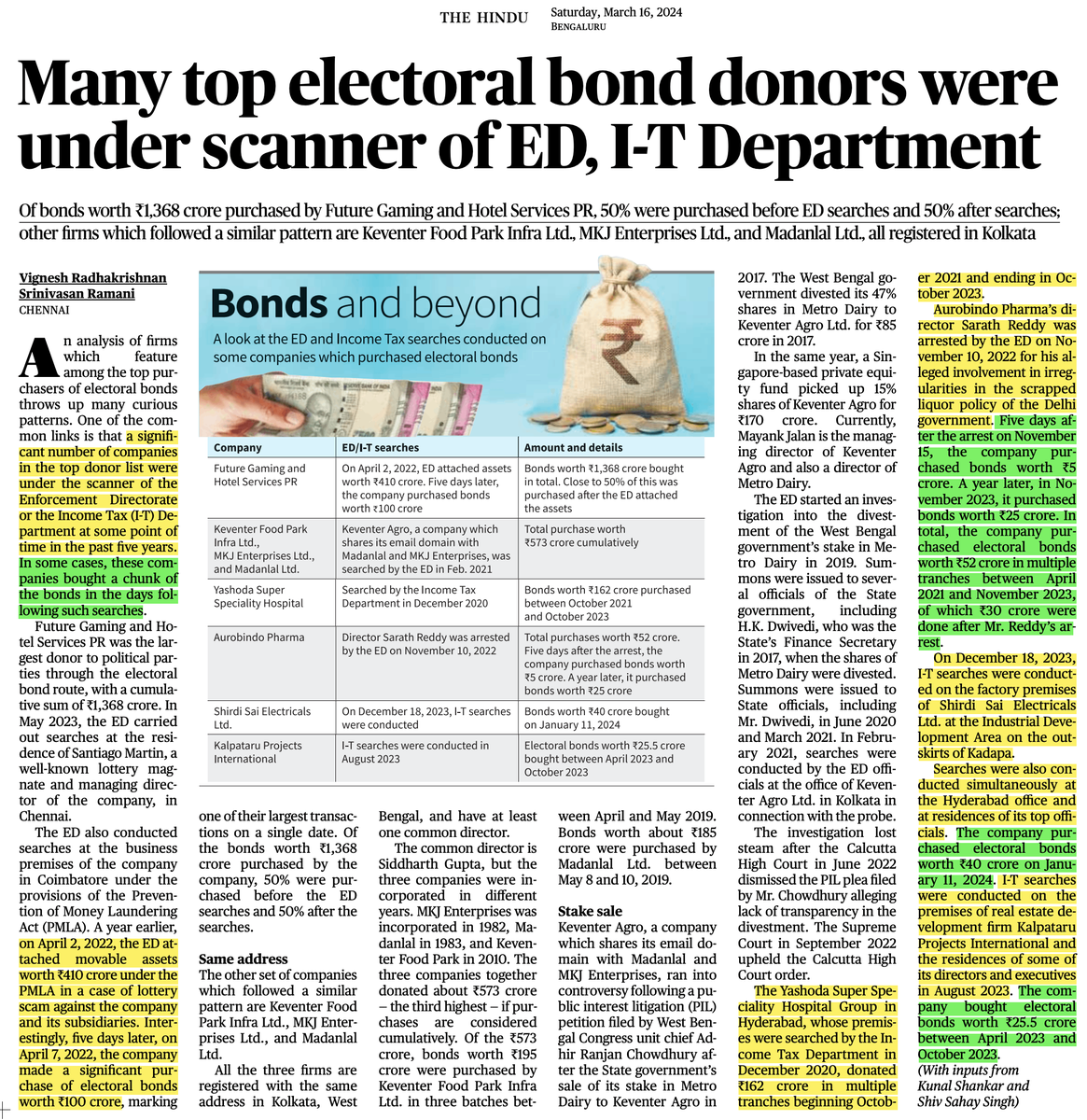
Oh, man... what a massive, massive organized, legalized (now illegal), and process-oriented extortion racket using (abusing, really) Central institutions and treating them as puppets!
—Santiago Martin:
April 2, 2022: ED attaches movable assets worth ₹410 crore.
April 7, 2022: Purchases electoral bonds worth ₹100 crore.
—Yashoda Super Speciality Hospital Group:
December 2020: IT search.
October 2021 to December 2023: Donates ₹162 crores.
—Aurobindo Pharma:
November 10, 2022: Director Sarath Reddy arrested by the ED.
November 15, 2022: Company purchased bonds worth ₹5 crore. November 2023: Purchased bonds worth ₹25 crore.
—Shirdi Sai Electricals Ltd:
December 18, 2023: IT search.
January 11, 2024: Company purchased electoral bonds worth ₹40 crore.
—Kalpataru Projects International:
August 2023: IT search.
April 2023 to October 2023: Company bought electoral bonds worth ₹25.5 crore.
The list published today by ECI is incomplete without assesing the tally of benefits those industrialists received from the govt before or after the donation.
Giving industrialists free hand to plunder India in return for donations is horrific 😯
A thread compiled by CA Himank Singla on #ElectoralBondsCase 👇
1) Wonder Cement Limited
My article on the Economies of Tamil Nadu and Uttar Pradesh…🙏 to @frontline_india for keeping it outside their paywall.
For the last 5 years, Per capita growth in UP has been ~2% lower than TN.
If it were to miraculously become 2% higher EVERY year, it would still take 60+ years for the average person in UP to reach the TN average.
Such disparity is not desirable for either those in UP, or those in TN. Or indeed for any Indian.
https://t.co/ixsUeWC7gR
2 per cent of Tamil Nadu lives in poverty compared to almost 12 per cent in Gujarat and almost 23 per cent in Uttar Pradesh. Despite being roughly equal in per capita income, those living under the Dravidian Model in Tamil Nadu fare much better than those under the Gujarat Model
Omg guys, someone recently tried to scam me with UPI.
I was at my parents'. My dad and I had just discussed about maturing investments and what to do next with it.
He had just left the house.
I get a call from some guy who said he got my number from my dad...