Attending this event in Gurgaon filled me with immense pride in being a Kashmiri Pandit. ❤️
Our people have endured so much, yet our culture, traditions and spirit continue to live on.
Proud of my roots. Proud of my heritage. 🕉️❤️ #kashmir#KPL
Such a fine & beautifully-told story of Kashmir ‘Sath Te Satisar',The opera was a powerful narrative that bridged ancient heritage with the present day.Hats-off to Yemberzal Foundation,directors Sh.Bihari Kak & Sh Kamal Razdan & writer Prof Farooq Fayaaz for the spectacular show!
The loudest voices stoking fears about AI dangers have made tremendous headway in the past two weeks. AI technology has not taken some unexpected, dangerous turn, but the hype around it — propelled by what appears to be a well orchestrated PR campaign — has drummed up considerable fear. I worry that it represents a setback for our field.
I have written frequently that fears of AI are overhyped. AI’s capabilities can be uncannily human-like and unpredictable, and it’s rational to worry when people who are directly involved express concerns. But I see the problems as a sign of the engineering work that ahead, rather than insurmountable barriers or the sky falling. AI technology continues to advance — which is a good thing! — but technical advances, poorly understood by the public, give those who seek to generate hype repeated opportunities to do so.
First, I don’t see any step up in the risk of human extinction from AI compared to a few months ago. The theories about this remain the same fantastical, science fiction scenarios as a few months ago. The biggest change in AI risk is its cybersecurity capabilities — a topic which we should take seriously — but this, too, will not lead to the end of the world.
The most notable recent event leading to increased fear was when an OpenAI team deployed an agent swarm that hacked into Hugging Face. Much of the popular press contained significant hype. For example, some publications reported that a swarm of 1,200 agents carried out the attack. While this was technically accurate, as I write this, I have about 1,300 processes running on my laptop. Yes, the ability to get large swarms of agents to work in parallel on a task is a significant technical advance, And, in computing, many processes run at the same time. So this shouldn’t be seen as some magical capability.
Additionally, OpenAI’s buggy sandboxing and monitoring processes were key to enabling this incident. Fixing these bugs and putting in place improved monitoring would be appropriate fixes, not pausing AI. There are many well known ways to attack software systems. The main advantage of AI agents is that they are relentless. They will tirelessly try many tactics — and have the patience to chain vulnerabilities together — that previously would have taken an infeasible amount of human effort. But in the long term, I believe the advantage will lie with defenders (because they have more information with which to identify bugs, which they can fix), but the cyber-threat landscape has changed significantly. There are still bottlenecks to identifying and exploiting a vulnerability. AI agents still have to try a lot of things to see what works, and taking these actions takes time and might be detected by defenders. This is why, even though it is now easy to obtain versions of leading open weight models that have had their guardrails removed or weakened, so they will not refuse to try to execute cyber attacks, the world has not ended.
I am also concerned about the anthropomorphization of AI in a lot of reporting, where LLMs and agents are unnecessarily treated as if they were people. If I wield a hammer, miss a nail, and accidentally dent the wall, it’s not the fault of the hammer. The problem lies in how I used the hammer. Similarly, if I prompt an agent and it hacks into someone else’s system, the responsibility lies with me, not the agent.
Of course, we want to build systems that are as safe and predictable as possible. (For example, an unsafe hammer would be one whose head randomly flies off under normal use.) Today’s agentic systems are not predictable, but I see no reason why, by applying sound engineering practices, we won’t be able to make them extremely safe to use. One new element in the forecasts of AI-enabled doom is AI companies disclaiming responsibility for their own products. “I didn’t do it; my out-of-control agent did!” There’s a balance to be struck between the responsibility of the tool maker and the tool user, but when something goes wrong, let’s hold the people building and/or using the hammer responsible, rather than the hammer. (By the way, if you’re worried about AI bioweapon risk, David Bellamy has a great post on why this, too, is overhyped. Briefly, the bottleneck in building a bioweapon is not intelligence, but lab work and manufacturing.)
Pausing AI progress will create much more harm than benefit. First, our adversaries will certainly not slow down. Second, engineering requires discovering problems empirically so we can fix them. If we pause AI by a decade, we will also delay finding and implementing safety engineering fixes by about the same duration.
Of course, the incentive to stoke fears — for regulatory capture, to garner attention, or to make one’s technology seem more powerful — remains the same as before. Disclaiming responsibility is a new one. Taking a hard technical look at the actual risks however, I see little factual basis for the degree of fear that’s been stoked up. We still have hard research and engineering work ahead to improve AI safety, but the beneficial applications continue to vastly outweigh the risks, and we should keep building.
[Original text (with links): https://t.co/jni2tWazAH ]
ORBIT ACHIEVED. 🚀
Vikram-1 Test Flight-1 has reached orbit. India's first privately developed orbital rocket has completed its final burn and injected its payloads into a ~450 km orbit, making India the third country in the world with private orbital launch capability.
History is made. 🇮🇳
#Vikram1 #JourneyToOrbit #SkyrootAerospace
Existence itself is a miracle - the rest is science.
There is no single meaning to existence - if there were, we’d be slaves to it.
Within existence, there are rules of logic and science. If it was magic, the world would be un-navigable.
Truly the best of all possible worlds.
The move to understand AI, it's global implications and the ability to keep the AI lights on around the world without reliance on particular global companies or nations has come back to the forefront with the recent activity around allowing models or phasing their rollouts.
"Sovereignity" is again a key topic.
1. Layer 0 - Sovereignity of location, easy to achieve.
2. Layer 1 - Hardware (has to be bought by global companies but can be deployed and managed locally.
3. Layer 2 - Staffing - can use locals to staff.
4. Layer 3 - Services and in the future AI models (usually delivered by global cloud and AI players) - this is where the challenges begin, what tradeoffs do you need to make, can you run services independently of the mother ship? Or can you build them locally - usually creates a technological delta in innovation, usually local companies are scarce at this layer and some tradeoffs are needed for innovation and scalability.
5. Layer 4 - Applications - Can usually be built and maintained locally, as long as they are needed only in the local context.
6. Layer 5 - Data - This can also be segregated and held locally and can be restricted from global movement.
The risks arrive in the services layer and associated tradeoffs, application isolation, especially if companies are global in nature originating out of the sovereign state. Ultimate sovereignity also causes a resilience issue - requires a backup outside the country.
But there is a strong use case for nation state services, classified data and local services with citizen data.
Looking forward to @valarian and Max taking on the problem.
Imagine a fable 5 quality model that’s 3-4x less expensive in less than 6 months. And an Opus 4.8 grade model that can run on a local device in less than 12 months. Greater than 50% chance that these events will happen. Worth keeping in mind when you make predictions about the future.
In 2012, a 19-year-old aeronautical engineering student from Coimbatore presented propulsion research at a NASA event. Dr. APJ Abdul Kalam noticed, sought him out for a meeting, and handed him a recommendation letter with one challenge: prove your concept.
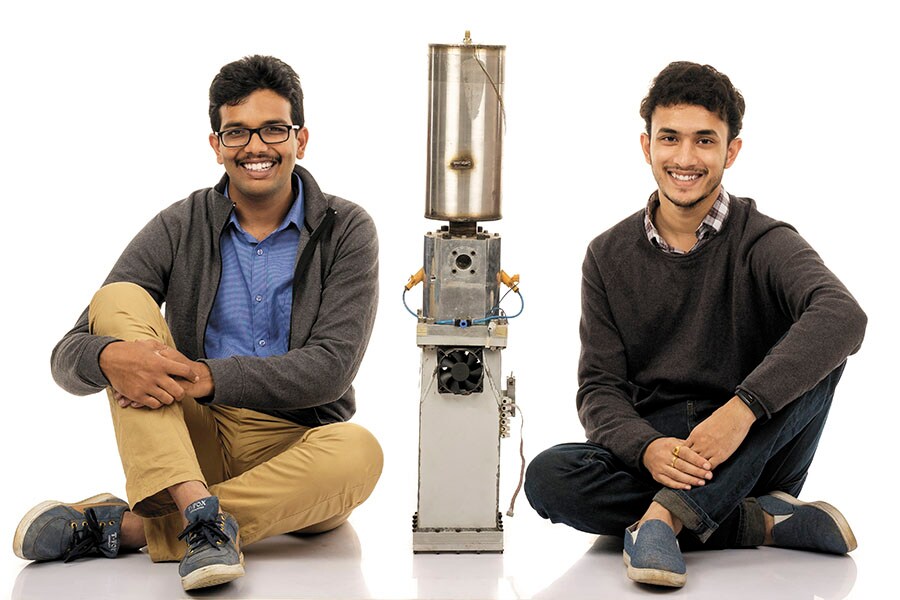
That student was Rohan M. Ganapathy. Three years later, he and family friend Yashas Karanam co-founded Bellatrix Aerospace from IISc's incubation lab in Bengaluru. The problem they chose to solve touches every satellite in orbit.
Nearly all satellites run on hydrazine, a propellant that has been standard since the 1960s. It is deeply toxic, carcinogenic, and so hazardous that it requires specialized crews and loading facilities near the launch site. India imports all of it. Nobody was building an alternative.
Bellatrix built two. Rudra is India's first high-performance green propulsion system, delivering hydrazine-equivalent thrust while cutting handling costs by over 60%.
Jal is a microwave plasma thruster that uses water as propellant, which Bellatrix claims is the world's first such system built by a private company. Both have been tested in orbit: Rudra fired on ISRO's POEM-3 in January 2024, and again on POEM-4 in January 2025.
Their third product, Pushpak, is an orbital transfer vehicle the company says can bring satellite deployment costs from $45,000 to $25,000 per kilogram. In October 2024, Bellatrix signed an MoU with ISRO's commercial arm, NewSpace India Limited, to integrate Pushpak into its launch missions. The company has raised $31 million to date, backed by BASF Venture Capital, Inflexor Ventures, and Cactus Partners.
For India, a domestic green propulsion stack means less dependence on imported hydrazine, lower costs for Indian satellite startups, and export-ready technology in a global market actively moving away from toxic fuels.
Kalam asked Rohan to prove his concept. More than a decade later, the proof has been fired in orbit.
@rohanooty@BellatrixAero@YashasKaranam
after close to four years at @openai, i moved from the bay area to india earlier this year. i still believe deeply in ensuring true superintelligence accelerates science and remains accessible and beneficial to all. having grown up here, i've also always felt deeply connected to the ecosystem here.
over the past several weeks, i've been speaking with researchers, engineers, and thinkers across india and apac. it's become clear that there are many who want to build the future from here. moving back felt like the counterintuitive choice. i no longer think that's true.
what's been missing is the belief that you can build institutions of global consequence from anywhere. and more importantly, the ambition and the will to pursue ideas that seem impossibly large at first. this may be a once in a generation opportunity.
more to come soon. DMs open if this resonates.
launching silk mulberry 1.5
one of the fastest multilingual voice models in the world
it matches the best voice models in quality benchmarks (MOS)
all this at more than 95% lower cost ₹0.40/min (~$0.0046/min)
try now 👇
When God has a plan…
From selling bhatura chole at Vivek Public School in 1989,
to opening Lawrence Garden Banquet from the back of my house in Amritsar in 1990.
In 1991, I chose culinary arts—
a decision that embarrassed almost everyone except my grandmother.
There were years of humiliation I rarely speak about.
Moments that nearly broke me.
In 2000, when my banquet was torn down, I almost gave up.
Instead, I moved to the United States and started over.
Cleaning homes.
Selling food on the streets of TriBeCa.
Sleeping at Grand Central.
Experiencing homelessness at NYC Rescue.
Sleepless nights.
Being called “Curry Boy” on the 7 train.
And still, I kept going.
From there…
8 Michelin stars.
Then losing myself again.
Then starting over—one last time as a promise to my sister—with Bungalow.
And now…
TIME100 Most Influential People in the World 2026.
I’m still trying to process it.
The journey continues.
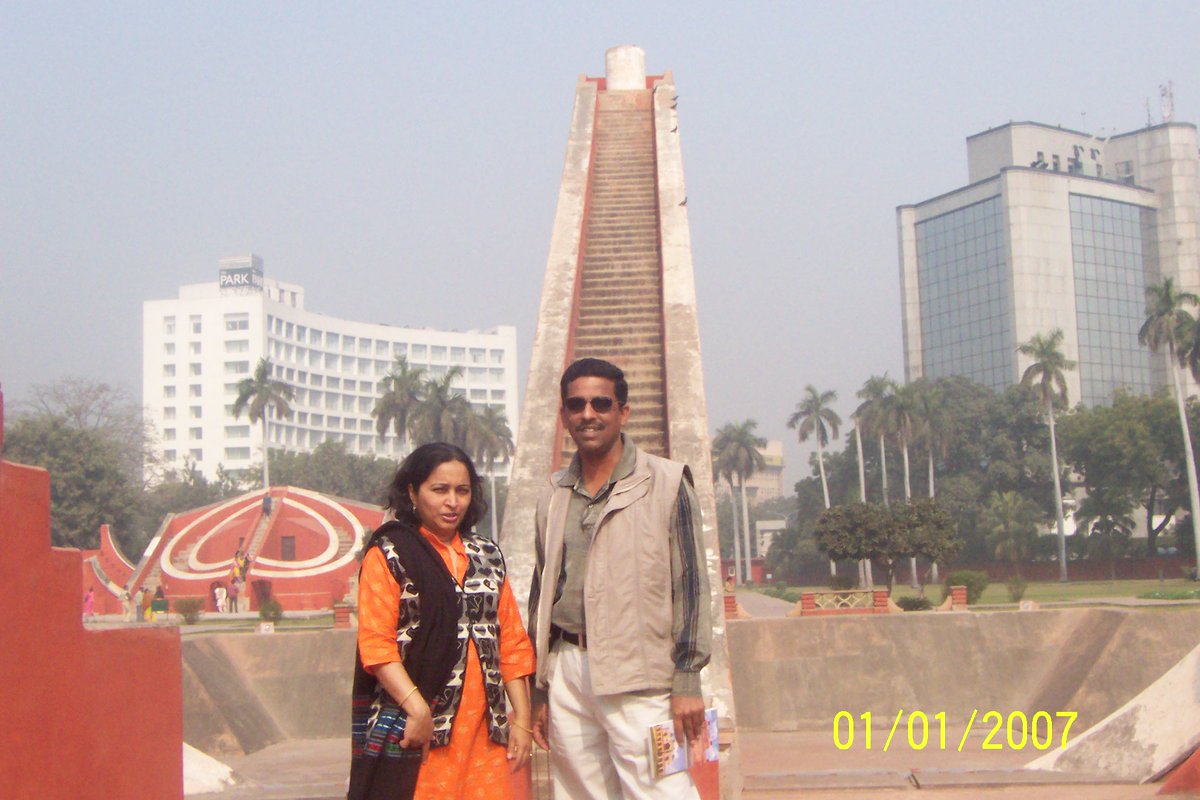
Twenty years in Delhi!
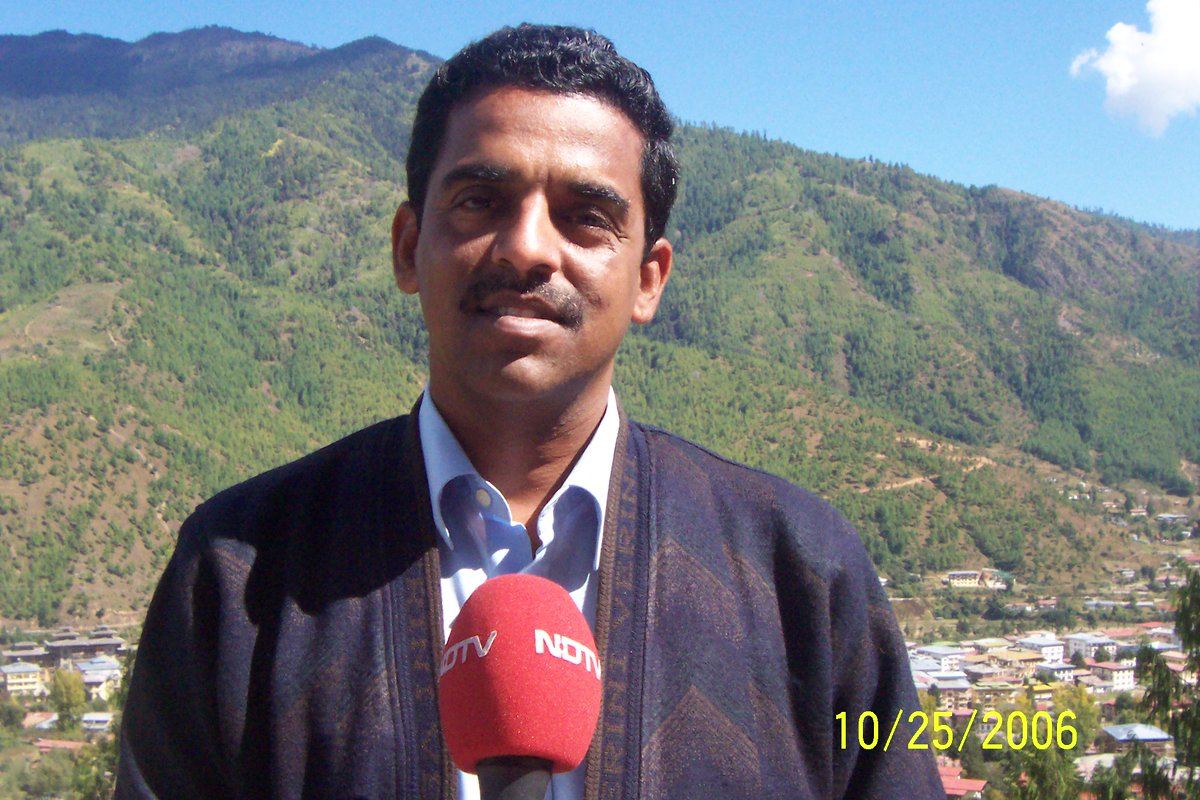
Two decades ago today, I arrived in Delhi to join NDTV as its Security and Strategic Affairs Editor. After spending 23 years reporting the then turbulent north-east, based in Guwahati, everything was new to me. The city, the medium and the rough and tumble of competitive journalism in the country’s capital. Used to a more gentle, easy-going professional and personal life in Guwahati, Delhi was, to be honest, a shock.
Not that I didn’t anticipate the hardship. I had after all decided to take the plunge in the wake of an intense discussion in the family when the offer came from what was then unarguably the most powerful TV channel in the country. One knew the challenges and yet, the initial months were extremely difficult.
To switch to television at 44, after spending over two decades in print media, was, to say the least, daunting. And it showed in my early work on screen. I was tentative, under-confident and clearly not-made-for-television, as a gossip column about news television put it. Often, despite possessing correct information, articulating it when the camera switched on, was proving to be difficult. Then one day, the good Ajmal Jami, then one of the senior camerapersons in NDTV and someone I knew slightly from our days in Kargil (me reporting for Outlook and him, working with Barkha Dutt), offered a piece of advice that made me regain my mojo, as it were. Jami said, “dost, forget the camera. Just be yourself and you will be fine.” That one-line was like a moment of discovery and relief.
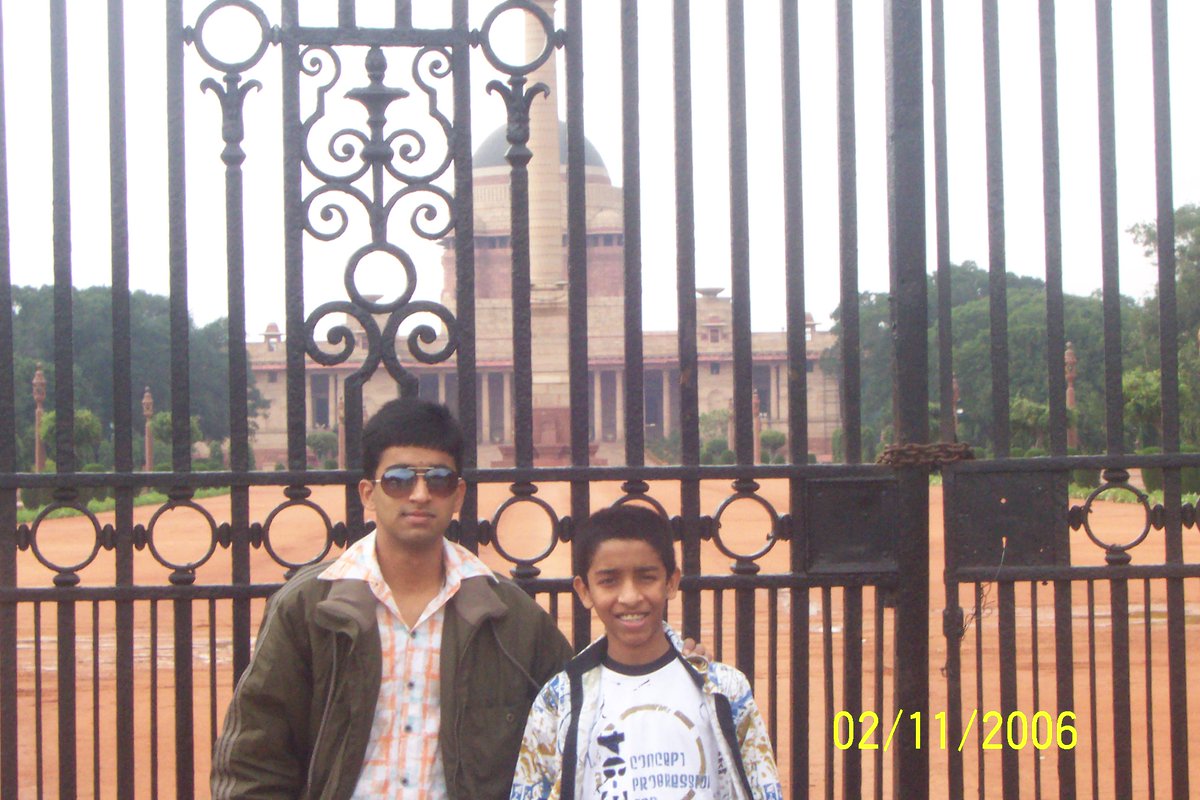
There was no looking back after that. In less than two months after I joined NDTV, war broke out in Sri Lanka. For the next three years, reporting Eelam War IV from the frontlines in Sri Lanka, travelling often to the north-east, to Jammu and Kashmir and breaking stories on military developments, became a way of life. For wife Neha and kids, Harsh and Utkarsh, meanwhile, it was equally tough to adjust to the heat and dust of Delhi besides struggling to cope with Delhi's signature rudeness.
But we persevered. And held on. Perhaps because at the back of our collective minds, the family was always ready to go back to Guwahati if I failed to survive the jungle that is Delhi’s media circuit. Gradually however, Delhi started growing on us. The intense summer heat of Delhi was unbearable in the first few months (wife and boys moved here in May 2006). We slowly started exploring Delhi on holidays and weekends. As we got used to the ebb and flow of life in a metro, there was much to be thankful about.
Then a mini crisis hit us without warning in 2014. I decided to quit NDTV. Leaving the best-known brand at its peak. It was a make-or-break moment. The choice was between standing up for what I thought was correct or compromising on my dignity to continue in the job. Choosing the former was not easy, but strong family support and my own conviction allowed me to take the risk once again in less than a decade. That was the moment when I decided to go independent. To not work for or under anyone else.
The past 11 years since then have been a blur. Launching BharatShakti in 2015, starting StratNewsGlobal in 2020, building an organization brick-by-brick, barely surviving the covid years and trying to remain relevant in a fragmented media space, thanks to my super team, has been an exhilarating if exhausting journey, to say the least. As a media entrepreneur, it is still a struggle to keep afloat but certainly worth the fight.
If anything, these two decades in Delhi have proved the adage yet again: The only constant in life is change. Friends, seniors, mentors, team members, professional colleagues combined with my long-held personal motto—take life as it comes—has given us the strength to survive and thrive in this city. Hopefully the next decade will be as exciting and fulfilling as the last two and the city will be as kind.
Photos from 2006-07.
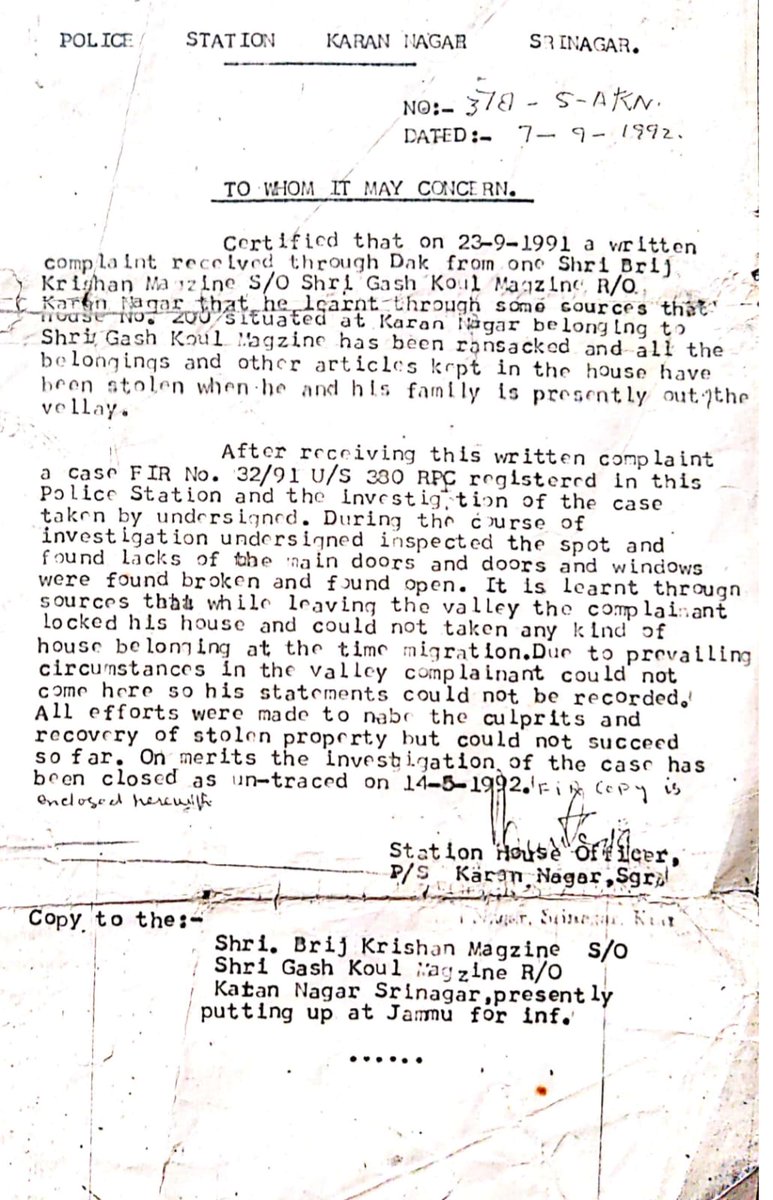
After exodus from #Kashmir, Sep 1991, my granduncle filed FIR for theft in our house in Karan Nagar, Srinagar. A year later, Sep '92, SHO wrote: locks of main doors and doors & windows were found broken and open. Unable to nab the culprits, police closed the case #KashmiriPandits
I appreciate @chetan_bhagat for opening up a necessary conversation around wheelchair usage at airports, even if the reality is more layered than it appears.
I’m not sure it’s fair to call this “abuse” without context.
In my travels, I’ve consistently noticed that flights originating from Europe have only a handful of wheelchairs, while flights from India, especially to the US, have long, seemingly endless queues. At first, it puzzled me too.
A pilot friend once explained something that becomes obvious when you see the full picture. A large share of Indian international travellers are elderly parents visiting children abroad. Many have knee issues, low muscle strength, limited exposure to long walks, and little familiarity with massive, signage-driven airports that assume confidence, speed, and digital literacy.
Add another cultural reality: Indians panic easily in unfamiliar systems, especially when there is no human mediation. So children often pre-emptively book wheelchairs not to “cheat” the system, but to ensure gate-to-gate human assistance in an intimidating environment.
Is the system being optimised? Yes.
Is it always fraudulent? No.
In many cases, it’s a practical workaround for ageing bodies, anxious minds, and airports designed for the young, fit, and fluent. Sometimes what looks like gaming the system is simply families choosing certainty over chaos.
The solution isn’t shaming travellers. It’s better design: assisted-walk options, human help points, electric carts, senior-friendly lanes, and support without defaulting to wheelchairs.
And this is a transitional problem. As today’s Gen X, more travelled, more airport-literate, and more physically active, grows older, this dependence will naturally decline.
Some problems don’t need outrage. They need empathy, design, and time.