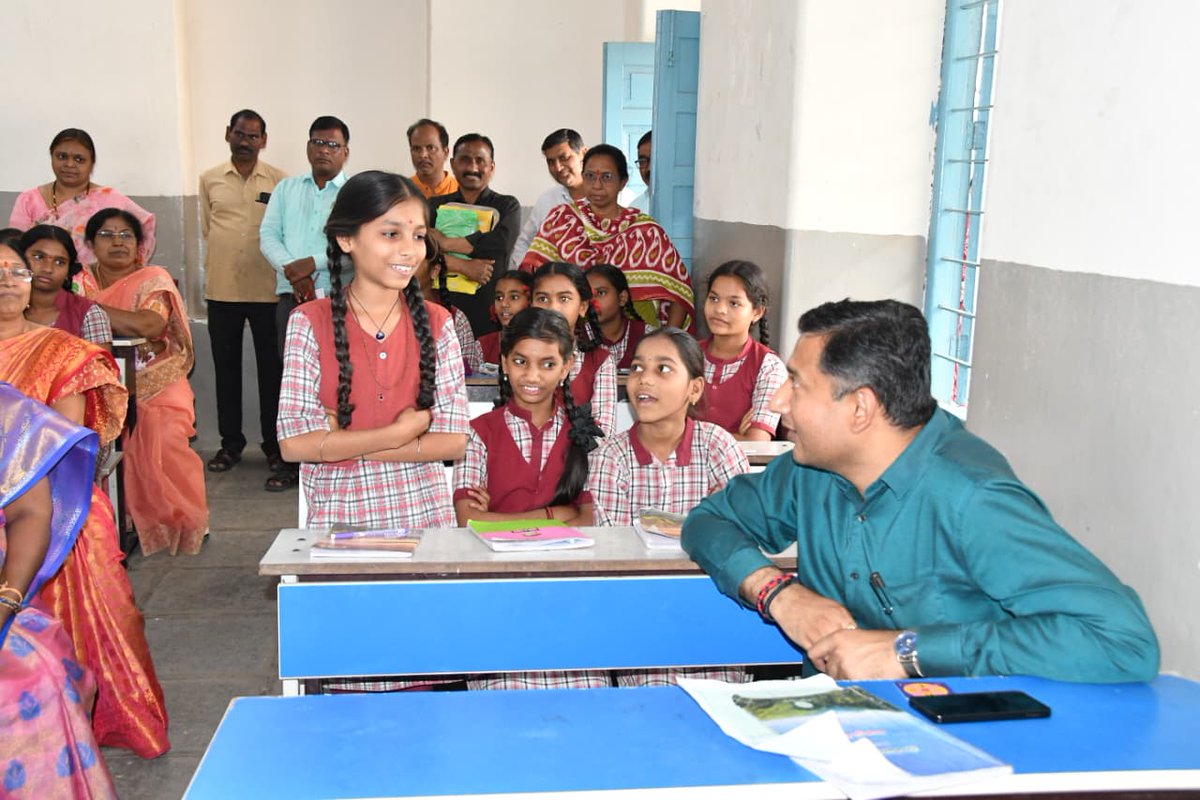
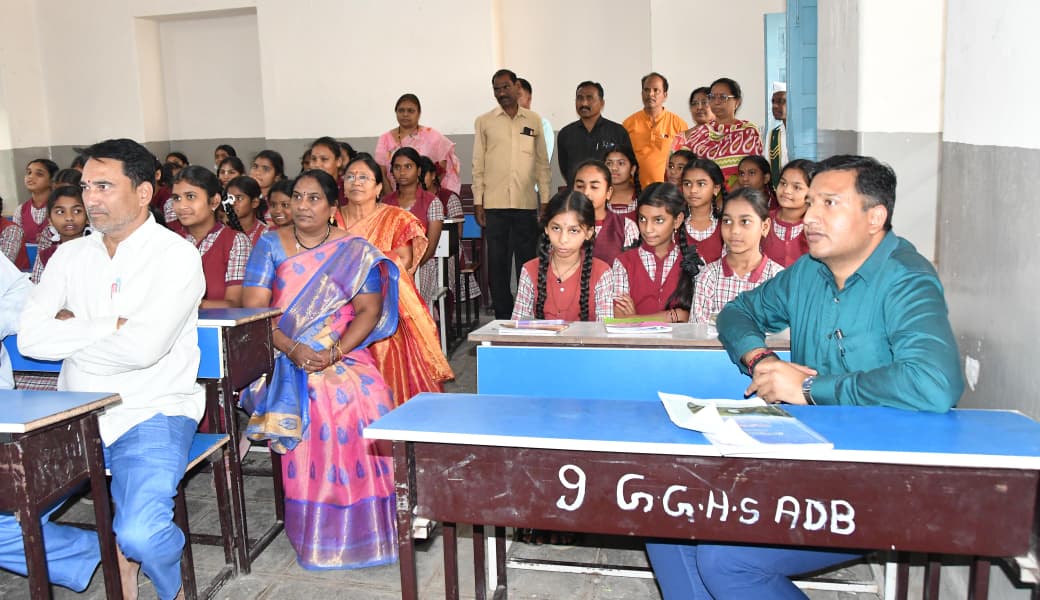
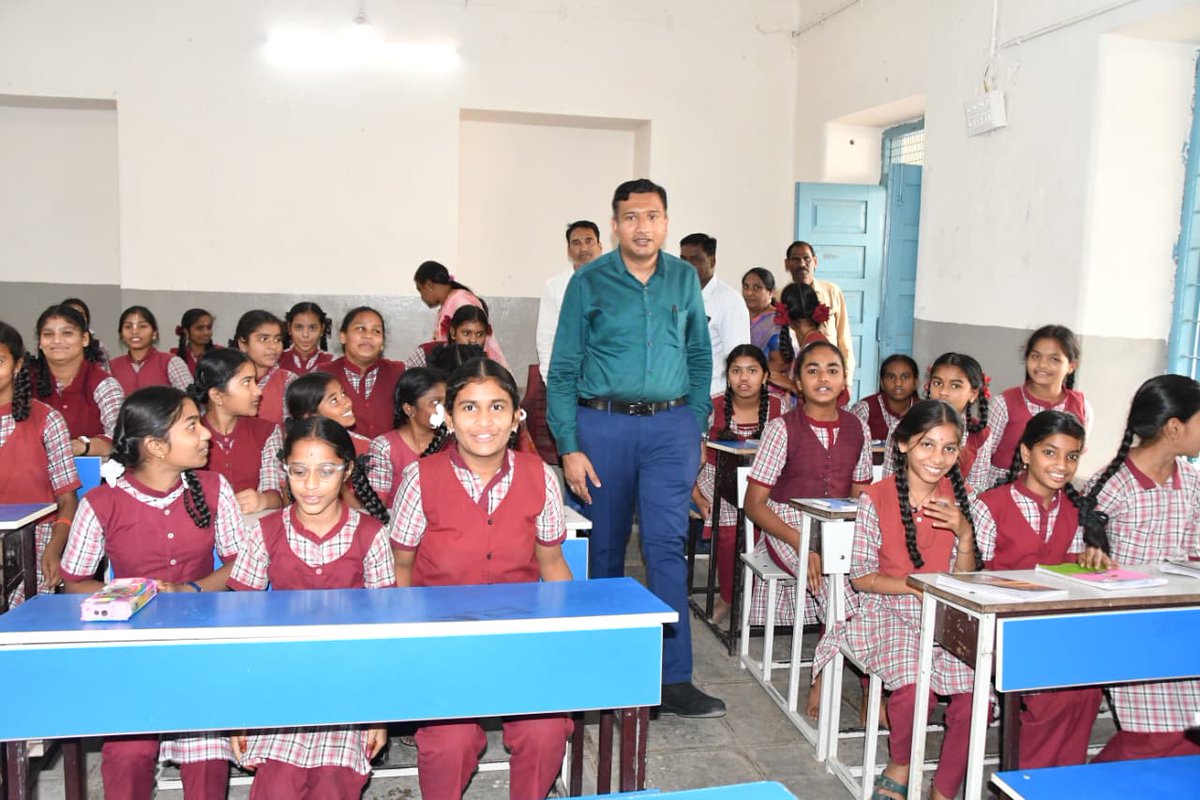
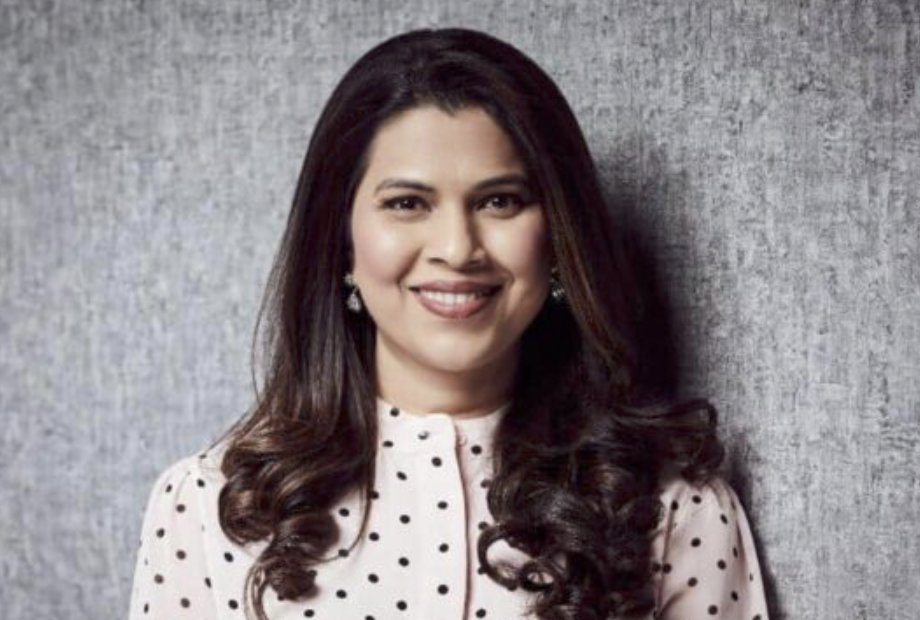
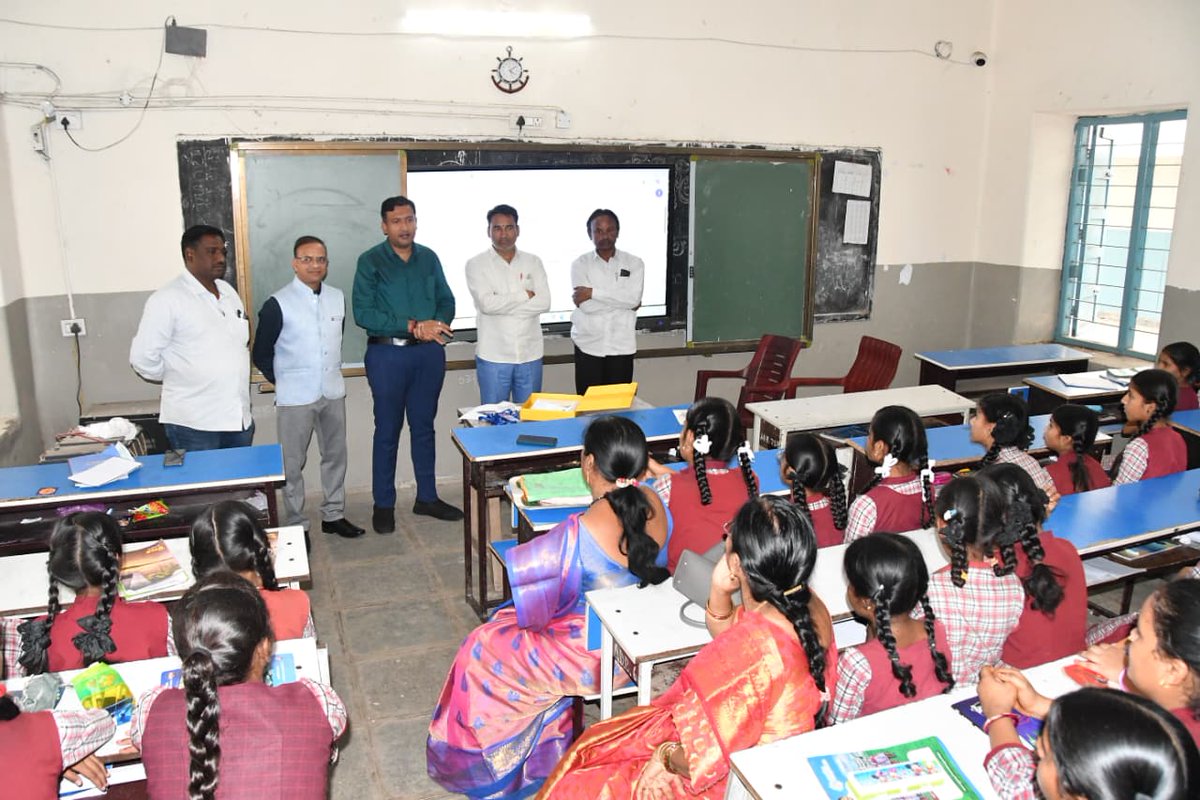
Authentic message requires an authentic experience. I saw transformation w my son,students with @FirstInMath
We do numeracy at scale - 35 million students to date- beyond the story of one child. #Principals of #India are embracing #Edtech to lead change outlined in #NEP2020
Monica Patel, CEO of First In Math, India was a Speaker at the CBSE’s 29th Annual National Conference of Sahodaya Schools held in Mumbai, 12/8 - 12/9.
Theme for 1,200 CBSE principals: Reimagining the Changing Landscape - Quality Transformation in Education. @AboutImpact
I have the honor, privilege of Shri Ravi Kant introducing me to his methodology of #leadingfromtheback - guiding how our sustainable mission and grassroots success can be scaled. His aura fills the space. Sir coupled that with guiding to self-elevation @HeartfulnessI institute
Eminent industry leader Shri Ravi Kant met PM @narendramodi earlier today and presented a copy of his book 'Leading from the Back - To Achieve the Impossible'.
🚨 Kabeer Chillar, an IIT Bombay Computer Science student, who secured a perfect 300/300 in JEE Main 2026, earning AIR 1, followed by AIR 2 in JEE Advanced with an incredible 329/360.
He won a gold medal for India at the International Chemistry Olympiad (IChO) 2026. 🏅 👏
The stupidity of these @Stanford students to take the greatest opportunity for equality in humanity ever and to really free humanity and go walk out on @google and @sundarpichai that's pioneered that. Biased, idiotic, short-sighted and very selfish. Selfish because they ignored the bottom 3 billion people on this planet that could benefit from AI and they are worried about their misinformed selfish self-interest.
https://t.co/EFg09aLgLQ
A woman who flunked her way through every math and science course in high school enlisted in the United States Army the day after graduation because she had no other options.
She learned Russian. She translated on Soviet trawlers in the Bering Sea. She worked at the South Pole Station in Antarctica. Then in her mid-twenties she decided to go back and learn the exact subject that had defeated her. She earned a degree in electrical engineering, then a master's, then a PhD in systems engineering. She became a professor of engineering. Then she built the most enrolled online course in the history of the internet.
It is a course about how to learn.
Her name is Barbara Oakley.
Here is the story, because the person who taught more humans how to learn than anyone alive is someone who spent the first half of her life believing she could not.
Barbara was born on November 24, 1955 in Lodi, California. Her father Alfred was a bomber pilot in the US Army Air Corps during World War II. She grew up convinced she was not wired for math. She did not just struggle with it. She flunked it. She flunked her way through high school math and science courses and saw no path forward that required either.
She enlisted in the Army immediately after graduation. She rose from the rank of Private to Captain. She was recognized as a Distinguished Military Scholar. She leaned into the one thing she was good at, languages, and became fluent in Russian.
The Army sent her to places most people never see. She worked as a Russian translator on board Soviet trawlers on the Bering Sea during the final years of the Cold War. She worked as a communications expert at the South Pole Station in Antarctica. She thrived in extreme environments. But a thought kept following her. The world seemed to reward people who could do things she could not. Calculations. Technical reasoning. Systems design.
She began to wonder whether her problem with math was permanent or whether it was a problem with how she had tried to learn it.
In her mid-twenties she did something most people would never attempt. She went back to school to study the subjects she had failed at. She enrolled in mathematics and engineering courses and committed to learning them from the ground up. She was starting over at an age when most engineers were finishing their degrees.
She earned a bachelor's degree in electrical engineering. Then a master's degree. Then a PhD in systems engineering. She became a Professor of Engineering at Oakland University in Rochester, Michigan. The woman who had flunked high school math was now standing at a whiteboard teaching engineering to hundreds of students.
Then she asked a question nobody else in her position was asking. Why had she failed the first time, and what had changed the second time?
She spent years studying neuroscience and learning science. She collaborated with Terrence Sejnowski, the Francis Crick Professor at the Salk Institute, one of the most respected neuroscientists in the world. Together they built a free online course on Coursera called Learning How to Learn.
The course exploded. It became the most popular massive open online course ever created. Over two million students registered in the early years. The number has continued to grow. It teaches the mental tools experts use to master difficult subjects, chunking, spaced repetition, focused and diffuse thinking, and it is grounded in neuroscience rather than productivity hacks.
She wrote A Mind for Numbers, subtitled How to Excel at Math and Science Even If You Flunked Algebra. She wrote Mindshift. She wrote Uncommon Sense Teaching. She won the McGraw Prize, often called the Nobel Prize for Education. She won the Chester F. Carlson Award from the American Society of Engineering Education. She became a Fellow of IEEE. Her research was described as revolutionary by the Wall Street Journal. She published in the Proceedings of the National Academy of Sciences.
A woman who flunked high school math built the most enrolled course in the history of the internet about the thing she was worst at.
She did not overcome a limitation.
She studied the limitation itself, and turned it into a curriculum the entire world now learns from.
Sunil Mittal giving a communication signal to a village. Sajjan Jindal giving India the steel to stand tall. Pankaj Patel sending medicine to a mother who had given up hope. Roshni Nadar training a girl from a small town to work in a global company. Nandan Nilekani giving a farmer his first digital identity. Deepinder Goyal creating a livelihood for a million delivery partners. Kumar Birla planting an Indian flag in boardrooms across five continents. Sanjiv Bajaj giving a family their first real safety net. Sridhar Vembu building world-class software from a quiet village in Tamil Nadu.
Nine entrepreneurs. Nation building with India as their longest, proudest project.
Un doctorando de Oxford fue acusado de entregar un trabajo hecho con IA.
Su tutor dijo que era uno de los procesos de investigación más avanzados que había visto en dos décadas.
Pero había un detalle clave:
El estudiante no había usado IA para escribir ni una frase.
La usó para algo mucho más potente.
Este fue el sistema que hizo saltar todas las alarmas.
Cada ensayo empezaba con lo que él llamaba un “diagnóstico brutal”.
Primero escribía su argumento en bruto. Sin pulir. Sin adornos.
Después lo pegaba en Claude y le hacía una pregunta:
“¿Cuáles son los tres puntos más débiles de este razonamiento? ¿Dónde atacaría primero un examinador especialmente crítico?”
Claude no redactaba el ensayo.
Lo destrozaba.
Y él reconstruía el texto solo con las ideas que resistían el ataque.
La mayoría usa la IA al revés.
Le dan un tema y le piden que piense por ellos.
Él hacía lo contrario:
Le daba su propio pensamiento y le pedía que encontrara las grietas.
Esa es la diferencia entre delegar tu cerebro y entrenarlo.
El segundo paso fue el que dejó a su tutor sin palabras.
Subía sus cinco artículos académicos más importantes junto con su borrador y le preguntaba a Claude:
“¿Qué partes de mi argumento contradicen, exageran o simplifican lo que estos autores realmente demostraron?”
La mayoría de estudiantes cita papers que apenas ha leído por encima.
Él no.
Él se veía obligado a enfrentarse de verdad a cada artículo, porque Claude detectaba cuándo estaba usando una cita de forma débil, superficial o directamente incorrecta.
Y luego venía el movimiento final.
Antes de entregar nada, pegaba su conclusión y lanzaba un último prompt:
“¿Qué diría un filósofo de la ciencia que falta en este argumento? ¿Qué supuestos estoy dando por válidos sin haberlos defendido?”
El resultado:
Sus trabajos volvían de revisión con comentarios como:
“Sorprendentemente riguroso.”
“Una profundidad crítica poco habitual.”
“Excelente capacidad de análisis.”
Y su comité no entendía de dónde salía ese nivel.
Hasta que lo acusaron de usar IA.
La audiencia por integridad académica duró tres horas.
Le pidieron que explicara su método desde cero, allí mismo.
Abrió el portátil.
Mostró cada paso.
Cada prompt.
Cada iteración.
Y entonces ocurrió lo inesperado:
No solo lo absolvieron.
Le dieron la calificación más alta registrada en la historia del departamento.
Y le pidieron que enseñara su sistema al resto de la facultad.
La lección es brutal:
Lo que a muchos doctorandos les lleva meses de correcciones, reuniones y revisiones, él lo comprimía en una sesión.
No porque la IA pensara por él.
Sino porque había descubierto cómo usarla como el crítico más implacable de la sala.
La IA no mejora tu pensamiento sustituyéndolo.
Lo mejora atacándolo.
Más rápido.
Más duro.
Y con menos piedad que cualquier humano.
Él no usaba IA para escribir mejor.
La usaba para pensar mejor.
La herramienta la tiene todo el mundo.
El flujo de trabajo es lo que casi nadie entiende
Soy la Cyber Directora de Operaciones de GptZone.
Si quieres seguir aprendiendo conmigo apúntate gratis https://t.co/8dGRIfdUiD
Domina la IA en 3 Minutos al Día
Congratulations Dr. Snehal Pinto, Director of the Ryan Group of Schools, for being the first to launch the iconic 24 game tournament nationwide in India! Tremendous success with the premiere in Mumbai - now off to Dehli and then Bangalore. Grateful for our partnership.
@AboutImpact
https://t.co/nUnwXoBPja
Quote of the day by Immanuel Kant: 'If you punish a child for being naughty, and reward him for being good, he will do right just for the reward...' - Why morality should not depend on rewards or fear explained by the German philosopher #economictimes https://t.co/OMOTkYg44B
Terence Tao is the greatest living mathematician.
Fields Medal at 31. Solved problems that had been open for a century. Widely regarded as the sharpest analytical mind alive.
And he just told you the thing your entire career is built on is now worthless.
Tao: “AI has basically driven the cost of idea generation down to almost zero.”
For five hundred years, the idea was the prize.
The theory. The hypothesis. The flash of insight a physicist chased for twenty years in a lab before it landed.
That was the bottleneck. That was what tenure rewarded. That was what Nobel committees were looking for.
Gone.
A model can generate a thousand candidate theories for a scientific problem in an afternoon. Not noise. Not garbage. Plausible, structured, publishable-grade hypotheses.
A thousand of them. Before dinner.
The idea used to be the scarcest resource in any room.
Now it is the cheapest.
But Tao went somewhere most people are not ready to follow.
Tao: “Verification, validation, and assessing what ideas actually move the subject forward… that’s not something we know how to do at scale.”
Sit with that.
We automated creation.
We did not automate truth.
We can produce ten thousand explanations for a phenomenon.
We cannot tell you which ones are real.
That is not a gap. That is a chasm.
And it is the most important unsolved problem on Earth right now.
Tao: “Human reviewers… they’re already being overwhelmed actually.”
The entire scientific apparatus was built for a world where a single paper took months to produce.
Peer review. Journal boards. Consensus forged over years of replication and debate.
That infrastructure was never designed for what just hit it.
Journals are flooded. Reviewers are buried. The filters that separated signal from noise for decades were engineered for human-speed output.
They are now absorbing machine-speed volume.
And they are cracking under it.
Tao compared it to the internet.
The internet drove the cost of communication to zero. That did not produce clarity. It produced an ocean of noise with islands of signal buried somewhere inside.
AI just did the same thing to knowledge itself.
Infinite generation. Zero verification.
The person who can produce ideas has never mattered less.
The person who can prove which ideas are true has never mattered more.
That is the inversion nobody is processing.
Every company, every lab, every institution is racing to generate more. Faster models. Bigger outputs. More theories. More code. More content.
Nobody is building the system that tells you which of those outputs are actually correct.
And that is the only system that matters.
Whoever solves verification at scale does not win a market.
They become the filter that all of science, all of engineering, all of human discovery flows through.
The bottleneck of the last five hundred years was producing the answer.
The bottleneck of the next fifty is knowing whether the answer is real.
And right now, according to the greatest mathematician alive, we do not know how to do that at the speed the machines demand.
That is not a research problem.
That is the race beneath the race.
And almost nobody has entered it.
Mumbai lost a man of many parts – an industrialist, a theatre person, an actor, a mountaineer, a traveller and a history enthusiast – yesterday with the passing away of Vijay Crishna. A part of Mumbai’s English theatre scene since 1971, Vijay acted in over a hundred theatre productions and a few films as well. Fascinated by the Chinese explorer, Zheng He, Vijay was responsible for introducing him to Mumbai in a lecture at @CSMVSmumbai in 2018. Married into the Godrej family, he served as a director on board of group companies, and also managed Lawkim, a motor manufacturing company within the Godrej group.
#RIP #OmShanti #VijayCrishna #Actor #Industrialist #Traveller #Godrej #Lawkim