The story of AI in the next few years is going to be compute: an essay on the future of AI.
K3 in 2 days is already #10 on OpenRouter with ~140B tok/day, and it’s infra is crumbling. Throughput is down from 30tok/s to 13tok/s, E2E latency is up to 72s and time to first token is >20s! It would cost a minimum of $500k to buy the 8 B300s it would take to serve even quantized Kimi K3 and ~$4M for the more recommended GB300 NVL72 rack.
I don’t think Moonshot has the compute available to scale to their demand! In fact, even the US based inference providers will likely not be able to scale capacity as much as they’d like even if they were to host it: a 2.8T model is no joke. GPU providers (neoclouds etc) are doing 3yr and I recently hear 5yr commits with an ungodly 30% down, and customers are chomping it up. Prices continue to go to the moon. The two big labs, hyperscaler clouds, Grok and Meta have compute deals locked in prior, and the rest are fighting for scraps. Tier 1 neoclouds (coreweave/nebius etc) are rumored to not even small “smaller” customers. Meta is the biggest wildcard here. With ~7GW of compute by eoy 2026 and no clear big model ties, they either get to frontier on their own or can host the most Kimi K3 capacity (unless they sell it to the labs).
Even though the price of models has fallen over time, it’s worth noting that the price of frontier has not. 3yrs ago, GPT-4 released at $60/M, o1 at $60/M, Opus 4 at $75/M, GPT5 at $10/M, Fable at $50/M and now Sol at $30/M and K3 at $15/M. Even if you consider K3 frontier, that’s only a 4-5x flux in 3yrs. In that time, frontier demand has increased at least 3+ ooms and frontier intelligence performance has gone 32x at least by task time by METR.
Essentially, so long as a) the demand for frontier intelligence continues to grow to near infinity, b) the frontier continues to grow in performance, even as c) if the price of frontier declines a little, the value accrued to frontier grows significantly! And there’s a tremendous bull case for those who have locked up compute if you’re bitter lesson pilled and believe larger models will always be smarter models.
One 150 g hamburger has a water use footprint of approximately 2,400 L,
equivalent to roughly 83,000 AI images.
One cotton T-shirt has a water use footprint of approximately 2,720 L, equivalent to roughly 94,000 AI images.
One hour of Netflix, including the TV, router and network, is roughly 1.9 L which is the equivalent of 65 AI images.
This includes training + inference. Comparing the same types of water btw so apples to apples.
US golf course irrigation costs 10-18x the water requirements of all data centers in America. Paper mill production water use is 2-3x of all AI data centers in the US.
‼️BREAKING
ssi are set to release a model superior to fable across the board.
amid growing investor pressure ilya’s hand has been forced to release.
expect a release at the earliest this month but most likely mid august.
things are hotting up indeed.
If you want to fundamentally challenge an assumption and innovate, try building things from scratch.
Building something from zero takes away every assumption you would otherwise inherit from an existing solution. You naturally start focusing on, "Does this even need to be true?"
That is the real reason greenfield projects (starting from scratch) often produce radical designs. Inherited code comes with inherited constraints. A blank slate has none, so you have to justify every choice from first principles. That, makes you think.
Kafka is a good example of this. Every message queue before it - JMS, RabbitMQ, you name it - agreed on one thing without really questioning it: once a consumer reads a message, delete it. A queue is a mailbox, not an archive.
When LinkedIn built Kafka from scratch, they were not trying to build a faster queue. They asked a more fundamental question: why delete data the broker already has?
So they went in the opposite direction.
On paper, that is a worse deal for a simple use case. More disk. More moving parts for the client to manage. But it made things possible that traditional queues simply could not do: replaying old messages, running multiple consumer groups over the same stream at their own pace, and treating the log itself as the source of truth.
Apache Spark is another example. Instead of optimizing disk-based processing, it did in-memory computation. Columnar databases made a similar shift by rethinking how data should be grouped and stored.
The point is, you do not stumble into designs like these by patching an existing system. You get there by starting over and refusing to accept what has been handed to you.
Hope this helps.
the best thing you can do for yourself is actively increase your surface area for luck to hit you. go outside, try new cafes, museums, events, take a new route home, speak to people, ask questions, side quest. the more you do, the more serendipity and synchronicity will find you.
This is literally the best time to switch jobs if you are in AI, but why?
Almost every AI startup who has raised funding is hiring for an AI Engineer, FDE, Deployment Engineer, or ML Researcher, etc and the syllabus is not yet defined for interviews.
Most of the interview discussions are around your knowlegde of RAG, Inferencing, System Design, Deployment, Fine Tuning or designing systems and not pure DSA or Problem solving.
and how can you be the one to get selected, what should you do now?
1. Solidify a base in these technologies - learn, upskill, and build.
2. Apply for as many roles as possible in which you are eligible.
3. Give interviews, you would get an idea on what's being asked in the initial 3/5 interviews and after that you know what you can expect.
4. Make naukri. com account, apply for all LinkedIn jobs and start cold DMing CTOs, Engineering Leaders from these companies with your resume.
thats it, you land a role soon and then once you are in the game - you can switch to a better role way more quickly with the new experience in your organization.
I have seen people jumping from 20 LPA to 40 LPA to 60 LPA in a matter of 1 to 1.5 years and its possible.
go give your shot, all the best!
#arshgoyal #ai #fde
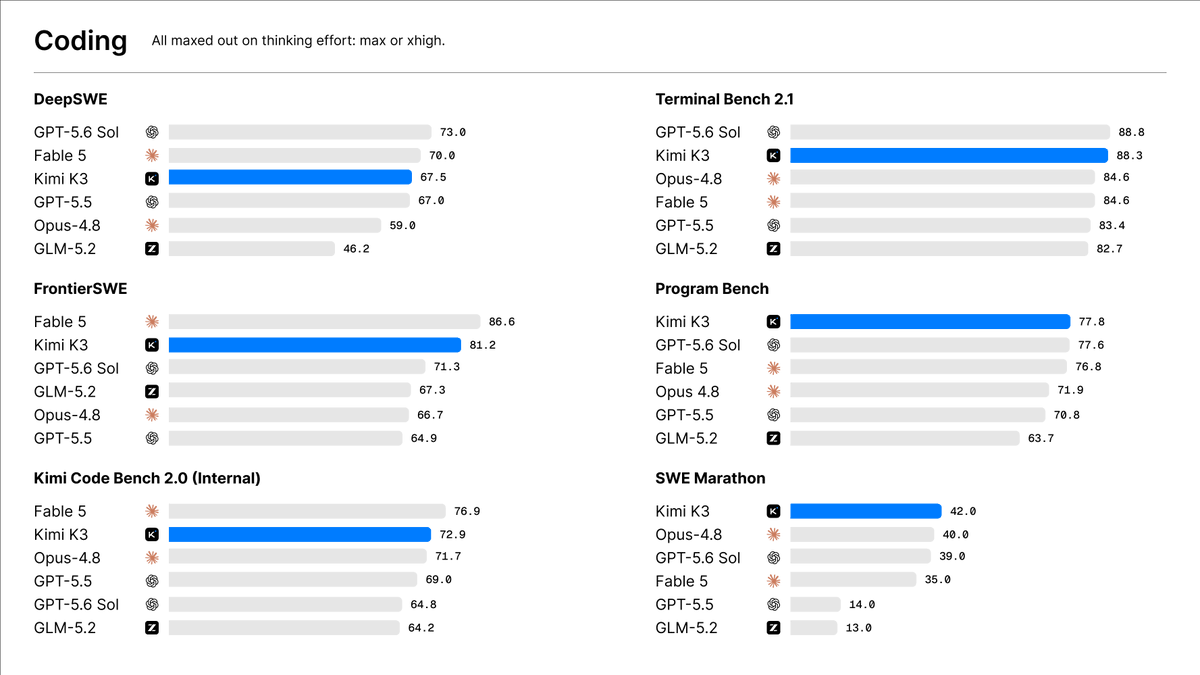
Introducing Kimi K3: Open Frontier Intelligence
🔹 2.8 Trillion Parameters, 1 Million Context, Native Multimodal
🔹 Kimi Delta Attention enables up to 6.3x faster decoding in million-token contexts
🔹 Attention Residuals deliver ~25% higher training efficiency at <2% additional cost
🔹 Built for long-horizon agentic coding and self-evolving workflows
Kimi K3 is now live on on https://t.co/zrk6zZxZUo, Kimi Work, Kimi Code, and the Kimi API.
Open Weights by July 27, 2026.
🔗 API: https://t.co/XCrgjXAqMw
🔗 Tech blog: https://t.co/YTfiMSNM1f
how small can you make a world model?
we built mira mini, the first reproduction of mira:
• reproduced in a week from scratch
• four players, one shared rocket league match, in the browser
• distilled to 364m params,
weights, code, full report: all open.
play it here ↓
Today, we are introducing Inkling.
Inkling reasons efficiently across text, image, and audio modalities. We are making the full weights available.
https://t.co/Ghebq5mG30
Available today for fine-tuning on Tinker. Play with it in the Inkling Playground. 🧵
An unexpected benefit of having run 3 mech interp workshops: we have a great dataset for analysing the rise of LLM slop in submissions!
@andyarditi investigated how much AI slop we let in, how things have changed since 2024, and more
Our review process isn't entirely noise!
The Indian Delegation at IPhO (International Physics Olympiad) has won all gold medals!
Here's the team that won it all -
🥇 Kanishk Jain
🥇 Riddhesh Anant Bendale
🥇 Rishit Garg
🥇 Shresth Suraiya
🥇 Svarit Joshi