There's a quadrillion-dollar question at the heart of AI: Why are humans so much more sample efficient compared to LLM? There are three possible answers:
1. Architecture and hyperparameters (aka transformer vs whatever ‘algo’ cortical columns are implementing)
2. Learning rule (backprop vs whatever brain is doing)
3. Reward function
@AdamMarblestone believes the answer is the reward function.
ML likes to use pretty simple loss functions, like cross-entropy. These are easy to work with.
But they might be too simple for sample-efficient learning.
Adam thinks that, in humans, the large number of highly specialised cells in the ‘lizard brain’ might actually be encoding information for sophisticated loss functions, used for ‘training’ in the more sophisticated areas like the cortex and amygdala.
Like: the human genome is barely 3 gigabytes (compare that to the TBs of parameters that encode frontier LLM weights). So how can it include all the information necessary to build highly intelligent learners? Well, if the key to sample-efficient learning resides in the loss function, even very complicated loss functions can still be expressed in a couple hundred lines of Python code.
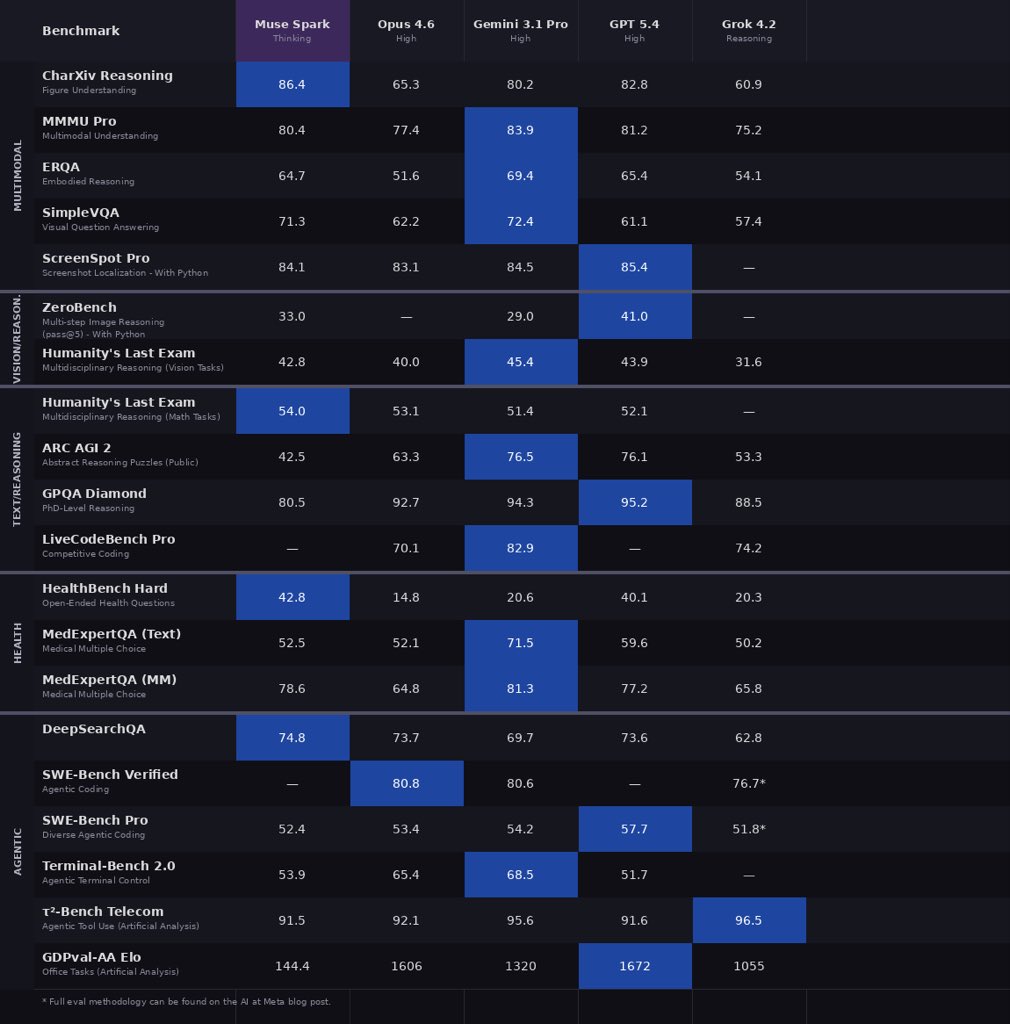
For those living under a rock: LLMs stopped becoming smarter around summer 2025.
Everything impressive you see since then is about finetuning them for specific tasks (mainly coding and software-tool-based task solving) and building tooling around them (such as agentic coding systems).
Shoe company Allbirds just announced that it's planning to
- Sell all of its brands and footwear assets
- Rebrand the company to Newbird AI
- Use a $50M convertible financing facility to "acquire high-performance GPU assets"
basically: anthropic sneakily turned down how hard claude thinks before editing code, changed the default from "high" to "medium" effort, and hid the reasoning from session logs. all without telling users.
an amd director had 7k sessions of telemetry to prove the degradation was real and measurable (not just vibes). anthropic admitted to the changes. there's a workaround (use "/effort max"). the uncomfortable part is most users had no data to notice it happened at all.
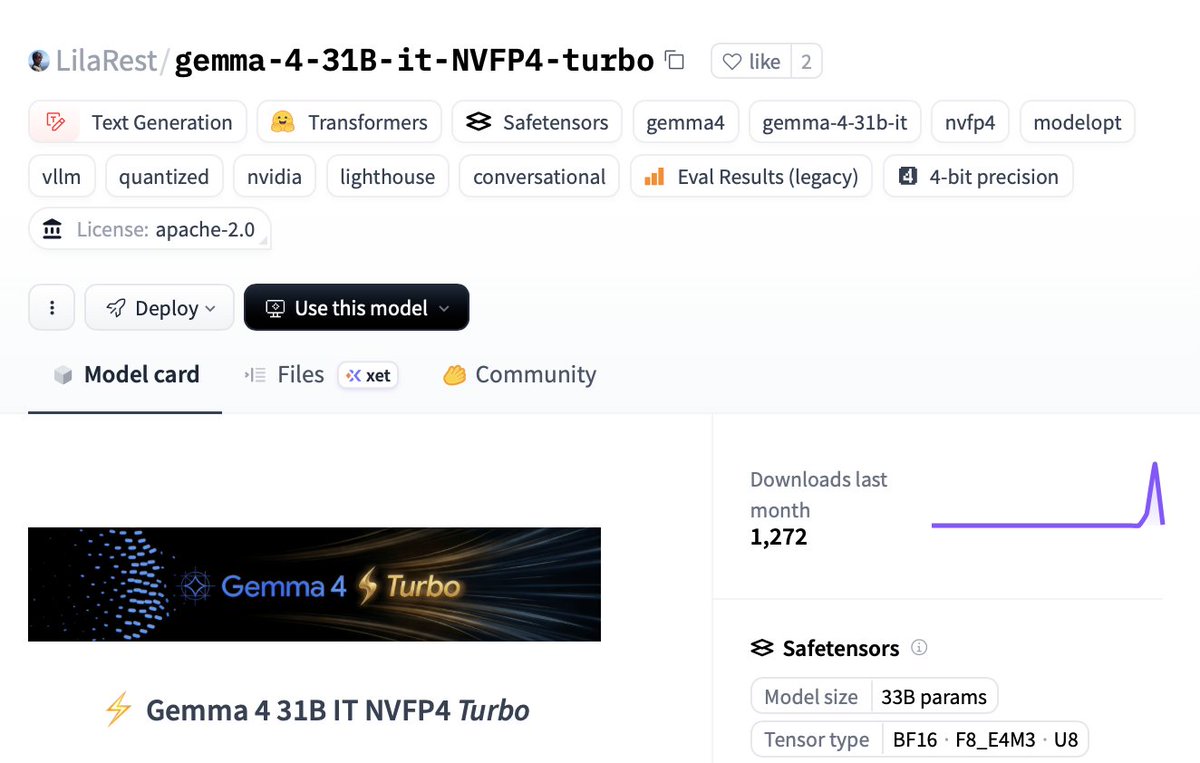
🚀 NEW GEMMA 4 31B TURBO DROPPED
Runs on a SINGLE RTX 5090:
⚡️18.5 GB VRAM only (68% smaller)
🧠51 tok/s single decode
💻1,244 tok/s batched
🤖15,359 tok/s prefill ← yes, fifteen thousand
🚨2.5× faster than base model with basically zero quality loss.
It hits Sonnet-4.5 level on hard classification tasks…
at 1/600th the cost.
Local models are shipping faster than we can test 👇🏻
🔥 HF: https://t.co/XUvVZBj9AX
-Papá, ¿tan bueno era Nadal en tierra batida?
-Muchísimo, hijo, no se ha visto nunca nada igual.
-¿Tan difícil era ganarle un partido?
-Los rivales celebraban ganarle un simple punto, hijo. Era una locura.
Announcing Amazon S3 Files.
The first and only cloud object store with fully-featured, high-performance file system access.
Learn more here. https://t.co/rNuWa5Rsi2
Excited to launch Gemma 4: the best open models in the world for their respective sizes. Available in 4 sizes that can be fine-tuned for your specific task: 31B dense for great raw performance, 26B MoE for low latency, and effective 2B & 4B for edge device use - happy building!
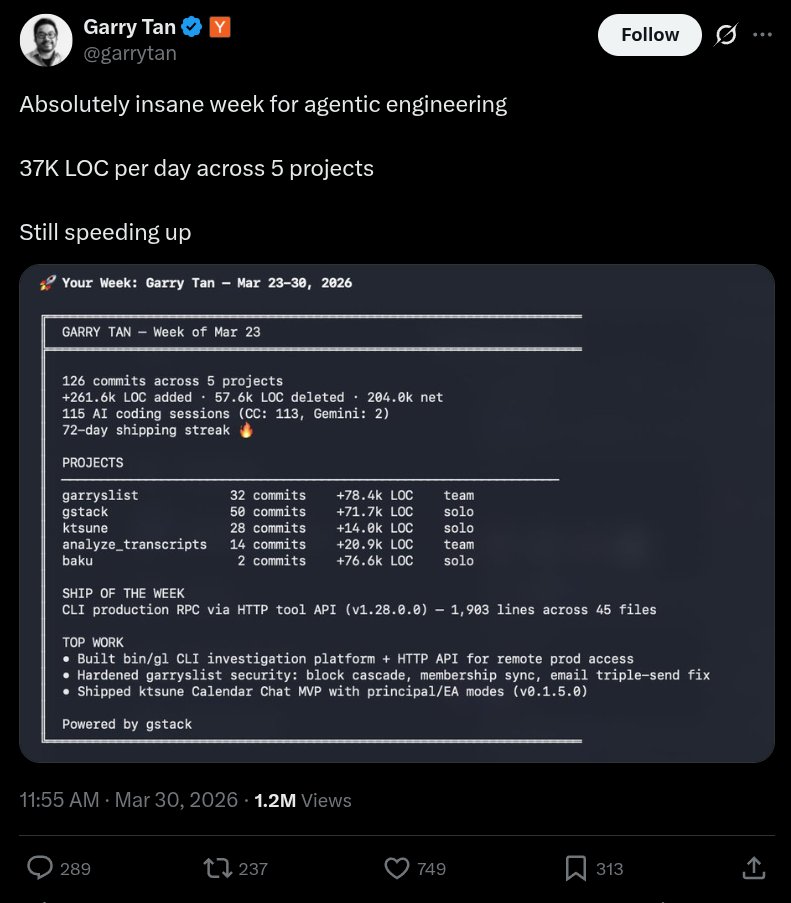
so... I audited Garry's website after he bragged about 37K LOC/day and a 72-day shipping streak.
here's what 78,400 lines of AI slop code actually looks like in production.
a single homepage load of https://t.co/TqaEZsF44N downloads 6.42 MB across 169 requests.
for a newsletter-blog-thingy.
1/9🧵
the year is 2027.
garry tan has just crossed 1b lines of code per day. water to 3 rural californian towns were diverted in order to cool his locally ran LLMs.
riots erupt, and protesters demand answers to one, single question:
"what is he building?"
2005, 2006, 2007, 2008, 2010, 2011, 2012, 2013, 2014, 2017, 2018, 2019, 2020, 2022
This LEGENDARY intro to Rafael Nadal's record at Roland Garros…Aura 🥶👑
The guy who helped build React, the most popular workaround for the browser's layout engine, just said the workaround isn't sufficient and built the replacement himself.
Cheng Lou's resume is the context that makes this announcement hit different. He worked on React at Facebook. Created ReasonML and ReScript. Built Messenger's frontend. Now runs Midjourney's entire UI stack on Bun. Every single role was a fight against the same enemy: the browser's rendering pipeline.
Here's why this matters beyond the engineering flex. The web was built to render documents. Static HTML, flowing text, pages you scroll through. CSS layout was designed for that world. Then we started building applications inside the document renderer: spreadsheets, design tools, messaging apps, AI chat interfaces. Every one of those applications has to ask the browser permission to know how big text is. That question triggers reflow. Reflow locks the main thread. At 60fps you get 16 milliseconds per frame. Spend those milliseconds on layout recalculation and the user sees jank.
The industry's answer for the last decade has been to work around the problem. Virtual DOM (React) batches the writes. CSS containment limits the blast radius. content-visibility skips offscreen layout. FastDOM separates reads from writes. Every solution accepts that the browser owns text measurement and tries to call it less often.
Cheng Lou's answer: stop calling it at all. Measure text in pure TypeScript. Skip the DOM. Skip CSS. Skip reflow entirely. Zero layout passes. The performance improvement, per his demo, is categorical. 0.05ms versus 30ms. Zero reflows versus five hundred.
The person who understands the browser rendering pipeline better than almost anyone alive just built the tool that makes part of it unnecessary. That tells you where application-grade UI is heading.