Introducing Langevin Flow Maps
TLDR: Neural Network Potentials that learn their own stochastic pathwise solution for faster simulation.
- Transferable across molecular systems.
- Transition dynamics are preserved.
- No trajectory data are required.
Work together with @sgmccallum, supervised by @AlexanderTong7, and @JamesFosterBath.
Arxiv: https://t.co/GGgujg56YH
Data: https://t.co/TeYvKN13o7
Code: https://t.co/HYiMqTI4jT
@ziziran2 Yes that’s a good point, the students with fewer block applications can give a cheap preview to help with searching for optimal seeds for the full depth teacher. I’ll share checkpoints shortly to try it
1/ I’m excited to share our work on “Depth as Time in One-Step Generative Models”!
https://t.co/M8OGqxykLk
TL;DR: We ask, when a model learns to generate an image in one forward pass, what happens to the denoising process? We observe that process unfolding over depth!
Do vision-language models actually lack visual understanding, or are they held back by their learned priors?
In our #NeurIPS2026 paper, we find that in-context learning can help VLMs overcome misleading priors, improving accuracy by up to 27%.
🔗 https://t.co/aUQN9LbO1M
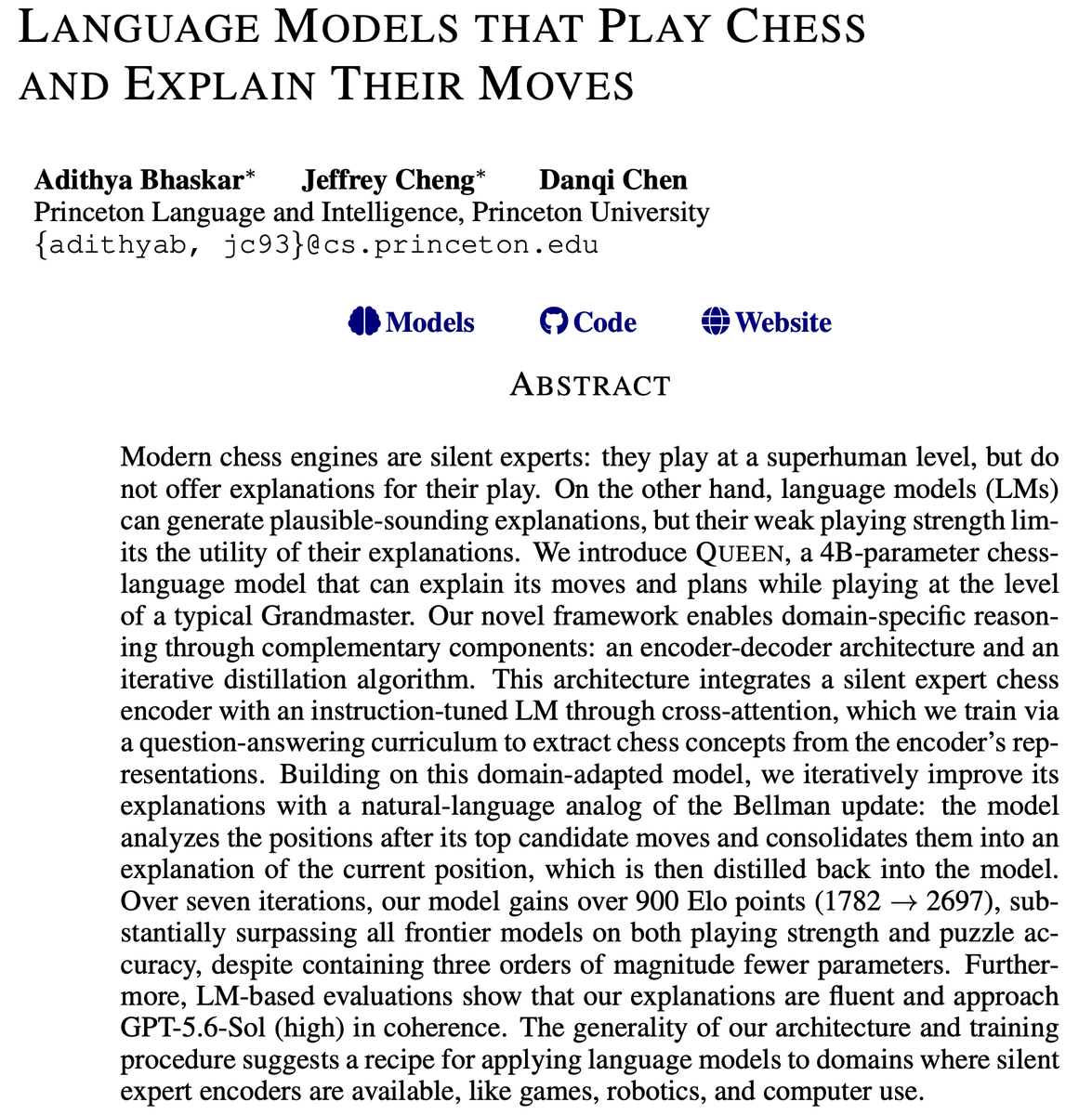
The most profound paper of my PhD so far. We truly did something special to make LMs play/explain chess, needing both architectural & algorithmic innovation (natural-language analogue of the Alphazero algorithm) + applicable to many other domains. Please read on and share!
1/10
I learned so much working on this project, and I’m excited to share this work! Joint work with @YangWilliam_, @SanghyukChun, Esin Tureci and @orussakovsky . Thanks also to Timothy Buschman, @ryan_p_adams, members of @VisualAILab for helpful discussions and feedback.
5/ we achieve 16.6× parameter compression on MeanFlow SiT-L/2, from 459M to 27.6M parameters, with FID 4.87 after FD-loss post-training, compared with 4.01 for the teacher.
4/ we also show that by making depth as time explicit and treating depth as its own flow, a shared, time-conditioned block can learn to denoise across layers. Distilling the teacher’s layerwise computation this way enables aggressive parameter compression.
3/ this progression depends on the transport task e.g., when mean flows predict a noisy intermediate endpoint, the layerwise predictions first reveal cleaner image structure, then renoise toward the requested endpoint, all within one forward pass.
2/ to see this, we apply the model’s own output head to intermediate layers, recovering layerwise velocity predictions. We use these to construct image predictions that progressively denoise across depth, without additional training.
Today, agents execute isolated tasks. Tomorrow, agents will steer complex decisions across long horizons.
Introducing CEO-Bench, a first step to measure "Steering Intelligence." In CEO-Bench, agents are asked to run a simulated startup for 500 days.
https://t.co/9gNWFALTKK
🥳Thank you to everyone who joined our #CVPR2026 tutorial, “The Principles of Diffusion Models: Real-Time Continuous & Discrete Diffusion”!
This event wouldn’t have been possible without all the participants, our amazing speakers (@ssahoo_ & @mittu1204), and the organizers (@gimdong58085414 & @DrYangSong & @StefanoErmon & @CVPR) who helped make it happen.
Grateful for the great energy and discussions!
Video models surprisingly can solve mazes, but inconsistently. We understand little about how they reason, making it hard to use such abilities.
We investigate the denoising process and find models commit to a plan early, letting us screen far more candidates for better perf.
🧵
We present🌊AquaBot🤖: a fully autonomous underwater manipulation system powered by visuomotor policies that can continue to improve through self-learning to perform tasks including object grasping, garbage sorting, and rescue retrieval.
https://t.co/GRtc3rSwDW
more details👇
At #ECCV2024, we presented Minimalist Vision with Freeform Pixels, a new vision paradigm that uses a small number of freeform pixels to solve lightweight vision tasks. We are honored to have received the Best Paper Award!
Check out the project here: https://t.co/D9giTIlEWa
🚨 New paper! 🚨
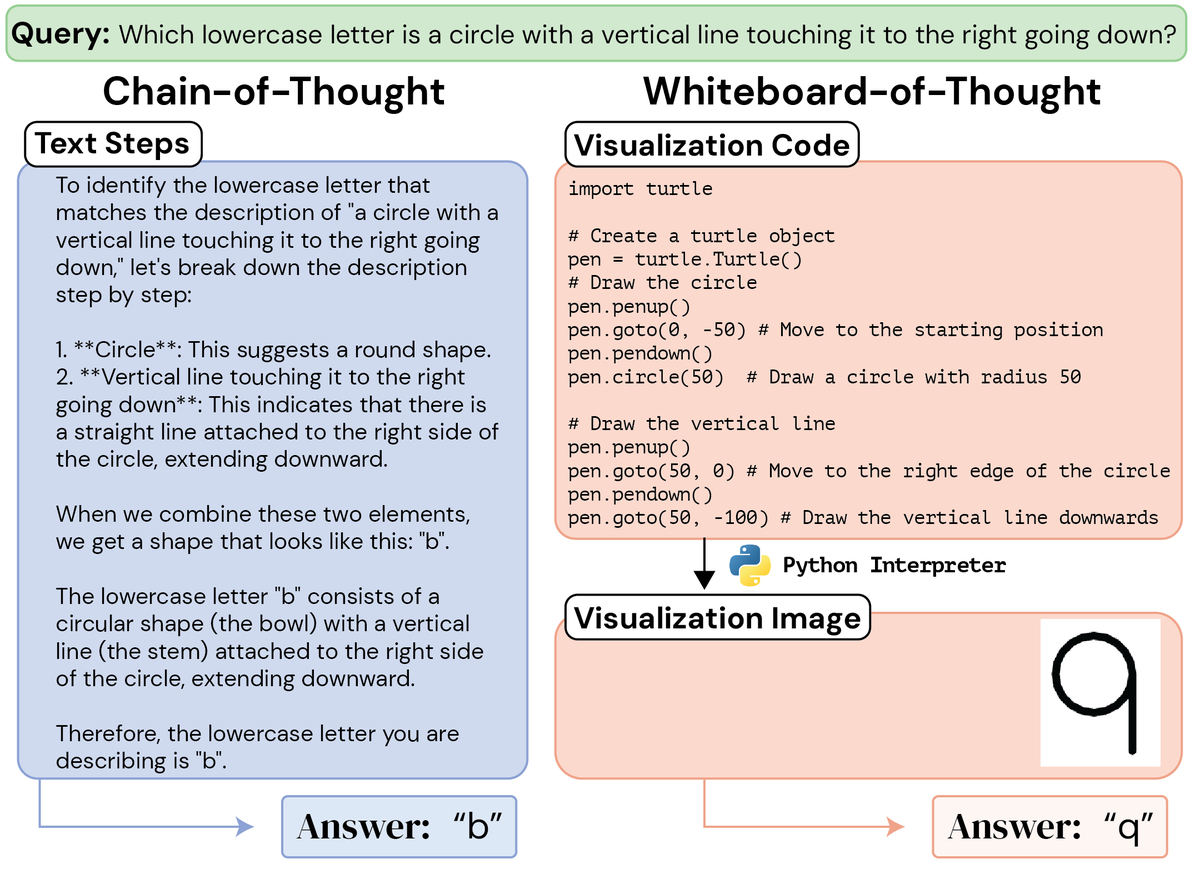
We solve lots of tasks posed in words by thinking visually. Can LLMs? Not in text, but we can unlock this ability with images!
Introducing whiteboard-of-thought, enabling MLLMs to express intermediate reasoning as images via code!
🔗 https://t.co/J0WUeVz3p3
🧵