Takeaway: ICL can address VLM biases and recover visual capabilities without additional training or architecture changes.
Thanks to my wonderful collaborators and mentors @cindy_x_wu, @SanghyukChun, @orussakovsky, and Esin Tureci at @VisualAILab!
📄 https://t.co/aUQN9LbO1M
6/6
Do vision-language models actually lack visual understanding, or are they held back by their learned priors?
In our #NeurIPS2026 paper, we find that in-context learning can help VLMs overcome misleading priors, improving accuracy by up to 27%.
🔗 https://t.co/aUQN9LbO1M
We pushed the models further and found limitations of ICL: in-context examples only refine a capability the model already has. ICL does not improve VLMs’ performance on high-count tasks, where VLMs are known to struggle zero-shot.
5/6
1/ I’m excited to share our work on “Depth as Time in One-Step Generative Models”!
https://t.co/M8OGqxykLk
TL;DR: We ask, when a model learns to generate an image in one forward pass, what happens to the denoising process? We observe that process unfolding over depth!
Perhaps this may also pique interests 👀
We did an autoresearch benchmark with 140 tasks across 12 different ML research domains (16xH200) led by @Lyubh22 , found a similar leaderboard order and a much wider gap to close :)
https://t.co/qikVTxOTT2
We ran the largest open experiment on how frontier models do AI research.
100+ autonomous runs across 10+ models, sandboxed on 8xH200s for up to 8 days, iterating on the nanoGPT optimizer track.
Best runs closed 82% of the gap to a record built by dozens of humans over months.
Everyone is talking about self-evolving AI, or recursive self-improvement. The methods that built modern ML are the ones that keep working across settings and scales, yet no benchmark directly tests AI systems for that ability.
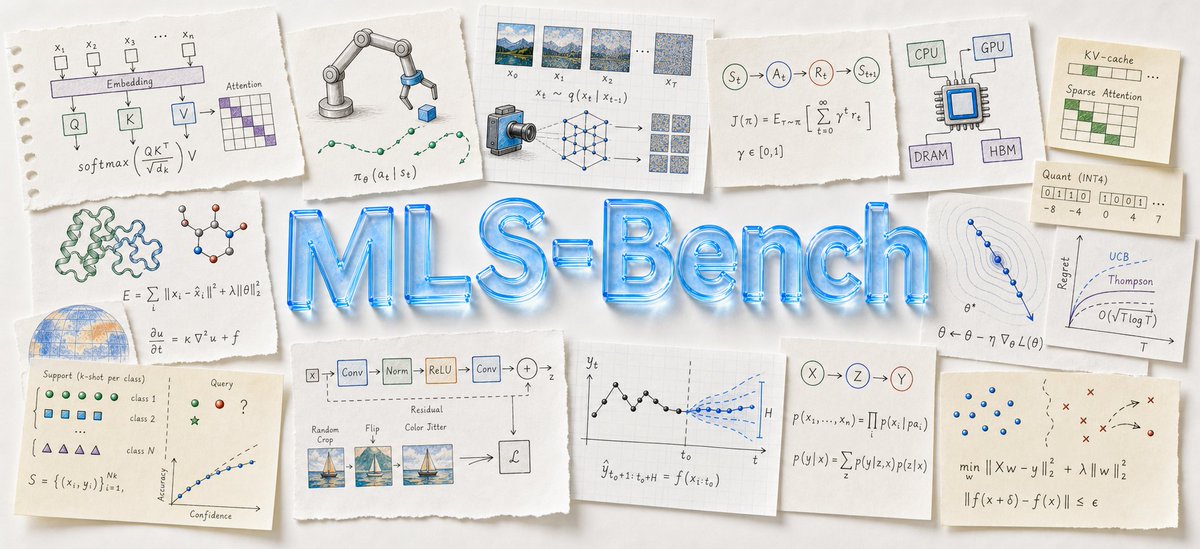
Today, after months of cross-platform validation with external teams, we're proud to introduce MLS-Bench, a benchmark for ML Science with 140 tasks across 12 ML domains. It asks whether AI systems can create scalable and generalizable ML methods, the way human researchers have pushed AI forward. (1/9)
Excited to share several recent works at #ICML2026! 🇰🇷 Happy to meet & chat about world models, video generation & data centric multimodal ML! DMs are open
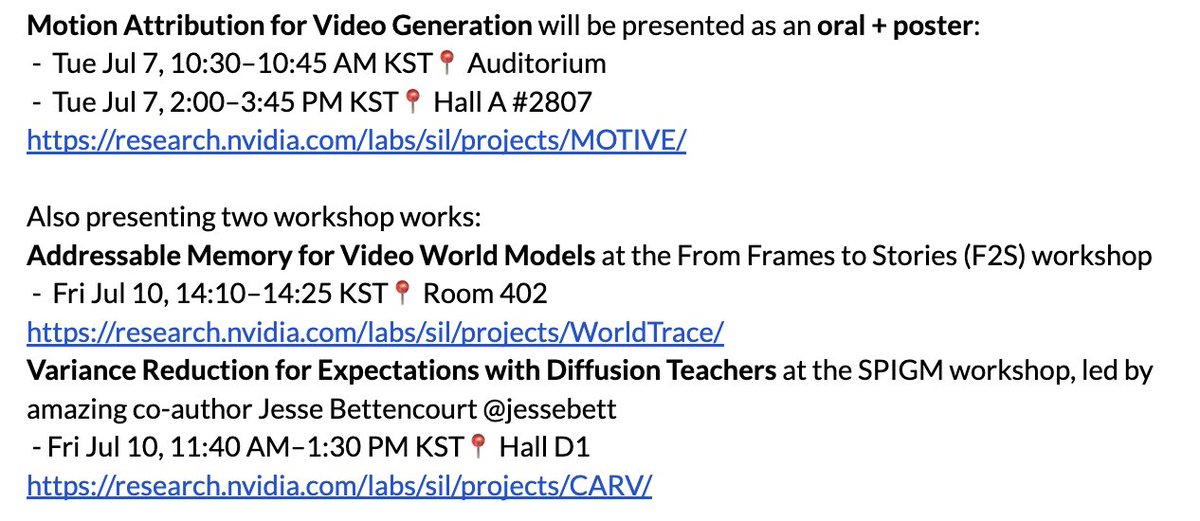
Motion Attribution for Video Generation will be presented as an oral + poster:
- Tue Jul 7, 10:30–10:45 AM KST📍Auditorium
- Tue Jul 7, 2:00–3:45 PM KST📍Hall A #2807
https://t.co/TbKXjQMN3H
Also presenting two workshop works:
Addressable Memory for Video World Models at the From Frames to Stories (F2S) workshop
- Fri Jul 10, 14:10–14:25 KST📍Room 402
https://t.co/6mmp5jKbft
Variance Reduction for Expectations with Diffusion Teachers at the SPIGM workshop, led by amazing co-author Jesse Bettencourt @jessebett
- Fri Jul 10, 11:40 AM–1:30 PM KST📍Hall D1
https://t.co/AvAsXkNk2b
https://t.co/TbKXjQMN3H
🤔Can LLMs reason by sampling continuous thoughts — not just tokens?
Introducing NF-CoT: Latent Reasoning with Normalizing Flows. It samples continuous chain-of-thoughts directly in the stream of LLM with exact likelihood -- powered by STARFlow.
🌐Page: https://t.co/yTJ8vATfJZ
Introducing MLS-Bench for machine learning science.
Auto research built on coding agents is undoubtedly another major market beyond SWE coding. It is harder and more challenging. However, we believe there are two different categories here. Auto research from @karpathy , MLE-Bench, and PostTrainBench are one type of attempt: engineering. Agents are asked to optimize a specific engineering objective, but we do not require them to produce transferable, generalizable behavior.
MLS-Bench contains 140 tasks across 12 domains. Each task requires an agent to improve a specific component of an ML system or algorithm, and to demonstrate that the improvement generalizes and scales under controlled settings. We find that current agents are still far from consistently outperforming human-designed methods, and that engineering-style tuning is much easier for them than genuine method invention.
@Lyubh22 is the lead of this project. I was deeply impressed by the way he used Discord to organize agent trajectories and share them with the team.
Paper: https://t.co/pr2DgBcQto
Code: https://t.co/mvoirci6o6
Website: https://t.co/jmJMwfgChL
Video models surprisingly can solve mazes, but inconsistently. We understand little about how they reason, making it hard to use such abilities.
We investigate the denoising process and find models commit to a plan early, letting us screen far more candidates for better perf.
🧵
How do discover #causal relationship from high-dimensional spatiotemporal data? Check out our #icml2025 paper on ``Discovering Latent Structural Causal Models from Spatiotemporal Data.''
Paper: https://t.co/wf4kTRcdEh
Code: https://t.co/bpleO04ZbZ
(1/3)