Teaching the next gen of health CEOs + backing early stage med tech ventures @MIT @UCLA @MITHackMed Father to 3 hilarious engineers and a few medical startups.
https://t.co/3BWIq8mv2F
A Framework for Autonomous AI-Driven Drug Discovery
Douglas W. Selinger, Timothy R. Wall, Eleni Stylianou, Ehab M. Khalil, Jedidiah Gaetz, Oren Levy
@plexresearch
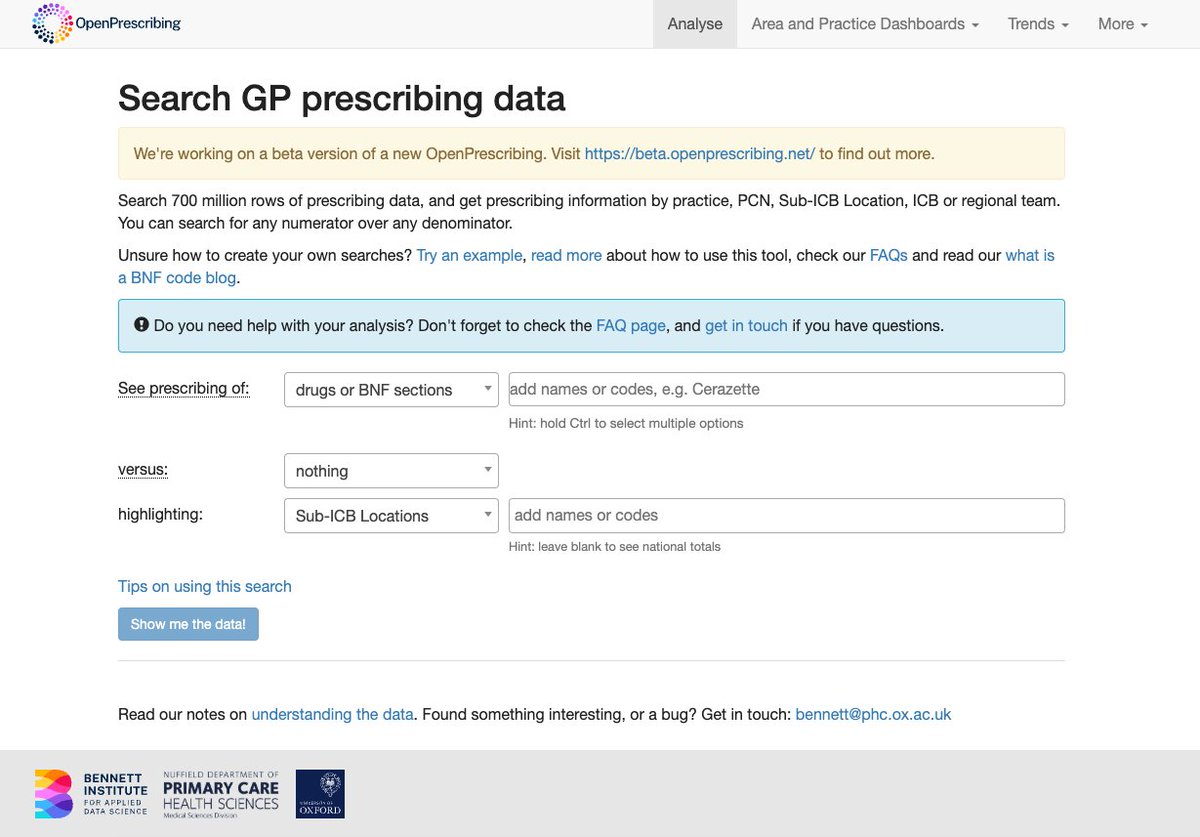
A team at Oxford built a search engine for every drug the NHS prescribes, and it has quietly saved the health service millions.
It's called OpenPrescribing.
The NHS publishes its full prescribing dataset every month. It's 700 million rows of raw numbers nobody could actually read. So Oxford built a tool that turns it into live charts in seconds.
You type a drug name. It shows you which practices over-prescribe it, which regions are slow to follow new guidelines, and where the money is being wasted.
→ Search any drug across any GP practice in England
→ Find safety and cost outliers instantly
→ 70+ ready-made quality measures
→ Updates monthly, automatically
→ Free, open source, MIT licensed
20,000 people use it every month. Doctors. Researchers. Journalists.
Public data that sat unreadable for years is now one search away.
https://t.co/U9KI0mUCAp
Excited for us to lead NewLimit's $435M Series C
Largest investment we've made into therapeutics in a long time
But what we love about @jacobkimmel & team is that they're building a company for a mega-outcome rather than just the standard Boston biotech $1b - $3b outcome
When Laura Katz founded Helaina, she wasn't just trying to build a venture-backed business. She was tackling the single most complex area of the global food chain: infant nutrition.
For decades, the fallback option for millions of families, infant formula, has left a massive compositional gap in digestibility and immune protection because it relied entirely on bovine proteins.
Today, the world's largest food company validated Laura's relentless 3-year scaling journey.
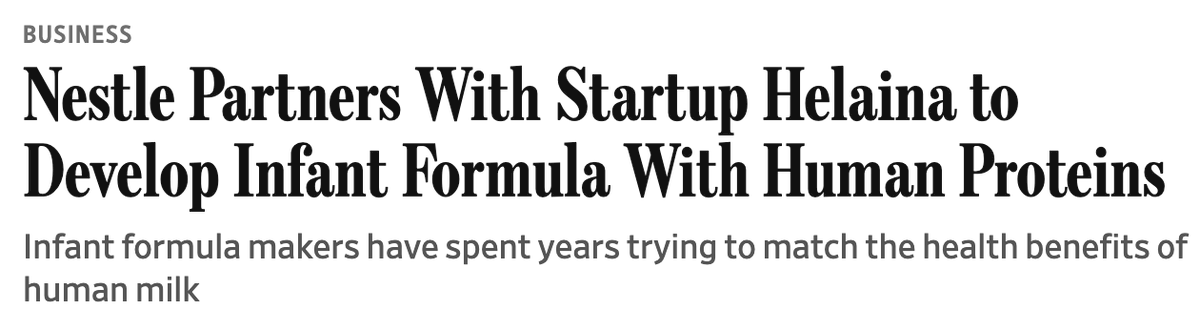
As reported on the front page of The Wall Street Journal, Helaina has officially entered a multiyear partnership with Nestlé to advance early-life nutrition through precision fermentation.
Nestlé is joining leading major supplement brands in the adult category and buying Helaina’s bioidentical human milk proteins to pioneer a completely new standard of baby formula.
The Investor's Take: People often underestimate the sheer economic leverage of proprietary biotech platforms.
If you look at the last two major infant formula partnerships driven by core ingredient innovation, they generated over $2B in enterprise value.
The difference here is that Lactoferrin is a $2B+ market that already exists today, but is strictly derived from Cows. Helaina's human identical protein is not only 10X better for humans, but it'll completely disrupt the market from a cost perspective. As a result, the number of companies adding Helaina's product to SKUs or replacing Bovine all together is exploding...and that's great for both human health and the business
This is a historic milestone for Laura, the entire Helaina team and an even bigger win for families worldwide.
Patient-first, America-first: The Case For Global Collaboration.
While the rise of Chinese biopharma in the past decade has been meteoric, I’m firmly in the camp that their engagement in the global ecosystem is good for the sector – its more opportunity than threat, great for patients, and is a healthy forcing function to raise the game for everyone
New blog link 👇
Reflections on “in-licensing” as the nucleating substrate for NewCo’s in VC-backed Biotech. It’s not new - it's been a tried-and-true component of venture creation for decades - finding great assets and starting companies around them.
~20% of our startups (out of ~50) in the 2002-2014 window (Funds VI-IX) were nucleated with in-licensed assets from Pharma at inception. None of the assets were from Chinese pharma - mostly US/EU/JPN.
~20% of our startups (~70) in the 2018-2026 window (Funds XI-XIV) were similarly nucleated with in-licensed assets at inception. A few of those began with assets from Chinese partners, but also others in US/EU/JPN
Most of what we continue to do is de novo venture creation around great science with talented entrepreneurs and founders. I suspect other early stage VCs are similar.
Reid Hoffman pledged $1B to back a secret DeepMind spinout from Google. Demis Hassabis used the leverage to pressure Google on safety oversight, but never told them the money existed and never exercised the threat. @scmallaby uncovered the story in his new book:
Re-tweeting. We need rapid policies that make USA companies more competitive and create a market mechanism that preserves patient options, while preventing harm to biotech innovation cycle.
10 years ago, this type of lung cancer was a death sentence for >95% of patients in less than 2 years. Since 2020, more than half the patients are still alive after 6 years! This is how we are curing cancer. In the next 5 years, these cure rates will greatly accelerate with AI.
The biggest cancer results from ASCO this week, ranked by how much they change a patient’s odds.
1. Colon cancer (BRAF-mutant): the combination doubled survival. Median 30.3 months vs 15.1 on the old standard. BREAKWATER. New standard of care.
2. Lung cancer (ALK+): five years out, 60% of patients on lorlatinib still hadn’t progressed. On the old drug, 8%. CROWN.
3. Lung cancer (EGFR+): amivantamab plus lazertinib cut the risk of death 25% vs the previous best pill. MARIPOSA.
4. Breast cancer (PIK3CA-mutant): gedatolisib hit its primary survival mark, beating the current targeted drug. VIKTORIA-1. Full numbers drop this week.
5. Prostate cancer (high-risk): apalutamide before surgery, the plenary headline. First efficacy readout lands this week.
6. Breast cancer (ER+): SERENA-6, the blood-test-guided drug switch, reports next.
Five years ago, half of these patients had almost nothing.
Super impressive data in cancer cachexia (which causes weight and muscle loss in advanced cancer)
A GDF15/IL6 bispecific antibody increased bodyweight (up to 25% for high dose vs. low dose), muscle mass, and appetite
Patients' main complaint was... gaining too much weight
There is a fundamental flaw with the argument: “U.S. is 70% of global profits in tx and therefore can dictate which therapies are allowed in the U.S., including excluding China assets".
The weight bearing assumption is that China’s biotech industry will not be able to sustain itself without US market.
This does not conform with reality.
Prior to 2022, Chinese biotech industry had minimal capital inflows from outlicensing / newco’s to US / Western pharma AND a very austere tx pricing environment domestically. Yet significant companies grew to dominate the domestic market, and many Chinese biotechs managed to move up the innovation curve.
Do you think that Chinese biotechs sprang up overnight in Dec 2022 when this out licensing wave started? Akeso, Keymed, Hengrui, Hansoh, Innovent, and so many others have been around for years - pretty much all of them starting off by making drugs for the domestic China market. US out licensing deals were few and far in between, and yet many of them became $ B+ or $10’s Bn companies in the process.
Furthermore, in recent months the Chinese payor market is now getting better at rewarding true innovation. 2025 NRDL reform introduced a higher pricing tier for true innovation (not me-betters). Domestic economics for first-in-class assets are getting meaningfully stronger, regardless of the exit to Western pharma path.
From a unit economics perspective, "removing the exit to the West will kill Chinese biotech progress" argument just isn’t supported by facts on the ground.
Another serious drawback to the banning argument is that presumes Chinese drugs are only me betters or me toos that are knock offs of western efforts (and will continue to be). Otherwise, the interpretation is that US patients would be ok not having access to the latest and greatest drugs.
This, too, does not conform with reality.
Chinese biotechs are now making net new innovative drugs across ADCs, in vivo CARs, genetic medicines and many more modalities, going after novel targets, payloads, and incorporating delivery tech that we have not seen here in the west; and if they work clinically - US patients will want access to as they will improve the clinical treatment paradigm.
I have spoken to the Chinese biotech CEOs and seen these programs. Some will work and some won’t (that’s just drug discovery), but they are coming, and there is no use in arguing about it.
Do you think it will be acceptable that US patients will not have access to best in class / first in class drugs?
so to summarize: in the US, we have an industry that is *losing* pricing power (no matter if R or Ds are in power, tx pricing pressure is on the docket), trying to keep drugs being made from a country with *increasing* pricing power (based on government support) out, at a time when those drugs are increasingly innovative.
Who do you think the actual loser from this is going to be?
US patients.
all this to say: the back and forth arguing is a moot point, the innovation is coming **whether we like it or not**.
I’d suggest we in the US get busy competing, investing in innovative science, deregulating trials, and doing less belly aching.
Patients, American and otherwise, are waiting.
Sending Americans who are exposed to or infected with Ebola to Kenya (instead of bringing them home) is an extraordinarily bad idea and it will backfire
On the surface -- it seems smart. Why not send people elsewhere instead of bringing them home
For three reasons actually
🧵
Could we get a room-temp superconductor from bio? What about chips built from biological materials?
For decades people have been predicting a material science revolution from biotech. So far it's not panned out.
But George Church, the godfather of modern synthetic biology, believes that will change soon.
We need an Innovation Review Voucher, where a USA innovator (not others) can apply, based on their innovation in a drug category or molecule, for super fast regulatory approval, AND a transferable and subdividable 3 year commercial exclusivity, which covers the structure and close derivatives.
Applications would be 90 day decisions, with a standard that a reasonable person would conclude that the technology was used or copied by the entity. In practice, this should prevent USA innovation from being decimated via less funding flowing in (which hurts patients in the long run), and if the commercial delay is critically important the vouchers are tradeable, and can be granted to more than one party at the discretion of the holder, so patients are protected.
Prob have like ARPA H like structure or some new DOC panel to do it.
The p-tau217 breakthrough blood test replicated again, predicting Alzheimer's disease in a large cohort mean age 61. The cover of the new issue is telling @TheLancet https://t.co/Qre6mCkpMV
I didn't know that a simple tool that I built would have an impact like this!
Last week, I built an AI tumor board, something to help me in my clinic to pull the most recent literature and approach a patient from multiple views, similar to what we do in a real-life tumor board, given the current clinical decision support tools lack that
To my surprise, this tool is being used in second- and third-world countries and places where they don't have access to Doximity and OpenEvidence
It's so satisfying to see that I'm able to help oncologists in other parts of the world!
I am not sure how long I can sustain this, but feel free to share this, and I will keep paying the tokens' price for now.
By the way, you don't need an account, and we don't save any data. This is a very simple user interface with a smart and simple backend
if you are a developer would love your thoughts on the GitHub.
https://t.co/O3j0Orp2Ts