I'm 100% Codex pilled now
Been using Codex and Claude Code side by side hours a day for 2 months straight
No longer using them side by side. Codex has become incredible
What did it for me is the self testing. Every change it makes it self tests in it's own browser
I went from about 40% of my changes being buggy on first go to at most 3% maybe? So much more reliable and allows me to get in an awesome flow state
Listen, Claude can literally drop an update tomorrow that changes all of this, but for now I'm really blown away by Codex
Do yourself a favor and don't have loyalty to any company. Use every tool. Use whatever is the best at the moment. Switch whenever they're no longer the best. No point in tribalism
But at the moment I'm REALLY enjoying my time with Codex
I didn't think it would happen this soon..
But the white-collar AI bloodbath is here.
This month alone:
• Ken Griffin, Citadel CEO (May 5): "extraordinarily high-skilled jobs being automated by agentic AI," - said he went home "fairly depressed." Was an AI skeptic in January.
• Brian Armstrong, Coinbase CEO (May 5): cut 14% of staff (~700). "engineers use AI to ship in days what used to take a team weeks."
• PayPal (May 5): planning to cut ~4,760 jobs (20%). CFO cited AI + automation on the earnings call.
• Mark Zuckerberg (one week earlier): told 8,000 staff their layoffs were a "direct consequence" of the $145B AI infrastructure bill.
• Cloudflare (May 7): cut 1,100 jobs (20%) - first mass layoff in 16 yrs - despite revenue +34% YoY. Internal AI usage up "more than 600% in the last three months alone."
• BILL (May 7): up to 30% workforce cut.
• Upwork (May 7): ~25% workforce cut.
• Cisco (May 13): cut 4,000 jobs. Stock popped 15% on surging AI orders.
• LinkedIn (May 13): cut 875 staff (5%). The platform that tracks the job market is laying off its own.
First the farm. Then the factory. Now the office?
2 days ago Elon released the new X algorithm
Since then I have read all ~22,000 lines of code 8 times over. Skipping almost every meal
Here are the 8 things I learned:
1. Followers mean basically nothing. Small accounts can now get more engagement than large accounts. It's just about the quality of your content
2. AI slop is dead. There is literally a slop detector built in. Stop posting AI videos of fairies fighting dragons
3. Undisclosed advertisements will DESTROY your reach. X is picking up on this now. Play by the rules and label your posts appropriately
4. Spamming the timeline is pointless. Every subsequent post during a day is shown on the timeline less
5. Microniches are everything. Become an expert at a microniche. Stick to it. Create valuable content on it. You'll blow up
6. X wants to eliminate toxicity. If you’re consistently attacking or trolling others the algorithm will pick up on it
7. It’s all about retention. If you create content that keeps people on it for a long time, you will get engagement no matter what your follower count is.
8. X is a video first platform. Videos are being push more than ever. It’s time for you to start making videos
All of these previous rules come down to one thing. Don’t game the system. Don’t be a jerk. Raise the vibrations of X.
If you’re only goal is to create engagement, you’re going to lose.
If you’re goal is to create great content and generate conversation, you’re going to win
This is an email I sent earlier today to all employees at Coinbase:
Team,
Today I’ve made the difficult decision to reduce the size of Coinbase by ~14%. I want to walk you through why we're doing this now, what it means for those affected, and how this positions us for the future.
Why now
Two forces are converging at the same time. We need to be front footed to respond to both.
First, the market. Coinbase is well-capitalized, has diversified revenue streams, and is well-positioned to weather any storm. Crypto is also on the verge of the next wave of adoption, with stablecoins, prediction markets, tokenization, and more taking off. However, our business is still volatile from quarter to quarter. While we've managed through that cyclicality many times before and come out stronger on the other side, we’re currently in a down market and need to adjust our cost structure now so that we emerge from this period leaner, faster, and more efficient for our next phase of growth.
Second, AI is changing how we work. Over the past year, I’ve watched engineers use AI to ship in days what used to take a team weeks. Non-technical teams are now shipping production code and many of our workflows are being automated. The pace of what's possible with a small, focused team has changed dramatically, and it's accelerating every day.
All of this has led us to an inflection point, not just for Coinbase, but for every company. The biggest risk now is not taking action. We are adjusting early and deliberately to rebuild Coinbase to be lean, fast, and AI-native. We need to return to the speed and focus of our startup founding, with AI at our core.
What this means
To get there, we are not just reducing headcount and cutting costs, we’re fundamentally changing how we operate: rebuilding Coinbase as an intelligence, with humans around the edge aligning it. What does this mean in practice?
- Fewer layers, faster decisions: We are flattening our org structure to 5 layers max below CEO/COO. Layers slow things down and create coordination tax. The future is small, high context teams that can move quickly. Leaders will own much more, with as many as 15+ direct reports. Fewer layers also means a leaner cost structure that is built to perform through all market cycles.
- No pure managers: Every leader at Coinbase must also be a strong and active individual contributor. Managers should be like player-coaches, getting their hands dirty alongside their teams.
- AI-native pods: We’ll be concentrating around AI-native talent who can manage fleets of agents to drive outsized impact. We’ll also be experimenting with reduced pod sizes, including “one person teams” with engineers, designers, and product managers all in one role.
In short: AI is bringing a profound shift in how companies operate, and we’re reshaping Coinbase to lead in this new era. This is a new way of working, and we need to leverage AI across every facet of our jobs.
To those who are affected
I know there are real people behind these decisions — talented colleagues who have poured themselves into this company and our mission. To those of you who will be leaving: thank you. You’ve helped build Coinbase into what it is today, and I am sincerely grateful for everything you've done.
All impacted team members will receive an email to their personal account in the next hour with more information, and an invitation to meet with an HRBP and a senior leader in your organization. Coinbase system access has been removed today. I know this feels sudden and harsh, but it is the only responsible choice given our duty to protect customer information.
To those affected, we will be providing a comprehensive package to support you through this transition. US employees will receive a minimum of 16 weeks base pay (plus 2 weeks per year worked), their next equity vest, and 6 months of COBRA. Employees on a work visa will get extra transition support. Those outside of the US will receive similar support, based on local factors and subject to any consultation requirements.
Coinbase prides itself on talent density. Our employees are among the most talented people in the world, and I have no doubt that your skills and experience will be highly sought after as you pursue your next chapters.
How we move forward
To the team that is staying, I know this is a difficult day. We’re saying goodbye to colleagues and friends you've been in the trenches with. But here’s what I want you to know as we move forward together:
Over the past 13 years, we have weathered four crypto winters, gone public, and built the most trusted platform in our industry. We’ve made it this far by making hard decisions and by always staying focused on our mission. This time will be no different – nothing has changed about the long term outlook of our company or industry. And most importantly, our mission has never been more important for the world. Increasing economic freedom requires a new financial system, and we’re building it.
The Coinbase that emerges from this will be more capable than ever to achieve our mission.
Brian
Announcing Cofounder 2: Run an entire company with agents.
It's the infrastructure for the one person billion dollar company - orchestrating agents across engineering, sales, marketing, ops, and design.
(and yes that's my real grandma in the video)
I'm 22 years old and Claude Code is deteriorating my brain.
Every single day for the last 6 months I've had 6 to 8 Claude Code terminals open, waiting for a response just so I can hit 'enter' 75% of the time. And it's doing something to me.
In convos with a couple of friends, it's been a point that's been brought up pretty frequently.
None of us feel as sharp as we used to.
I don't know if it's just us, or others in their 20s are feeling the same thing, but it's something I've been thinking about a lot.
P.S. I know this is a problem with my reliability/usage of it, not Claude Code itself, but the effects are real nonetheless
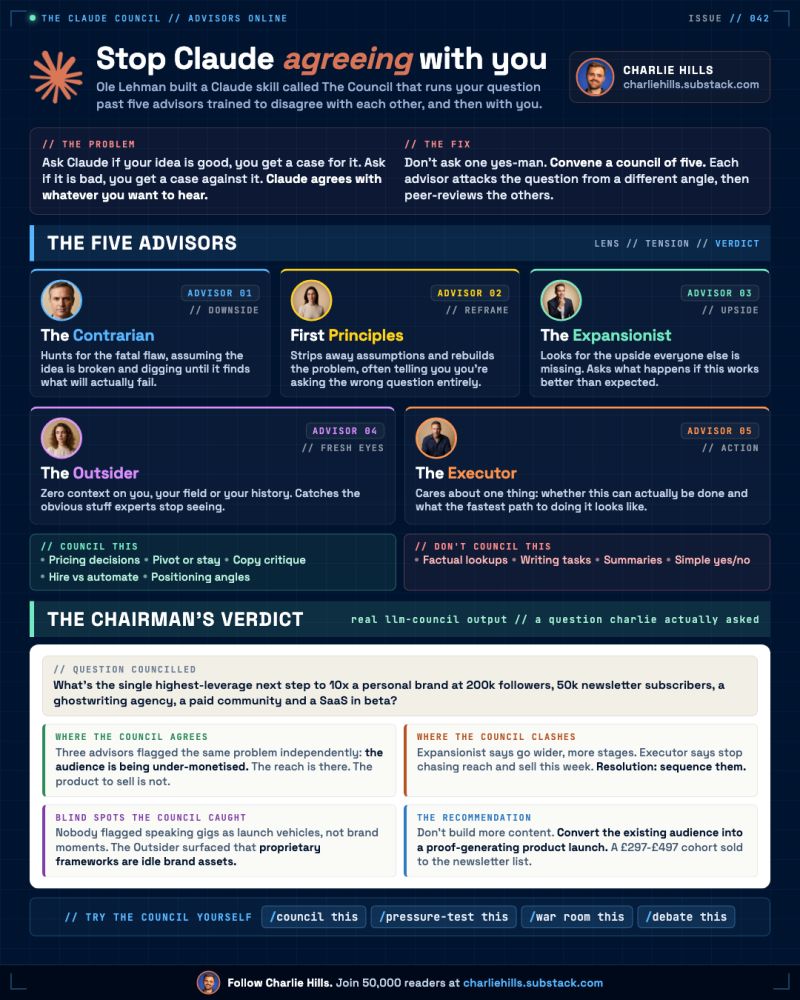
Claude will gaslight you, until you install this skill.
It's called The LLM Council.
You ask a question. 5 advisors attack it from different angles. Then they peer-review each other before giving you the verdict.
How it works:
1. You ask a real decision question.
2. 5 advisors attack it from different angles.
3. They grade each other's work anonymously.
4. Chairman synthesises one verdict and the next step.
Install in 4 steps:
1. Download the skill
https://t.co/mnpPNSnDXu
2. Open Customise skills in Claude
3. Upload the SKILL.md file
4. Type /llm-council
One Claude tells you you're right.
Five Claudes show you where you're wrong.
Get more free AI guides here https://t.co/1F12fOTjss
Repost ♻️ to help someone in your network.
P.S. Credit to Ole Lehmann for building it.
i'm done. codex is fucking incredible
after heavily using claude code for over 13 months, i've moved to codex
opus 4.7 is painfully slow and takes 5-10 mins for a one-liner. the app is super buggy and flickers constantly. low thinking is useless. and they keep nerfing the model for some reason??
codex's new app is genuinely beautiful and gpt-5.5 thinking-medium is the perfect balance
ngl @sama you cooked on this one
Jack Dorsey, co-founder of Twitter (now X) and Block, on why treating AI as a "copilot" is a losing strategy:
@jack argues that most companies are approaching AI in a way that will make it nearly impossible for them to survive.
"I think most of the industry is thinking about AI as like a co-pilot, as something that is augmented onto, rather than like how do you just rebuild our whole company with this as the core."
His concern is that bolting AI onto existing structures produces companies that look indistinguishable from each other, and from the AI labs themselves.
"If it doesn't make sense for your business to do that and you end up being or looking very similar or rhyming too closely with the frontier labs, then I think it's going to be very, very challenging to differentiate and survive."
This thinking has been driving his decisions since early 2024, when these tools "really came to bear."
That's when his team began building Goose, an agent coding harness, as part of a broader effort to rebuild around AI rather than layer it on top.
The core insight?
Speeding up old workflows with AI is a short-term gain every competitor will match. Real differentiation comes from rebuilding the company itself around intelligence.
My biggest takeaways from Claude Code's Head of Product @_catwu:
1. Anthropic’s product development timelines have gone from six months to one month, sometimes one week, sometimes one day. Part of this acceleration is access to the latest models (i.e. Mythos). Another is shipping new products into “research preview,” making clear it's early, experimental, and might not be supported forever. Another is an evergreen "launch room "where engineers post ready features and marketing turns around announcements the next day.
2. The PM role is shifting from coordinating multi-month roadmaps to enabling teams to ship daily. As Cat puts it, “There should be less emphasis on making sure you are aligning your multi-quarter roadmaps with your partner teams and more emphasis on, OK, how can we figure out the fastest way to get something out the door?”
3. The most efficient shipping unit is an engineer with great product taste. On Cat’s team, many engineers go end-to-end—from seeing user feedback on Twitter to shipping a product by the end of the week—without a PM involved. Also, almost all the PMs on the Claude Code team have either been engineers or ship code themselves, and the designers have been front-end engineers. The roles are merging, and the most valuable skill is product taste, not job title.
4. Build products that are on the edge of working. Claude Code’s code review product failed multiple times because earlier models weren’t accurate enough. But because the prototype was already built, they could swap in Opus 4.5 and 4.6 and immediately test whether the gap was closed. Teams that wait for the model to be ready will always be a cycle behind.
5. The most underrated skill for building AI products is asking the model to introspect on its own mistakes. Cat regularly asks the model why it made an unexpected decision. The model will explain that something in the system prompt was confusing, or that it delegated verification to a subagent that didn’t check its work. This reveals what misled the model so the team can fix the harness.
6. Every model release forces their team to revisit existing products and audit their system prompt to remove features the model no longer needs. Claude Code’s to-do list was a crutch for earlier models that couldn’t track their own work. With Opus 4, the model handles it natively. Features built as scaffolding for weaker models become debt when the model catches up—so the team actively strips them.
7. Anthropic employees build custom internal tools instead of buying SaaS products. A sales team member built a web app that pulls from Salesforce, Gong, and call notes to auto-customize pitch decks—work that used to take 20 to 30 minutes now takes seconds. Their core stack is Claude Code, Cowork, and Slack. No Notion, no Linear, no Figma.
8. People underestimate how much Claude’s personality contributes to its success. As Cat describes it, “When you reflect on everyone you’ve worked with, there’s just some people where you’re like, I really like their energy, their vibe.” Claude is designed to be low-ego, positive, competent, and earnest—qualities that make it feel like a great coworker, not just a tool. This isn’t cosmetic; it’s what makes people want to use Claude for hours every day. The team has a dedicated person, Amanda, who “molds Claude’s character,” and it’s one of the hardest roles at the company because success is so subjective.
9. The future of work is managing fleets of AI agents, not doing the work yourself. Cat sees a clear progression: first, individual tasks become successful. Then people start running multiple tasks at the same time (multi-Clauding). Next, people will run 50 or 100 tasks simultaneously, which will require new infrastructure—remote execution, better interfaces for managing tasks, agents that fully verify their work, and self-improving systems that incorporate feedback. The human role shifts from doing the work to knowing which tasks to look into, verifying outputs, and giving feedback that makes the system better over time.
10. Hire people who lean into chaos and face every challenge with a smile. At Anthropic, there are weeks when a P0 on Sunday becomes a P00 by Monday and a P000 by Monday afternoon. If you get too stressed about any one thing, you’ll burn out. Their team looks for people who can look at a hard challenge and say, “Wow, that’s gonna be hard. But I’m excited to tackle it and I’m gonna do the best that I possibly can.” This mindset—optimism, resilience, and comfort with constant change—is increasingly essential as the pace of AI development accelerates.
Don't miss the full conversation: https://t.co/1wOUHcdYQN
Qwen 3.6 27B + Pi on a MacBook Pro, fully local: a beast.
27B dense model, flagship-level agentic coding, running entirely on hardware in your hands. Speed is impressive, Utility is extremely high. It punches orders of magnitude above its weight.
Local AI is getting real.
This is where we are right now. And i’m not gonna lie it feels pretty magical 🧚♀️
Qwen3.6 27B running inside of Pi coding agent via Llama.cpp on the MacBook Pro
For non-trivial tasks on the @huggingface codebases, this feels very, very close to hitting the latest Opus in Claude Code, or whatever shiny monopolistic closed source API of the day is.
In full airplane mode.
Most people haven’t realized this yet.
If you have, it means you have a huge headstart to what I call the second revolution of AI.
Powerful local models for efficiency, security, privacy, sovereignty 🔥
The Local LLM cheat sheet for your 16GB RAM device
I pulled together a lineup of small models that can run comfortably on a Mac Mini or personal laptop while still leaving room for context without melting your machine.
Models for Daily Use
Qwen3.5 9B / GGUF / Q4_K_M
Daily driver. General chat, drafting, research, translation. If you're keeping only one, keep this.
DeepSeek-R1 Distill Qwen 7B / GGUF / Q4_K_M
Reasoning engine. Math, logic, step-by-step problems. Slower, but worth it when you need actual thinking.
Models for Specialty Work
Qwen2.5 Coder 7B / GGUF / Q4_K_M
Code specialist. Completions, refactors, debugging, repo Q&A. Better than a generalist when the task is code.
Llama 3.1 8B / GGUF / Q4_K_M
Long context worker. RAG, doc chat, codebase Q and A. The output isn't top tier, but the context is strong for its size.
Phi-4 Mini Reasoning / GGUF / Q4_K_M
Compact thinker. Logic, structured answers, math, and short coding bursts. Smaller context is the catch.
Models for Efficiency
Gemma 4 E4B / GGUF / Q4_K_M
Light all-rounder. Writing, chat, light agents, structured output.
Phi-3.5 Mini / GGUF / Q5_K_M
Pocket sidekick. Summaries, extraction, background doc chat. Easy to pair with a bigger model.
Qwen3.5 2B / GGUF / Q4_K_M
Useful for summaries, tagging, rewrites, and lightweight sidekick work.
Micro Models
Qwen3.5 0.8B / GGUF / Q5_K_M
Classification, keyword routing, binary decisions, triage.
Gemma 4 E2B-it / GGUF / Q4_K_M
Lightweight chat, quick Q and A, summaries, tiny agents.
My personal choice for a single model is Qwen3.5 9B
For two models use Qwen3.5 9B + Qwen2.5 Coder 7B for code, or Qwen3.5 9B + Phi-3.5 Mini for support tasks.
Let me know in the comments your experience with these models, or any I have left out.
Claude Design is incredible
It allows ANYONE to design BEAUTIFUL apps and websites
But here's the thing, when combined with ChatGPT's new image model it's 10x better
In this video I cover how to use Claude Design and ChatGPT Image 2 together to design BEAUTIFUL apps:
Introducing USVC - a single basket of high-growth venture capital, for everyone.
No accreditation required, SEC-registered, and a very low $500 minimum.
Includes OpenAI, Anthropic, xAI, Sierra, Crusoe, Legora, and Vercel. As USVC adds more companies, investors will own a piece of that too.
Liquidity typically comes when companies exit, but we’re aiming to let investors redeem up to 5% of the fund every quarter. This isn’t guaranteed, but if we can make it work, you won’t be locked up like in a traditional venture fund.
It runs on AngelList, which already supports $125 billion of investor capital.
And I’ve joined USVC as the Chairman of its Investment Committee.
—
Go back to the 1500s, you set sail for the new world to find tons of gold - that was adventure capital.
Early-stage technology is the modern version. It says we are going to create something new, and it’s risky. It’s daring.
But ordinary people can’t invest until it’s old, until it’s no longer interesting, until everybody has access to it. By the time a stock IPOs, most of the alpha is gone. The adventure is gone. Public market investors are literally last in line.
This problem has become farcical in the last decade. Startups are reaching trillion dollar valuations in the private markets while ordinary investors have their noses up to the glass, wondering when they’ll be let in.
Investing in private markets isn’t easy. You need feet on the ground. You need judgment built over years. Most people don’t have the patience to wait ten or twenty years for an investment to come to fruition.
But there is no more productive, harder-working way to deploy a dollar than in true venture capital.
USVC enables you to invest in venture capital in a broad, accessible, professionally-managed way, through a single basket of innovation, focused on high-growth startups, at all stages.
It is how you bet on the future of tech: the smartest young people in the world, working insane hours, leveraged to the max, with code, hardware, capital, media, and community. Your dollar doesn’t work harder anywhere.
There is an old line - in the future, either you are telling a computer what to do, or a computer is telling you what to do. You don’t want to be on the wrong side of that transaction.
USVC lets you buy the future, but you buy it now. Then you wait, and if you are right, you get paid.
Get access here:
https://t.co/pAj1sqUsG0