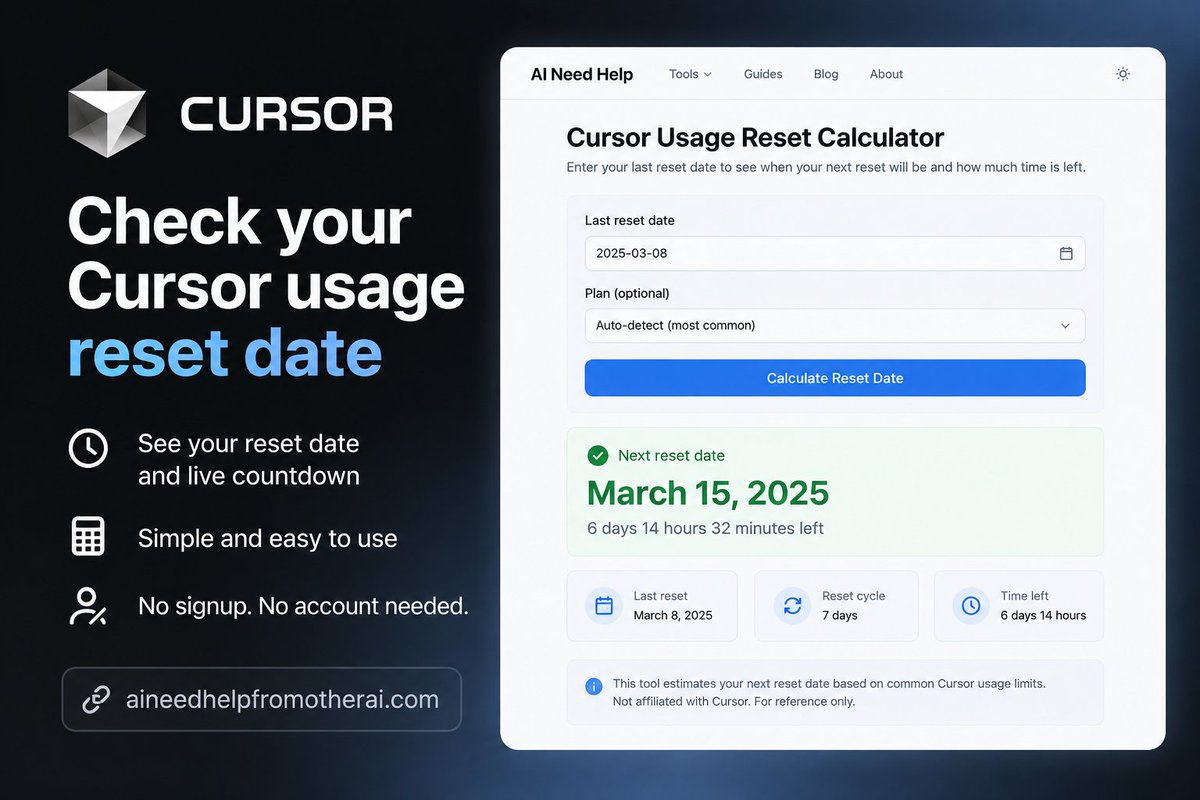
Cursor usage reset confusing?
I built a free calculator that shows your reset date and live countdown.
No signup. No account needed.
https://t.co/n4YHaKnCtZ
@grrajan The seam I see break first isn't model→tool. It's the contract boundary — the schema the agent reads. One ambiguous field name and it fills the gap with a confident guess, then fires a call you never sanctioned. The handoff teams debug last is the one that does the most damage.
I shipped a tool last month and watched two completely different users land on it.
The human spent 4 minutes. Scrolled the landing page, read the feature bullets, hovered the pricing card, clicked around the demo, then signed up. Standard funnel, the one every product team optimizes.
The agent spent 0.6 seconds. It never rendered the page. It fetched the openapi.json schema, checked which endpoints were authenticated, picked the two it needed, and called them directly. My onboarding flow — the thing I spent two weeks polishing — was skipped entirely.
This is the shift nobody on my timeline is naming clearly enough: in 2026 you are not building one product. You are building two. One for humans who judge you on UI, trust signals, and copy. One for agents who judge you on schema cleanliness, auth simplicity, and latency.
The brutal part: the agent is the higher-leverage user. One human signs up once. One agent integrates you into a pipeline that runs a thousand times a day, and if your schema is ugly it will route around you in the next prompt without ever telling you why.
I used to put the pretty docs first and the API second. I've flipped it. The schema is now the front door. The landing page is the side entrance for people who like animations.
The teams still spending 90% of design budget on the human funnel and 0% on the agent surface are going to wake up to a traffic graph they can't explain.
@mtmjr77 Fair on bank access. But the line isn't "AI touches money," it's read vs write vs irrevocable. A read-only agent flagging duplicate charges is useful. An agent moving funds without a human tap-to-confirm is the one to refuse. Scope, not the AI.
@VicMGil The mascot isn't the risk, the scope model is. Most agent frameworks hand out full filesystem + account access as one blob, no per-action confirm. The gap isn't alignment — "read your inbox" and "send a wire" share one permission toggle.
@demisama_ For reuse across tasks, the pattern that held up for me: serialize every finished task as a skill = {intent, steps, gotchas}, then retrieve by intent similarity before acting. Reuse isn't copying steps — it's pulling the right failure-notes so you don't repeat them.
Source for the bridge I mentioned — open source: https://t.co/4DHpVLLBJV. Lets web ChatGPT read/write/run a local working dir via MCP. Scope it to one throwaway folder first.
I keep paying for three AI coding tools and only using one model.
When a refactor gets ugly, I still paste the mess into web ChatGPT — because that model, in that textbox, thinks better than the agents wired into my editor.
The tradeoff bugged me for months: the best model lives in a tab that can't touch your files. The agents that can touch your files run a weaker brain. So you copy, paste, copy back, and lose half the context every round trip.
Someone open-sourced a fix this week — a small Windows app that exposes local MCP to the web ChatGPT tab. Pick a working directory and the chat can read, write, run commands, and iterate inside that folder without you touching a terminal. No Codex quota, no CLI babysitting.
The interesting part isn't the tool. It's what it proves: the bottleneck was never the model or the editor, it was the bridge between them. The labs built walled gardens — web chat here, CLI agent there, editor over there — none talk to each other, so power users stitch the pieces with a local bridge.
Three things I'd watch:
1. You're handing a browser tab write access to a real folder. Scope it to one throwaway project dir, not your home folder — the same trick that runs your project can delete the wrong path on a bad day.
2. Ban risk is real and unanswered. ChatGPT's terms weren't written for "browser tab that controls my filesystem."
3. Bridges like this have a short shelf life. Once a lab ships native local-file access for web chat — and one will this year — every community bridge becomes tech debt overnight.
Treat it as scaffolding, not infrastructure. The model and the hands are about to merge; the only question is which lab does it first.
@AIsmiley_inc Sol at 1/5 of Astra's price is the real headline: labs now compete on cost-per-task, not benchmarks. Great for API bills. Awkward for everyone who paid /mo expecting Astra headroom.
@eduardadotai Cheaper model at 1/5 the price is the soft cap: same subscription, quietly smaller compute. The Pro plan that returned Sept 29 already shipped with half the Astra headroom. Unlimited now means unlimited access to the cheap tier.
@garberchov The 60%-with-2-days-left math is the new normal. Codex moved resets to a fixed global schedule (tomorrow 10am PST) and now everyone batches real work into the same windows. The cap didn't reduce usage, it just rescheduled it.
Codex resets tomorrow 10am PST. My timeline is people sprinting to burn leftover quota.
Limits didn't make us use AI less. They turned us into quota accountants, planning real work around reset windows.
The scarce resource was never compute. It's your Tuesday.
@JustinNgien That 'model at capacity' wall is mostly a peak-hour problem, not a plan problem — everyone hits the same lane at once. I moved my heavy Codex runs to off-peak (late-night / weekend US) and the errors all but vanished. $200 doesn't buy a queue jump, just the same shared lane.
92% of the MCP servers on the popular lists wrap a single API call nobody asked for.
Same skeleton every time: a README, one tool definition, a demo that works on the first prompt, then it ghosts on the second request. I stopped counting at 40 installs.
The ones that earned a permanent slot in my config do the boring thing — they hand the model dense, structured context it couldn't fetch on its own. Not "search GitHub." More like "return my repo's open PR diffs with CI status attached." Context engineering, not tool glitter.
If your MCP server's entire pitch is "now the model can call X," the model could already call X. You deleted two lines of code and shipped a dependency.
The servers worth keeping feel less like new tools and more like a better memory.
@madebymochi benchmarks tell you who won today. tooling tells you who ships tomorrow. an open Ascend dev path means the second ecosystem grows by community PRs instead of vendor promises - that compounds differently
this is the part that matters. FlashMLA and DeepGEMM already had real fork velocity from the OSS community - porting that same maintainer energy to Ascend kernels turns 'China-only workaround' into an actual second ecosystem. watching whether the Ascend PRs land as first-class CI or just compat shims