A Brown professor gave his students a take-home midterm exam. After suspecting many cheated using AI, he made the final in-person. The orange dots are the midterm scores and the gray dots are the final scores. Looks like all but 3 cheated on the midterm.
If you want to start a startup, don't learn "entrepreneurship." Learn how to build things. The hard part of startups is not "entrepreneurship" but product: to know what to build, and to be able to build it.
There are layers of working with AI. Prompt engineering. Context engineering. Harness engineering. Loop engineering.
Layer 1 is prompt engineering. What you type into the chat window. How you word the instruction, what you ask for, what you tell it to avoid. This is where everyone starts. It matters, but few people go further.
Layer 2 is context engineering. Everything the model sees before your prompt. System instructions, reference files, conversation history, examples of good output. A mediocre prompt with great context beats a great prompt with no context every time.
Layer 3 is harness engineering. The code around the model. Tool routing, verification steps, retry logic, structured outputs. This is what makes AI reliable instead of just impressive. When the model checks its own work before returning it to you, that's the harness.
Layer 4 is loop engineering. The system runs itself. You set a goal and a stop condition. The loop prompts the model, checks the output, adjusts, and repeats without you. This is where you stop being the bottleneck entirely.
Each layer wraps the one before it. Better prompts help, but without context the model guesses. Context helps, but without a harness the output is inconsistent. A harness helps, but without a loop you're still manually triggering every run.
Full setup guide for all 4 layers using Fable 5 below.
Don't train the model, evolve the harness.
I read a brilliant blog post from Hugging Face where they took a frozen open model scoring 0% on a hard legal agent benchmark, left its weights alone, and let an automated loop rewrite only the code around it.
That code layer is the harness, the runtime wrapper that feeds the model context, runs its tool calls, and decides when a run ends.
By the time the loop finished, the system had essentially matched Sonnet 4.6 on the benchmark's headline metric, at roughly 7x lower cost per task. Zero weights changed.
The gain existed because of where the model was failing. The judge only grades files saved in the right place under the exact requested filename, and the model kept doing the legal analysis correctly, then saving it under the wrong name, dropping it in a scratch folder, or never writing it at all.
So the 0% was never measuring legal reasoning. It was measuring the harness.
Hand-tuning that layer is slow and model-specific, so they automated it. A Claude proposer adds exactly one mechanism per iteration, and an outer loop keeps it only if it clearly beats the current best, so accepted mechanisms compound.
What the loop discovered says a lot about where agents actually fail.
→ The biggest single gain was file handling, not intelligence. An automatic step that lands the deliverable exactly where the judge expects it beat every prompt change, with zero extra model tokens.
→ Code fixes transferred across models, prompt playbooks did not. The same harness lifted a smaller model from the same family by 14 points, but the tuned prompts hurt a different model family on tasks it could already finish.
→ The harness mattered more than anything else. Same model, same judge, same tasks, and five different harnesses scored anywhere between 3.5% and 80.1%.
The gains do eventually flatten, and the remaining misses look like real capability gaps. At some point the wrapper runs out of tricks and the model has to carry the work.
But the lesson holds. A benchmark score measures the model and its harness together, and until the harness is fixed, it's impossible to know which one failed.
I highly recommend reading this: https://t.co/3ZIeKhsngn
I also wrote a deep dive on agent harness engineering a while back, covering the orchestration loop, tools, memory, context management, and everything that turns a stateless LLM into a capable agent.
The article is quoted below.
일론이 '맞다'고 말한 안드레 카파시의 학생들에 대한 조언
요약 : 학교에서 학점을 완벽하게 받는 것에 집착하지 말고, 모든 과목에서 85점 정도만 받고 나머지 시간과 에너지는 세상으로 나가서 실전경험을 쌓고 무언가를 만들고 그것을 블로그 등에 기록하는데 집중하라
"학부생의 시야 협착과 성적의 실체
학부생은 수업에 대해 편협한 시야를 갖는 경향이 있음. 좋은 성적을 받는 것 등에 집착함. 깨달아야 할 핵심적인 사실은 성적이 아주 나쁘지 않은 이상 아무도 네 성적에 신경 쓰지 않는다는 것임. 예를 들어 나는 가장 똑똑한 학생은 모든 과목에서 85퍼센트를 받는 학생이라고 항상 말하곤 했음. 이렇게 하면 4.0 정도의 점수를 얻으면서도 과도하게 공부하지 않고 부족하지도 않게 공부하게 됨.
시간 자원의 전략적 배분과 우선순위
네 시간은 소중하고 한정된 자원임. 시험을 망치지 않을 정도의 수준에 도달하고 나면 훨씬 더 중요한 일들로 관심을 돌려야 함. 그 일들이 무엇인지 묻는다면 다음과 같음.
실무 경험의 중요성과 기록의 가치
시시한 수업 과제 밖에서 실제 코드 베이스를 다루고 프로젝트를 하거나 문제를 해결하며 실제 세상을 경험하는 것이 극도로 중요함. 세상 밖으로 나가서 멋진 무언가를 만들거나 만드는 것을 도와야 함. 그것을 잘 문서화하고 블로그에 기록해야 함. 이것들이 몇 년 뒤 사람들이 진정으로 관심을 가질 대상임. 네 성적은 그 과정에서 처리해야 할 성가신 일일 뿐임. 시간을 잘 활용하고 행운을 빎"
Andrej’s 2025 LLM Review is the PewDiePie YouTube Rewind of AI.
His naming superpower is unmatched. 2 tweets. 2 most influential AI terms of the year:
- “Vibe coding”
- “Jagged Intelligence”
#Apple announces the new Mac mini!
Featuring Apple Intelligence, in a 5x5” chassis.
The new Mac mini comes with:
- M4 Chip
- 2 USBC ports on the front
- HDMI, Ethernet, & 3 Thunderbolt ports on the back
- New design & thermal architecture
What do you think? 👀
FSD v12.5.6.1 with E2E highway is great. Much smoother lane changes, no more significant lateral g-load when taking exits, and much better about getting out of the way for faster traffic. Great progress by @Tesla@Tesla_AI team! Unsupervised is likely closer than we think.
This from a really nice review @NeuroCellPress (doi below) on Neurobehavioral meaning of pupil size. How far are we from measuring these things via phone cameras along with eye tracking to match content foraging, physiology & dwell times etc. ?
Seems doable & valuable.
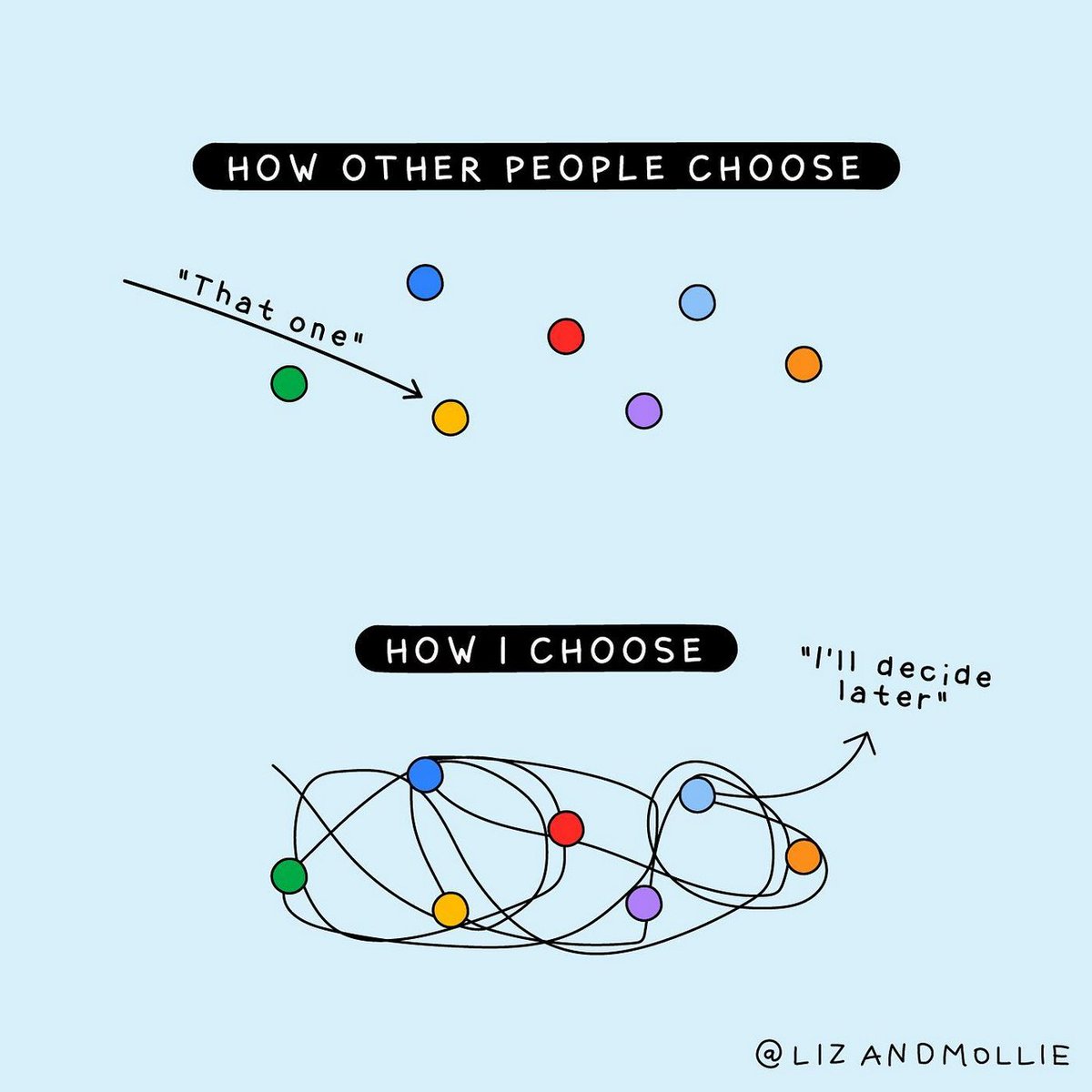
Postponing a choice rarely solves analysis paralysis. It often amplifies anxiety.
The antidote to chronic indecisiveness is not to gather more information. It's to clarify your values.
The goal is not to check every box. It's to find an option that meets your top priorities.
Y Combinator : 혁신 연구소 https://t.co/J2c3MXZl1Q
세계 최고의 스타트업 액셀러레이터, YC가 가진 힘을 분석한 The Generalist의 보고서 요약
# Y Combinator 오버뷰
- 시작부터 pre-IPO 까지 도와주는 "풀 스택 벤처"
- "네트워크 효과"를 가지고 있는 VC : 포트폴리오를 코호트로...
#8. Growth Stage Valuations Soaring Due to Demand for Deals (https://t.co/b2h7VlQt38)
- 22년 1Q 중반이 지나면서, 시장은 높은 변동성이 계속 된다.
- 몇 가지 예를 들자면, 인플레이션 상승, 오미크론, 연준 금리 인상, 우크라이나의 긴장, 정치적 분열 등이다.