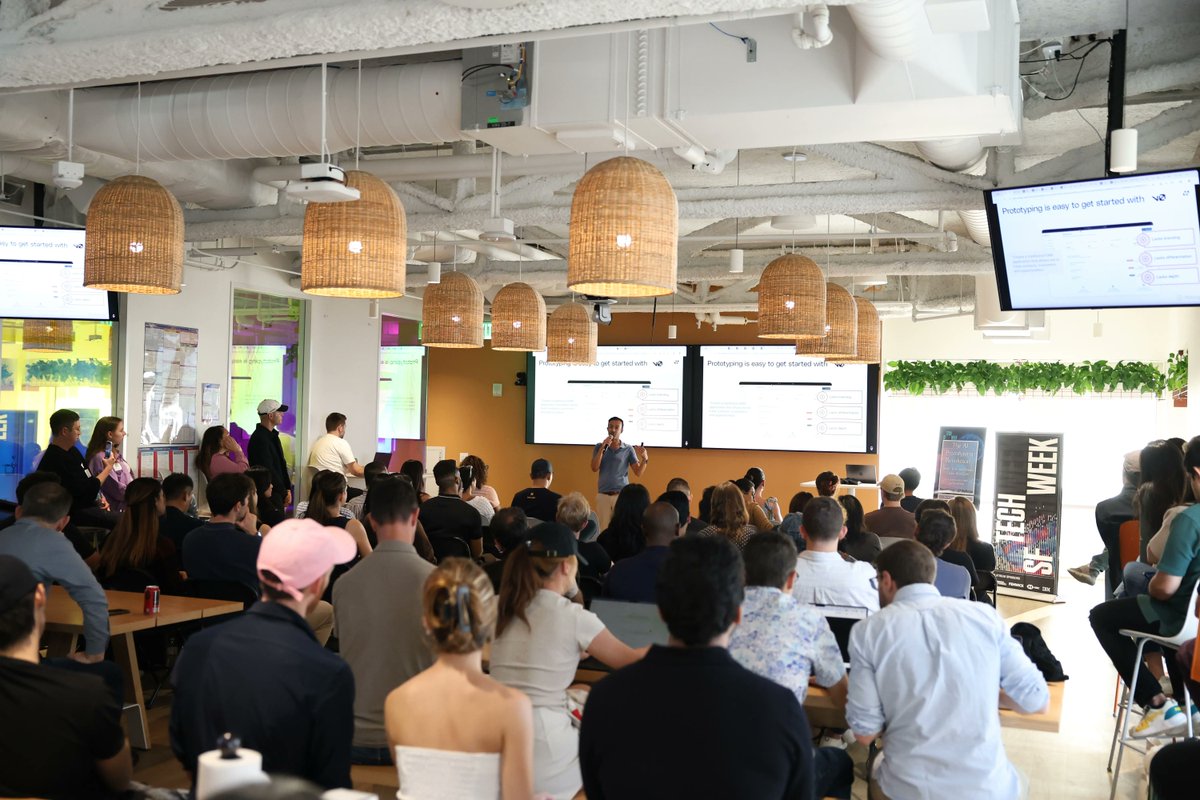
On stage, @sachinrekhi breaks down 15 essential skills for #AI prototyping, mapped Apprentice, Journeyman and Master. Why it matters: each step shortens time-to-rung and turns demos into durable workflows. #SFTechWeek
@noahkagan Congrats Noah and family! Excited for this next chapter. @sachinrekhi and I loved that book, too- it prompted a ton of conversations on parent vs child centered lifestyle. Also, we had our kid attempt the yogurt cake too! 😂
THE LIES WE TELL OURSELVES
(FUNDRAISING EDITION)
as y'all know, A16Z is running a startup accelerator focused on the intersection of TECH x GAMES called SPEEDRUN and during/after Demo Day I'm always coaching founders on their fundraising. (Aside: we’re investing $30M over the next 43 days, $750k per co - apply here: https://t.co/lExlSgiixi)
Anyway, let’s get started. Here are some common lies we tell ourselves:
- We're not fundraising
- Our pitches went great, the investors all love us
- Our product is the best in the market. Here's a 2x2
- Retention is fine, just need more notifications
- Yes our CAC is high, but it'll decrease when we scale
- Our TAM is huge huge, only need 1% to be successful
- Execution is our defensibility, and we execute better than anyone
- We hire the best people, full stop
- Our sales cycle long but deals will close soon
- Our partnerships will drive massive growth
- We have no direct competitors, blue ocean market
- We don't need more runway, we're raising for offensive reasons
- Once we add in XYZ feature, our traction is going to inflect
- We a clear path to profitability, but burning cash to grow
- ... and many hundreds more variations :)
Haha
I poke fun at this because naturally founders (including myself, as a former founder!) are an optimistic bunch. And to build a new product against all odds requires a little bit of self deception in addition to the reality distortion field that pulls in both employees as well as investors and other folks. So, in a way, this is meant to be expected, and in fact, it might even be a requirement in order to thrive.
However, it's also true, that if a founder is not able to properly assess how their fundraising going, nor which messages are resonating with investors, then they may find themselves with a busted round. many of the lies that we end up telling ourselves start from a place of goodness, but when the reality distortion field collides with reality, then reality usually wins.
As a result, I want to talk about some of these lies, and how to assess truth versus fiction.
ALL OUR PITCHES ARE AMAZING
Let’s start with good/bad pitch meetings with investors. There’s a saying- You'll never meet a sales person who had a bad sales meeting and you'll never meet a founder who has had a bad pitch. I observe this to be empirically true. The honest truth is that it's actually very hard to tell if a pitch went well or not. Often the meetings only last for 30 minutes, there's a group of investors who ask a few questions and are mostly furiously taking notes (or rudely doing emails), and at the end, they excitedly tell you that they will follow up very soon. You have to ignore what they say, and instead watch what they do. If they reach out immediately and try to schedule a second meeting, including more people in the firm, then that's a good sign. If they immediately follow up and ask for data or have other questions, then that’s pretty good. but the majority of interactions will conclude with a nebulous next step, and potentially no further meetings. And sometimes the associate you pitched in the first meeting doesn’t like it enough to pull in senior partners into the next meeting. Sometimes it’s them, not you.
Some people deal with the potential for rejection by simply saying that they are not fundraising. This has become a very popular stance among founders, almost to the point where they believe it themselves. Of course, almost all startups are fundraising at all times, they may just not be able to get the valuation and round that they want, and as a result, they will take meetings, but without a specific goal in mind. There's a hope that maybe an investor will pull them into a process right away. I often find this to be a negative outcome, because it leads to a very disorganized fundraising process where one firm is may be ahead of everybody else, but the data room and other meetings are thrown together haphazardly.
MY PRODUCT IS AMAZING
The products that founders build often become a sort of extended avatar of themselves. If their product is complimented, they feel great. If there are problems with it, they feel a deep personal pain. As a result, in order to manage the ups and downs of product development, it is often easier to lie to yourself, and imagine that things are going better than they really are. Otherwise it can get depressing.
As an example, it's often argued that “my product is the best, just look at our logo on the top right of this 2x2.” And our retention is great, but it's going to be even better once we add all these notifications and viral hooks. The challenge with this view is that usually a brand new startup is actually not going to have the best product in the market — it’s just too new to say that. Instead of competing with more established products based on the best features, I advocate that founders talk about there, asymmetric abilities. Perhaps it's better suited for a premium audience, or perhaps it incorporates some cutting edge, technology or platform that most companies are not focused on (i.e., web3 or VR/AR). Often times the features that a new product offers are simply not what customers really understand to be better. (Reference Marc Pincus’s proven/better/new framework). Founders say that their products are better, but instead maybe it’s enough to just be different? And instead of attacking via the front door, to go through a side door in the market, one that feels too small to start.
And most retention is not great, by definition, and it's often very very hard to change. So much of retention/engagement is just built on the nature of the product. Travel products are low frequency because people don’t travel much. A used car marketplace is not going to be used more than once a year. If you build a SaaS product that’s not part of the daily workflow, your prosumer usage at work will suck. And although you could change that by small bits via iteration, I’ve never seen a team A/B test itself from non-PMF to PMF. Rather than lying to yourself with optimism, I would always advocate for bigger bets. And to move on quickly when things aren’t working.
OUR MARKETING IS AMAZING
The sad truth of marketing is that everything is always getting worse. The Law of Shitty Clickthroughs encapsulates the forever war between marketers at different companies, who all converge to the same channels with the same messaging and eventually use up the channel. That’s why it’s so hard to grow with paid marketing, and SEO, and all these long-running, mature channels.
Of course, as founders, how else do you tell the story of growth? I think it has to ultimately revolve around the fact that — first, you have to be so efficient in your growth channels that even as they degrade, you have a margin of safety. A 10:1 LTV/CAC with mostly organic traffic is a lot easier to start from than if you are already 2:1 and you want to increase your spend 10X. Or you have to embrace the magic of direct sales teams — not everything can just be product led. Sometimes you need lead bullets, not a silver bullet.
When it comes to sales and marketing, obviously we want to all believe that the entire pipeline will convert. And that the deals you strike with stakeholders are the ones that their product teams will integrate, thus giving you a successful partnership. But what I often see is the opposite — the corp dev teams and corp VC arms of large companies strike deals, then struggle to actually execute it. Months turn into years. Nothing happens. If you lie to yourself and say a particular deal will save you, you’re so dependent on them. And your investors will have questions too. Better to have a strategy that gives you control of your destiny — and lets you acquire customers yourself.
THE TRUTHS WE TELL OURSELVES
All of this is to say, there is a fine line between pitching to others and lying to yourself. When you pitch, you are telling “the most attractive version of the truth” (as my colleagues often say). And that is a necessity. When you lie to yourself and it starts to color your day-to-day decisions, it often leads to subpar decisions that ultimately lead your startup off the golden path. And startups are hard enough as it is, without losing the ability to seek the truth.
Thus, let's all maintain the contradiction -- of pitching hard and selling, but also being truth seeking when it comes to your own assessment. Maybe that investor meeting didn't go well, because they laughed at all our jokes and said great things, but 3 days later there hasn't been a followup. Maybe our retention numbers are actually shit, and we need to reset. Or maybe we should stop wasting time with these partnership people at BigCo and take control of our destiny. That might just be the truths we need.
As I mentioned, I give advice on all this — and more — via the A16Z SPEEDRUN program we’re running later this year. We’re investing in preseed/seed startups at the intersection of TECH x GAMES, and happy to tell you more if you want to apply!
https://t.co/lExlSgiixi
"There is so much more to life than just work."
I honestly didn't really believe that until my mid-30s. Once I left corporate America behind I finally had the space to really appreciate that this was actually true.
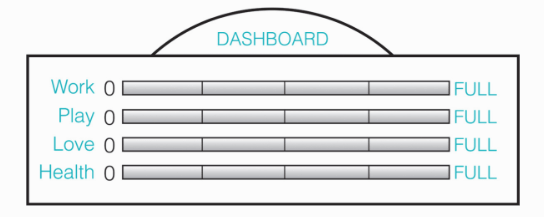
Since then, one of the best books I've read is Designing Your Life by Bill Burnett & Dave Evans. The exercise I love the most from the book asks you to make a list of the activities you do in each of these 4 categories of life and rate how satisfied you are with them.
1️⃣ Work - Not just what you’re paid to do, but also other duties you take on such as second jobs, consulting, advising, volunteering, home-making.
2️⃣ Play - Any activity that brings joy just for the sake of doing it, which can include organized activities or productive endeavors so long as they’re done for fun and not merit.
3️⃣ Love - The health of your primary relationships, children, pets, community, or anything else tied to affection.
4️⃣ Health - Not just physical health, but an engaged mind and satisfied spirit.
You can then do a gap analysis of where you are currently at and where you aspire to be to figure out how you might move the needle on each category.
I've been so inspired by this framework that I now categorize my annual resolutions across the same 4 dimensions to ensure I'm being thoughtful about each of them.
To learn more about this framework, I encourage you to read @adachen's fantastic summary of the Designing Your Life book https://t.co/iDit1TMRgK
@5le@SurveyMonkey@Quora I consider you my go-to expert for all things SEO and growth. At @SurveyMonkey, you were always one of the mvps. So excited to see you on @useintro!
Big news! ✨ Starting today, I'm available on @useintro to give personalized executive coaching to founders and CEOs. Need someone to act as a sounding board on an issue you’re working through? Keep reading ⬇️
The first three episodes of the Slow Down To Speed Up podcast are out! In episode 1, I help @kevinleeme explore the challenge of letting go of his maker tendencies so he can actually lead his team.
Big news! ✨ Starting today, I'm available on @useintro to give personalized executive coaching to founders and CEOs. Need someone to act as a sounding board on an issue you’re working through? Keep reading ⬇️
Honored to be on Intro alongside world-class experts like @davekashen, @andrewchen & @mejoff.
Want to hop on a 15-min call this week? Book me here:
https://t.co/jPk22543OY
Schedule a call for advice on:
✔️ Scaling teams from 0 to 100+ of people
✔️ Creating alignment between functions
✔️ Entrepreneurship / scaling yourself
✔️ Growth for SaaS business
✔️ Share lessons from other successful founders
✔️ 0 to 1 marketing
✔️ Co-founder issues
✔️ & more
That’s why I’m excited to open a few 1:1 slots on @useintro each week to be your personal coach & business advisor. To pay it forward, I’m starting with a limited-time introductory price.
These days I get countless requests from founders asking for advice on how to scale, but unfortunately, I’m not able to get back to everyone as I’d like to.
I help early-stage founders scale themselves alongside their teams, and I’m known for my straight-talk, no BS approach to helping others overcome obstacles.
As a 2x founder with an exit, I’ve been through the emotional roller coaster ride of fundraising, the trough of sorrows, and the joy of shipping products that connect with people.