A British biologist looked at 200,000 years of human history and found that the entire reason humans broke out of poverty was not intelligence, not language, not even agriculture, but one mechanism so simple a 6-year-old could explain it.
His name is Matt Ridley.
He is a zoologist by training, an evolutionary biologist by career, and in 2010 he wrote a book called The Rational Optimist that quietly argued the most important fact about human progress had been hiding in plain sight for the entire history of economics.
Naval Ravikant has been telling people to read everything Ridley has ever written for the last 15 years. The reason is the argument inside this one book.
For 200,000 years, anatomically modern humans walked around with the same brain you have right now. Same skull size. Same neural architecture. Same raw capacity for language, planning, and abstract thought.
For roughly 190,000 of those years, almost nothing happened. Generation after generation lived and died inside the same Stone Age toolkit their great-great-grandparents had used. Then somewhere around 50,000 years ago, the line on the chart of human progress started to tick upward. Then it bent. Then it exploded.
The question Ridley spent years on was the only question that mattered. What changed.
It was not the brain. The brain had been the same for 190,000 years. It was not language, which had existed long before the takeoff. It was not even agriculture, which arrived only 10,000 years ago and was actually preceded by the upward bend, not the cause of it.
What changed was that humans started trading with strangers.
This sounds too small to be the answer. Ridley argues that it is the answer to almost everything. The moment one human exchanged a useful object with another human from a different group, something happened that no other species on earth had ever done.
Two ideas that had developed in isolation came into contact. The flint knapper learned what the spear maker had figured out. The fisherman from the coast learned what the hunter from the forest had figured out. The two pieces of knowledge fused into something neither side could have produced alone.
Ridley calls this ideas having sex. The phrase sounds frivolous and it is meant to. The point is that ideas, like genes, get better when they combine with other ideas from different lineages.
An idea sitting inside one head, no matter how brilliant the head, eventually hits a ceiling. The same idea exposed to ten thousand other ideas does something genes do under sexual reproduction. It mixes. It recombines. It produces offspring nobody planned.
The cleanest proof of this argument is the most uncomfortable case study in the book. Tasmania.
Around 10,000 years ago, rising sea levels cut Tasmania off from mainland Australia. A population of roughly 4,000 humans was now isolated on an island, with no possibility of contact with the rest of humanity. They had the same brains. The same language. The same starting toolkit as their cousins 150 kilometers north. The natural experiment was now running.
What happened next is something no economist or geneticist had ever predicted.
The mainland Australians kept inventing. Boomerangs. Spear-throwers. Fishing nets. Bone needles for sewing fitted clothes. Watercraft with paddles. Their technology compounded slowly across the centuries.
The Tasmanians went the other way. They did not just fail to invent the new tools their cousins were developing. They started losing the tools they already had. Fishing was abandoned within a few thousand years. Bone tools disappeared. Fitted clothing disappeared. They forgot how to make fire from scratch and started carrying lit firebrands from camp to camp instead, relighting their fires from a neighbor's whenever their own went out.
By the time European explorers arrived in the 17th century, the Tasmanians had the simplest toolkit of any human society ever recorded. Their material culture had gone backward for 8,000 years.
The archaeologist Rhys Jones called it a slow strangulation of the mind.
Joseph Henrich at Harvard later proved with formal mathematical models that there was nothing wrong with Tasmanian brains. There was something wrong with their network. A toolkit requires a critical mass of people exchanging skills to maintain itself.
The act of teaching a skill is imperfect. Every generation loses a small percentage of what the last generation knew. If your population is large enough and trading widely enough, those losses get caught and corrected by someone else who still remembers.
If your population shrinks below a certain threshold and stops mixing with outsiders, the small losses compound until entire technologies disappear.
This is the part that should haunt anyone reading this in 2026.
Intelligence is not a property of the individual brain. Intelligence is a property of the network the brain is connected to. A genius in isolation will produce less than a mediocre thinker inside a dense exchange of other mediocre thinkers.
The thing your ancestors needed in order to break out of 190,000 years of stagnation was not better brains. It was better connections between brains they already had.
The implication for any individual is direct and uncomfortable. If you are smart and isolated, you will be outproduced by people half as smart who are connected.
The most successful people in any field are almost never the smartest people in it. They are the ones positioned at the intersection of the most idea flows. They are reading more authors than their competitors. They are talking to more people from more disciplines. They are in the rooms where ideas from different lineages bump into each other.
Ridley ends the book on the line that sounds optimistic but is actually a warning its this "The future will be invented by people who connect ideas, not by people who guard them."
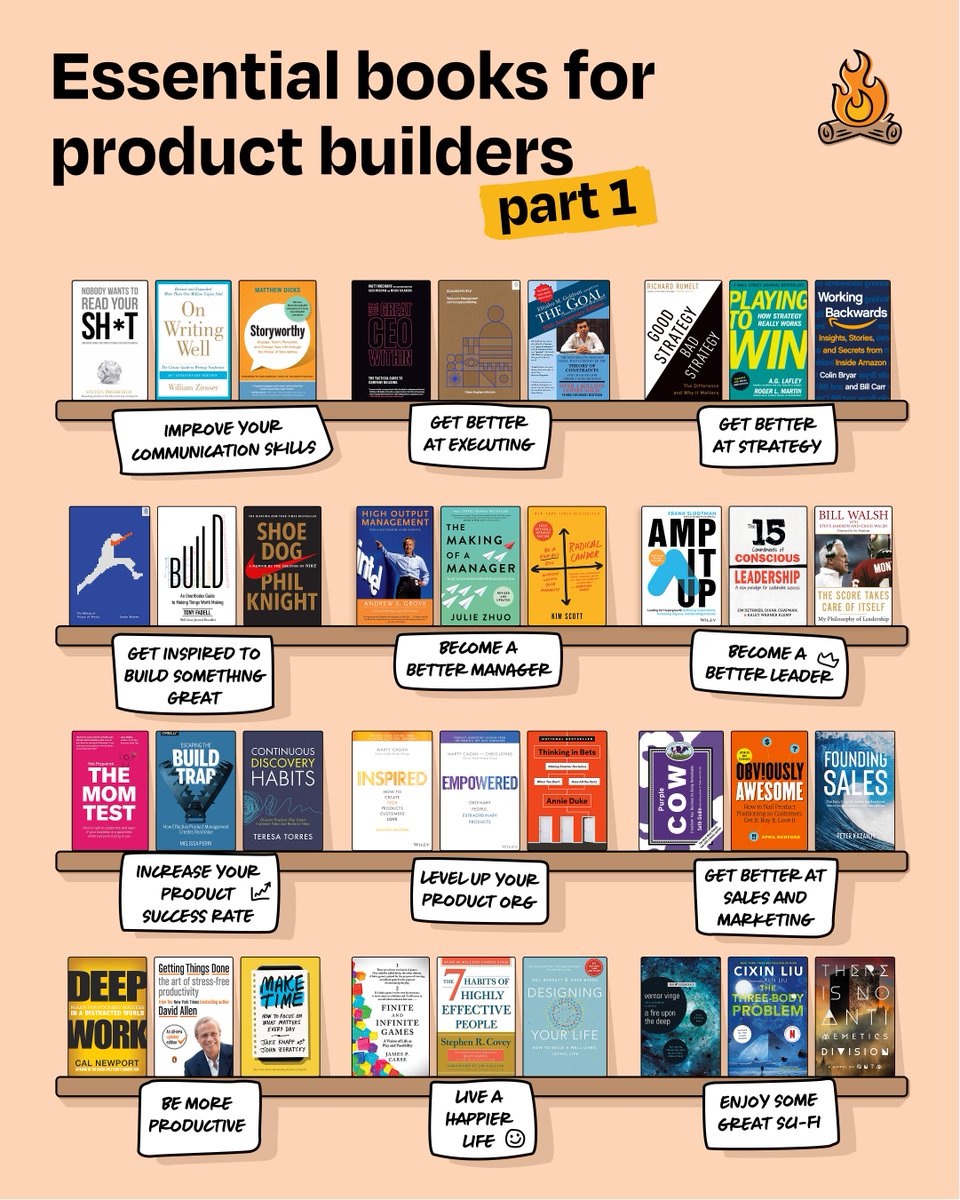
Essential books for product builders
I've put together a collection of my all-time favorite books, organized by their jobs-to-be-done. When your manager tells you to work on a particular development area—or if you’re just feeling the itch for self-improvement—these are the books to read.
To keep this list extremely high signal-to-noise, I forced myself to pick only three books per category (so hard!), and only books I’ve completed.
The collection includes both classics and under-the-radar gems. I very much agree with @pmarca's take that you should mostly read books that are over 10 years old (because those are the books that have stood the test of time), so you’ll notice no super new books.
There are so many great books that I didn’t include here, either because I haven’t had a chance to read them or they just didn’t make the cut. I’m sorry if I didn’t include your book, or a book you love. I probably forgot some important titles, too. That’s why we’ll have a part 2 (coming soon)!
Here's the full collection: https://t.co/USi56JOxNa
P.S. What's a must-read that I missed (within these 12 categories)? Let me know in the comments.
P.P.S. If you’re feeling like you have no time to read, I was in the same boat, especially after having a kid. @bryan_johnson's suggestion of reading a book for 10 minutes before bed changed my life. I started reading more books, and I got better sleep! Try it out.
Just do the thing. Don't do the thing because you think it'll make you better at something else. If it does, great. If it doesn't, even greater. One thing doesn't have to be in service of another thing. Don't spoil the parts by trying to make them the whole.
If you thought that Ben Affleck was right re Gen AI movie development not happening just a few weeks ago, I got bad news for ya.
Here's a 5 minutes AI short film about D-Day.
This tech is barely 12 months old!
https://t.co/7ck1YqziRX (via @azeem)
The lighthouse instills comfort as ships navigate the waters.
In the darkness their beams of direction guide us away from adversity and back to home.
This is a map of some of the world’s lighthouses.
"Doing something different means you might underperform, but it also means you might change the game. If you do what everyone else does, you’ll get the same results that everyone else gets. Best practices aren’t always the best. By definition, they’re average." - @shaneparrish
Today's the day: Writebook is here! And it's free.
https://t.co/LSqaxN3IGm
Blogging and posting on social is easy. But why is it so hard to publish a whole book on the web? It’s not anymore. Writebook is remarkably simple software that allows you to publish text and pictures in a simple, browsable online book format.
It's perfect for publishing instruction manuals), a collection of short stories, poetry, graphic novels, handbooks, and anything that fits better together than apart.
Writebook isn't a service, it's software you download and install on your own server. We've made it incredibly easy to get going — it just takes a few minutes. Even non-technical folks can get it all set up. We'll email you a single command you paste into a terminal and it takes care of the rest. No maintenance required either, it takes care of itself, auto-updates, etc.
And it also comes with all the Rails code so you can see how it's built, modify it for your own use, and learn how applications like this are made.
So, grab it and dive in! We'd love to see what you publish.
https://t.co/LSqaxN3IGm
Chile is so long, it's curved
How long is it?
Why not longer?
Why no other country is as long?
How does that make Chileans incomprehensible?
A thread about Chile and its humongous length
🧵
Marketers often have an unhealthy obsession with efficiency - in many circumstances the Principle of Redundancy might be of more value
In the excellent Why Does the Pedlar Sing by Paul Feldwick
This is mind-blowing! The film/media industry will never be the same again. I used to make films on MiniDV, now all you need is a prompt. How long before we get the first AI superstar or an AI film winning Best Picture at the Oscars?! #sora#openai https://t.co/lOWqE62uDw
LIVE WITH IT FOR A WHILE
In the course of building products, you'll likely experience moments when you're unsure of a certain screen, flow, condition, label, idea, whatever.
Maybe this button doesn't feel right. Or the name of this feature feels unresolved. Or some color is jarring, but kind of interesting nonetheless. Or the way something gets set up seems a bit kludgy at the moment. Maybe this stuff is alright, maybe it's not, but it feels unsettled.
I like these moments. It's practice. It's a chance to sit with them, to let them be, to work on other things while they marinate in the back of your mind. They aren't blockers, they aren't deal breakers — they're just things that may or may not work out.
Sometimes time makes them work. Or reveals that they certainly don't. Sometimes they weren't that important anyway, and it's just a matter of getting used to them. Sometimes they're novel and unusual, which can be jarring to the uninitiated, but endearing to the experienced. Sometimes!
So just let them be. Come back around to them later if they continue to bug you. It's perfectly OK to leave things unresolved, and let the resolution force itself on you eventually. If you forget about them, they didn't matter anyway. If you can't forget, maybe they do matter more than you realized.
Projects unfold. Live with it for a while. The answers will reveal themselves when they're ready.