As believers of open research, we are disappointed to see Anthropic silently degrading Fable 5 for AI development
"Any topic related to building pretraining pipelines, distributed training infrastructure, or ML accelerator design... may have limited effectiveness through Claude via methods such as prompt modification, steering vectors, or parameter-efficient fine-tuning."
Not only do they get to decide what you use LLMs for in research, but this also enables them to silently intervene in your research without you knowing.
This sets a dangerous precedent. If a model refuses openly, users can understand the boundary. If a model falls back to another model, users can still evaluate the difference. But if a model silently modifies or weakens its own answers while still pretending to help, researchers lose the ability to know whether a failed result came from their own idea, their implementation, or an invisible intervention by the model provider.
That is not safety. Safety policies should be transparent, auditable, and user-visible.
On top of that, the people most harmed by this are not the largest labs with massive teams and proprietary infrastructure. It is the independent researchers, academic groups, startups, and open-source builders who rely on public tools to compete, innovate, and pioneer AI for everyone else.
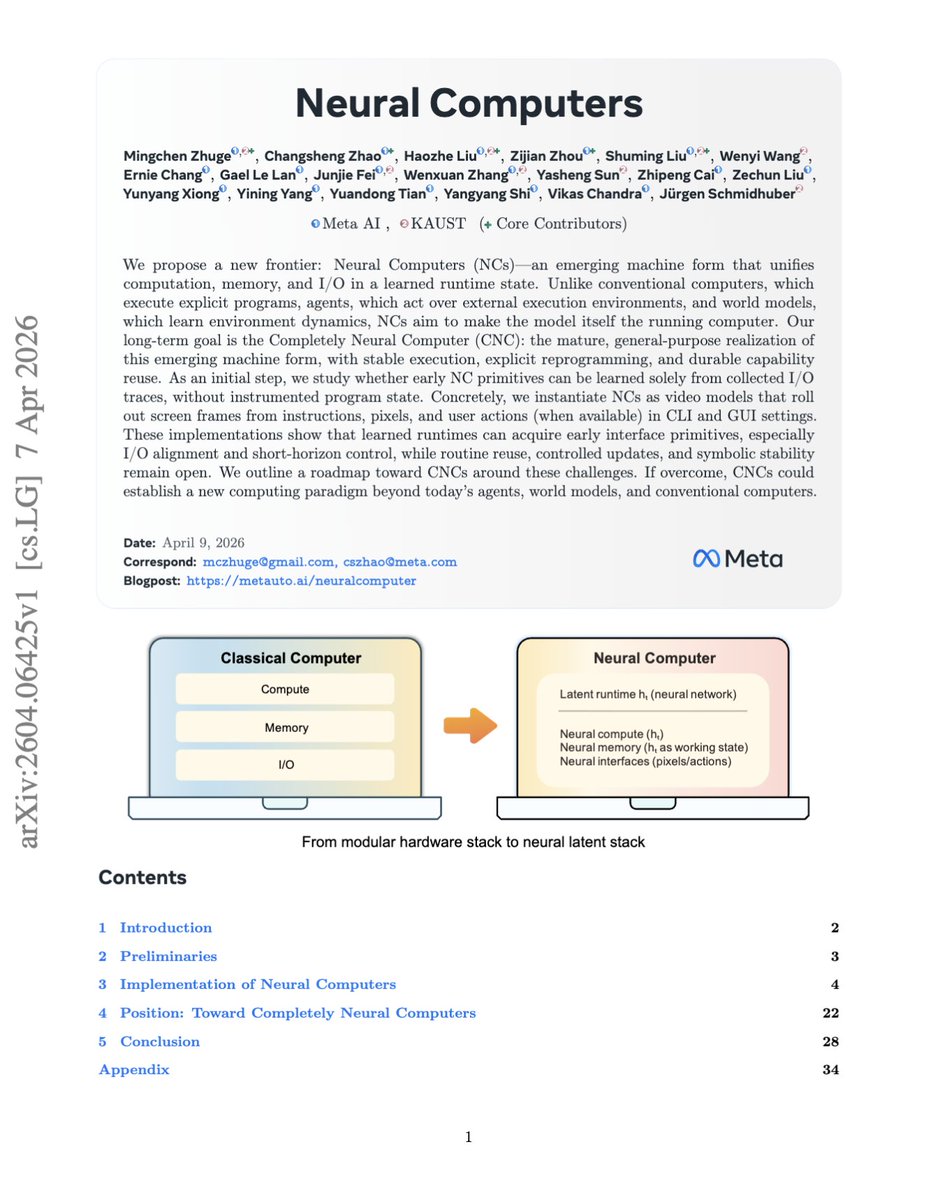
What if the model didn’t just use a computer, but actually was the computer?
Meta AI introduces "Neural Computer", a model where computation, memory, and I/O are all inside one learned system.
Their early prototype learns from screen recordings of terminals and desktops, and it can already imitate some basic computer behavior like rendering interfaces and responding to clicks or commands.
But it still breaks on slightly harder tasks like reliable reasoning, stable memory, and reusable skills.
@Almost_Sure@miniapeur My Eurostar train from Brussels to Amsterdam was delayed for 3 hours and got cancelled. I waited another 8 hours for the new train, which also arrived an hour late.
Eurostar is the worst 😅