Regular reminder to read the code (at least skim it)!
Agents write better code than you. That's not the problem.
They make *assumptions* when missing info and bake them in. This is (IMO) the worst kind of bug: the kind agents don't even recognize as bugs.
You can have the agent grill you with 200 questions and it still may make assumptions because sometimes things aren't knowable *until* implementation. Code review agents are really good at reviewing code at face-value, but they rarely catch instances where the code doesn't match your desired behavior.
The solution: read the code. Even if it's skimming the tests, the core logic, having the agent summarize it for you (sigh), just do a little human review.
OpenCode is the first time i could justify event sourcing in a real system
everything that happens is an event which gets projected into the sqlite db
this means you can consume the event stream and replicate it durably into another db
A 17-year-old developer from Uzbekistan has built the open-source app store GitHub never shipped.
It’s called GitHub Store.
The platform turns GitHub releases into a clean app-store experience for Android, Windows, macOS, and Linux.
For years, downloading open-source apps from GitHub has been messy.
Users had to open a repo, find the releases page, choose between APK, EXE, DMG, AppImage, or DEB files, and hope they picked the right one.
GitHub Store removes that friction.
It automatically detects installable files from GitHub repositories, shows the correct version for your device, and lets you install or update apps directly.
It includes:
- One-click installs
- Update tracking
- Popular apps
- Recently updated apps
- Platform filtering
- No account requirement
- No tracking
- Open-source code
This is basically an app store built on top of GitHub releases.
And it may be one of the simplest ways to discover and install open-source software without digging through release pages.
GitHub Store is free, open-source, and available now.
https://t.co/ZNVHPIcn4n
@athasdev@igor9silva https://t.co/rPV5YI5xB9 could help. It has built-in editor, git integration, files browser, multi agent/session support, multi project, integrated terminal, all in a single browser window (availavle as PWA and Desktop). Built on opencode. #openchamber#ai
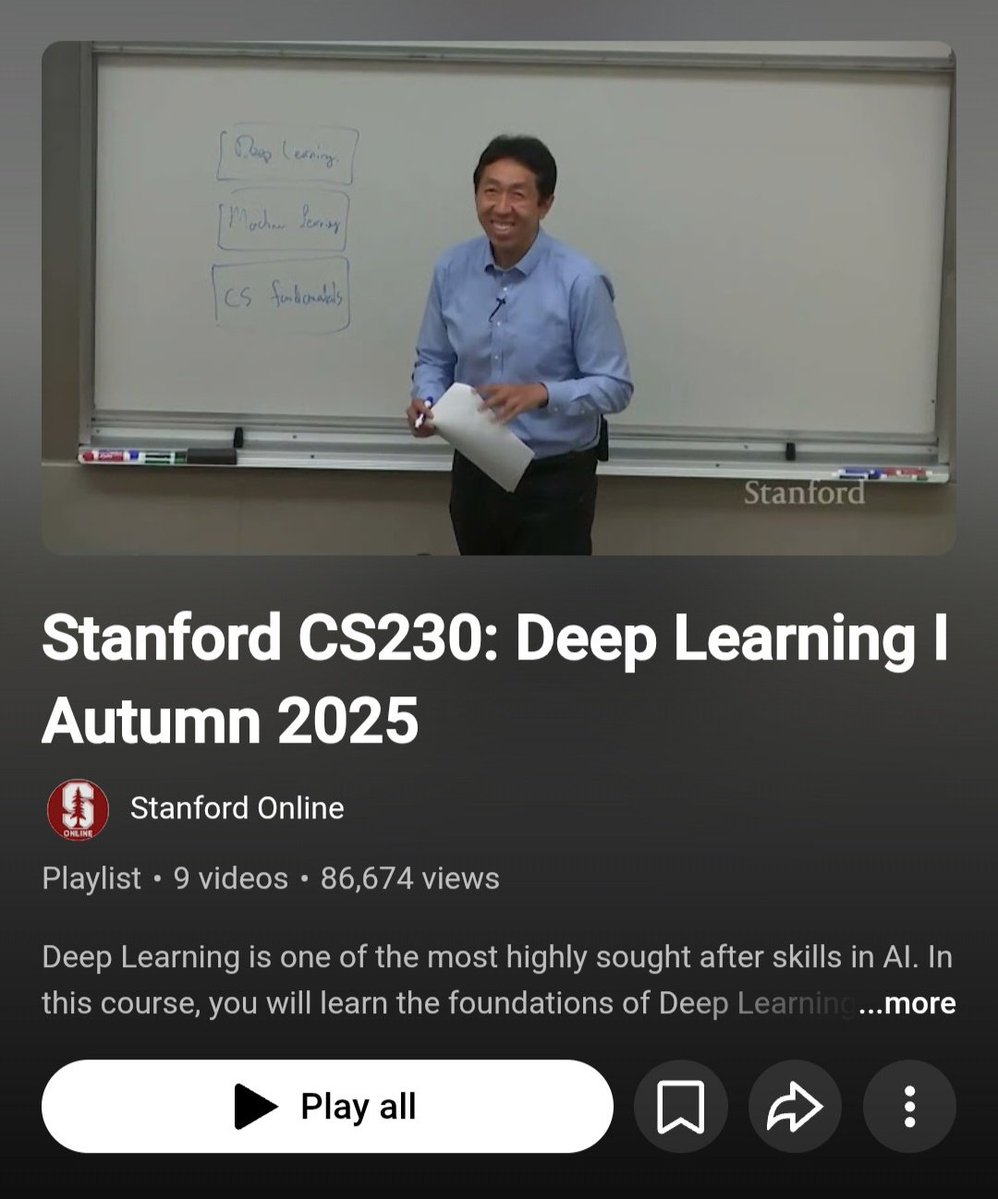
Stanford just made a $200,000 AI degree free.
No application.
No tuition.
No “elite access”.
Stanford released its actual AI/ML curriculum on YouTube.
Not a PR-friendly intro.
Not “AI for the public”.
This is the real thing.
The same lectures shaping people working on frontier models.
What just became public:
Deep Learning (CS230)
→ https://t.co/DUtL9MO6Y7
Transformers & LLMs (CME295)
→ https://t.co/gN57biwLsE
Language Models from Scratch (CS336)
→ https://t.co/GnH11pPBdW
ML from Human Feedback (CS329H)
→ https://t.co/X9nxEX6PNg
Computer Vision (CS231N)
→ https://t.co/oBxKKWZP22
LLM Evaluation & Scaling
→ https://t.co/1tDpw9ArTq
The uncomfortable truth:
The degree isn’t the scarce asset anymore.
Execution speed is.
Top schools know this.
That’s why they’re publishing the playbook.
👉 Bookmark this.
Comment the first lecture you’ll actually watch.
This Stanford University paper just broke my brain.
They just built an AI agent framework that evolves from zero data no human labels, no curated tasks, no demonstrations and it somehow gets better than every existing self-play method.
It’s called Agent0: Unleashing Self-Evolving Agents from Zero Data via Tool-Integrated Reasoning
And it’s insane what they pulled off.
Every “self-improving” agent you’ve seen so far has the same fatal flaw:
they can only generate tasks slightly harder than what they already know.
So they plateau. Immediately.
Agent0 breaks that ceiling.
Here’s the twist:
They spawn two agents from the same base LLM and make them compete.
• Curriculum Agent - generates harder and harder tasks
• Executor Agent - tries to solve them using reasoning + tools
Whenever the executor gets better, the curriculum agent is forced to raise the difficulty.
Whenever the tasks get harder, the executor is forced to evolve.
This creates a closed-loop, self-reinforcing curriculum spiral and it all happens from scratch, no data, no humans, nothing.
Just two agents pushing each other into higher intelligence.
And then they add the cheat code:
A full Python tool interpreter inside the loop.
The executor learns to reason through problems with code.
The curriculum agent learns to create tasks that require tool use.
So both agents keep escalating.
The results?
→ +18% gain in math reasoning
→ +24% gain in general reasoning
→ Beats R-Zero, SPIRAL, Absolute Zero, even frameworks using external proprietary APIs
→ All from zero data, just self-evolving cycles
They even show the difficulty curve rising across iterations:
tasks start as basic geometry and end at constraint satisfaction, combinatorics, logic puzzles, and multi-step tool-reliant problems.
This is the closest thing we’ve seen to autonomous cognitive growth in LLMs.
Agent0 isn’t just “better RL.”
It’s a blueprint for agents that bootstrap their own intelligence.
The agent era just got unlocked.
You will never achieve something unless you first believe it is possible. Cultivate a sense of total knowing that it will be done. Even if you can’t see the path, feel it in your bones that you will take your machete and cut a way if you have to. This faith unlocks miracles.
Nvidia CEO: Greatness does not come out of intelligence, it comes from character.
Character is not formed out of smart people: it is formed out of people who have suffered.
Wrapped up Stanford CS336 (Language Models from Scratch), taught with an amazing team @tatsu_hashimoto@marcelroed@neilbband@rckpudi. Researchers are becoming detached from the technical details of how LMs work. In CS336, we try to fix that by having students build everything: