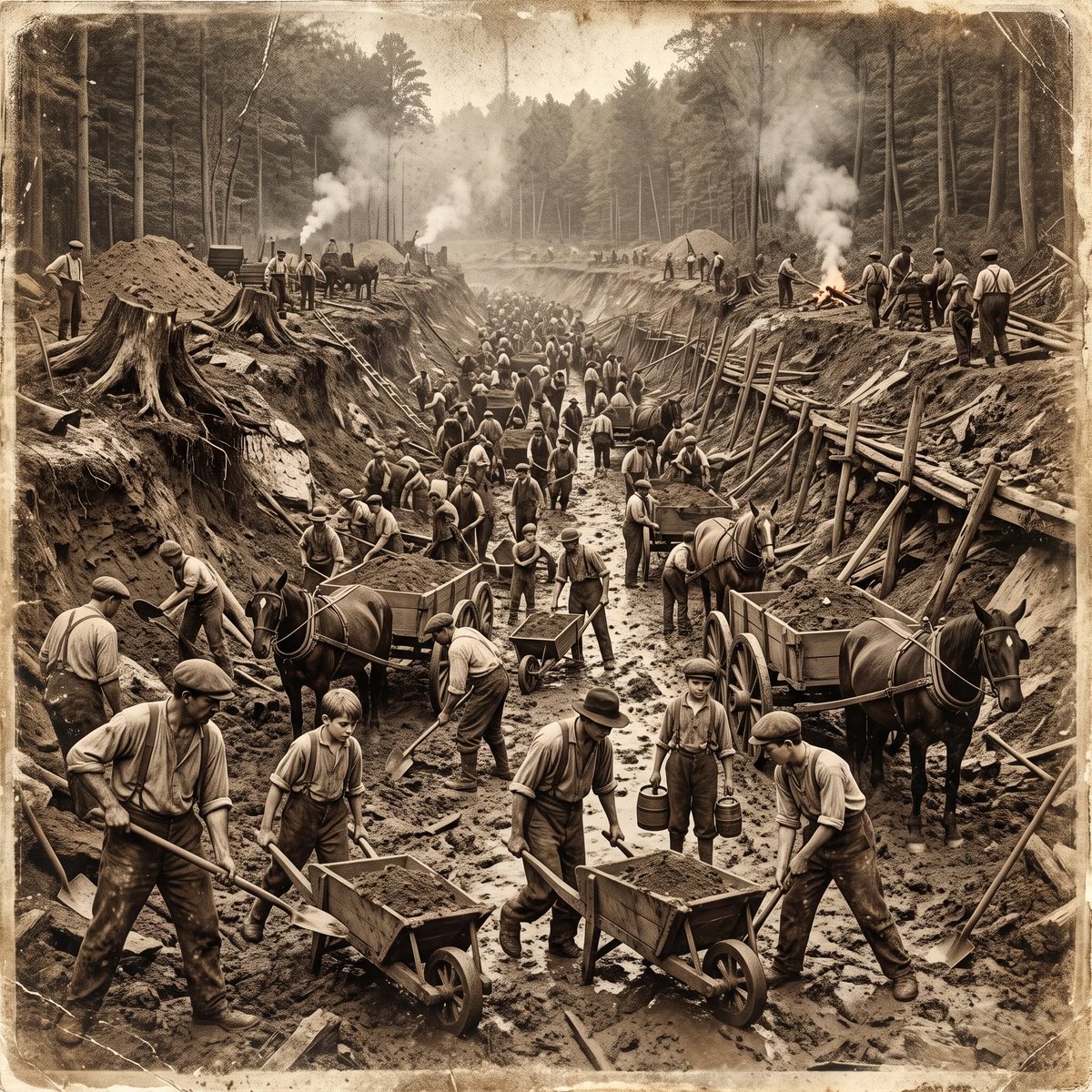
In 1817, New York decided to cut a river across 363 miles of swamp, forest, and rock. Hudson River to Lake Erie. Engineers said it was impossible. The U.S. had never built a canal over 28 miles. No engineers signed up. So farmers and Irish immigrants dug it. 50,000 men with shovels, wheelbarrows, and black powder. Pay was 80 cents a day plus whiskey.
They dug through Montezuma Swamp — malaria killed 1,000 men in one summer. They called it “digging their graves.” They blasted through limestone at Lockport with gunpowder. One bad fuse and you were gone. Boys carried powder kegs. 8-year-olds. They invented American engineering on the job. No cement existed, so they found natural rock in New York that hardened underwater. They invented it. Called it “Rosendale cement.” It built the Brooklyn Bridge later.
In 1825 they opened it. Governor Clinton poured Lake Erie water into the Hudson. They called it “Wedding of the Waters.” Freight cost dropped from $100 a ton to $10. New York City became New York City. 1,000 men died and are buried in unmarked ditches along Route 31. No monument. The canal paid for itself in 7 years.
Panelled doors wasn't a pretty extra but a clever solution to doors expanding with moisture and warping or jamming shut. Because wood expands and contracts in relation to the ambient air humidity (and also rain etc. if outdoors), the wood panels (not nailed or glued) could move freely inside the groves of the frame. This allowed tight doors that shut very close to the door frame, often mere millimeters or fractions of an inch, giving us ncreased privacy and better acoustics.
And they look very charming.
Il y a un London Bridge en plein désert de l'Arizona. Et c'est le vrai.
Londres l'a vendu en 1968. Il a été réinauguré là-bas il y a 55 ans, le 10 octobre 1971.
Ce pont de granit enjambe la Tamise depuis 1831. Mais au XXe siècle, il ne supporte plus la circulation automobile.
Il s'enfonce dans le fleuve. En 1924, un côté est déjà 7 à 10 centimètres plus bas que l'autre.
La ville de Londres décide de le remplacer. Et de vendre l'ancien.
En avril 1968, un industriel américain, Robert McCulloch, l'achète pour 2,46 millions de dollars.
Il vient de fonder une ville nouvelle en Arizona, au bord d'un lac de barrage : Lake Havasu City. Il cherche à y attirer des visiteurs.
Chaque bloc de granit de la façade est numéroté. Il y en a plus de 10 000.
Les pierres passent par le canal de Panama et débarquent en Californie. Des camions les emmènent dans le désert.
Le pont est remonté sur la terre ferme, autour d'une structure en béton. Le chantier dure 3 ans et coûte 7 millions de dollars de plus.
Le 10 octobre 1971, le lord-maire de Londres vient l'inaugurer devant des milliers de spectateurs.
Au programme : feux d'artifice, parachutistes, montgolfières.
Ensuite, on creuse un canal sous ses arches et on le remplit d'eau.
Le London Bridge enjambe aujourd'hui un bras de lac, à plus de 8 000 kilomètres de Londres.
Oct 7, 1763: King George III drew a line down the spine of the Appalachian Mountains and told American colonists they couldn't cross it.
Britain had just won the French and Indian War and taken control of everything east of the Mississippi. That spring, Native nations led by the Ottawa war chief Pontiac rose up across the Great Lakes and Ohio Valley and captured or attacked British forts all over the frontier. London wanted to stop the bloodshed and avoid paying for endless Indian wars.
So the Proclamation of 1763 reserved all the land west of the mountains for Native peoples. Colonists already living out there were told to leave. Nobody could buy Native land except through the Crown.
The colonists were furious. Many of them had fought in the war specifically to open up that land. Veterans had been promised land grants out there. Speculators had already staked claims. One of those speculators was George Washington, who privately called the proclamation a temporary measure and kept quietly surveying western land anyway.
Thousands of settlers ignored it and crossed the mountains regardless. The line never really held. But it was one of the first times Americans felt London was deciding their future without them, and that feeling kept growing for the next 13 years.
Este vídeo existe para hacer visible una idea que la física acepta y que tu cerebro rechaza, el tiempo no pasa, estás extendido dentro de él..
El paso de peatones dentro del cubo muestra cada trayectoria entera y congelada.
Nada avanza, todo ya está ahí.
Tell your boss that I gave you the rest of the week off so you can explore this amazing interactive map showing the road network of the Roman Empire. This is so much fun to explore you can compare the Ancient and Modern road network for example. Great stuff. Your boss will understand... Source: https://t.co/Y8vig00PWY
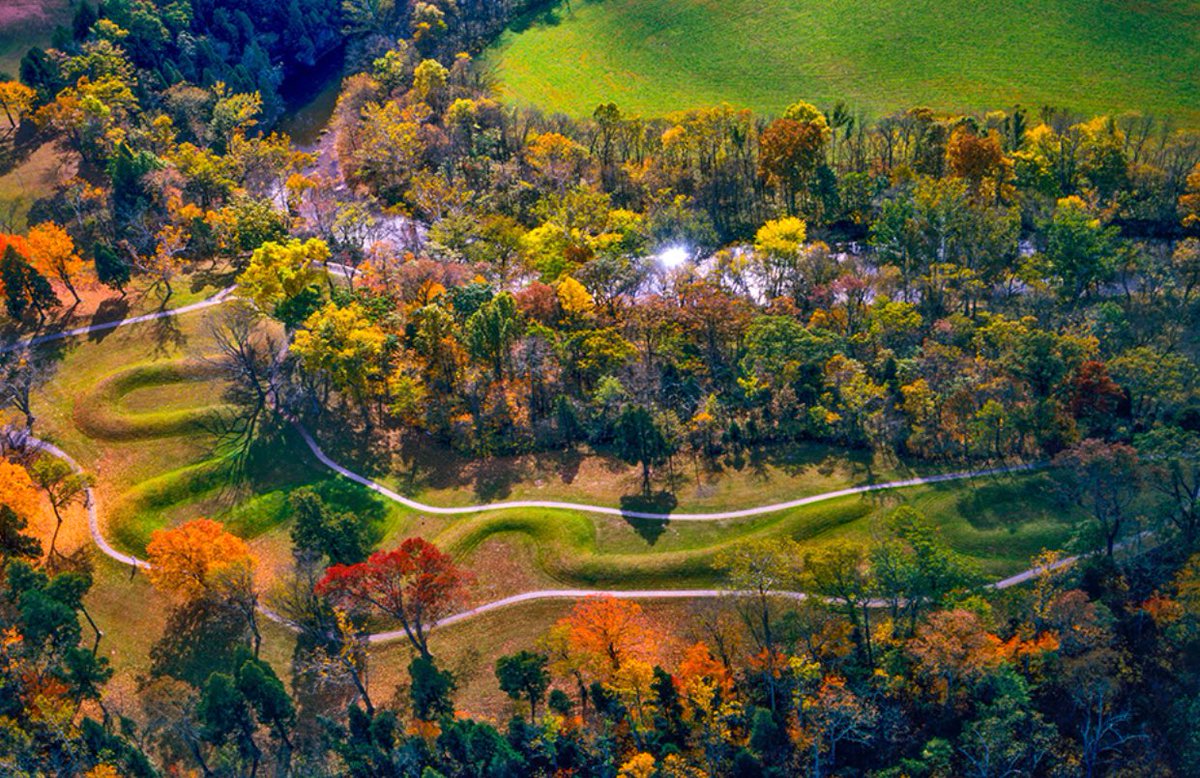
There’s a 1,348-foot-long serpent carved into the earth in Ohio.
It tracks the sun.
It coils with the moon.
It sits on a 5-mile-wide impact crater.
And it might be older than the pyramids.
Why aren’t we talking more about this 🧵
I find these World Trade Center simulations by Kostack Studio fascinating because they remove the smoke and let you see the collapse much more clearly.
In the real footage, so much is hidden by fire, dust, debris, distance, and chaos that many people come away with the impression that the towers simply dropped straight down into their own footprints.
But that is not really what happened.
These simulations make it much easier to see that the collapse begins in the heavily damaged and fire-weakened region, the upper section starts moving and tilting, and the destruction then propagates downward through the structure.
The towers do not simply disappear vertically into their own footprints. Large portions of the upper structure and exterior are moving outward and to the side as the collapse develops. Much of that motion is simply obscured in the real videos once the enormous debris cloud forms.
And this is also why I find these simulations useful when people describe the collapses as looking like “controlled demolition.”
Strip away the smoke and dust and the resemblance becomes much less convincing.
What you see is a highly asymmetric structural failure beginning around the aircraft-damaged and fire-affected floors, followed by an enormous moving mass progressively overwhelming the structure beneath it. There is tilting, rotation, exterior columns peeling away, debris being thrown far outside the building footprint, and structural failure occurring chaotically as the collapse moves downward.
That is very different from the neat mental image usually implied by “controlled demolition,” where structural supports are deliberately severed in a carefully timed sequence to produce a predetermined collapse.
And importantly, we already know what preceded these collapses.
Both towers suffered massive aircraft-impact damage. Fireproofing was stripped from portions of the structure. Large, uncontrolled fires then burned across multiple floors - for about 56 minutes in the South Tower and about 102 minutes in the North Tower - heating and weakening structural components until collapse initiated.
Once that upper mass began moving, the loads imposed on the floors and structure beneath became vastly greater than anything they had been designed to carry.
The result was progressive collapse.
No, an animation is not proof simply because it looks convincing, and these are not official NIST simulations. They are visualizations built under particular assumptions.
But as visualizations, I think they are extremely useful.
They let you see something the original footage often cannot show clearly: beneath that enormous cloud of smoke and debris was a complicated, violent, asymmetric structural failure - not two buildings neatly dropping straight down into their own footprints.
A note on the simulation: this is not intended to reproduce the collapse down to the exact motion of every beam, floor panel, and fragment of debris. No practical simulation could do that. Its value is in modeling the large-scale structural behavior - how the major sections deform, move, tilt, separate, and progressively fail. Think of it as a visualization of the mechanics and overall collapse behavior, not a frame-by-frame reconstruction of where every piece of steel ultimately landed.
@sagesteele It’s hard to wrap my head around this one.
Hopefully we have the passion and the pink shirts for the next black mother who murders her three children????
Where am I?