Founder of PALiNVEST. UNIDO Head in Palestine, 2014–2024.
Recovery is not reconstruction.
Building systems that hold under pressure.
Husband. Father of four.
From yesterday's @ipinst discussion:
Plans can be adjusted. Trust cannot.
For Gaza, that distinction may matter as much as any individual arrangement, structure or financing mechanism.
Access is not a footnote to recovery.
In Gaza, it is the difference between a funded priority and a functioning service people can rely on.
If access remains exceptional, recovery remains exceptional.
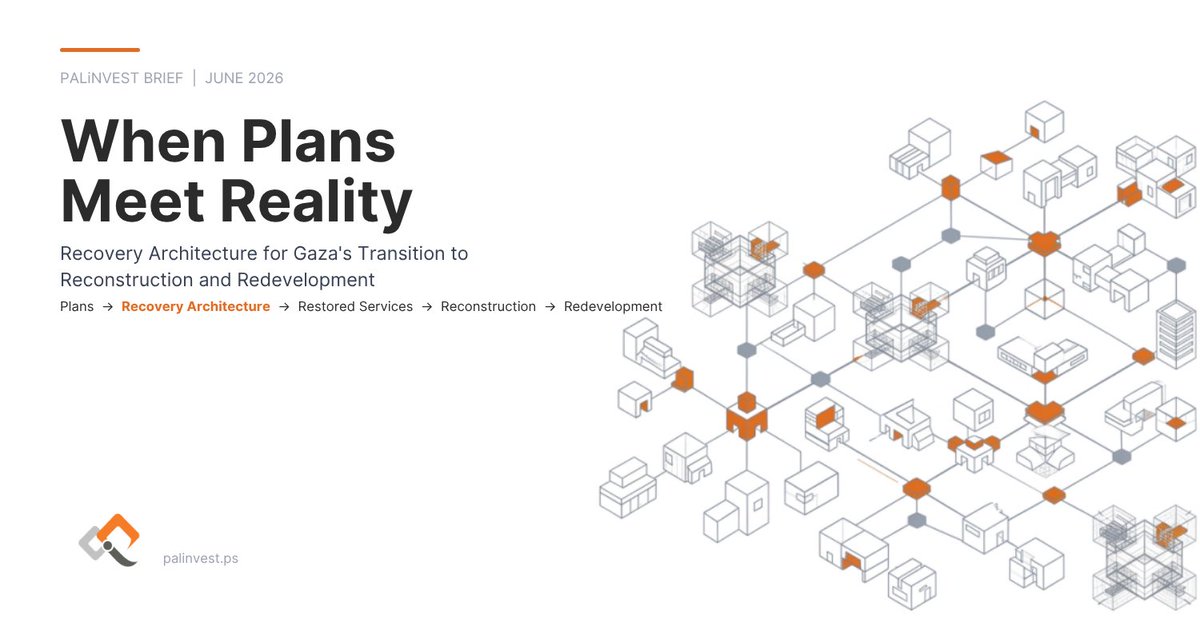
More in PALiNVEST’s first Brief:
https://t.co/ObMXQNBvS3
Recovery architecture cannot be designed only after conditions open.
Gaza is no exception.
When the first phase begins, authority, access, financing, institutions and restored services all have to connect — under pressure, no margin to improvise.
https://t.co/nEk5I40aU7
I published this brief because Gaza already has many plans on the table.
The issue is not the existence of plans. It is whether authority, access, financing, institutions, and civilian services can actually connect under real constraints.
PALiNVEST’s first Brief is now published.
Gaza has a substantial planning landscape. The practical question is how plans connect to authority, access, financing, institutions and restored civilian services under real constraints.
Full Brief:
https://t.co/ObMXQNBvS3
The recovery discussion needs to stay close to what actually functions: clinics, water, local teams, markets, and the systems that keep them going.
That is the space I see @PalinvestSystem working in.
In recovery under constraint, the unit of progress is not the announcement.
It is the civilian function restored: a clinic working, water moving, a school reopening, a market operating, or a local team carrying responsibility.
Gaza does not mainly suffer from a framework deficit.
The harder gap is conversion: authority, money, territorial access, and operating control are not yet becoming functioning services people can feel.
That gap is not theoretical. It is visible every day.
The next step is activation: proven Palestinian solutions, connected to real service needs in clinics, water systems, and small businesses.
This was the starting point we were building from:
https://t.co/VV9xKKkkjP
Two years ago in Cairo, we framed cleantech not as a climate add-on, but as part of early recovery: energy, water, SMEs, jobs, and local solutions that can keep services functioning under constraint.
That logic is even more relevant now.
Recovery is not reconstruction.
It begins when people can see services returning: water, clinics, fuel, movement, schools, livelihoods.
It holds when local systems can carry responsibility, and when institutions prove progress without overstating it.
Gaza’s recovery will be judged in very practical terms.
Are services working? Are resources moving? Can local teams carry the work? Can people feel that life is beginning to function again?
That is where recovery becomes real.
The practical test is no longer only whether mechanisms exist.
It is whether they restore civilian functions people can feel: water, clinics, treatment access, fuel for essential services, livelihoods, and local administration.
Recovery starts when systems function again.
At today’s Security Council, Nickolay Mladenov introduced language that moves beyond decommissioning alone:
“Meaningful and practical modalities to advance civilian stabilization, humanitarian relief, and recovery,” even if transition is delayed.
That shift matters.
The BoP report’s clearest line:
“Funds committed but not yet disbursed represent the difference between a framework that exists on paper and one that delivers on the ground.”
That is the delivery gap Gaza cannot afford to keep repeating.
@SamerWFP Absolutely. Political solutions are essential. And while diplomacy moves, access, food systems, livelihoods, and basic services need enough space to keep functioning for people.
A critical moment, a timely appointment for the region.
@RaniaAlMashat brings deep experience: international cooperation, finance, and economic policy. Essential to ESCWA’s role today. The region needs institutions able to connect recovery, resilience, stability, and investment.
مع تولي مهمتي الدولية الجديدة في لجنة الأمم المتحدة الاقتصادية والاجتماعية لغربي آسيا (@UNESCWA)، أشارككم لمحة عن دورها في المنطقة. تعد الإسكوا واحدة من ٥ لجان إقليمية تابعة للأمم المتحدة وتضم ٢١ دولة، تواجه تحديات متشابكة اقتصاديًا واجتماعيًا إلى جانب التوترات الجيوسياسية.
Very long day ahead, but after a quick flight from Ankara, an early morning start today in Cairo with Foreign Minister Badr Abdelatty reviewing the next steps in the implementation of Phase two of the Gaza peace plan. Egypt remains a critical partner as we work together towards a Gaza that is reconstructed and secured by the transitional Palestinian administration @NCAG, free of weapons and tunnels, and reunified with the reformed and legitimate Palestinian Authority. This is in President Trump's Plan and #UN Security Council Resolution 2803. All sides have endorsed the plan, the international community has supported it, now is the time to agree to the framework for its implementation. For the sake of both Palestinians and Israelis, there is not time to lose. Thank you, @MFAEgOfficial!
#WestBank:
🚫 During the olive harvest, Palestinian farmers' access to their farmlands is often restricted and many are exposed to settler violence.
Humanitarian Coordinator @HadiMuhannad shares how the @UN and partners are supporting farmers, with funding from @CBPFs.
The Humanitarian and Resident Coordinator, Muhannad Hadi, together with humanitarian and development partners, led a diplomatic visit to Kifl Haris village of the Salfit governorate, where he highlighted concerns related to the upcoming olive harvest in the West Bank.
Announcing the successful conclusion of #MOUSTADAMA Programme! Our event "Solutions, #Sustainability, and #RoadtoImpact" celebrated our achievements in #sustainableenergy. Huge thanks to partners and beneficiaries who have been with us along the way https://t.co/owAYR0lKOv @UNIDO