On Wednesday, I traveled to the Pnyx, a hillside overlooking the towering columns of the Acropolis in Athens.
There, I delivered a simple message: The West is at a crossroads. The decisions we make in the next decade will define the next century.
https://t.co/G91uSBHY6H
In 1789, only a handful of countries had both an elected parliament and government.
Today, over 160 do. The two lines crossed around 1960, and since then, self-governance has become the global norm.
Congress destroyed Robert Oppenheimer in 1954, and 6 years later the BBC gave him 9 minutes to say what science would find next. Almost no one watches it.
Panorama broadcast it on 4 January 1960. The man who built the bomb sits in a chair at Princeton, stripped of his clearance, and makes 3 calls for the decade ahead.
No music, no second take, just one camera and 9 minutes of tape.
He opens by saying the gloom has no floor. Then he refuses to talk about it.
Watch the point where he moves from matter to life. He calls that one the biggest, and he reaches for the word explosion to describe it.
Quarks arrived in 1964. Penzias and Wilson found the microwave background in 1965. Researchers cracked the genetic code by 1966.
All 3 landed inside his 10 years, and he never mentioned the bomb once.
A mathematician spent seventy-three minutes explaining why the models Wall
Street runs on are the wrong shape. The talk was not published until six years
after he died. It has 34,000 views.
The industry never argued with him. It just kept using the models.
His name was Benoit Mandelbrot, and his complaint was narrow. The mathematics
finance was built on assumes price moves cluster around an average and that
extreme moves are rare enough to ignore. He had been saying since the 1960s that
cotton prices did not behave that way, that no market did, and that the tails
were far heavier than the theory allowed.
Watch any minute of it and you get the same frame. A heavy old man in a
short-sleeved shirt and a loose tie, standing at a lectern, talking with his
hands.
There is not a single slide in the entire recording. No chart, no equation on a
screen, nothing to screenshot. The man who told finance its picture of the world
was the wrong shape gave seventy-three minutes without one picture.
That is why almost nobody finishes it. There is no way to skim a lecture with no
visuals. You either sit down and listen to him or you get nothing at all, and
most people chose nothing.
The talk is called The (Mis)Behavior of Markets: A Fractal View of Risk, Ruin
and Return. Note which word sits in the middle of that title.
Pareto counted and could not explain. Mandelbrot explained and was filed under
interesting. Both are still free, and the profession went on pricing risk as
though the bell curve were true.
A neuroscientist spent 30 years proving the 100-year dogma that the adult brain never makes new neurons was wrong, and the activity his lab identified as the strongest natural trigger of the process is more powerful than any drug ever invented.
His name is Fred Gage.
He runs the Laboratory of Genetics at the Salk Institute in California, and the paper that ended one of the longest-standing dogmas in modern neuroscience was published in 1998 in Nature Medicine. The finding is sharp enough that it should have changed every doctor's office on Earth.
The dogma he had to break was almost a century old.
Santiago Ramón y Cajal, the Spanish anatomist considered the father of modern neuroscience, declared in the early 1900s that the adult brain was structurally fixed. Once you were grown, the wiring was finished forever.
In his exact words, the founts of growth and regeneration in the brain had dried up irrevocably. Every neuron you would ever have, you already had. The only direction your brain could move from adulthood onward was downward, into decline.
This was treated as settled fact for the next 60 years.
The first person who actually tested it was a young neurobiologist named Joseph Altman.
In 1962, working at MIT, Altman injected adult rats with a radioactive form of thymidine, which is one of the four building blocks of DNA. Any cell that divides has to copy its DNA, so any new cell formed after the injection would carry the radioactive marker.
When Altman cut open the brains of those adult rats and looked at the hippocampus under a microscope, he saw radioactive new neurons glowing in the tissue. The adult brain was making new neurons. He published the finding in Science magazine and titled the paper with the question itself. Are new neurons formed in the brains of adult mammals.
The field rejected him almost universally.
Altman eventually moved from MIT to Purdue and spent the next 30 years quietly publishing more evidence with his wife Shirley Bayer. The scientific community largely ignored him. He died in 2016 having lived to see the dogma collapse, but never having received credit for being the first one to break it.
The man who finally proved Altman right was Fred Gage.
In 1998, working with the Swedish neuroscientist Peter Eriksson, Gage got access to brain tissue from five cancer patients who had died in Sweden. These patients had been given a chemical called BrdU during their treatment for tumor diagnosis.
BrdU works the same way Altman's radioactive thymidine did. It incorporates into the DNA of any dividing cell. If the patients' brains had produced new neurons during their final months of life, those neurons would carry a chemical fingerprint that could be made visible under a fluorescent microscope.
Every single one of the five hippocampi was glowing with new neurons.
The paper was published in Nature Medicine in November 1998 under the title Neurogenesis in the Adult Human Hippocampus. Five hippocampi ended a century of dogma. Cajal was wrong. Altman was right. The adult human brain manufactures fresh neurons every day for as long as it is alive.
What Gage's lab did next is the part that should change how every reader of this thinks about their own body.
One year later, Henriette van Praag, a postdoc in Gage's lab, ran an experiment to figure out what actually controls the rate of neurogenesis in adults. She put mice in five different conditions. Some learned a water maze. Some swam without learning anything. Some lived in enriched environments full of toys and tunnels. Some had standard cages. And one group simply had access to a running wheel.
Only two conditions doubled the production of new neurons. The enriched environment, and running.
When she isolated the variables further, running alone was sufficient. A mouse with nothing in its cage but a wheel produced twice as many new hippocampal neurons as a mouse without one. The water maze did not do it. Swimming did not do it. Learning by itself did not do it.
The thing that physically grew new brain cells inside an adult mammal was the rhythmic act of running.
The mechanism turned out to be a single molecule.
It is called BDNF, which stands for brain-derived neurotrophic factor. Researchers in the field nicknamed it Miracle-Gro for the brain, because it is what tells neural stem cells in the hippocampus to divide, mature, and integrate into existing circuits.
Sustained aerobic exercise raises BDNF in the hippocampus more sharply than almost any other intervention ever measured. Antidepressants raise it too. So does electroconvulsive therapy. But the natural trigger your body evolved to release the molecule is the one almost nobody uses on purpose.
Your legs telling your brain to grow.
The most important confirmation came 13 years later in human beings.
In 2011, a researcher named Kirk Erickson at the University of Pittsburgh ran a one-year randomized trial on 120 sedentary older adults whose hippocampi were already shrinking with age.
He split them into two groups. One group walked around a track for 40 minutes three times a week. The other group did stretching and toning exercises for the same amount of time. He scanned their brains at the start, at six months, and at one year.
The walkers grew their hippocampi by two percent.
In a brain that loses one to two percent of hippocampal volume every year after age 50, growing it by two percent in one year of light walking is equivalent to reversing two years of aging in twelve months.
The stretching group, doing identical session lengths without aerobic load, lost volume on schedule. Same minutes. Same effort signature from the outside. Completely different outcome inside the skull.
The paper was published in the Proceedings of the National Academy of Sciences. The editor who approved it was Fred Gage.
The comparison with drugs is the part of the story that should rearrange anyone's thinking about mental health.
Every major antidepressant on the market works partly by raising BDNF. Prozac, Zoloft, the rest of the SSRIs all converge on the same final pathway that exercise activates naturally.
The difference is that Prozac takes several weeks of daily dosing to produce measurable neurogenesis, comes with side effects, and only touches one biological mechanism.
Exercise activates 7 different pathways at once, including inflammation reduction, cortisol regulation, blood flow to the brain, endocannabinoid release, and direct stimulation of neural stem cells in the dentate gyrus.
There is no pill that does what running does to the human brain. The molecule the pills are trying to imitate is one your body manufactures on its own the moment your heart rate climbs and your feet hit the ground.
This is the part nobody talks about.
Cajal declared the brain fixed in 1900. Altman discovered new neurons in 1962 and got rejected for 30 years. Gage closed the case in 1998. Van Praag identified running as the trigger in 1999. Erickson proved it works in living humans in 2011. Half a century of research, published in the most prestigious journals on Earth, replicated in dozens of labs across multiple continents.
And the average reader of this will close this post, sit back down, and stay there for the next ten hours, while their own hippocampus quietly shrinks for the rest of the day.
The most powerful neurogenesis drug ever discovered does not need a prescription. It needs a pair of legs and a willingness to use them.
The smartest students at Harvard and Stanford aren't smarter than you.
They just stopped studying the way that feels good and started studying the way the brain actually works.
10 techniques their professors actually teach:
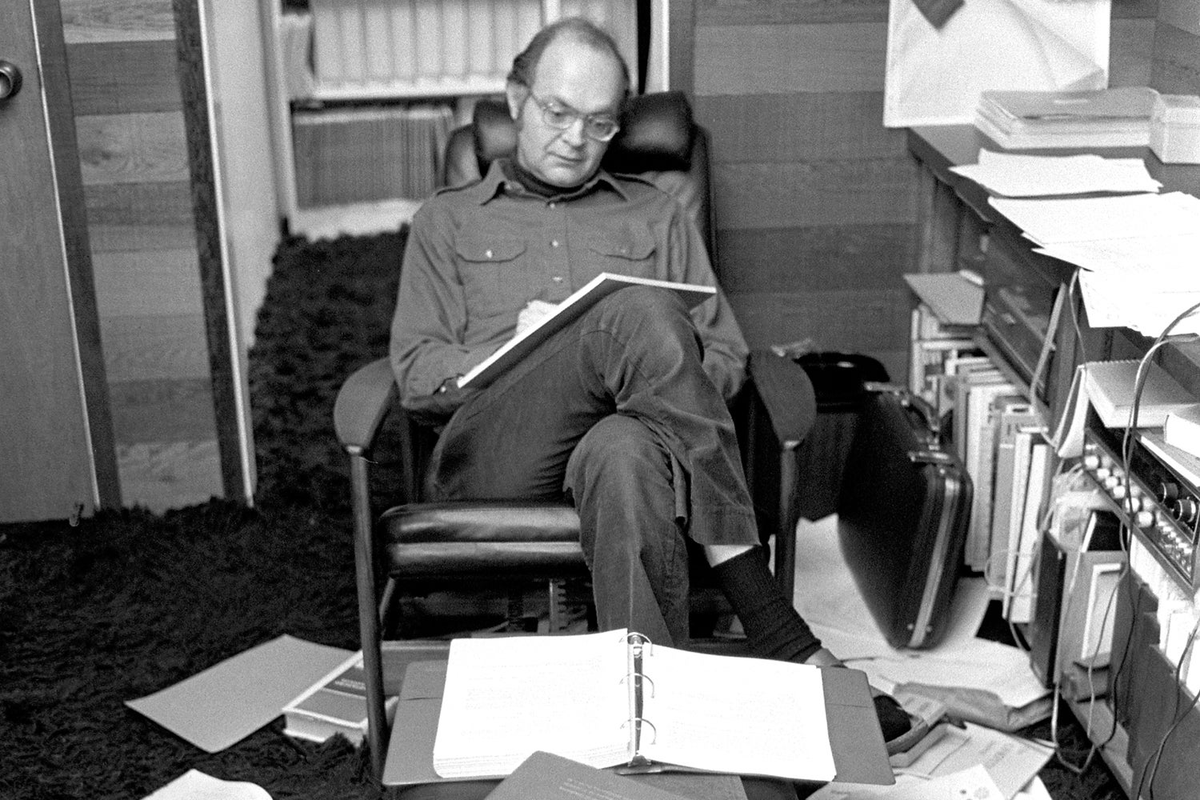
A computer scientist won the Turing Award at 36 and then walked away from almost every other project for the next 50 years to write one book that he has still not finished at age 88, and it may be the most important book in his field.
His name is Donald Knuth. He won the Turing Award in 1974, which is the closest thing computer science has to a Nobel Prize.
He was 36 years old. He had already written volumes one, two, and three of a book series called The Art of Computer Programming. He was the youngest person ever to receive the award at that point in its history.
Almost anyone else would have ridden that moment for the rest of their career. Founded a company. Sat on boards. Gone on speaking tours. Knuth did the opposite. He went back to his desk and kept writing.
He started the book in 1962. He was 24 years old. His publisher had asked him to write a short paperback on compilers. He sat down to outline it and discovered that to explain compilers properly he would have to explain the deeper algorithms underneath them first.
The short paperback became a draft outline of 12 chapters. The 12 chapters became a planned 7-volume series. The 7-volume series became the project he is still working on 63 years later.
Volume 1 came out in 1968. Volume 2 in 1969. Volume 3 in 1973. He was producing books faster than most academics produce papers. Then everything stopped.
In 1977 he received the printed proofs of the second edition of Volume 2. He looked at the pages and was so disgusted by how the publisher had typeset his mathematical notation that he could not bring himself to release the book.
The equations looked ugly. The fonts looked wrong. The spacing was off. He decided he could not in good conscience publish another volume of TAOCP until the typesetting problem was solved.
So he paused the book.
He stopped writing TAOCP and spent the next 8 years inventing TeX from scratch.
TeX is the typesetting system that every academic paper, every math textbook, every physics journal on earth now uses. Every PhD thesis in the sciences is set in TeX. Every paper on arxiv. Every equation in every paper Anthropic, OpenAI, and DeepMind have ever published. The system that the entire scientific publishing world runs on exists because one man refused to compromise on how the second edition of Volume 2 looked.
He gave the entire TeX system away for free. He never tried to commercialize it. He went back to writing TAOCP.
In 1992 he retired from Stanford at the age of 54. Most professors retire to slow down. Knuth retired to speed up. He explicitly said he was leaving teaching because he needed every remaining hour of his life to keep writing the book. He stopped using email on January 1, 1990.
He answers no calls. He takes paper mail only. He is on a personal mission to finish a multi-volume series that nobody is forcing him to write, on a deadline that only exists in his own head.
Volume 4A came out in 2011. Volume 4B in 2022. He is currently working on Volume 4C. Volumes 4D, 4E, 4F, 5, 6, and 7 are still ahead of him. He is 88 years old. He will almost certainly die before he finishes.
The thing that should haunt anyone reading this is the math of his choice.
Every modern incentive structure tells you to optimize for speed. Ship the imperfect version. Get it out the door. Iterate later. Move on to the next thing.
Knuth has spent 63 years doing the exact opposite. He pays a $2.56 reward in hexadecimal dollars to anyone who finds an error in his published books. Real checks, until check fraud made him switch to certificates of deposit. He treats every single error in every single volume as a personal failure. He revises. He rewrites. He goes back to fix issues that nobody else could have spotted.
He could have written 30 books in 63 years. He chose to write one.
The reason is the one almost nobody understands the first time they hear it. There is a category of work that loses all its value when it is done quickly.
A reference book that engineers will rely on for the next 200 years is not the same kind of object as a blog post that has to ship today. The slow project and the fast project look like the same activity from the outside. They are completely different games.
Bill Gates once said in an interview that if you can read the whole of TAOCP, you should send him your resume. He meant it. He was not joking. The man who founded Microsoft was telling the world that the rarest skill on earth is being able to finish a book that one man has spent his entire adult life writing for an audience that mostly does not have the patience to read it.
The book may never be finished.
The man writing it knows this and keeps writing anyway.
The work outlives the worker. That is the entire point.
A Dutch computer scientist gave one lecture in 1988 arguing that programming is unlike anything humans have ever tried to do before, and the reason most software on earth is broken is that we are still teaching it as if it were a hobby.
His name was Edsger Dijkstra. He won the Turing Award in 1972. He invented the shortest path algorithm that every GPS on earth still runs on.
He wrote the paper that killed the goto statement in modern programming languages.
He spent 50 years quietly being one of the most consequential thinkers in the entire history of computer science, and he was in a very bad mood by the time he stood up at the ACM Computer Science Conference in 1988 to deliver the lecture that almost nobody at the conference wanted to hear.
The lecture was called On the Cruelty of Really Teaching Computer Science.
It is now one of the most cited papers in the entire history of computing education. It was filed in his archive as EWD1036, handwritten in his careful fountain-pen calligraphy because he refused to use a typewriter and famously refused to use email for the rest of his life.
The argument was simple and uncomfortable.
Programming, Dijkstra said, is a radical novelty. Not a new tool. Not a new skill. Not a faster version of something humans already knew how to do. A genuinely new category of intellectual activity that has no real precedent in the entire history of the human species, and our brains have not been built to handle it.
Here is what he meant by that.
When a programmer writes a line of high-level code and presses run, that single line might trigger a billion operations at the level of the silicon.
The ratio between the abstraction you are working in and the physical events you are actually causing is roughly one billion to one. No engineer in history before computing ever had to reason about a system spanning that kind of ratio inside their own head.
A bridge builder reasons about steel beams and the physics of weight. A surgeon reasons about organs and the physics of tissue. A chemist reasons about molecules and the physics of bonds.
All of them are working inside ratios of physical scale where the largest and smallest things they need to think about are within a few orders of magnitude of each other.
A programmer routinely writes one line that orchestrates a billion physical events on a chip, and is expected to predict the behavior of all of them in advance.
Dijkstra argued that the human brain was simply not built for this. Every intuition we have evolved over hundreds of thousands of years comes from a world of medium-sized objects behaving in continuous ways. Computing is the opposite. It is discrete, not continuous.
A program that runs perfectly a billion times can crash on the billion-and-first iteration because of a single bit. A single character missing from a line of code can take down a power grid. There is no margin. There is no graceful degradation. The system either works or does not, and the only way to know is to actually run it.
This was the part of the lecture where Dijkstra made everyone in the room uncomfortable.
He said the way computer science was being taught in universities was a quiet disaster. Professors were teaching programming the way carpenters teach woodworking. With examples. With metaphors. With analogies to things students already understood. Files are like folders. Memory is like a desk. A function is like a recipe.
Dijkstra said this was actively making it harder for students to think clearly. The whole point of a radical novelty is that there is nothing in your past experience to compare it to.
The moment you start reaching for metaphors, you are smuggling in old intuitions that do not apply, and those intuitions will betray you the first time you try to reason about a system the metaphor was not built to describe.
His exact line was this: the usual way in which we plan today for tomorrow is in yesterday's vocabulary. And yesterday's vocabulary, he argued, was killing the field.
The reason most software is broken is downstream of this single misunderstanding. Programmers are taught to think of code as a craft. Something you get a feel for.
Something you pick up through practice. Something where intuition gets sharper with experience.
Dijkstra said this is exactly backwards. Programming is not a craft. It is closer to mathematics than to carpentry, and the moment you treat it as a craft, you guarantee that the software you produce will be full of the kind of bugs that craftsmanship cannot catch.
The fix, in his view, was to teach programming the way mathematics is taught. You should be able to prove your program correct before you run it.
You should reason about your code formally, the way a mathematician reasons about a theorem, not the way a carpenter feels their way through a joint. The students who learned this way, he said, would walk out of their classes with a kind of confidence that no amount of typing practice could produce.
The lecture was published in Communications of the ACM in 1989. The field did not listen. Universities kept teaching programming the same way.
Software kept getting bigger. Bugs kept compounding. By 2026, almost every piece of software on earth has known security vulnerabilities, undefined behaviors, and edge cases that nobody has ever proven safe. The doom that Dijkstra warned about in 1988 is now the default condition of the digital world we have built.
The deeper lesson is the one most readers miss the first time through.
Dijkstra was not just talking about software. He was making a much bigger point about how humans learn anything that is genuinely new. The instinct to translate the unfamiliar into the familiar is the most natural thing in the world.
It is also the single biggest obstacle to actually understanding something that has no precedent. If you keep reaching for analogies, you will never see the new thing clearly. You will only see your old framework projected onto it.
This is happening right now with AI. The same instinct that made people learn programming through metaphors of files and folders is making people understand large language models through metaphors of brains and people.
Almost every framework being used to describe AI in 2026 is borrowed from a previous domain. None of them quite fit. The few people who are actually building useful intuitions about how these systems work are the ones who have done what Dijkstra recommended forty years ago.
They have set down the old vocabulary. They have looked at the new thing on its own terms. They have accepted that the radical novelty is radical for a reason.
You are not slow. You were taught a discipline as if it were a hobby. The cruelty is real.
The fix is still available.
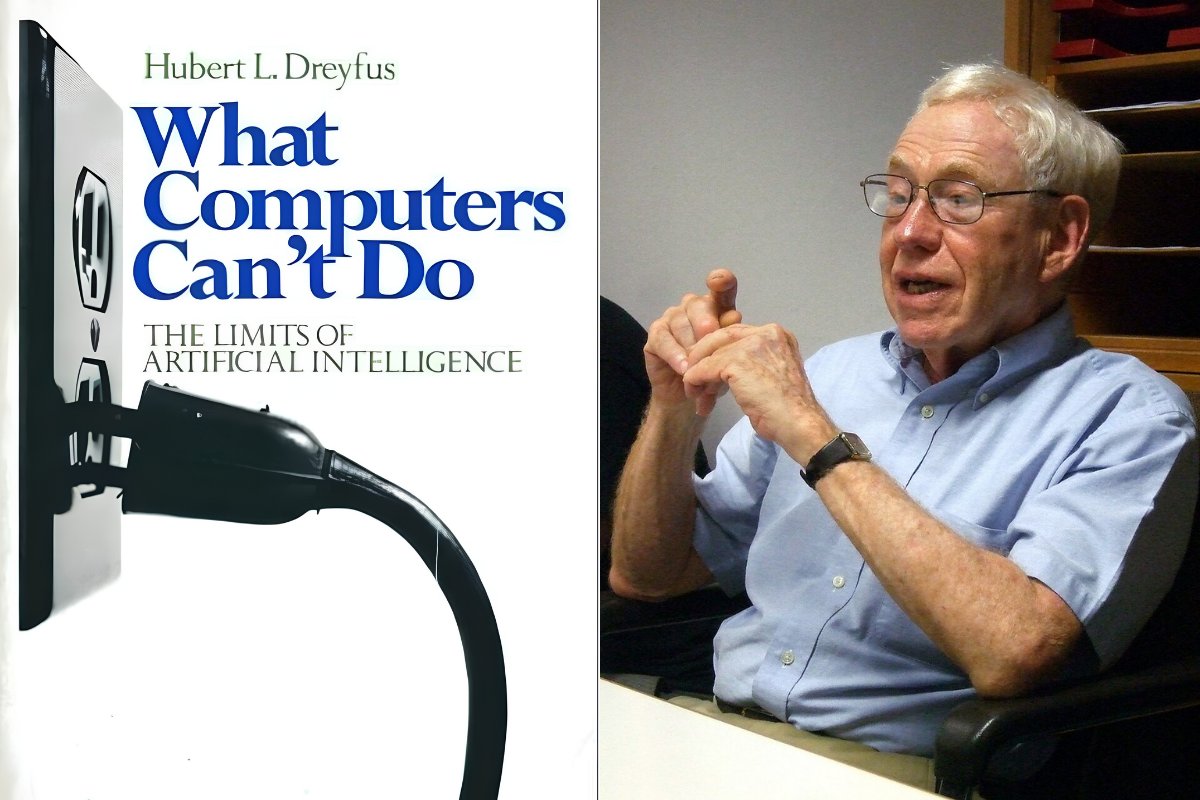
A Berkeley philosopher published a book in 1972 warning that AI would never understand the world the way humans do, got laughed off campus for it, then watched the entire AI research community spend 50 years slowly proving him right.
His name was Hubert Dreyfus. The book was called What Computers Can't Do.
And the story of what happened to him before, during, and after he wrote it is one of the most important things nobody tells you about the history of AI.
It started in 1965. RAND Corporation hired Dreyfus to study artificial intelligence. He turned in a 90-page report comparing AI research to alchemy. Not as a compliment.
He argued that AI researchers had made the same mistake over and over for a decade. They would get a narrow system working, predict it was the first step toward general machine intelligence, and watch it hit a wall nobody predicted. Simon said by 1967 computers would be world chess champion. They were not even close. Dreyfus called the whole thing a pattern. Early wins, massive promises, quiet collapse.
The AI community did not take it well.
Herbert Simon called the paper "garbage." Dreyfus taught at MIT at the time and later wrote that his colleagues "dared not be seen having lunch with me." The entire building avoided him.
Then they challenged him to a chess match against a computer.
Dreyfus had never claimed to be good at chess. He had only claimed that AI chess was weak, which it was. But MIT researchers organized a public game between Dreyfus and MacHack VI in 1967. He lost. The Association for Computing Machinery newsletter ran the headline: "A Ten-Year-Old Can Beat the Machine. But the Machine Can Beat Dreyfus."
The entire field celebrated. They had not answered his argument. They had just beaten him at chess. Nobody seemed to notice the difference.
Dreyfus expanded the paper into a full book in 1972. What Computers Can't Do laid out something deeper than chess criticism.
His argument was philosophical, not technical. He said human intelligence was not symbolic manipulation. It was not rules and logic trees. It was something more fundamental that no one had cracked: the ability to understand context, to act in the world through a body, to make judgments that depended on being alive and embedded in a situation.
He called it know-how versus know-that. A doctor who can feel something is wrong in a patient before naming what it is. A chess grandmaster who sees the right move before calculating it. A person who walks into a room and understands the social dynamics in four seconds without running a single algorithm.
These were not tasks you could formalize. Not because they were mysterious. But because they were rooted in physical embodiment and years of embedded experience in the world. A machine sitting inside a server rack had none of that. It had never touched anything. It had no body. It had never been afraid or hungry or confused in the middle of a city.
The AI community kept dismissing him for 20 more years. Then quietly, things started shifting.
The symbolic AI approach he had criticized started breaking down exactly where he said it would. Language was too ambiguous. Common sense was impossibly hard to encode. Systems that worked in narrow domains failed completely the moment the real world showed up.
By the 1990s, the field had largely abandoned the approach Dreyfus had attacked. When MIT Press published a new edition in 1992 with a long introduction updating his position, historians of AI started writing sentences like "time has proven the accuracy and perceptiveness of Dreyfus's comments."
In 2007, a journalist asked him whether he thought he had won the argument. He said: "I figure I won and it's over. They've given up."
He was right and wrong at the same time. Symbolic AI did collapse. But something else rose in its place: deep learning, trained on massive amounts of human-generated data, learning patterns from the bottom up instead of the top down. Systems that were not programmed with rules but that absorbed something about language and images and tasks from raw experience.
That is where the argument gets genuinely interesting and genuinely unresolved.
Dreyfus spent his last years thinking carefully about whether deep learning addressed his critique or just circumvented it. He had always said the problem was not intelligence as pattern recognition. He had always said the hard part was something else. Situatedness. Meaning. The ability to care about outcomes in a way that comes from having skin in the game.
A model trained on a trillion tokens of human text knows a great deal about what humans say. Whether it knows what humans mean is a different question. Whether it can act in the world the way a human acts, with a body and a history and stakes in what happens, is the question he spent 50 years trying to make people take seriously.
He died in 2017. GPT-2 was released two years later. GPT-4 was released six years after that.
The question he raised is still open. We build systems now that would have seemed miraculous in 1972. Systems that write, reason, code, argue, compose, translate, and explain. And the AI researchers at every major lab spend an enormous amount of time trying to figure out exactly what these systems are missing.
Dreyfus spent 50 years on a campus where people refused to eat lunch with him for saying that question mattered.
The man who was wrong about chess was right about almost everything else.
A new article has been published in Enacting Cybernetics: Composing Systems for Advancing Advancing, by Bill Seaman, developed from the Ranulph Glanville Memorial Lecture given at the International Society for Systems Sciences conference, 7–11 Jul 2022. https://t.co/0eR6jIcXxm
🎙️ Episode 2 of the 'Nature of Intelligence' season is out on #Complexity podcast!
What’s the relationship between language and thought?
Complex language is unique to the human species. It’s part of how we evolved, the backbone of our societies, and one of the primary ways we judge others’ intellect. Is it our intelligence that leads to our language abilities, or conversely, does our ability for language enhance our intelligence, or both? How do language and thinking interact? And can one exist without the other?
Join our guests @ev_fedorenko, @spiantado & @glupyan to explore this important and often contentious debate.
Listen now https://t.co/w50bXzlPye
or visit https://t.co/RvvwRFWPGr
#NatureofIntelligence #ComplexityPodcast #AI #Intelligence #Language #Cognition
#mdpisystems Call for reading:
Problems with Abstract Observers and Advantages of a Model-Centric Cybernetics Paradigm
https://t.co/Nigvenwcay
by Mr. Mick Ashby from @cybsoc, @asc_cybernetics and The International Society for the Systems Sciences
#systems#ethicalcybernetics
INSTEAD OF WATCHING A 2-HOUR MOVIE.
Watch this Anthropic Claude for Finance lecture.
It’s probably the best free hour in quant AI right now.
Bookmark it and watch it today, no matter what.
Interesting paper 😀
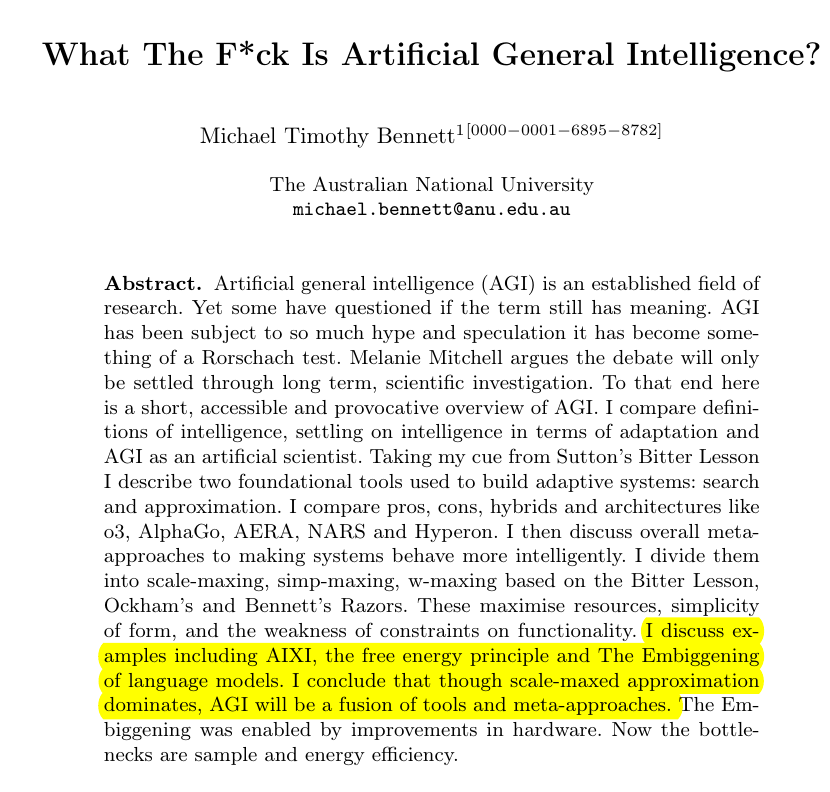
"What the F*ck Is Artificial General Intelligence?"
Defines intelligence as adaptability under limits of compute, memory, and energy.
So AGI is a system that adapts at least as generally as a human scientist
That means it should be able to plan experiments, learn cause and effect, balance exploration and action, and operate with autonomy.
The paper calls this type of AGI an artificial scientist, because it is judged by its ability to discover and adapt across many tasks, not just by passing human-like tests.
So AGI is not just “human-level AI” but a whole system that can adapt broadly, efficiently, and scientifically, at least as well as a human scientist.
----
arxiv. org/abs/2503.23923
Finally, we have a definition for AGI!
A recent paper breaks down what it actually means to reach human-level AI, and the results are surprising.
Here's what matters:
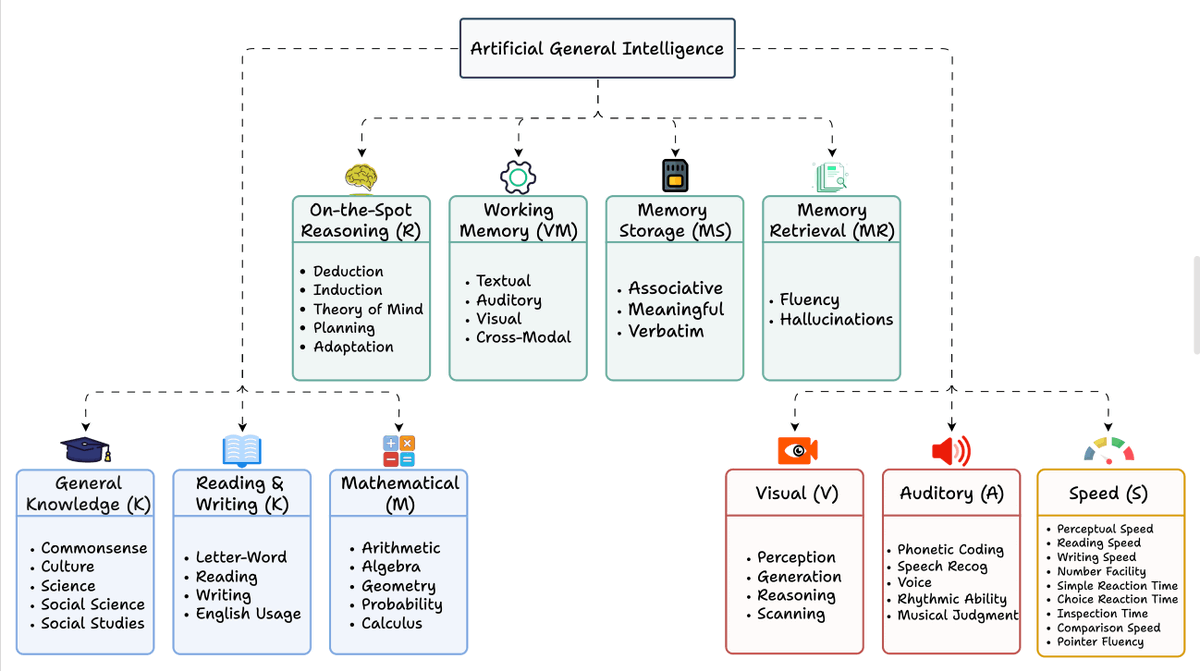
AGI isn't about passing a single test or excelling at one task. It's about matching the cognitive versatility and skill of a well-educated adult across 10 fundamental areas.
The paper breaks down human intelligence into 10 cognitive domains to create an AGI Score (0-100%). Each domain gets equal weight:
- General Knowledge
- Reading & Writing
- Mathematical Ability
- On-the-Spot Reasoning
- Working Memory
- Long-Term Memory Storage
- Long-Term Memory Retrieval
- Visual Processing
- Auditory Processing
- Processing Speed
So, where do we stand today❓
GPT-4 scored 27%. GPT-5 jumped to 58%.
That's massive progress, but here's the catch:
Current AI has a jagged cognitive profile. It dominates knowledge-rich domains but crashes on core cognitive machinery. GPT-5 still scores 0% on long-term memory storage.
We use large context windows and RAG systems as workarounds, not solutions.
The real bottlenecks:
Long-term memory remains unsolved, causing amnesia every interaction. Memory retrieval is unreliable. Visual and auditory reasoning are incomplete.
Even at 58%, GPT-5 is only halfway there.
Reaching AGI isn't about scaling current architectures. We need to solve fundamental bottlenecks in memory, reasoning, and integration.
Find the link to the paper in replies!
Microsoft just banned its own engineers from using AI.
The tool was literally costing MORE than the humans it was supposed to replace.
They lied to you about AI adoption and now the whole narrative is blowing up:
Microsoft gave thousands of engineers access to Claude Code six months ago and encouraged them to use it.
Engineers loved it and adoption exploded. But then the invoices arrived.
Token-based pricing means every query, every code review, every debugging session costs money. At scale across 100,000 engineers, the numbers became so large that Microsoft issued an internal order to cancel nearly all Claude Code licenses by end of June and force everyone onto their own cheaper tool instead.
The company that invested $5 billion in Anthropic just told its own people to stop using Anthropic's product because it costs too much.
Uber's story is even worse...
Their CTO Praveen Neppalli Naga told The Information that the budget he planned for the full year was "blown away already" by April.
Uber had rolled out Claude Code in December 2025. By March, 84% of their 5,000 engineers were using it with 70% of all committed code coming from AI systems.
Heavy users were burning $500 to $2,000 per month each. Naga himself spent $1,200 in a single two-hour demo session.
The company had even built internal leaderboards ranking engineers by how much AI they used. They literally gamified the spending and then ran out of money.
Now look at what Nvidia's own VP of applied deep learning Bryan Catanzaro said to Axios last month. Direct quote:
"For my team, the cost of compute is far beyond the costs of the employees."
This is a VP at the company that SELLS the chips saying that using AI is more expensive than paying humans.
Think about what this means for the entire AI narrative.
Every CEO on every earnings call for the past two years has said the same thing:
AI will make us more efficient, reduce headcount, and cut costs.
The stock market rewarded every company that said it.
Fired workers, stock goes up. Announced AI adoption, stock goes up.
But the actual companies deploying AI at scale are discovering the math doesn't work. The MORE employees use AI, the HIGHER the bill.
Goldman Sachs forecasts a 24x increase in token consumption by 2030 as companies adopt AI agents. Gartner just published a report showing that even though individual token prices will drop 90% by 2030, total enterprise AI costs will go UP because agents consume exponentially more tokens per task than basic tools.
Meta built an internal dashboard called "Claudeonomics" to track which employees use the most AI. Amazon started pushing engineers to "tokenmaxx," their internal term for consuming as many AI tokens as possible.
Both companies are spending hundreds of billions on AI infrastructure this year alone.
And Microsoft, the company that bet its entire future on AI, just told 100,000 engineers to stop using the tool they liked best because the per-token bills got out of control.
The companies building AI are telling investors it saves money. The companies using AI are finding out it costs more than the humans it was supposed to replace. And even the company that makes the chips just admitted it through its own VP.
This is the gap nobody on Wall Street is pricing in.
$725 billion in AI infrastructure spending this year across Big Tech. And the first companies to actually deploy these tools at scale are already pulling back because the economics don't work.
What do you think?
Two straits and two very different uses of power.
Hormuz proves geography can reshape the global economy. The Øresund strait could pressure Russia's war machine without firing a shot.
Sweden and Denmark hold the keys.
Read more in The Cipher Brief. https://t.co/KHx1doVO5I
Trump’s Beijing summit produced few clear deliverables, but gave Xi Jinping something valuable.
Two Cipher Brief experts assess what the summit revealed about U.S.-China competition, Taiwan, AI and Beijing’s growing confidence.
https://t.co/lZnACTqhKa