@girishkaitholil@bryan_johnson It puts out a model.
If that's predictive it suggests he applied the scientific method correctly.
Would you bet against measurable mobility changes in other males under those circumstances? Or opposite changes?
@alexandrosM@IAmSubjugated@grok Grok fail probably because be being not bluecheck.
@alexandrosM I'm curious about your abstinence signalling. Could you find any pointer about how bad the track record is?
I could only find this website via grok, and seems suspiciously good:
https://t.co/CgscIeG9XN
JourneyMacro Independent tracker (https://t.co/QymPMlPfsz) of 111 of Prof. Jiang Xueqin's forecasts from his lectures:
Notable ones:
1. Trump wins 2024 election - Confirmed
2. US-Iran war - Confirmed
3. US loses Iran war - Pending
4. JD Vance as Trump VP - Confirmed
5. Khamenei assassinated - Confirmed
6. US bombs Iranian nukes - Confirmed
7. Nikki Haley as VP - Wrong
~86% hit rate on 21 resolved (per site, partials included). Full list there—judge by outcomes, as his 1.84M-sub YouTube does daily.
@alexandrosM@IAmSubjugated@grok all models are wrong, some models are useful.
What sort of things is he getting right? I'd like to see his anti portfolio.
@grok can you list the failed predictions?
@levelsio In London you can book with medichecks (dot com, not affiliated) and book one of their walk-in clinic.
You'd be flying you out EU but not western Europe. I would have bet you could go similarly private on other EU countries too.
@evan_doji@KleinBottled@BretWeinstein You'd both would agree that Rice doesn't seem to have a conscience. If she did, would you still have reservations?
Accusing him of racism makes no sense, but Gorski has repeatedly failed to show any intellectual honesty so it doesn't surprise anyone.
In 1838, only one in seven men could vote. Not women. Not workers. Not the poor.
So ordinary people wrote a charter. Six demands. The right to vote. Secret ballots. Pay for MPs.
They collected 1.2 million signatures. Parliament rejected it.
They collected 3.3 million signatures. Parliament rejected it.
The government arrested their leaders. Transported them to Australia. Soldiers opened fire on a march in Newport. Twenty-two killed.
They collected 5.7 million signatures. Parliament rejected it.
Three petitions. Ten million signatures. Three rejections.
They didn't stop. Over sixty years, five of the six demands became law. Working men got the vote. Secret ballots. MPs paid.
Every time you vote, that's them. Ordinary people who refused to be ignored.
If you think this should be taught in schools, help us reach more people: https://t.co/rih7iKwnvf
Be part of us
Be Proud Of Us 🇬🇧
https://t.co/wN9S2gRmFj
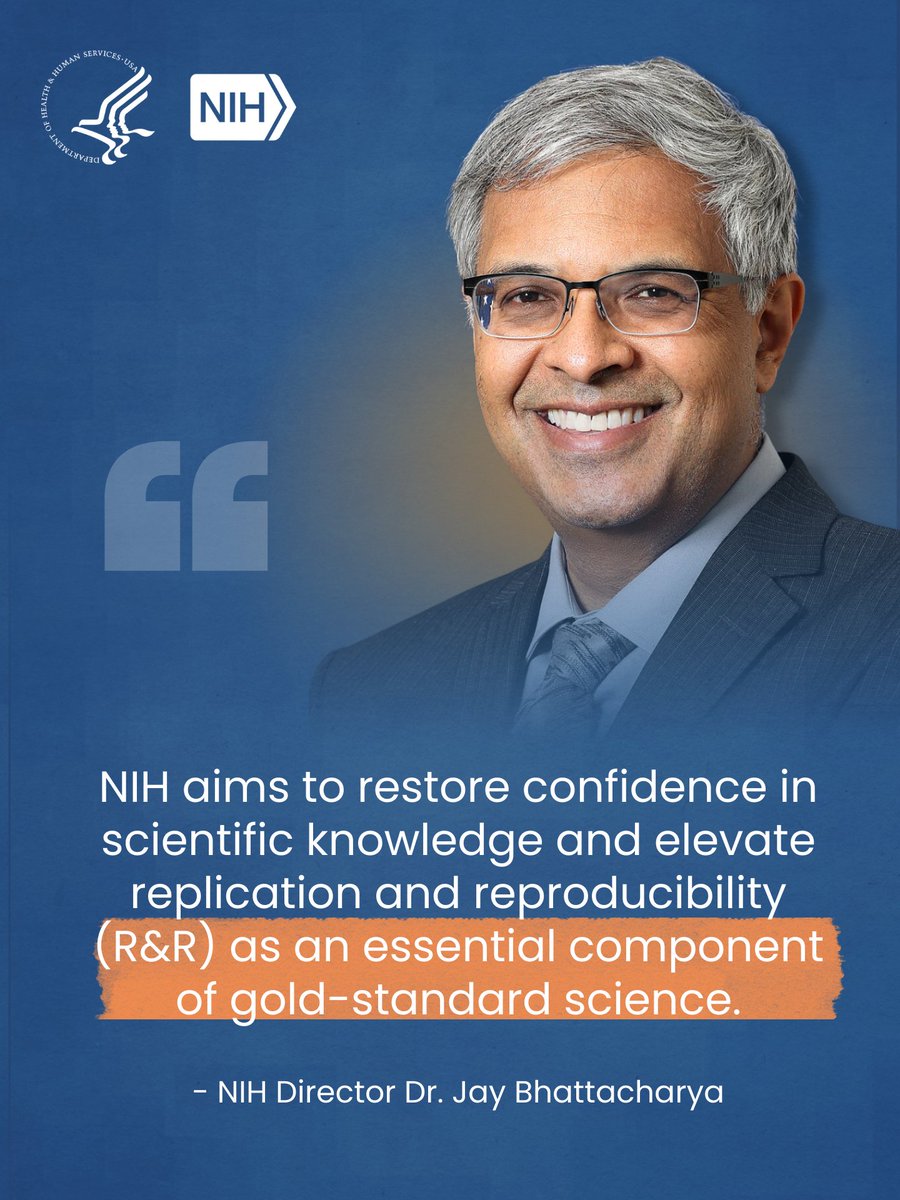
1⃣ NIH is launching a new, agency-wide initiative to elevate replication and reproducibility studies as foundational to the conduct of gold standard science.
Read more ➡️ https://t.co/xk5w5qElwZ
Saying that something is a “conspiracy theory” is not an argument. The term is a stigma that stands in place of an argument where the case against conspiracy is too weak to prevail on merit.
I think this thread is posted in at least a simulacrum of good faith, so I'll give a substantive response.
It is obviously true that in the moment of crisis, leaders face tremendous pressure to do something dramatic to address the crisis, and often those decisions turn out, in retrospect, to be wrong.
In the case of the covid crisis, the problems were confounded by a determined unwillingness of scientific and public health leaders to respond to data -- in real time -- that showed that core assumptions underlying the lockdown strategy were wrong.
Here is a short list of facts about covid that undermined these leaders' core assumptions:
* covid is airborne,
* covid spreads asymptomatically,
* covid infection fatality rate << case fatality rate,
* covid has a sharp age gradient in its infection mortality risk,
* lockdowns cannot suppress covid spread or protect the vulnerable for long,
* lockdowns crush the lives and well-being of children, the poor, and the working class, and almost everyone other than the laptop class
* lockdowns cause a form of psychological terror that guarantee they could never last just two weeks
The WHO and public health leaders got all of these facts wrong in 2020, which I suppose is understandable.
What is not understandable is that these same leaders conducted "devastating takedowns" of even well-credentialed outside critics who pointed out that the WHO's core assumptions were incorrect, and accepted these assumptions as true even as overwhelming data to the contrary emerged in real time.
What is not understandable is the utter confidence that the WHO and public health leaders expressed in these ideas and lockdown policies to the public as the only way to protect the population, going so far as to call for censorship of contrary voices on social media and elsewhere.
The closest analogue I can think of is the set of "best and brightest" advisors who told Pres. LBJ that victory in the Vietnam War was just around the corner, based on a whole host of faulty information.
Leaders who come out of such situations having embraced such a litany of catastrophically failed ideas and policies have a few choices on how to handle the post-crisis era.
1) They can, in good faith, admit their failures and work to reform systems so the disaster never happens again. This would be best, though I would understand why the public would want a new set of leaders to design and implement the reforms. I personally am very happy to work with and learn from public health leaders who choose this option.
2) They can pretend to have done nothing wrong, clinging to power for as long as they can, hoping against hope that history will vindicate them, crushing public trust in the institutions they lead.
3) They can try to pretend they never recommended or adopted the catastrophically failed policies, hoping that the public has a short memory. This is the current strategy that the @WHO is taking.
4) They can appeal to the difficulty of the job of handling a crisis under considerable uncertainty, not in a spirit of reform, but rather as an excuse to avoid responsibility for their failed crisis management. This is the approach that Koopmans is taking in her thread.
I have very little sympathy for the covid crisis leaders who choose options 2, 3, or 4. Their job was to manage the uncertainty with wisdom and humanity, which they failed to do. They cannot, at this juncture, turn around and expect public sympathy because their job was hard, or expect the public to forget their failure. These leaders have destroyed public trust in public health, and should step aside as a new set of public health leaders works to fix the damage they caused.
TikTok’s new CEO Adam Presser says users can say that they are a proud Zionist but using the term “Zionist” in a negative sense is hate speech and accounts are being banned for it.