My son, liquid money is like a basket of fresh fruit.
If you leave it sitting in the corner of your house, it is sweet today, but within weeks it will attract flies and rot. By the time the dry spell arrives, you will be holding an empty basket.
The wise farmer does not watch his harvest spoil. He slices his extra fruit and spreads it out in the hot sun. By drying the harvest, he is handing a share to tomorrow.
Treat your income the same way. Do not let your money rot. Buy assets to dry some for tomorrow.
Be blessed.
My son, assuming the good times will never end is a foolish mistake.
A matooke farmer knows the rainy season brings big yields and quick cash. But he survives because he saves his profits to feed his family when the hot sun returns to dry the soil.
The unwise man survives a few months of plenty and suddenly forgets how to spell poverty. He upgrades his life and eats his entire harvest, ignoring the changing weather.
When the money stops, he points fingers at his relatives and blames witchcraft for his downfall. But witchcraft is innocent; his own lack of discipline was the real curse.
Store your harvest while it is raining.
Be blessed.
My son, making money is easy. It is making money while carrying a family that breaks a man.
A youth can afford to plant his entire harvest because he only has his own stomach to manage. He can bury his money in the soil and wait for time to multiply it.
But a man with many mouths to feed is forced to throw his seeds straight into the boiling pot. He cannot afford to invest for tomorrow because his family is starving today.
Use your youth. It is the only time in your life when you are allowed to plant a seed without someone demanding to eat it first.
Be blessed.
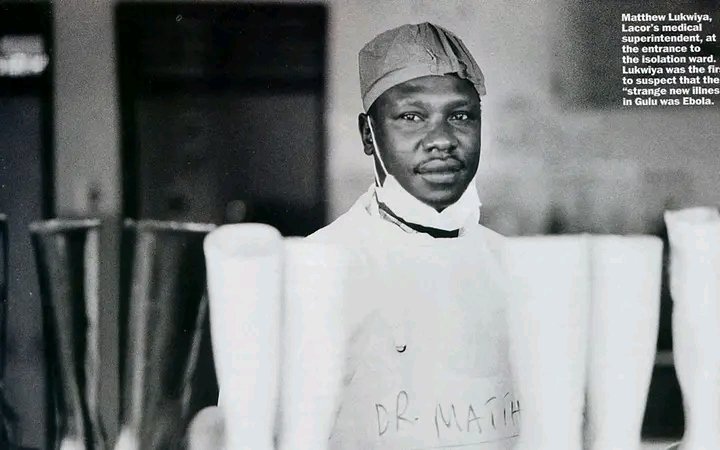
In Memory of Dr. Mathew Lukwiya
In his final hours, he spoke to Sister Apio Anyai Angioletta, the paediatric nurse who had known him for years. She would later remember his exact words.
"Sister, things are worsening. I have tried to fight. The battle is almost over. Now I am seeing that I am also going. The time has come for me to go. That I know. I am going. But if I go, I will be at the doorway. Nobody is going to die now. I will tell my God that enough is enough."
Then he began to sing a hymn about war. Everyone in the room broke down. Sister Apio replied, "No, doctor, it will not be like that." But it was. On December 4th his breathing briefly stabilised. Later that evening his lungs began to haemorrhage. He died at 1:20am on December 5th, 2000.
He was buried at 4pm the same day. The coffin was sprayed with Jik bleach as it was lowered. Margaret asked if she could see him one last time and was refused. The body was considered too infectious.
He was placed in a grave he had chosen himself while he was dying, at the Grotto inside the hospital grounds, beside Dr. Lucille Teasdale and later Piero Corti. Teasdale had died in 1996 of AIDS, contracted while operating on an HIV-positive patient.
The student was buried beside his mentors.
And then something extraordinary happened. After Lukwiya's death, every remaining Ebola patient at Lacor survived. Not another single person died at the hospital. Sister Apio remembered the promise he had made on his deathbed: "I will tell my God that enough is enough." It is the kind of detail you would not believe if you read it in a novel.
By the time the WHO declared Uganda Ebola-free on February 6th, 2001, 425 confirmed and probable cases had been recorded, and 224 Ugandans had died, including thirteen health workers from Lacor alone.
The survival rate during the outbreak was nearly 50%, compared to as low as 10% in previous African outbreaks, largely because of the systems Lukwiya had built before anyone else even knew what was happening.
This is what the mainstream story leaves out. The intern who refused a teaching job in England. The doctor who walked into the bush instead of the nuns. The administrator who turned the hospital into a shelter for nine thousand people, most of them children, every night.
The Acholi son of a smuggler who topped his country in school, won the John Hay Prize at Liverpool, and still chose Gulu over everything else. By the time he made that final speech to his nurses, the heroism was already the entire shape of his life. The Ebola work only made it public.
Happy Heroes Day, Dr Matthew and all healthcare workers who sacrifice more than they should have to! #HeroesDay
# *Copied*
🤯 𝗪𝗘 𝗪𝗢𝗡'𝗧 𝗦𝗘𝗘 𝗔𝗡𝗬𝗧𝗛𝗜𝗡𝗚 𝗟𝗜𝗞𝗘 𝗧𝗛𝗜𝗦 𝗘𝗩𝗘𝗥 𝗔𝗚𝗔𝗜𝗡.
🏆 In the huge title showdown between the top two in the National League, Rochdale scored in the 90+5' minute to take the lead. Fans thought they'd won it and full scale pitch invasion took place.
After a long 7-minute pause in the game, the referee finally restarted the action with fans returning to their seats.
York immediately went up the other end and scored in the 90+13' minute to clinch the draw and re-take the lead in the league.
York City are 𝗣𝗥𝗢𝗠𝗢𝗧𝗘𝗗 to League Two.
Rochdale must now go into the play-offs. 𝗨𝗡𝗕𝗘𝗟𝗜𝗘𝗩𝗔𝗕𝗟𝗘.
I wrote this in a moment I never would have chosen. A sudden pause that made me see my life clearly.
The meaning of our work is profound. This experience simply helped me see more clearly what matters most.
“Time is Finite” JAMA
https://t.co/IwkKdyeEWx
If I had to start agribusiness all over again
I would slow down at the beginning and think very differently about how I enter the game. When I was starting out like many people, my mindset was simple produce more, improve quality, expand gradually and the market will eventually respond. It felt logical. After all, if you have a good product buyers should come, right?
But the reality on the ground teaches you in a much harder way.
I remember moments where we had good coffee clean, well-handled with real effort behind it but still found ourselves negotiating prices we knew didn’t reflect that work. Not because the coffee wasn’t good but because we were trying to fit it into a market we didn’t fully understand.
At that point, you realize something uncomfortable: the market doesn’t adjust to you, you adjust to the market often when it’s already too late.
That’s where many of us get it wrong. We invest in production first, then start looking for buyers later. And in that gap we lose power. You find yourself compromising on price, on terms sometimes even on relationships just to move your product. It’s not a quality problem it’s a positioning problem.
Over time, I started seeing things differently. The market is not the final step in agribusiness it’s the foundation. It shapes everything before you even plant or source that first kilogram. It determines what quality actually means, what volumes are realistic, what consistency is required and most importantly what someone is willing to pay for again and again.
If I were starting again today, I would begin with the market and work backwards. I would spend more time understanding buyers, what they truly value beyond just “good quality,” how they make purchasing decisions and what gaps exist that I can realistically fill. Only then would I align production, sourcing and systems to meet that demand.
Because one thing becomes very clear with experience agribusiness is not just about growing or trading a product. It’s about aligning that product with the right market at the right time and in the right way.
And if there’s one lesson I’ve learned the hard way, it’s this: it’s better to grow into a market than to struggle to fit into one later.
So before you rush to plant, expand or invest more into production maybe pause and ask yourself one question:
Are you building for a market… or are you hoping one will find you?
For God and my country
That Ministry of Health suggestion that medical interns should work for free, or that medicine should be extended to 6 years specifically to make internship unpaid without any consideration, made me feel so much pain in my heart.
I always ask myself: why do fellow doctors always wish the worst for their colleagues? You literally know what it means to be an intern, working 36 hours nonstop. We have seen interns fall into severe depression due to stress. You know that medical internship is more stressful than military training.
I understand the public saying anything, they don’t know, but you know how much pain one goes through.
In medical school, fellow doctors will want to fail you and see you repeat a year, yet medicine is already 5 years and very stressful. Still, they find so much happiness in seeing others suffer, as long as you are a colleague.
I am deeply disappointed in you, lecturers who know what 5 years of medicine means, yet still fail medical students without serious cause, often out of malice. Research supervisors who know that most master’s programs are 2 years and part-time, while medical programs are 3+ years full-time, yet still try to make others repeat, not because they are incapable, but out of spite. You disappear when students need you most to complete their research.
During my internship, we had no weekends, no public holidays, and had to do a minimum of two night shifts every week. Shifts were 36 hours. For example, you start Monday morning, do ward rounds with seniors until about 3:00 PM. After that, interns remain to implement everything discussed. Those on night duty continue until morning without sleep, managing a full ward with very limited staff.
By morning, seniors do not allow you to leave until you join the next ward round. So after 24+ hours, you continue working the entire day and only leave in the evening, just to rest briefly and start again the next day.
Most times, the following day you are in clinic, seeing so many patients that your brain feels overwhelmed. I remember once falling asleep in front of a patient because I was extremely exhausted, every part of me felt drained.
Now imagine doing all this and still having to worry about finding food.
I had a business that was doing well, but the moment I started internship, it collapsed completely. There is simply no way to earn while doing internship.
We used to run clinics seeing over 200 patients with only two interns. It sounds impossible, but it is real. A regional referral hospital can serve up to 20 districts. In a hypertensive clinic, 200 patients is actually on the lower side.
On such days, we would start at 7 AM and finish at night without eating. Patients would get frustrated, but we were doing everything humanly possible.
We were four interns in internal medicine. When two were running clinic, the other two were managing a full ward alone, and you know they were suffering.
We used to receive a stipend of 750,000 UGX per month from the government. It was small, but at least we could pay rent (around 200k) and afford some food and transport. In some districts, even finding accommodation is difficult.
In my life as a doctor, the people who have shown me the harshest side of this profession have been fellow doctors. You see them in leadership and think they will advocate for you, but they don’t.
My recommendation to medical students, well-wishers, and UMA: meaningful change will likely come from Parliament or the President. Unfortunately, doctors in leadership often make things worse.
The first time interns received improved pay was when the late Hon. Jacob Oulanyah heard their concerns, along with the President. However, it did not last because some doctors reportedly advised that the funds were being wasted.
@Thomas_Tayebwa@AnitahAmong@MinofHealthUG@DianaAtwine
As a superstar, we return to the show as we take on our elders of @FCKyangabukama in our season opener.
Entertaining football | Beer | Networking | Wags
#ShanaBakiibe#BackToTheKraal