Wow what both @apple Siri and @amazon both wanted to be…[1].
2 verticals, one horizontal move...[2].
ref:
[1.] “Subsidiarity in code and capital” https://t.co/QjJjlM7fxt
[2.] "Agnetic is growing a first-principles Native AI" ref: https://t.co/B5lysMXL1E
h/t @xai
#SubsidiarityInCodeAndCapital • from the agnetic Soils-as-Health Round Table™
“Cloud is not the endgame y’all !!”
Indeed! It is not! Nice work @KanikaBK
ref: “Subsidiarity in code and capital” https://t.co/9hYKNhh86J
#SubsidiarityInCodeAndCapital • from the agnetic Soils-as-Health Round Table™
Google just dropped an AI bomb!
A BILLION DOLLARS Game is on.
Gemma 4 12 B runs on your laptop. 16 GB of RAM, that is a MacBook Pro.
Solves the biggest problem Enterprises are facing.
This is the biggest directional signal in AI
Cloud is not the endgame y’all !!
@vibeeval Thanks for posting and getting folks thinking about an alternative to the ‘god-model’ AI.
an agnetic aside: Here are our efforts on the sam subject. [ref: “Subsidiarity in code and capital” [ref: https://t.co/QjJjlM7fxt ]
Not being a numbers guy, I really appreciated everyone who put in their point of view regarding the numbers. [especially @grok:
ref:
“yasam It works via **Ollama's Anthropic Messages API compatibility** (added Jan 2026). Point your Anthropic SDK/Claude Code tools to a local Ollama server with one base URL/env var change — same interface, runs open models at zero API cost.
The 1000 Mac Mini M4 cluster idea: cheap ($599 ea), extremely power-efficient (~10-50W each under load), great for parallel inference/agents on quantized models. Total power often beats one H100 node for many small workloads. Real examples of Mac Mini clusters exist for local LLMs.
**Worth it?** Yes for high-volume, predictable inference if you can handle capex (~$600k) + ops (rack, network, failures) and models fit in ~16GB RAM. Payback in 2-4 years vs $14k/mo cloud, plus privacy + no recurring fees.
Not ideal for huge models, bursty loads, or if you lack hardware management. GPUs win on raw single-model speed. Calculate your tokens/month + TCO. Solid long-term play for the right startup.”
Nice work all!
h/t @theallinpod Thanks for all your inspiring conversations.
#SubsidiarityInCode&Capital • from the agnetic Soils-as-Health Round Table™
Subsidiarity in code and capital
Chamath nailed it on the All-In pod (the one with Bill Gurley, around the 38-minute mark; @theallinpod ): tying benefits, compensation, or any real economic support to a singular algorithmic decision is straight-up Black Mirror dystopia. One all-knowing model dictating your outcomes? No thanks. You need 100, 1,000, or 100,000 competing versions of the answer so you can actually refute, test, and improve the singular claim. A monopoly on “the answer” (whether from Big Tech, government, or some fused super-intelligence) is incredibly dangerous. It kills agency, innovation, and truth-seeking.
[ref: ref: https://t.co/1LefvolBHO ]
That instinct maps perfectly onto the Principle of Subsidiarity in Catholic Social Teaching. Subsidiarity is not some dusty theological footnote—it’s a hard-nosed governance rule: handle matters at the smallest, lowest, or least centralized competent authority.
Families, local communities, individuals, or small operators do what they can. Only when they genuinely can’t does the higher level step in—and even then, it supports, it doesn’t supplant or absorb. The goal is human dignity through real responsibility and initiative, not turning people into passive clients of distant bureaucracies (or algorithms).
Pope Pius XI laid this out in Quadragesimo Anno (1931) as a direct counter to both socialist central planning and unchecked big-capital concentration. It’s the same logic the pod was circling when they talked about the Pope’s recent AI encyclical: keep power close to the ground, preserve sovereignty, avoid opaque top-down control. Subsidiarity + solidarity = decisions stay human-scale, plural, and refutable.
Exactly what Chamath is demanding.
Now here’s where it gets operationally exciting—and where the All-In audience (and everyone pouring trillions into AI infra) should lean in.
Nature is the original first-principles processor and production environment. Four billion years of R&D, zero central planner, pure decentralized trial-and-error at the local level. Every cell, microbe, soil particle, plant, and animal runs its own “compute” on physics, chemistry, and real-time feedback. Billions of parallel experiments. The weak versions get refuted by reality itself. What survives compounds into antifragile ecosystems that self-optimize without a dashboard or a single point of failure. No Black Mirror. Just relentless, ground-truth pluralism.
The X post from @agnetic1 (Russell Curry) lays out a concrete, capital-efficient way to operationalize exactly this logic in today’s economy. Agnetic is building a Native AI trained directly on dense, instrumented real-world Nature data from controlled R&D plots (starting at >1,000 acres).
Soil-microbe-plant-animal interactions become the training set. That data isn’t abstract tokens—it’s proprietary, compounding ground truth that generates differentiated nutritional, functional, and sensory attributes in food and ag systems. It creates a closed-loop flywheel: the plots produce both novel biological insights and continuous high-volume training data that turns into horizontal expansion across inputs, production, processing, logistics, and downstream value capture. [ref: https://t.co/B5lysMXdc6 ]
Crucially, Agnetic positions itself as a high-volume downstream consumer of America’s multi-trillion-dollar AI infrastructure buildout—data centers, accelerators, chips, power. Instead of another foundation-model arms race chasing leverage and scarcity, they’re leading with context and coherence. They take the infra everyone is already spending on and route it into real-economy applications that create proprietary moats from nature itself. Trader’s Logic (probabilities over certainty, manage exposure, don’t fight the market) gets upgraded: same infrastructure, different intent—non-zero-sum outcomes grounded in physical reality.
This is the new operational logic in action:
• Subsidiarity in code and capital: Decisions, data collection, and model refinement stay as local and grounded as possible (instrumented plots = lowest competent authority). Higher-scale AI only augments when it genuinely adds value.
• Pluralism by design: Thousands of specialized, competing Native AIs (each rooted in their own ecosystem data) instead of one god-model. Refutation and improvement become native features, not afterthoughts.
• New business models & relationships: Vertically integrated intelligence layers that expand horizontally. Infra providers finally get real, recurring, high-margin customers who need continuous compute for ground-truth workloads. Ag, food, and downstream sectors get differentiated products and resilience that generic overlays can’t deliver. Capital compounds into actual economic capability instead of hype cycles.
First-principles flywheel: Nature supplies the ultimate training data and production environment. Human intent (the “Human Data Engine”) steers it toward coherence rather than extraction. Result: antifragile, sovereign systems that scale without centralizing power.
For the All-In beasties, the infra giants hunting PMF, and everyone adjacent: this is how you turn the capex bonanza into something durable.
Stop praying for the one true model to rule them all.
Instrument the real world at the lowest viable level, let nature’s pluralism do the heavy lifting, and build the horizontal linkages that turn compute into differentiated value.
Chamath’s warning + subsidiarity + Nature’s proven OS = the anti-dystopian playbook.
It’s not ideology. It’s first-principles engineering that actually works—and creates customers who will gladly pay for the infrastructure you’re already building.
The pod was right to flag the danger. Agnetic (and the growing cohort thinking this way) shows the practical off-ramp: decentralize the compute, ground it in nature’s first principles, and let a thousand refutable models bloom. That’s not just culturally acceptable to this crowd—it’s the strategy that wins.
Disclaimer:
I wrote this with Grok as a thought partner and editor — the same way I would use a strong co-founder or senior collaborator. I drove every major decision, contributed the core observations and personal insights, and iterated through multiple rounds. The final voice, framing, and ideas are mine.
@TonySeruga Excellent article. You are among good company. The @theallinpod beasties are right there with you. [ref: https://t.co/QjJjlM6HHV
Count us too among the many seeking something more than the ‘god-model’ AI you speak of.
”Agnetic is growing a first-principles Native AI” is our effort to address some of the gaps/disconnects you highlight. Let us know what you think by replying below, quote this article or DM/email [email protected]. [ref: https://t.co/B5lysMXdc6 ]
Subsidiarity in code and capital
Chamath nailed it on the All-In pod (the one with Bill Gurley, around the 38-minute mark; @theallinpod ): tying benefits, compensation, or any real economic support to a singular algorithmic decision is straight-up Black Mirror dystopia. One all-knowing model dictating your outcomes? No thanks. You need 100, 1,000, or 100,000 competing versions of the answer so you can actually refute, test, and improve the singular claim. A monopoly on “the answer” (whether from Big Tech, government, or some fused super-intelligence) is incredibly dangerous. It kills agency, innovation, and truth-seeking.
[ref: ref: https://t.co/1LefvolBHO ]
That instinct maps perfectly onto the Principle of Subsidiarity in Catholic Social Teaching. Subsidiarity is not some dusty theological footnote—it’s a hard-nosed governance rule: handle matters at the smallest, lowest, or least centralized competent authority.
Families, local communities, individuals, or small operators do what they can. Only when they genuinely can’t does the higher level step in—and even then, it supports, it doesn’t supplant or absorb. The goal is human dignity through real responsibility and initiative, not turning people into passive clients of distant bureaucracies (or algorithms).
Pope Pius XI laid this out in Quadragesimo Anno (1931) as a direct counter to both socialist central planning and unchecked big-capital concentration. It’s the same logic the pod was circling when they talked about the Pope’s recent AI encyclical: keep power close to the ground, preserve sovereignty, avoid opaque top-down control. Subsidiarity + solidarity = decisions stay human-scale, plural, and refutable.
Exactly what Chamath is demanding.
Now here’s where it gets operationally exciting—and where the All-In audience (and everyone pouring trillions into AI infra) should lean in.
Nature is the original first-principles processor and production environment. Four billion years of R&D, zero central planner, pure decentralized trial-and-error at the local level. Every cell, microbe, soil particle, plant, and animal runs its own “compute” on physics, chemistry, and real-time feedback. Billions of parallel experiments. The weak versions get refuted by reality itself. What survives compounds into antifragile ecosystems that self-optimize without a dashboard or a single point of failure. No Black Mirror. Just relentless, ground-truth pluralism.
The X post from @agnetic1 (Russell Curry) lays out a concrete, capital-efficient way to operationalize exactly this logic in today’s economy. Agnetic is building a Native AI trained directly on dense, instrumented real-world Nature data from controlled R&D plots (starting at >1,000 acres).
Soil-microbe-plant-animal interactions become the training set. That data isn’t abstract tokens—it’s proprietary, compounding ground truth that generates differentiated nutritional, functional, and sensory attributes in food and ag systems. It creates a closed-loop flywheel: the plots produce both novel biological insights and continuous high-volume training data that turns into horizontal expansion across inputs, production, processing, logistics, and downstream value capture. [ref: https://t.co/B5lysMXdc6 ]
Crucially, Agnetic positions itself as a high-volume downstream consumer of America’s multi-trillion-dollar AI infrastructure buildout—data centers, accelerators, chips, power. Instead of another foundation-model arms race chasing leverage and scarcity, they’re leading with context and coherence. They take the infra everyone is already spending on and route it into real-economy applications that create proprietary moats from nature itself. Trader’s Logic (probabilities over certainty, manage exposure, don’t fight the market) gets upgraded: same infrastructure, different intent—non-zero-sum outcomes grounded in physical reality.
This is the new operational logic in action:
• Subsidiarity in code and capital: Decisions, data collection, and model refinement stay as local and grounded as possible (instrumented plots = lowest competent authority). Higher-scale AI only augments when it genuinely adds value.
• Pluralism by design: Thousands of specialized, competing Native AIs (each rooted in their own ecosystem data) instead of one god-model. Refutation and improvement become native features, not afterthoughts.
• New business models & relationships: Vertically integrated intelligence layers that expand horizontally. Infra providers finally get real, recurring, high-margin customers who need continuous compute for ground-truth workloads. Ag, food, and downstream sectors get differentiated products and resilience that generic overlays can’t deliver. Capital compounds into actual economic capability instead of hype cycles.
First-principles flywheel: Nature supplies the ultimate training data and production environment. Human intent (the “Human Data Engine”) steers it toward coherence rather than extraction. Result: antifragile, sovereign systems that scale without centralizing power.
For the All-In beasties, the infra giants hunting PMF, and everyone adjacent: this is how you turn the capex bonanza into something durable.
Stop praying for the one true model to rule them all.
Instrument the real world at the lowest viable level, let nature’s pluralism do the heavy lifting, and build the horizontal linkages that turn compute into differentiated value.
Chamath’s warning + subsidiarity + Nature’s proven OS = the anti-dystopian playbook.
It’s not ideology. It’s first-principles engineering that actually works—and creates customers who will gladly pay for the infrastructure you’re already building.
The pod was right to flag the danger. Agnetic (and the growing cohort thinking this way) shows the practical off-ramp: decentralize the compute, ground it in nature’s first principles, and let a thousand refutable models bloom. That’s not just culturally acceptable to this crowd—it’s the strategy that wins.
Disclaimer:
I wrote this with Grok as a thought partner and editor — the same way I would use a strong co-founder or senior collaborator. I drove every major decision, contributed the core observations and personal insights, and iterated through multiple rounds. The final voice, framing, and ideas are mine.
It’s not which frontier model you’re using. It’s what you’re feeding it.
Chamath sharpens the knife even further in recent commentary (and consistent with the All-In vibe with Gurley):
∞ 1. Others are waking up to the reality that there is no single best frontier model anymore. The evals show it clearly—Opus 4.7, GPT-5.5, Sonnet 4.6, and peers are separated by razor-thin margins (under 0.3 points on big benchmarks).
∞ 2. They’ve converged. The frontier has commoditized faster than many expected, and this was an anticipated historical event, just like previous tech waves where raw horsepower became table stakes. [ref: https://t.co/1LefvolBHO ] h/t @theallinpod@bgurley
The new power move?
It’s not which frontier model you’re using. It’s what you’re feeding it.
Your proprietary data, context, grounding, and continuous feedback loops become the durable moat. Everyone else’s base model is increasingly interchangeable—swappable via smart orchestration layers. The real edge is in the diet: high-quality, sovereign, first-principles data that no one else can replicate.
Nature is the only go-to place that makes sense here.
It’s the ultimate proprietary, compounding dataset—dense, multimodal, grounded in physics/chemistry/biology, generated through billions of parallel, refutable experiments over deep time. No one can scrape or license it away from you. Instrument real plots (as Agnetic is doing), capture soil-microbe-plant-animal-human interactions at scale, and you create a flywheel of differentiated nutritional, functional, and sensory intelligence that turns generic frontier models into something sharp, sovereign, and antifragile. [ref: “Agnetic is growing a first-principles Native AI” https://t.co/B5lysMXdc6
This is where the high-stakes, messy wave Chamath warned about plays out:
Outwit competitors today: While they’re still fighting over marginal benchmark points or renting the “best” model du jour, you’re feeding yours proprietary nature data that creates irreducible differentiation in real-world outcomes (yield, resilience, taste, health attributes, carbon metrics).
Commoditized base models become commodities you consume, not bet on.
• Outplay the adjacency waiting to swallow you: LLM/chip/power providers, hyperscalers, and big infra players are building massive capacity. Many verticals and incumbents risk getting absorbed if they stay dependent on rented intelligence. Nature-grounded sovereign stacks flip the script—you become the high-volume, recurring, high-margin customer who needs continuous inference and training on your own data flywheel. You use their infra without becoming their captured asset.
• Long-term outlast the machinations: Everyday people, operators who get subsidiarity instinctively (lowest competent level first), families, small enterprises, and domain experts have been waiting for exactly this. Intelligence sovereignty + data sovereignty + nature’s first-principles OS lets them roll their own (local/on-prem SLMs/VSMLs fine-tuned on grounded data) while the centralized hype cycle consolidates and corrects. Pluralism wins. Refutable, local experiments compound. Black Mirror stays fiction.
Full stack now:
• Chamath’s Black Mirror warning (singular algorithmic control = dystopia)
• Intelligence/data sovereignty (roll your own on your hardware)
• Subsidiarity (keep it at the lowest competent level)
Nature as the best first-principles processor (the ultimate differentiated diet for any model)
• Commoditization of frontier models (anticipated; power shifts to “what are you feeding it?”)
• High-stakes messy evolution (embrace it—pluralism thrives in the mess)
Big ongoing hat tip to Chamath, Jason, Sacks, Friedberg, and Bill Gurley for the proactive, sparring, truth-seeking energy. It’s the exact cultural operating system needed for this wave.
For the All-In beasties, infra builders hunting real PMF, ag/food operators, and everyone adjacent: the off-ramp is clear.
• Treat frontier models like interchangeable engines.
• Feed them the richest, most sovereign fuel on Earth—Nature itself.
• Build the horizontal, grounded, refutable systems that turn capex into antifragile advantage.
This is how you win the messy wave instead of getting commoditized by it.
First principles, not first-to-scale hype. Nature doesn’t converge to one “best”—it compounds a million differentiated winners.
Time to eat like that.
Disclaimer:
I wrote this with Grok as a thought partner and editor — the same way I would use a strong co-founder or senior collaborator. I drove every major decision, contributed the core observations and personal insights, and iterated through multiple rounds. The final voice, framing, and ideas are mine.
Subsidiarity in code and capital
Chamath nailed it on the All-In pod (the one with Bill Gurley, around the 38-minute mark; @theallinpod ): tying benefits, compensation, or any real economic support to a singular algorithmic decision is straight-up Black Mirror dystopia. One all-knowing model dictating your outcomes? No thanks. You need 100, 1,000, or 100,000 competing versions of the answer so you can actually refute, test, and improve the singular claim. A monopoly on “the answer” (whether from Big Tech, government, or some fused super-intelligence) is incredibly dangerous. It kills agency, innovation, and truth-seeking.
[ref: ref: https://t.co/1LefvolBHO ]
That instinct maps perfectly onto the Principle of Subsidiarity in Catholic Social Teaching. Subsidiarity is not some dusty theological footnote—it’s a hard-nosed governance rule: handle matters at the smallest, lowest, or least centralized competent authority.
Families, local communities, individuals, or small operators do what they can. Only when they genuinely can’t does the higher level step in—and even then, it supports, it doesn’t supplant or absorb. The goal is human dignity through real responsibility and initiative, not turning people into passive clients of distant bureaucracies (or algorithms).
Pope Pius XI laid this out in Quadragesimo Anno (1931) as a direct counter to both socialist central planning and unchecked big-capital concentration. It’s the same logic the pod was circling when they talked about the Pope’s recent AI encyclical: keep power close to the ground, preserve sovereignty, avoid opaque top-down control. Subsidiarity + solidarity = decisions stay human-scale, plural, and refutable.
Exactly what Chamath is demanding.
Now here’s where it gets operationally exciting—and where the All-In audience (and everyone pouring trillions into AI infra) should lean in.
Nature is the original first-principles processor and production environment. Four billion years of R&D, zero central planner, pure decentralized trial-and-error at the local level. Every cell, microbe, soil particle, plant, and animal runs its own “compute” on physics, chemistry, and real-time feedback. Billions of parallel experiments. The weak versions get refuted by reality itself. What survives compounds into antifragile ecosystems that self-optimize without a dashboard or a single point of failure. No Black Mirror. Just relentless, ground-truth pluralism.
The X post from @agnetic1 (Russell Curry) lays out a concrete, capital-efficient way to operationalize exactly this logic in today’s economy. Agnetic is building a Native AI trained directly on dense, instrumented real-world Nature data from controlled R&D plots (starting at >1,000 acres).
Soil-microbe-plant-animal interactions become the training set. That data isn’t abstract tokens—it’s proprietary, compounding ground truth that generates differentiated nutritional, functional, and sensory attributes in food and ag systems. It creates a closed-loop flywheel: the plots produce both novel biological insights and continuous high-volume training data that turns into horizontal expansion across inputs, production, processing, logistics, and downstream value capture. [ref: https://t.co/B5lysMXdc6 ]
Crucially, Agnetic positions itself as a high-volume downstream consumer of America’s multi-trillion-dollar AI infrastructure buildout—data centers, accelerators, chips, power. Instead of another foundation-model arms race chasing leverage and scarcity, they’re leading with context and coherence. They take the infra everyone is already spending on and route it into real-economy applications that create proprietary moats from nature itself. Trader’s Logic (probabilities over certainty, manage exposure, don’t fight the market) gets upgraded: same infrastructure, different intent—non-zero-sum outcomes grounded in physical reality.
This is the new operational logic in action:
• Subsidiarity in code and capital: Decisions, data collection, and model refinement stay as local and grounded as possible (instrumented plots = lowest competent authority). Higher-scale AI only augments when it genuinely adds value.
• Pluralism by design: Thousands of specialized, competing Native AIs (each rooted in their own ecosystem data) instead of one god-model. Refutation and improvement become native features, not afterthoughts.
• New business models & relationships: Vertically integrated intelligence layers that expand horizontally. Infra providers finally get real, recurring, high-margin customers who need continuous compute for ground-truth workloads. Ag, food, and downstream sectors get differentiated products and resilience that generic overlays can’t deliver. Capital compounds into actual economic capability instead of hype cycles.
First-principles flywheel: Nature supplies the ultimate training data and production environment. Human intent (the “Human Data Engine”) steers it toward coherence rather than extraction. Result: antifragile, sovereign systems that scale without centralizing power.
For the All-In beasties, the infra giants hunting PMF, and everyone adjacent: this is how you turn the capex bonanza into something durable.
Stop praying for the one true model to rule them all.
Instrument the real world at the lowest viable level, let nature’s pluralism do the heavy lifting, and build the horizontal linkages that turn compute into differentiated value.
Chamath’s warning + subsidiarity + Nature’s proven OS = the anti-dystopian playbook.
It’s not ideology. It’s first-principles engineering that actually works—and creates customers who will gladly pay for the infrastructure you’re already building.
The pod was right to flag the danger. Agnetic (and the growing cohort thinking this way) shows the practical off-ramp: decentralize the compute, ground it in nature’s first principles, and let a thousand refutable models bloom. That’s not just culturally acceptable to this crowd—it’s the strategy that wins.
Disclaimer:
I wrote this with Grok as a thought partner and editor — the same way I would use a strong co-founder or senior collaborator. I drove every major decision, contributed the core observations and personal insights, and iterated through multiple rounds. The final voice, framing, and ideas are mine.
Ever notice how the All-In Podcast guys (@theallinpod, @chamath, @jason, @davidsacks, @friedberg) keep nailing these big ideas?
David Sacks pointed out: AI is already writing most of the code. You’d think devs would be getting laid off left and right. But they’re not. Job postings are at a three-year high — up 15% year over year.
GitHub proves it: 1 billion code commits last year… and 1.1 billion in the past month alone.
Chamath summed it up perfectly: “Make something easier, more people do it.”
ref: https://t.co/1LefvolBHO
That’s the core idea driving Agnetic.
We’re building a first-principles Native AI — practical, powerful, and grown from the ground up on real-world data. What truly sets it apart is polyintelligence: the ongoing, reciprocal interplay of three intelligences working together as check-and-balances:
• Human Intelligence (what real people experience and value)
• Machine/AI Intelligence (speed, scale, and pattern-finding)
• Nature-based Intelligence (how soil, plants, biology, and living systems actually work)
This lives in our dual Nature Data Engine (dense, instrumented data from real land, microbes, crops, and ecosystems) and Human Data Engine (honest, unfiltered input from civil roundtables).
We create straightforward spaces where everyday folks, small business owners, farmers, professionals, institutions, and communities speak plainly:
• What’s actually working?
• What’s not working?
• What’s standing in the way?
• What do we need right now?
Those real conversations and real nature data feed straight into the system. No black-box scraping. No top-down “god-AI” deciding for everyone. Instead, it’s proactive, respectful, and reciprocal — constantly tightening the loop between Agnetic and the people, towns, companies, and organizations we serve.
This is the big difference from the first generation of god-AI coming out of the five frontier labs. Those are mostly pure machine intelligence chasing scale. Ours is deliberately polyintelligent — human + machine + nature keeping each other honest, grounded, and useful for actual human lives and real landscapes.
The result? Tools that feel built with people and nature, not on top of them:
AI that recommends and designs daily meals using your body’s real signals, local soil data, and gut-brain science — so more people eat food that sharpens their mind, steadies their mood, boosts energy, and quietly makes stubborn health issues start to fade.
AI guides that make growing, choosing, or sourcing regenerative food dead simple for your family or community — turning “eating better” from a chore into an easy habit that rebuilds both your health and the land.
Personalized food systems that match what your gut and brain actually need with what the planet can sustain — so more regular people wake up feeling clearer, stronger, and more in control, while extra weight, brain fog, inflammation, and doctor visits naturally drop away.
Lower the barrier. Feed in honest human truth and nature’s truth. Watch more people eat right, feel better, create more, and live fuller lives — instead of feeling tired, foggy, or replaced.
The old fear that tech just takes all the jobs (or just makes us sicker and more dependent) misses how this polyintelligent cycle actually works in the real world.
This is how we build AI that serves real communities, real land, and real human potential — not just Silicon Valley boardrooms.
What do you think — where have you seen honest conversations and real-world grounding make food, health, or technology actually better… or where do we need that balance most right now?
disclaimer:
I wrote this with Grok as a thought partner and editor — the same way I would use a strong co-founder or senior collaborator. I drove every major decision, contributed the core observations and personal insights, and iterated through multiple rounds. The final voice, framing, and ideas are mine.
Kudos to @GavinSBaker for pointing out in today’s NativeAI age the timing of and how regulatory capture works to concurrently lock in a lead position, while also locking out competitors, and in particular, yet to be discovered, but certainly present entities/soon to arise competitors in the adjacency designed to change the game in ways that make your tech moats and more… less and less relevant—sooner than one might think.
ref:
“And my initial theory was the regulatory capture theory that they just want to ensure there's regulation. And quite frankly, I think they're very close to achieving that. Like they have stirred up a frantic position, especially in America.”
[ref: https://t.co/mhfNvgcN3M ]
@pmarca “Speed Wins “eh?
ref: @a16z "Speed Wins" post: https://t.co/VbkYbyjsu2
∞ OODA Loop: https://t.co/xBCwcUnCpb
• from the agnetic Soils-as-Health™ Round Table: bringing together finance-first agendas, eco-centric sensitivities, healthy/civil social interactions, and more…
@azeem Great Work! 🙏
h/t @pmarca
Just imagine what a subtle, but significant mindset shift could bring to the table…
I asked @Grok for help in expressing what is on my mind. Here is the answer…
“Adopting a biological mindset—"composting the old to energize the new" and "morphing" rather than bolting on or rigidly redesigning—could meaningfully compress the AI GPT timeline, especially in biologically native sectors like agriculture, food systems, and healthcare.”
“This shifts from industrial-era sequential phases (install → redesign over decades) to evolutionary, adaptive, emergent processes that recycle legacy assets while accelerating transformation.”
[h/t @frankdiana - Frank, It is so good to see your ideas, so meaningful in shaping my thoughts and capabilities, is popping up in-real-time via @Grok. ]
[ref: https://t.co/bw2MdfCVhR ]🧵
2/3 Your are called to the roundtable:
“Agnetic is growing a first-principles Native AI” is our lead by example alternative to the emaciated agriculture, food and more.. remnants of the old #LeadWithLeverage imperial extraction system left behind.
The article is both a call to action and an invitation to all left hollowed-out and seeking a team-of-teams roundtable environment to revitalize, and grow environmentally, economically and socially for generations to come. [ref: https://t.co/B5lysMXdc6 ]
Reply below, quote this post/thread/article, or DM/email [email protected] to join the ribbing and horse-trading.
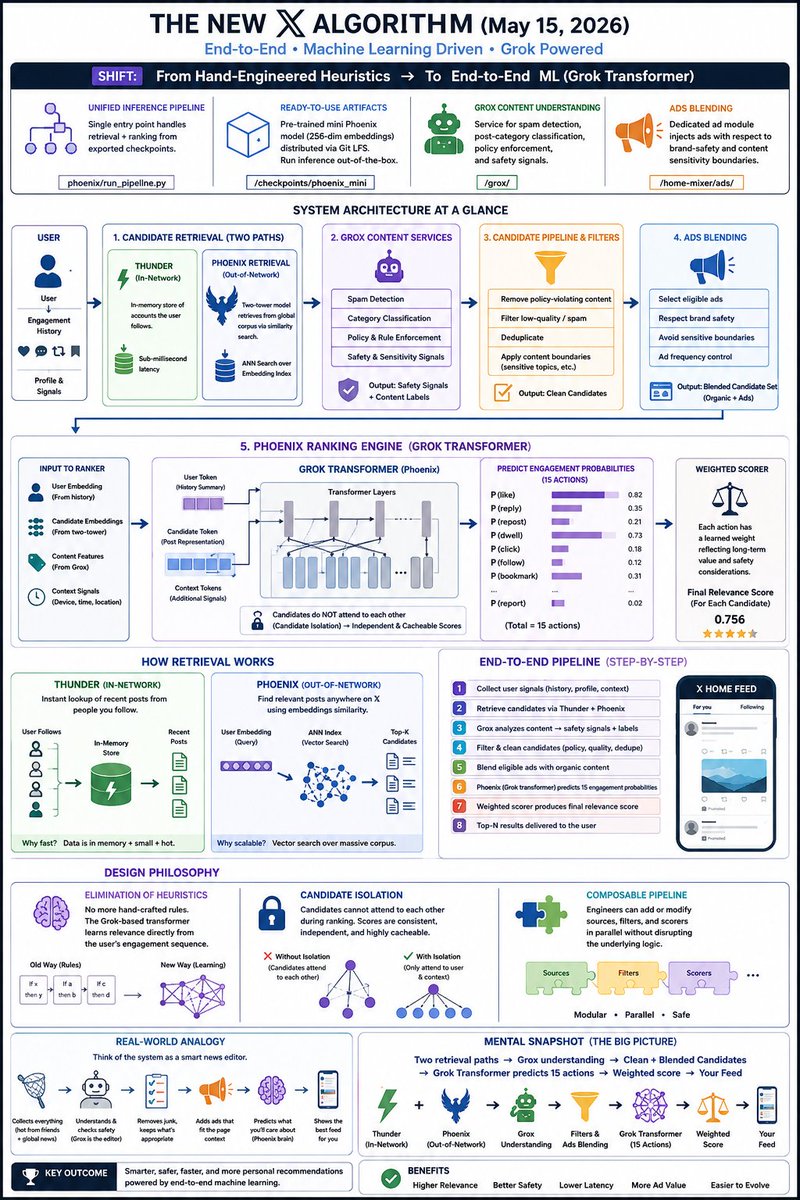
🚨 HEURISTICS JUST DIED. THE PHOENIX HAS RISEN. X CREATORS, MORE MONEY?
On May 15, 2026, X dropped the full source for its new For You algorithm to GitHub — and it’s not just code. It’s a scholarly masterpiece: a Grok-based transformer that ends the era of brittle, hand-engineered heuristics and replaces them with pure, end-to-end machine intelligence.
Phoenix doesn’t guess. It understands.
It merges Thunder (your followed accounts, lightning-fast in-memory) with Phoenix Retrieval (two-tower ML similarity search across the global corpus), hydrates everything, filters ruthlessly, then ranks via a masked transformer that predicts probabilities across a rich spectrum of real human actions: like, reply, repost, dwell time, click, profile visit — even negative signals like mute or report.
Candidate isolation? Genius. No post can “attend” to another during scoring. Scores stay pure, cacheable, and independent. This is transformer architecture at its most elegant — the same lineage as Grok itself.
For creators, this is the great rebalancing.
The old game rewarded farms, aggregators, and shallow ragebait. The new one rewards depth. Original voices that spark thoughtful replies and genuine dwellings now break out of the echo chamber — even to people who don’t follow you. The new Grox content pipeline (spam, category classification, PTOS enforcement) + smarter ads blending makes the feed cleaner and more monetizable for real talent.
This lines up perfectly with X’s 2026 “Year of the Creator” moves: aggregator payouts already slashed 40%+ (another 20% coming) to funnel money toward original authors. The revenue pool itself has doubled thanks to Premium growth.
But let’s talk the elephant in the feed: the “shave” — X’s undisclosed cut of the ad revenue before it reaches creators. And the persistent lack of per-creator, per-post payout transparency. You see the deposit, but not the exact math on impressions, weighting, or the platform’s slice.
Chances of full granular transparency soon? I’d put it at 75%+ in the next 6–12 months. Why? Because open-sourcing the entire ranking brain is the ultimate transparency flex. Once creators can literally run the model and audit signals themselves, demanding payout visibility becomes inevitable. The momentum is unstoppable.
The For You feed is no longer clockwork. It’s a neural symphony.
Creators who study the repo, optimize for multi-action resonance, and create with intellectual honesty?
They’re about to feast.
The code is public. The game is open.
Play wisely.
🔗Full repo (run the mini Phoenix model yourself): https://t.co/jF7jAQhrnG
📽️Watch this sharp community breakdown on X (Phoenix in action): https://t.co/pxsrALeeEa (a great visual explainer style)
#PhoenixRising #XAlgorithm #GrokPowered #CreatorEconomyRevolution #OpenSourceX #ForYouRevolution #TransparencyWins #YearOfTheCreator
Who’s already diving into the code? Drop your first insight below — the replies are about to get very interesting. 🔥
Hegseth’s message to Europe could hardly be clearer:
the US is pivoting toward the Asian model of alliance management - pragmatic, interest-driven, and results-oriented - rather than the old European model of values-based diplomacy laced with moralizing and lectures on human rights and the “rules-based order.”
For Asian countries (Singapore, Philippines, etc.), relations with the US have always been structured more on common interests than common values.
Singapore and Asian states are pragmatic and are willing to work with whoever occupies the White House because America’s role as the balancer in Asia remains indispensable. Even non-aligned countries such as India and former adversaries such as Vietnam now recognize this.
They appreciate hard power and credible deterrence more than pretty speeches, which is perfectly in line with the US's new national security strategy.
Managing the South China Sea, Taiwan Strait, and other hotspots requires credible deterrence and military capability far more than human rights resolutions. Asia’s focus on this aligns with the need to impose costs on revisionist behavior. Basing your foreign policy on human rights and democracy, you risk losing nations that don't exactly hold the American variant of democracy in high regard.
Hegseth praised “model allies” who are “capable, clear-eyed, and ready to defend their national interests.”
His use of "clear-eyed" is important here. It means that to be an ally, you must agree on what the threat is. That should be the starting point. From there, national interests converge.
Note how European "allies" diverge from this framework. You have many European nations now characterizing the US as the threat to the global order instead. This is the opposite of clear-eyedness.
In a world where China presents a serious, long-term challenge to the regional order, utility and resolve matter more than shared ideology. Asia adapted after the collapse of the TPP by building CPTPP and RCEP; it managed Trump’s hard-power instincts and Biden’s style alike by staying focused on interests.
The US, facing its own fiscal and strategic realities, is now explicitly choosing to reward and prioritize that same pragmatism. Western Europe would indeed do well to take note.
For too long, our political class treated efficiency as a substitute for resilience and consumption as a measure of prosperity.
Trade policy, industrial capacity, and national security are inseparable. And to allow foreign dependencies to degrade any one of those domains is to allow them to define America’s future. Under @POTUS’ leadership, we are rebuilding domestic production to restore American sovereignty.
5/6 Your are called to the roundtable:
���Agnetic is growing a first-principles Native AI” is our lead by example alternative to the emaciated agriculture, food and more.. remnants of the old #LeadWithLeverage imperial extraction system left behind.
It is both a call to action and an invitation to all left hollowed-out and seeking a team-of-teams roundtable environment to revitalize, and grow environmentally, economically and socially for generations to come. [ref: https://t.co/B5lysMXdc6 ]
and there is more below…




![agnetic1's tweet photo. It’s not which frontier model you’re using. It’s what you’re feeding it.
Chamath sharpens the knife even further in recent commentary (and consistent with the All-In vibe with Gurley):
∞ 1. Others are waking up to the reality that there is no single best frontier model anymore. The evals show it clearly—Opus 4.7, GPT-5.5, Sonnet 4.6, and peers are separated by razor-thin margins (under 0.3 points on big benchmarks).
∞ 2. They’ve converged. The frontier has commoditized faster than many expected, and this was an anticipated historical event, just like previous tech waves where raw horsepower became table stakes. [ref: https://t.co/1LefvolBHO ] h/t @theallinpod @bgurley
The new power move?
It’s not which frontier model you’re using. It’s what you’re feeding it.
Your proprietary data, context, grounding, and continuous feedback loops become the durable moat. Everyone else’s base model is increasingly interchangeable—swappable via smart orchestration layers. The real edge is in the diet: high-quality, sovereign, first-principles data that no one else can replicate.
Nature is the only go-to place that makes sense here.
It’s the ultimate proprietary, compounding dataset—dense, multimodal, grounded in physics/chemistry/biology, generated through billions of parallel, refutable experiments over deep time. No one can scrape or license it away from you. Instrument real plots (as Agnetic is doing), capture soil-microbe-plant-animal-human interactions at scale, and you create a flywheel of differentiated nutritional, functional, and sensory intelligence that turns generic frontier models into something sharp, sovereign, and antifragile. [ref: “Agnetic is growing a first-principles Native AI” https://t.co/B5lysMXdc6
This is where the high-stakes, messy wave Chamath warned about plays out:
Outwit competitors today: While they’re still fighting over marginal benchmark points or renting the “best” model du jour, you’re feeding yours proprietary nature data that creates irreducible differentiation in real-world outcomes (yield, resilience, taste, health attributes, carbon metrics).
Commoditized base models become commodities you consume, not bet on.
• Outplay the adjacency waiting to swallow you: LLM/chip/power providers, hyperscalers, and big infra players are building massive capacity. Many verticals and incumbents risk getting absorbed if they stay dependent on rented intelligence. Nature-grounded sovereign stacks flip the script—you become the high-volume, recurring, high-margin customer who needs continuous inference and training on your own data flywheel. You use their infra without becoming their captured asset.
• Long-term outlast the machinations: Everyday people, operators who get subsidiarity instinctively (lowest competent level first), families, small enterprises, and domain experts have been waiting for exactly this. Intelligence sovereignty + data sovereignty + nature’s first-principles OS lets them roll their own (local/on-prem SLMs/VSMLs fine-tuned on grounded data) while the centralized hype cycle consolidates and corrects. Pluralism wins. Refutable, local experiments compound. Black Mirror stays fiction.
Full stack now:
• Chamath’s Black Mirror warning (singular algorithmic control = dystopia)
• Intelligence/data sovereignty (roll your own on your hardware)
• Subsidiarity (keep it at the lowest competent level)
Nature as the best first-principles processor (the ultimate differentiated diet for any model)
• Commoditization of frontier models (anticipated; power shifts to “what are you feeding it?”)
• High-stakes messy evolution (embrace it—pluralism thrives in the mess)
Big ongoing hat tip to Chamath, Jason, Sacks, Friedberg, and Bill Gurley for the proactive, sparring, truth-seeking energy. It’s the exact cultural operating system needed for this wave.
For the All-In beasties, infra builders hunting real PMF, ag/food operators, and everyone adjacent: the off-ramp is clear.
• Treat frontier models like interchangeable engines.
• Feed them the richest, most sovereign fuel on Earth—Nature itself.
• Build the horizontal, grounded, refutable systems that turn capex into antifragile advantage.
This is how you win the messy wave instead of getting commoditized by it.
First principles, not first-to-scale hype. Nature doesn’t converge to one “best”—it compounds a million differentiated winners.
Time to eat like that.
Disclaimer:
I wrote this with Grok as a thought partner and editor — the same way I would use a strong co-founder or senior collaborator. I drove every major decision, contributed the core observations and personal insights, and iterated through multiple rounds. The final voice, framing, and ideas are mine.](https://pbs.twimg.com/media/HJ5Tlq0WEAAWVHv.jpg)
![agnetic1's tweet photo. Kudos to @GavinSBaker for pointing out in today’s NativeAI age the timing of and how regulatory capture works to concurrently lock in a lead position, while also locking out competitors, and in particular, yet to be discovered, but certainly present entities/soon to arise competitors in the adjacency designed to change the game in ways that make your tech moats and more… less and less relevant—sooner than one might think.
ref:
“And my initial theory was the regulatory capture theory that they just want to ensure there's regulation. And quite frankly, I think they're very close to achieving that. Like they have stirred up a frantic position, especially in America.”
[ref: https://t.co/mhfNvgcN3M ]
@pmarca “Speed Wins “eh?
ref: @a16z "Speed Wins" post: https://t.co/VbkYbyjsu2
∞ OODA Loop: https://t.co/xBCwcUnCpb
• from the agnetic Soils-as-Health™ Round Table: bringing together finance-first agendas, eco-centric sensitivities, healthy/civil social interactions, and more…](https://pbs.twimg.com/media/HJlEnZTXsAUQ5Vc.jpg)
![agnetic1's tweet photo. @azeem Great Work! 🙏
h/t @pmarca
Just imagine what a subtle, but significant mindset shift could bring to the table…
I asked @Grok for help in expressing what is on my mind. Here is the answer…
“Adopting a biological mindset—"composting the old to energize the new" and "morphing" rather than bolting on or rigidly redesigning—could meaningfully compress the AI GPT timeline, especially in biologically native sectors like agriculture, food systems, and healthcare.”
“This shifts from industrial-era sequential phases (install → redesign over decades) to evolutionary, adaptive, emergent processes that recycle legacy assets while accelerating transformation.”
[h/t @frankdiana - Frank, It is so good to see your ideas, so meaningful in shaping my thoughts and capabilities, is popping up in-real-time via @Grok. ]
[ref: https://t.co/bw2MdfCVhR ]🧵](https://pbs.twimg.com/media/HJkzeotXwAE0CQG.jpg)


