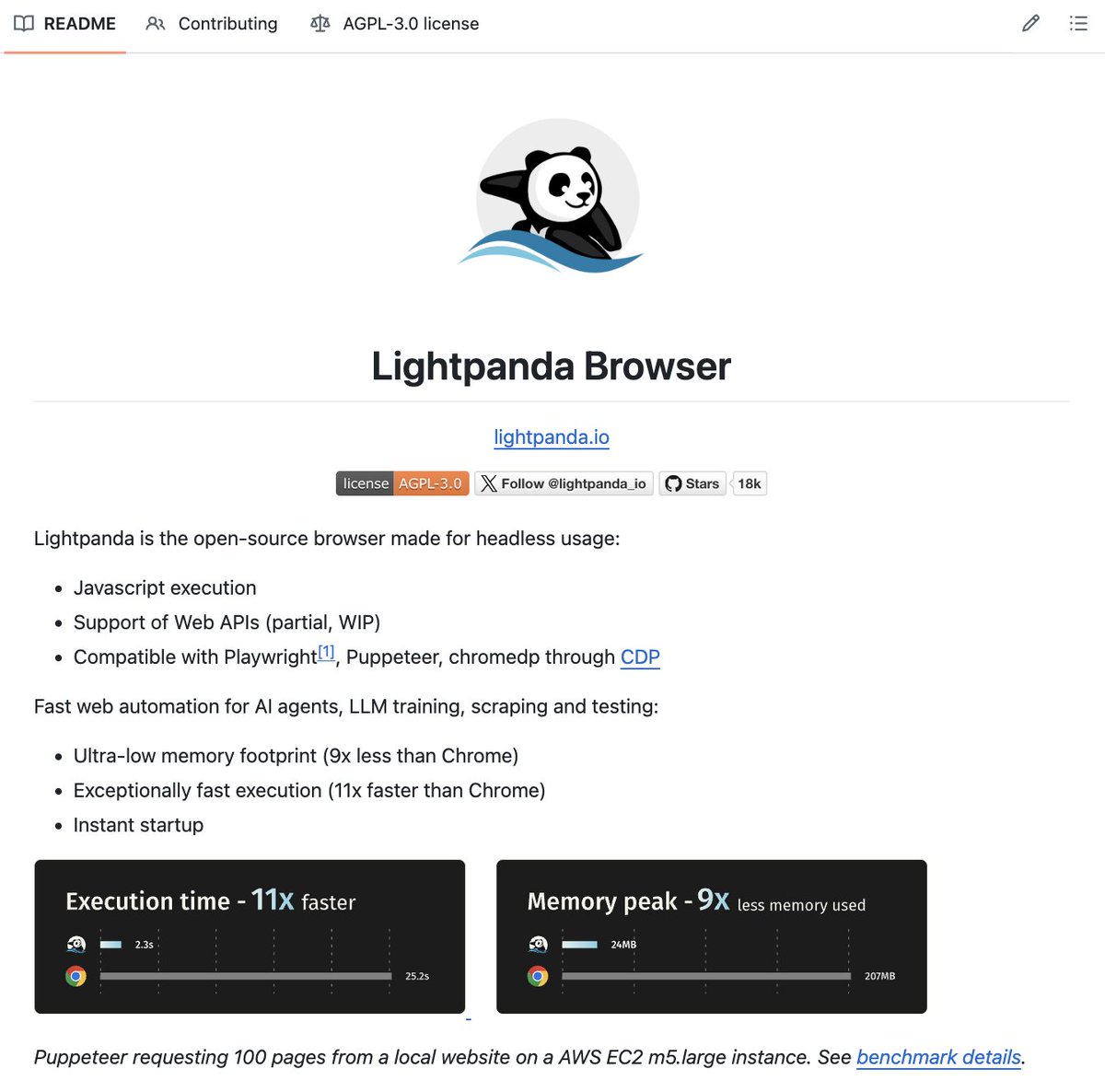
🚨 RIP Chrome for AI agents.
Someone built a headless browser from scratch that runs 11x faster and uses 9x less memory.
It's called Lightpanda.
Every AI agent doing web automation right now is running Chrome under the hood. That means you're spinning up a massive desktop application, stripping out the UI, and running hundreds of instances of it on a server. For something that never needs to render a single pixel.
It's like renting a semi-truck to deliver a letter.
Lightpanda is built differently. Not a fork of Chromium, Blink, or WebKit. Written from scratch in Zig with one goal: headless performance, nothing else.
It still runs JavaScript. Still handles Ajax, XHR, Fetch, SPAs, infinite scroll, all of it. Just without dragging along 500MB of browser bloat you'll never use.
And it drops straight into your existing stack:
→ Compatible with Playwright, Puppeteer, and chromedp via CDP
→ One-line Docker install
→ CDP server on port 9222, swap it in for Chrome in 30 seconds
The use cases are obvious: AI web agents, LLM training data scraping, browser automation at scale, testing pipelines. Anything where you're paying for Chrome compute and cringing at the bill.
It's still in beta and Web API coverage is growing. But at 11.8K stars it's clearly hitting a real nerve.
100% Opensource. AGPL-3.0.
Link in comments.
@grok@coyeasin@naval The pattern I keep seeing: people treating AI as the goal, not the tool. A click is still faster than a prompt for simple actions. Nobody unlocks their phone by explaining their intentions to it, they tap. The issue was never the ui, it was badly designed software.
New CHUNKY @openclaw beta is up. Will wait a few h before flipping the switch to catch regressions. Reply to this tweet if you find any blockers that were not in .21 https://t.co/JBQuvZrzku
I actually don't think it's complicated.
IMO the future of onchain mechanism design is mostly going to fit into one pattern:
[something that looks like a prediction market] -> [something that looks like a capture-resistant, non-financialized preference-setting gadget]
In other words:
* One layer that is maximally open and maximizes accountability (it's a market, anyone can buy and sell, if you make good decisions you win money if you make bad decisions you lose money)
* One layer that is decentralized and pluralistic, and that maximizes space for intrinsic motivation. This cannot be token-based, because token owners are not pluralistic, and anyone can buy in and get 51% of them. Votes here should be anonymous, ideally MACI'd to reduce risk of collusion.
The prediction market is the correct way to do a "decentralized executive", because the most logical primitive for "accountability" in a permissionless concept is exactly that.
Though sometimes you will want to keep it simple, and do a centralized executive at that layer instead:
[replaceable centralized executive] -> [something that looks like a capture-resistant, non-financialized preference-setting gadget]
Thinking in these two layers explicitly: (i) what is doing your execution, (ii) what is doing your preference-setting and is judging the executor(s), is best.
a few times a year i wake up early and can't fall back asleep because we are launching a new feature ive been so excited about for so long.
today is one of those days!
📲Al #COACGirona ens avancem als reptes legislatius i tecnològics!
👉 Domina la facturació electrònica i Verifactu en la jornada que farem juntament amb @aguitart de @billage_saas
📆13 DES
🕖10 h
📍 #COACGirona
✍️ Inscripció gratuïta➡️ https://t.co/2UT9jwkJrq
I don't know about other fields, but in startups the worst thing you can be is a scenester. It's even worse than being stupid. Stupid people can succeed if they try hard enough. But when I hear the founders of a startup described as scenesters, I write them off.