A Total Solar Eclipse will be visible to various parts of North America on April 8, 2024
How will it look like on your location?
Find out on Stellarium Mobile!
Google Play: https://t.co/h7lWEV0BWB
Amazon App Store: https://t.co/IURTa9fjPa
Apple App Store: https://t.co/IVQqR9uPxl
Supernova 2024bch in NGC 3206. https://t.co/ThXWno3Deh Another recent supernova - this one being the bright star just below the galaxy nucleus. NGC 3206 is around 60 million l.y. away. 43cm CDK with Morovian camera. LRGB. 2hrs.
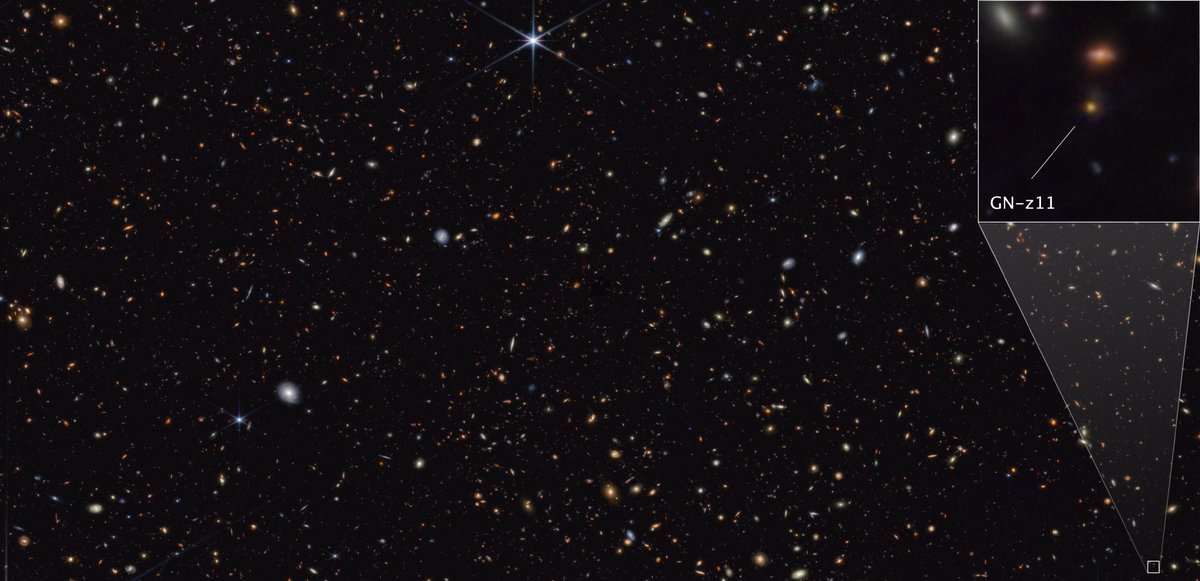
Webb may have found evidence for the long-theorized first generation of stars — as well as the most distant active supermassive black hole to date. GN-z11, a galaxy that existed 430 million years after the big bang, is giving up its secrets: https://t.co/0m659P21vT
There are likely tens of millions of black holes dotted around the Milky Way, but so far we’ve only identified a few dozen. The ones we’ve found are typically orbiting a star, interacting with it in a way that reveals the black hole’s presence. #MondayMotivation
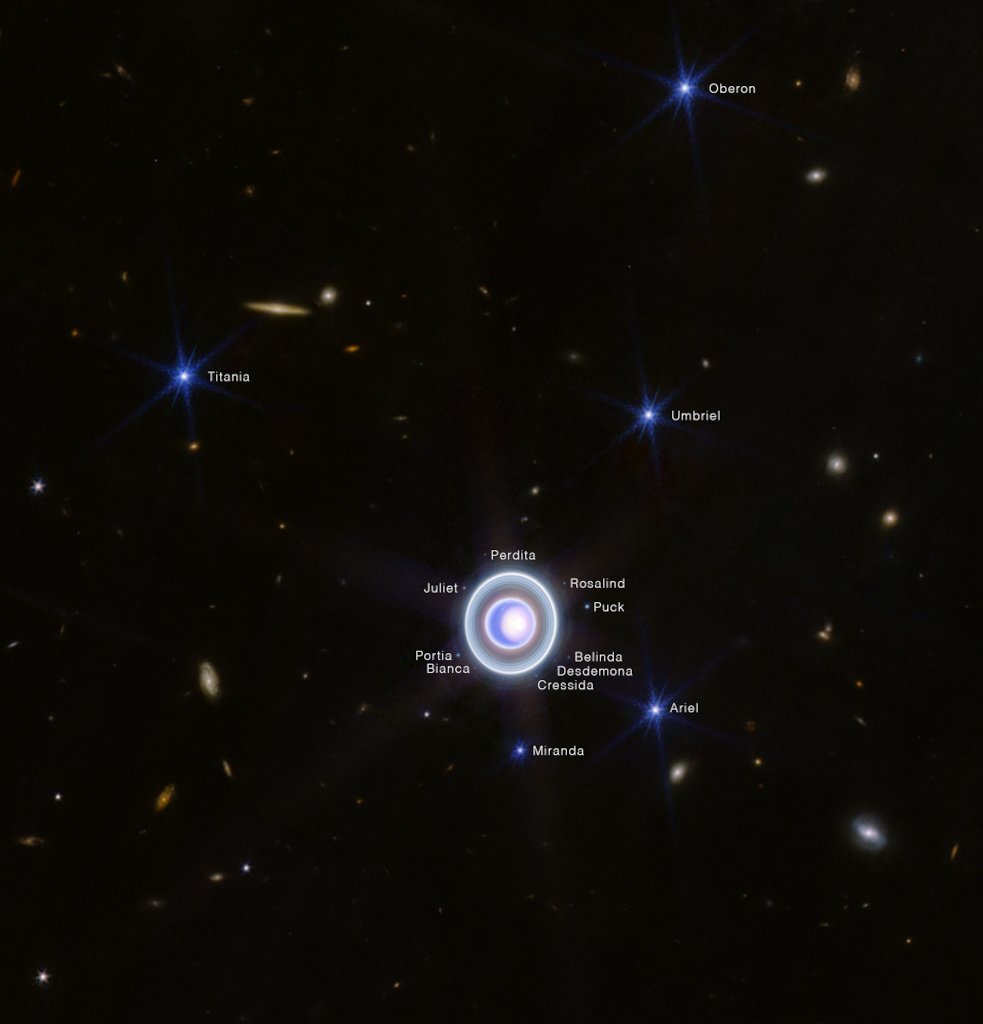
Shakespeare in Space
Image Credit: NASA, ESA, CSA, STScI
Explanation: In 1986, Voyager 2 became the only spacecraft to explore ice giant planet Uranus close up. Still, this newly released image from the NIRCam (Near-Infrared Camera) on the James Webb Space Telescope offers a detailed look at the distant world. The tilted outer planet rotates on its axis once in about 17 hours. Its north pole is presently pointed near our line of sight, offering direct views of its northern hemisphere and a faint but extensive system of rings. Of the giant planet's 27 known moons, 14 are annotated in the image. Mixed with fuzzy background galaxies, the brighter moons show hints of Webb's characteristic diffraction spikes. And though these worlds of the outer Solar System were unknown in Shakespearean times, all but two of the 27 Uranian moons are named for characters in the English bard's plays.
To celebrate the holidays this year, we've made a list of our favorite papers on Fermat's Library— the second one is "A universal law of procrastination" by Tomasz Durakiewicz.
Tomasz analyses how humans deliver under pressure to deliver on deadlines (e.g term papers, tax returns). Turns out the hyperbolic function provides a more accurate description of the "deadline rush" than an exponential function!
Read the paper here: https://t.co/6galkSHFBC
Project Lyra explores the possibility of sending a spacecraft to chase 'Oumuamua using an Earth gravity assist to reach Jupiter, which robs the craft of almost all its speed, causing it to drop to the Sun for an Oberth maneuver.
Thanks @hibberdadam994 for the trajectory data!
1/ #Jupiter's great shrinking spot! Two images taken 20yrs apart showing the dramatic shrinkage of the GRS over that time. The GRS is currently the smallest it has ever been, now barely large enough to hold a single Earth.
This is what happens when you take nine hours of data with really high cloud. It’s IC1848, LOL. It’s not all glitz n glamour. LOL.
I did manage to salvage something though! #nebula#ASTRO
#Jupiter with GRS and Io transit (Nov 6th.) https://t.co/4WQqT2HhN2 Some moments of good seeing from here at home on the 6th. Io and shadow in transit with the GRS and Oval BA toward lower right. C14 with QHY200M camera.