The CPJ decision to functionally change the definition of journalist - while our news industry in the U.S. is filled with former IDF soldiers covering the occupation & genocide they helped build and justify, including Barak Ravid who was in the IDF reserves until March 2023 - is not only indicative of the racism under which the entire western journalism order functions but also of the extent of the complicity of this industry in the slaughter of Palestinian journalists.
A dark, shameful day and proof that no, things are not getting “better” - the whole project is to erase and minimize these crimes until everyone forgets and moves on.
NEW: The Board of Directors at the Committee to Protect Journalists (CPJ) will formally change its definition of who qualifies as a journalist, to broadly exclude slain Palestinian and Lebanese journalists who worked for government-funded media outlets. Israeli, American, and Ukrainian journalists who work for state-funded outlets or are embedded with the military will remain recognized as journalists, of course.
The move was catalyzed to appease the right-wing Zionist rag The Free Beacon, which has repeatedly accused Palestinian and Lebanese journalists of being undercover militants or used their political opinions or affiliations as justification for their killing by the IOF.
This is a racist scandal of massive proportions for everyone involved, and it makes a mockery of the purported mission of the organization. It is absolutely abhorrent that the organization’s resources are wasted on this cowardly witch-hunt, at a moment in history that is the deadliest for journalists, especially in Palestine and Lebanon.
@SpeakerMenin I want to be "crystal" clear says @crystalforbk/@CMCrystalHudson with a little chuckle.
"We will come out here as many times as needed..." to push for FHEPS.
Ashura is a time of remembrance, sacrifice and reflection.
Today, on the 10th day of Muharram, we are reminded of Imam Hussain's unwavering commitment to truth and dignity. His timeless legacy reminds us of the enduring values of faith, service to one another, and the belief that justice is always worth fighting for.
Our City’s strength comes from the many faith traditions that shape it — and our shared struggle against injustice and oppression.
May we carry these values forward as we continue building a more just City for every New Yorker.
Imam Hussain starts to make sense when you realise that Islam was never meant to be an empty ritualistic tradition, but a revolutionary force against oppression and imperialism. Shi’ism in its true form is not a religion of mourning, but a religion of martyrdom.
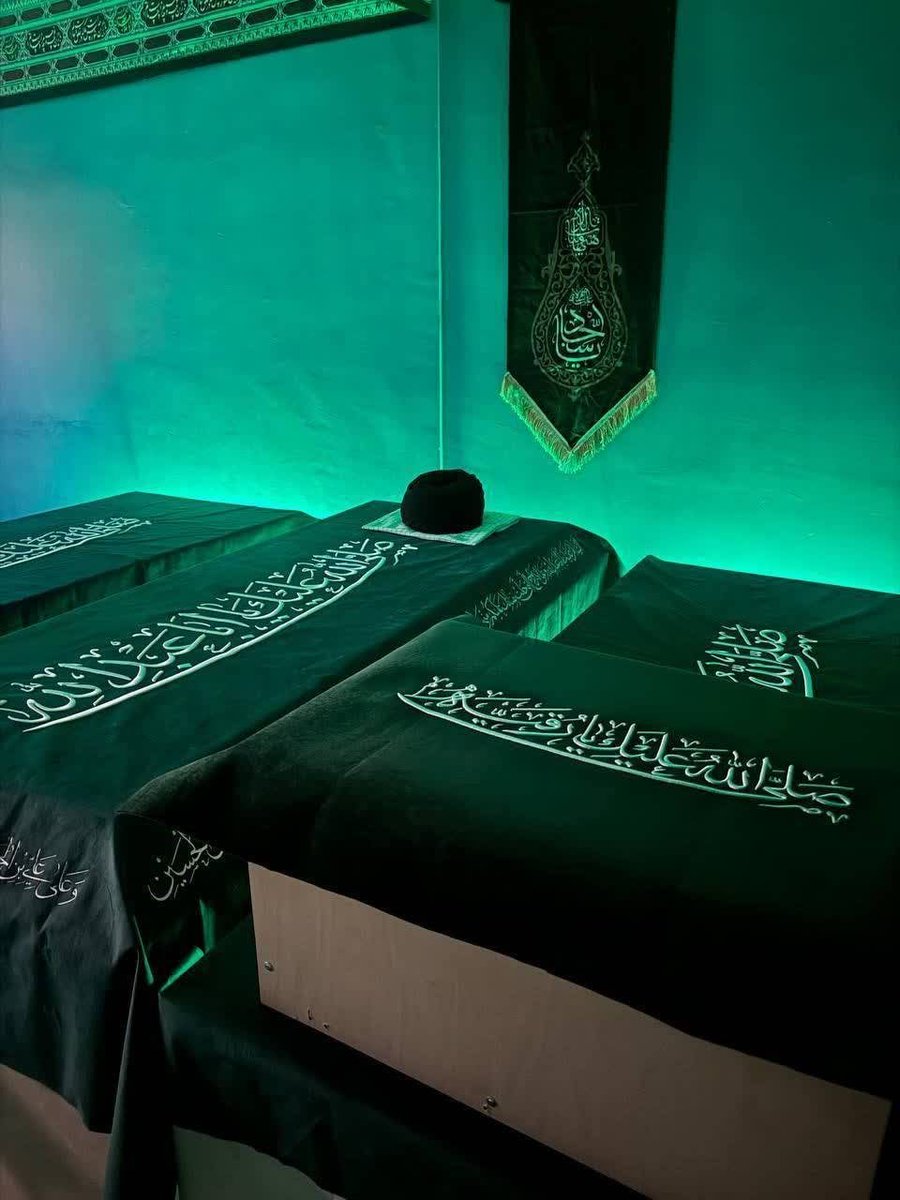
Iran is deep in Muharram mourning rituals ahead of Ashura tomorrow. This year's ceremonies have been shaped by the aftermath of the war, giving the themes of sacrifice, loss, resistance, martyrdom a renewed resonance.
Scenes from Tehran, Karaj, Yazd, Zanjan in recent days 👇
embarassing seeing shia vs sunni "debates" in 2026 when the shia leaders of the time have made the reigning imperial power kneel and the sunni leaders have mostly been fighting to prolong their hold on power that doesnt go beyond subjugation of their own people.
To be a Shia in Pakistan is to constantly be punished. What kind of hatred pushes a man to slam his car into a majlis, what kind of family, community and mind must he come from to kill those grieving there family of his own prophet (pbuh).
Introducing the Karbala Paradigm: Anti-Imperialism for Muharram https://t.co/U92B5bspqu via @YouTube
Join me at 3pmET today for the first day of Muharram. I'm doing a series during the first 10 days to explore what has been called "The Karbala Paradigm" and other issues related to anti-imperialist resistance, Islamic liberation theology, and revolutionary Shi'i history and devotion through remembrance of the martrydom of Imam Husayn.
Let's observe an anti-imperialist Muharram and learn together!
👇 This is exactly the kind of deeply misguided analytical framework that has produced decades of failed U.S. policy in the Middle East—and that analysts like @ksadjadpour and @arash_tehran continue to advance.
For decades, Iran has been treated as the uniquely ideological actor in the Middle East, while the actions of Israel, the UAE, the U.S., etc are framed as pragmatic pursuits of "stability" and "prosperity."
Yet what is more ideological than the pursuit of a "Greater Israel"?
What is more ideological than trying to ceaselessly reorder the Middle East through military force, occupation, regime change wars, and permanent domination by an apartheid, expansionist, ethno-surpemacist state?
What is more ideological than the decades-long American project of maintaining regional primacy through military supremacy, backing authoritarian "partners", suppressing popular movements, and preventing the emergence of a stable balance of power in which local actors set the rules?
What is more ideological than MBZ's decades-long campaign to suppress popular politics across the Arab world, crush Islamist and democratic movements alike, and construct a regional order aligned with his own megalomania, having the UAE punch far above its weight in a way that culminated in this disastrous war for his country?
Whatever one thinks of Tehran's policies and tactics, they have long been driven by recognizable realpolitik and balance-of-power calculations: deterring stronger adversaries, preventing encirclement, building alliances, raising the costs of external pressure, and seeking a regional order in which Iran has a recognized place rather than one organized around its isolation and exclusion.
The region's instability has often stemmed from a basic analytical error: treating U.S. and Israeli ideological ambitions as reasonable policy rather than recognizing them for what they were.
Time and again, the U.S. convinced itself it could reshape the Middle East according to grand visions that repeatedly collide with political, social, and demographic realities.
Treating Iran as the unique ideological actor and everyone else as merely responding has been one of the great analytical failures of the past two decades.
For those of you who don't know:
Bernie Sanders does not believe in equal rights for Palestinians and Jews in the Levant.
"If that happens, then that would be the end of the State of Israel. And I support Israel's right to exist".
Bernie Sanders is a Jewish supremacist.
There is something people still fail to understand about Palestine.
Not every battle is fought first on the battlefield. Some are fought inside the human being. Some are fought against fear, humiliation, and the belief that submission is inevitable.
That is why so many people connect Palestine to Karbala. Not because the events are identical, but because they see in Karbala the refusal to accept that truth is measured by power, numbers, or immediate outcomes.
Imam Husayn (AS), in Shia tradition, became a symbol of refusing legitimacy to what one believes is oppression even when the cost is immense. The lesson many take from that story is not seeking death — it is refusing to let fear decide what is true.
When figures in Palestinian resistance publicly speak positively about Iranian support, many supporters interpret that through that same lens: not as sect, ethnicity, or geography, but as standing with those who they believe chose support over abandonment at moments they felt isolated.
To them, the real victory begins before territory. It begins when a people stop believing that defeat is their natural condition.
The most dangerous thing any occupier can lose is not land. It is control over the imagination of the people.
Because once people stop accepting humiliation as destiny, history changes.
Karbala, for those who invoke it, was never simply about who remained standing at the end of the day. It was about what survives after sacrifice: conviction, memory, and the refusal to normalize what one sees as injustice.
That is why some say: first the mind is liberated, then the land follows.