@TheRealNamzoo just laid out why we started Airbound and why we raised a Series A to do it.
An aircraft should move what you care about, not spend itself hauling its own weight. We build them light enough that the payload wins. Get the aircraft right and the air becomes the cheapest way to move anything on earth.
Things first, people next.
The world might be chasing faster horses, but we intend to put all movement in the air. The full case: https://t.co/YeVZ4Pc4nk
For too long, we've accepted that the flying is a fundamentally more expensive form of movement. I reject that reality.
Today we're announcing our $37M Series A, led by @Greenoaks, to build a world where all movement is in the air.
https://t.co/OqVzz2073i
It started with YouTube tutorials and a bedroom that probably shouldn’t have had that much resin in it.
Now it’s Airbound. @TheRealNamzoo tells the whole story on Core Memory with @ashleevance
And we’re hiring. If you want to build what others won’t, come build with us: https://t.co/Rq59QzQQBb
As a teenager, Naman Pushp taught himself how to build carbon fiber aircraft by watching YouTube videos. He turned his bedroom into a toxic R&D lab along the way.
Now, at 21, his company Airbound is on a quest to make the lightest, most efficient aircraft ever produced.
Naman is more or less the posterchild for a new wave of young Indian startup founders trying to do more ambitious things in the country.
We get into the aircraft, carbon fiber, India's pros and cons and much more on the pod. Full episode right here - https://t.co/6J9VubmJR2
Our deep exploration of the Indian tech scene begins tomorrow!
We're talking super light aircraft, the rise of Indian hardtech, carbon fiber and, er, the problems with democracies on the Core Memory podcast with @TheRealNamzoo from @Airbound_Aero
Great to see folks like @ashleevance and others visit the India deep tech scene. The more visibility, the better. It's obvious to many now, but wasn't when we led the seed / pre-seed rounds at @PixxelSpace or @Airbound_Aero both of whom featured in the piece. The world should celebrate these cos more, including the likes of @SkyrootA@atherenergy@ExponentEnergy@ParsecAerospace & many more.
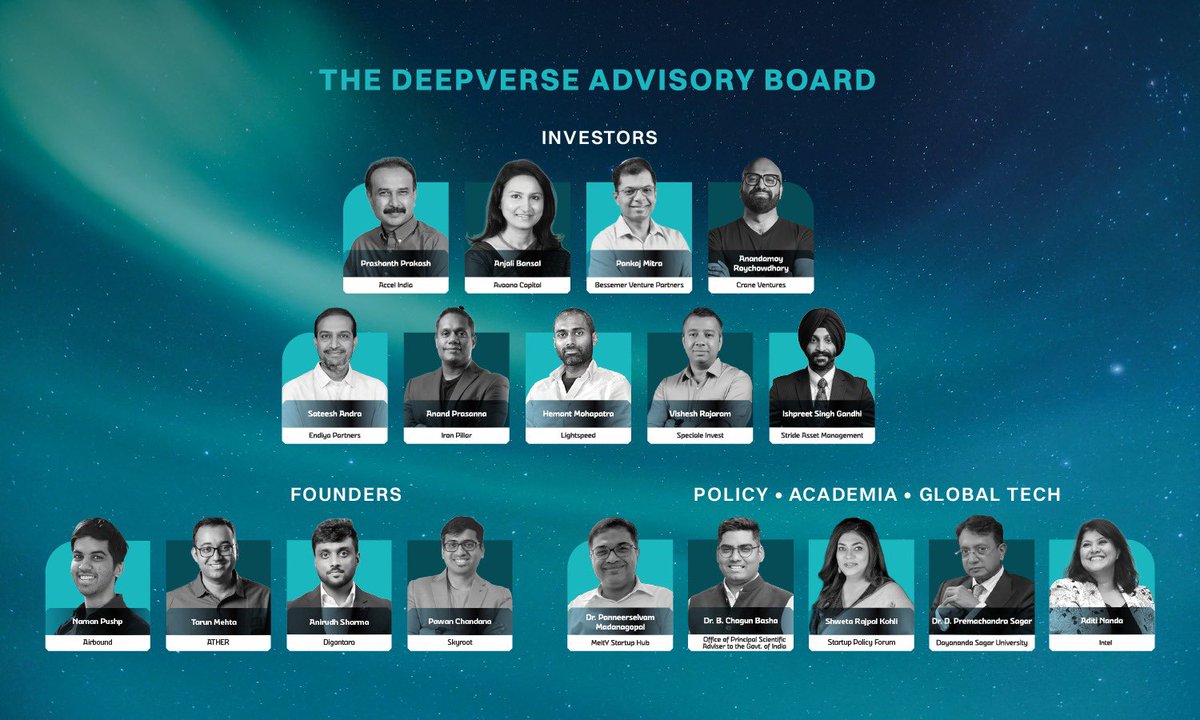
We're pleased to welcome Airbound to DeepVerse and their Founder & CEO Naman Pushp to the Advisory Board.
Airbound, a Deep Core member, is an aerospace startup based in Bengaluru that designs and manufactures ultra-lightweight, autonomous delivery drones. Its aim is to make aerial logistics cheaper than ground transport.
Airbound has been one of the most active members of Startup Policy Forum and we are excited to deepen our collaboration with DeepVerse.
@Airbound_Aero | @TheRealNamzoo@ShwetaRKohli | @AvantikaGode | @Shubhangip611
| @akankshaghosh13 | Oishika Ghosh | @bforbaruah
‼️ Introducing DeepVerse, Startup Policy Forum's Centre for DeepTech Innovation.
♦️Why "DeepVerse"?
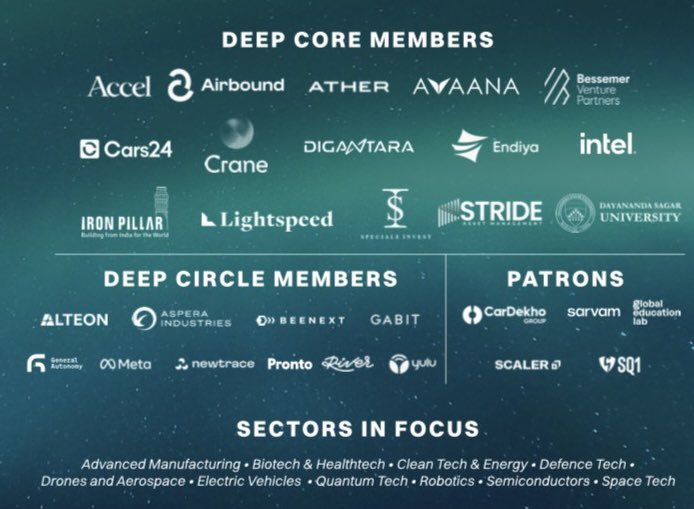
Deeptech isn't one sector. It's a universe. On one side: semiconductors, space, robotics, biotech, quantum, clean energy, advanced manufacturing. On the other: multiple ministries, departments, regulators whose decisions matter. These worlds often work in separate orbits. DeepVerse brings that universe together.
♦️Why does DeepVerse matter?
Deeptech moves on long timelines, needs patient capital, and often enters territory regulation hasn't mapped yet. Founders know where they're stuck. Investors see what makes capital flow. Academia drives the research. Big tech brings scale. The government sets the rules. DeepVerse brings them together. We have launched with an initial 30+ partners across startups, investors, academia and big tech, to build a sustained policy dialogue, so the people writing the rules hear directly from the people building and backing the future.
We also have an 18-member high-powered Advisory Board to guide us.
♦️The Logo Read it one way: a spark of invention held between the brackets of hard science, with a beam cutting deep into the lab and reaching all the way to orbit. Read it another: two drones flanking a rocket on lift-off, a nod to the aerospace and space tech founders, representing two of the 10 focus sectors.
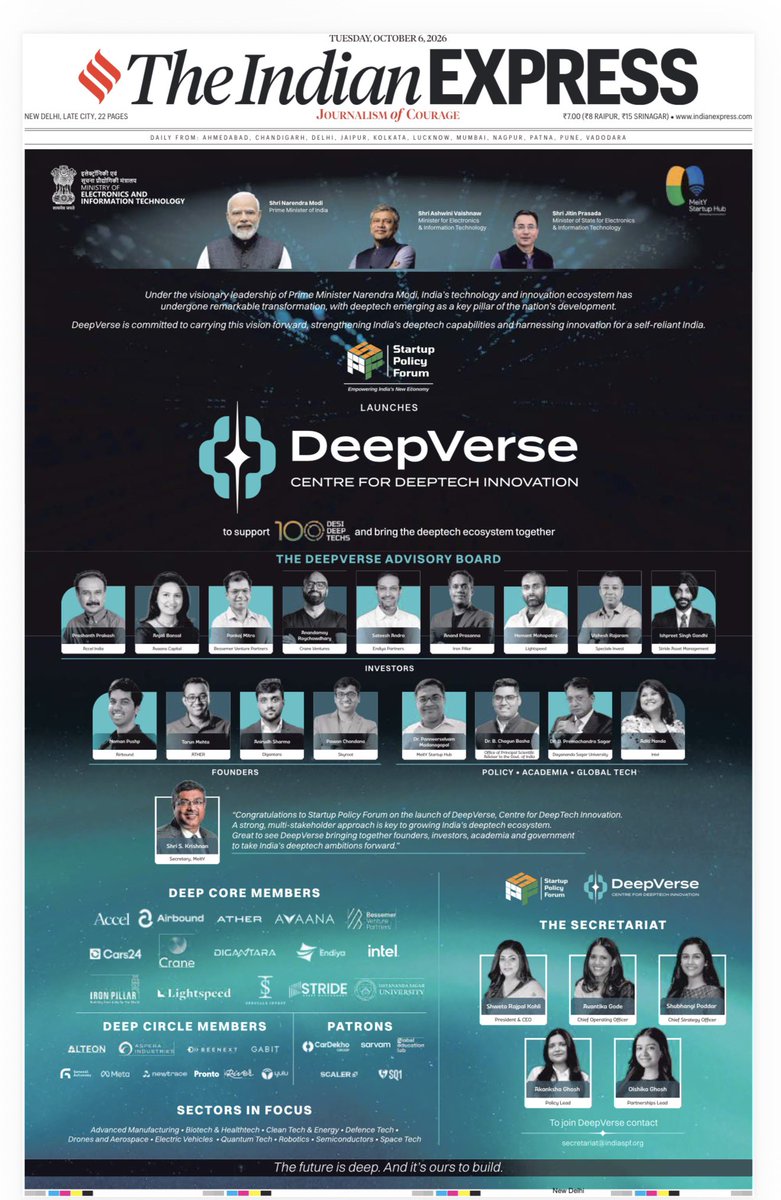
Our full page ads announcing the launch have appeared across leading national and business dailies today including @EconomicTimes, @livemint and @IndianExpress
Let’s move India’s deeptech ecosystem forward, together.
@PMOIndia@narendramodi@AshwiniVaishnaw@JitinPrasada@SecretaryMEITY@prashanthp@tarunsmehta@PawanKChandana@TheRealNamzoo@MohapatraHemant@visheshrajaram@sateesh_andra@GandhiIshpreet@smdcmc@anirudhnsharma@ChagunBasha@BessemerVP@ironpillarfund@crane_vc@AccelIndia@LightspeedIndia
Much of the physical world is made in China. Much of the digital world will be made by Indians. I didn't get that memo. I moved from India to Texas and started building chemical reactors. Neither did Naman Pushp.
He told @packyM he will make carbon fiber about as cheap as steel.
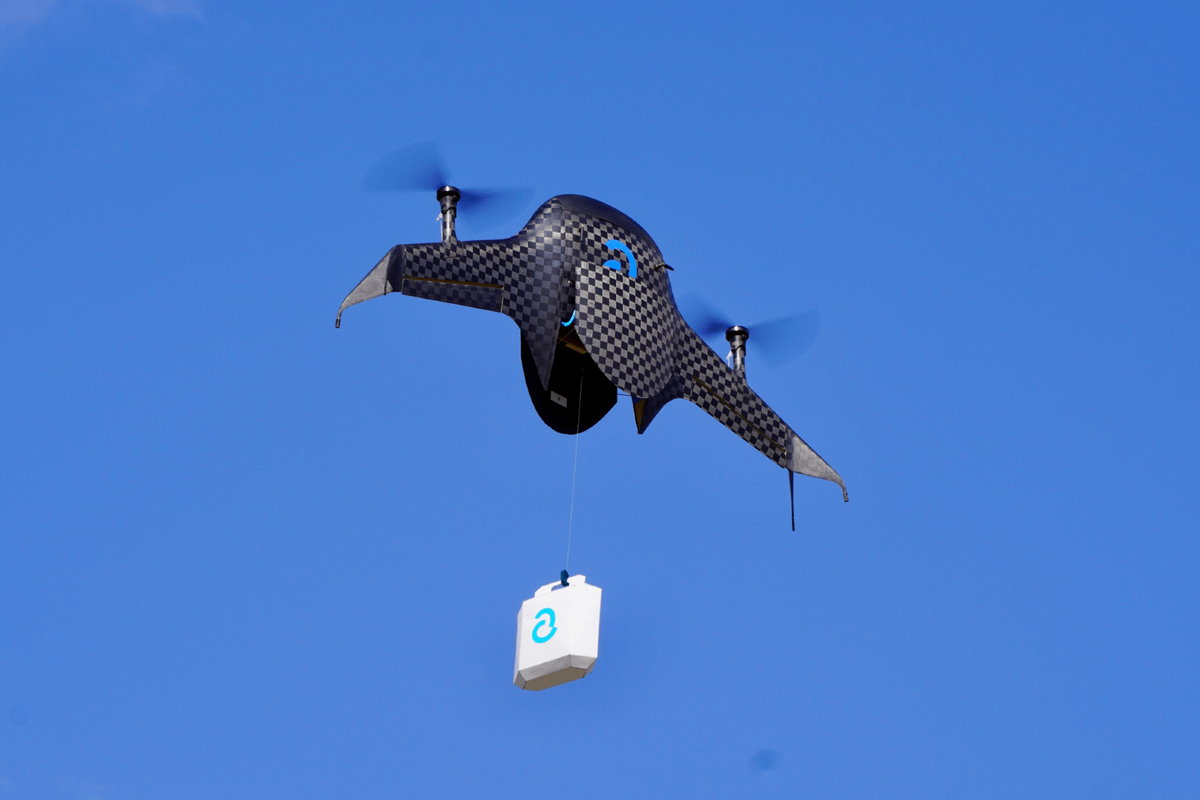
Naman (@TheRealNamzoo) builds carbon fiber drones in Bengaluru. He says his newest one weighs about 6.6 pounds and can carry 11. Amazon's MK30 weighs 78 pounds and carries 5.
In 1906, Henry Ford wanted vanadium steel for his cars because it was stronger than ordinary steel, so the parts could be lighter. He couldn't find a steel maker in America that could make it, so he worked with a metallurgist from England and contracted a small mill in Canton, Ohio to make it. In 1908, vanadium steel went into the Model T.
Naman can't buy carbon fiber at the price he wants either.
Most carbon fiber starts as a liquid chemical called acrylonitrile, made from propylene and ammonia. Manufacturers turn it into a plastic, spin the plastic into thin threads, and bake the threads until almost only carbon is left. About half the weight leaves as gas, so one kilogram of carbon fiber takes about 2 kilograms of acrylonitrile. In the US, those 2 kilograms of acrylonitrile alone cost over $2.50. A kilogram of US hot-rolled steel costs $1.34.
To get carbon fiber at steel prices, you need to change the chemistry.
Packy's deep dive on Airbound:
Less than 1% of all movement happens in the air, and it's not because flight is slow. It's because planes are heavy, so most of their lift goes to carrying themselves instead of their cargo.
Fix the cost of that and everything changes. Flying gets cheaper than the bus. Goods move as freely as information. Roads become optional.
That's the whole bet at Airbound: one number, cost per kilogram-kilometer, driven down until the sky is the cheapest way to move anything.
For the first time, the technology lines up. Because the aircraft can fly themselves, there's no pilot to pay for, which means you no longer have to build big to be economical. Electric motors and carbon fiber let you build small and light instead. That combination didn't exist a decade ago.
@packyM just wrote the definitive deep dive on how we get there. Made in India, made for the world.
NEW DEEP DIVE
Airbound is my favorite kind of company.
Naman Pushp is making an all-in bet that the bottleneck to moving all movement - of goods and people - to the skies is cost.
He and Airbound are maniacal about lowering the cost per kg-km of flight. To lower it, they vertically integrate, devise novel uses of carbon fibers, and don’t allow themselves to get distracted by such trivialities as near-term commercial traction.
Their newest aircraft - the V2 - carries more than it weighs (Amazon, for comparison, carries 5 lbs with a 78 lb drone).
If they can make flight ridiculously cheap, the logic goes, cheaper than a delivery guy on a bike or scooter, then a car, then a van, then a truck, then a bus, then then then… then they can eat those vehicles’ markets, push an enormous amount of demand into just three platforms (Small, Medium, and Large), bring costs down even further, and create a world in which we fly wherever we want to go, and whatever we want flies to us.
Then, the world reshapes itself around flight, and the earth around humans.
This is a Deep Dive on how they plan to do it.
A year ago, Airbound was 50 something people in Hoskote, building one drone a day. Today it's 150+ people across 8 sites. Hundreds of TRTs flown, some of them crashed. Thousands of kilometers flown. Tens of thousands of hours, nobody's kept an exact count.
TRT has now flown 13,000+ times, most of it in the last 6 months. A year ago the whole team would stop to watch an aircraft land. Now we barely noticed when we crossed 10,000.
What does it take to make flying cheaper than the bus?
@TheRealNamzoo is live on @MTSlive today - on autonomous aviation, drone delivery economics, and putting all movement in the air.
✈️ @Airbound_Aero raises $37M in Series A after completing 1,000+ autonomous flights.
@TheRealNamzoo speaks to @Arundathi_Ram about scaling autonomous aviation, making drone deliveries cost-competitive with road transport & taking the network to 10,000 flights a day.
Must read. The airbound manifesto is the best founder writing i've read in a long time. clear, first-principles, genuinely ambitious.
https://t.co/JSt3ZAA6tw
Take a bow @Airbound_Aero@TheRealNamzoo
Today a friend was worried that his new VC website would be a bit too much. In the meantime this what @Airbound_Aero website looks like, imo: fucking dope. Congrats on the raise guys, amazing manifesto
Every company should have a manifesto page. Talk about why you’re doing, what you’re doing. It showcases why someone should care about you. Talent. Investors. Customers. It goes a long way.
And Airbound’s manifesto is a fantastic example - it’s so beautifully penned. Rooting for you and Airbound! @TheRealNamzoo
Sharing my favourite lines below:
“…If you love animals, you can live in open grassy fields with ample space for all your pets. If you love nature, you can live in lush forests, while still being able to access the rest of your life. If you hate nature, you can live in a concrete jungle, with skyscrapers all around you.
There will be stores that sell furniture that perfectly matches your tastes, and arenas for the most eccentric sports.All this, and countless more wondrous things will be possible.
Yet to you, who lives in this world, everything will feel mundane. None of this will feel special anymore, and your expectations will change. A 15-minute commute will feel painful, food that’s not Michelin-grade will taste terrible, and a 10,000 sq ft home will feel too small.
Such is the beauty of humanity. If we could be permanently satisfied, we would never move forward. We constantly look to the future, to the stars, to see just how much further we can go. But once in a while, we look back to the past - just for a fleeting moment - and revel in the world we’ve built.”
Autonomous logistics is going to change the way you live your life in the next decade as much as AI.
Beautifully written manifesto from Naman, please take time to read it!
Naman is a rare thing to exist.
He can come out of situations like a winner that will absolutely crush others. I think this makes him the CEO this generation has not seen.
@TheRealNamzoo