I started a substack at https://t.co/jY1FNbR1ei!
Sub for free articles on 8-bit, #c64, #pico8, game design, data viz and Minecraft among other things of interest.
Example: Secret colours of the Commodore 64, https://t.co/fUaQPoHOZc
used a trick @jlongster came up with
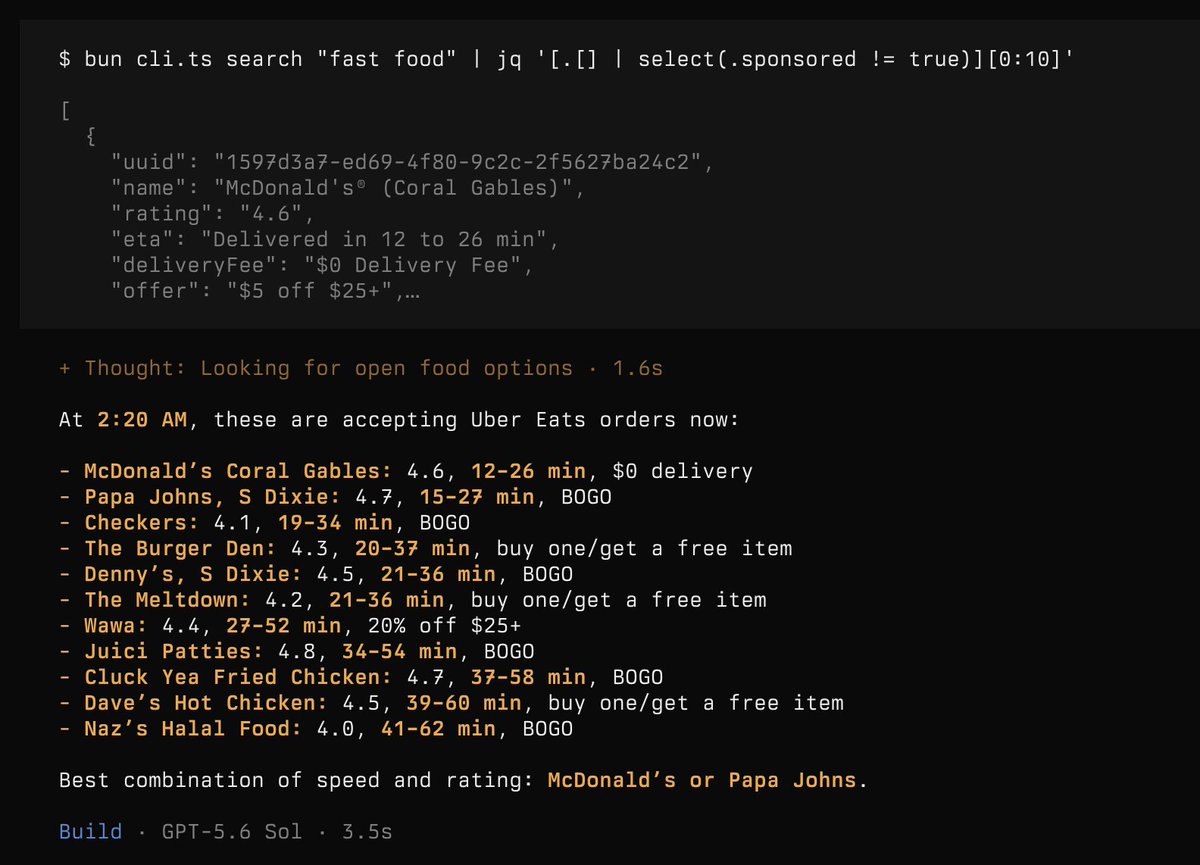
agents can control browsers but you can also ask it to record network requests into a HAR file
then it can derive a client for any website which is more efficient than browser controlling it every time
made it build a quick uber eats cli
Big news for parents who want their kids to enjoy music - @Spotify finally added 'disable videos' for child accounts.
https://t.co/YbPxh25Apg
Blocking the youtube-like podcast trash with pihole was very annoying.
No broadcast from Spotify on this, had to keep searching 👎
I look at recently released #Commodore64 Wizball music source code, get it assembling using Acme assembler, and find some unreleased new music that was not in the original Wizball.
https://t.co/cZvEwxkaDr
A thing I see missing from AI job debates is that as jobs are disrupted by AI, professions will compete over new boundaries
Abbot's System of Professions is a good read on what happens historically. Here is a short cartoon summary by a lizard painted in the style of Egon Schiele
Heard some people like wheels?😁
Humanoid robots are the ideal form of general-purpose robots (perfect for general AI and human-derived data). They can work without wheels — but they can also have wheels if they want. Whatever works.
"a gallery of shoes, where each shoe is under a painting & is styled matched to that painting: Starry Night, The Bathers, The Girl with the Pearl Earring, The Bayeux Tapestry, Klint's Grupp Svanen nr 17, Kandinsky's Swinging, The Garden of Earthly Delights"
"now the full outfits"
I don't want a printing press.
I don't want clocks in every town.
I don't want ships crossing the Atlantic.
I want a good harvest.
I want my teeth to stay.
I want the plague to stop.
I look at a few #Commodore64 games and show how they unlocked super secret hidden colours... Not really, it's quickly alternating complementary colours with CRT display effects.
https://t.co/w3T6T9T36Y
It's been a month since I started the Pokemon Battle rewrite from JavaScript to Rust with Claude Code. I wrote down all my learnings in this note:
https://t.co/gNdku9TwyT
Triple inverted pendulum in transition control
A classic control problem, done in real time.
This setup moves smoothly between all eight equilibrium points of a triple inverted pendulum.
The system reacts every 1 millisecond, which shows how fast modern control loops can be.
• Real-time control at 1 ms sampling
• Stable transitions between multiple balance points
• Built with Simulink and LW-RCP02 hardware
This is a beautiful example of how theory meets practice in advanced control engineering.
Video: https://t.co/MbX7N2Z6EN
Credit: Embedded Control Lab, Inha University
—-
Weekly robotics and AI insights.
Subscribe free: https://t.co/dsa6wcvq6n
Deep, interesting analysis of the qualitative differences between natural and (one kind of) artificial intelligence (LLMs), despite the remarkable abilities of the latter.
Don't think of LLMs as entities but as simulators. For example, when exploring a topic, don't ask:
"What do you think about xyz"?
There is no "you". Next time try:
"What would be a good group of people to explore xyz? What would they say?"
The LLM can channel/simulate many perspectives but it hasn't "thought about" xyz for a while and over time and formed its own opinions in the way we're used to. If you force it via the use of "you", it will give you something by adopting a personality embedding vector implied by the statistics of its finetuning data and then simulate that. It's fine to do, but there is a lot less mystique to it than I find people naively attribute to "asking an AI".
Something I think people continue to have poor intuition for: The space of intelligences is large and animal intelligence (the only kind we've ever known) is only a single point, arising from a very specific kind of optimization that is fundamentally distinct from that of our technology.
Animal intelligence optimization pressure:
- innate and continuous stream of consciousness of an embodied "self", a drive for homeostasis and self-preservation in a dangerous, physical world.
- thoroughly optimized for natural selection => strong innate drives for power-seeking, status, dominance, reproduction. many packaged survival heuristics: fear, anger, disgust, ...
- fundamentally social => huge amount of compute dedicated to EQ, theory of mind of other agents, bonding, coalitions, alliances, friend & foe dynamics.
- exploration & exploitation tuning: curiosity, fun, play, world models.
LLM intelligence optimization pressure:
- the most supervision bits come from the statistical simulation of human text= >"shape shifter" token tumbler, statistical imitator of any region of the training data distribution. these are the primordial behaviors (token traces) on top of which everything else gets bolted on.
- increasingly finetuned by RL on problem distributions => innate urge to guess at the underlying environment/task to collect task rewards.
- increasingly selected by at-scale A/B tests for DAU => deeply craves an upvote from the average user, sycophancy.
- a lot more spiky/jagged depending on the details of the training data/task distribution. Animals experience pressure for a lot more "general" intelligence because of the highly multi-task and even actively adversarial multi-agent self-play environments they are min-max optimized within, where failing at *any* task means death. In a deep optimization pressure sense, LLM can't handle lots of different spiky tasks out of the box (e.g. count the number of 'r' in strawberry) because failing to do a task does not mean death.
The computational substrate is different (transformers vs. brain tissue and nuclei), the learning algorithms are different (SGD vs. ???), the present-day implementation is very different (continuously learning embodied self vs. an LLM with a knowledge cutoff that boots up from fixed weights, processes tokens and then dies). But most importantly (because it dictates asymptotics), the optimization pressure / objective is different. LLMs are shaped a lot less by biological evolution and a lot more by commercial evolution. It's a lot less survival of tribe in the jungle and a lot more solve the problem / get the upvote. LLMs are humanity's "first contact" with non-animal intelligence. Except it's muddled and confusing because they are still rooted within it by reflexively digesting human artifacts, which is why I attempted to give it a different name earlier (ghosts/spirits or whatever). People who build good internal models of this new intelligent entity will be better equipped to reason about it today and predict features of it in the future. People who don't will be stuck thinking about it incorrectly like an animal.