Out now our work to accelerate the development of biocatalysts completely outside of cells! Barely using twitter, and now engaging more frequently on LinkedIn: https://t.co/bZYs1PV1DR
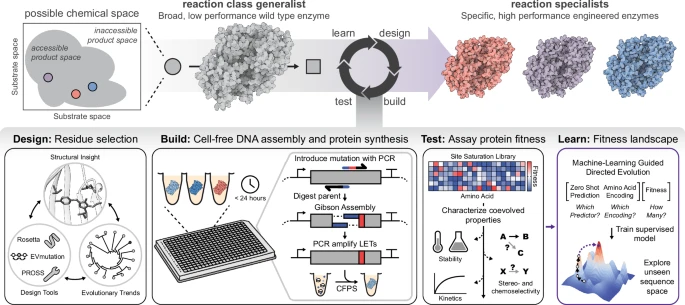
How can we create versatile biocatalysts for sustainable chemistry faster? We can use ML-guided design of enzymes enabled by synthetic biology. Research led by Grant Landwehr & Jon Bogart @NUSynBio@akarimlab
https://t.co/w5LhjzrsqL
Accelerated enzyme engineering by machine-learning guided cell-free expression @NatureComms
1. This study presents a novel machine-learning (ML)-guided platform for enzyme engineering, integrating cell-free DNA assembly, expression, and functional assays. It significantly accelerates the process by exploring protein sequence space and optimizing enzymes for diverse chemical reactions.
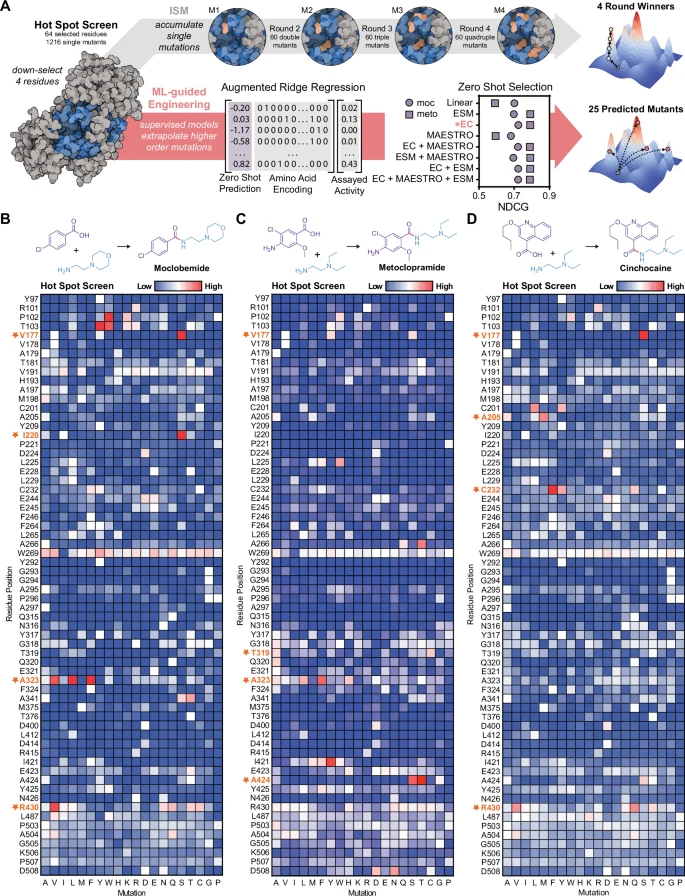
2. The platform was demonstrated on amide synthetases, evaluating 1217 enzyme variants across 10,953 reactions. Using ML, researchers built predictive models that achieved up to 42-fold activity improvements over parent enzymes for nine pharmaceutical compounds.
3. A key innovation is the use of cell-free gene expression systems in a design-build-test-learn (DBTL) workflow, which bypasses the limitations of traditional directed evolution, such as narrow sequence-space exploration and iterative site saturation mutagenesis.
4. The ML-guided framework includes augmented ridge regression models, which use sequence-function relationship data to predict higher-order mutants. These models showed superior performance, requiring only CPU-level computational resources.
5. This approach enabled rapid creation of specialized biocatalysts, reducing enzyme engineering timelines to just one week for multiple campaigns. For example, a quadruple mutant for moclobemide synthesis achieved a 96% conversion rate with a 42-fold increase in catalytic efficiency.
6. Beyond activity improvements, the engineered enzymes retained strict regio- and stereoselectivity without additional selective pressures, showcasing the robustness of the framework.
7. The study emphasizes the versatility of the platform, applying it to engineer six additional pharmaceutical compounds, yielding activity improvements ranging from 1.6- to 34-fold over the wild type.
8. By combining ML with cell-free systems, the framework circumvents path dependencies and expands the protein engineering toolbox, enabling simultaneous exploration of broad sequence spaces with reduced experimental burden.
@MichaelCJewett@akarimlab
💻Code: https://t.co/XQkigw2Wfj
📜Paper: https://t.co/gM5saNk5T2
#MachineLearning #ProteinEngineering #SyntheticBiology #Biocatalysis
What is needed to accelerate enzyme engineering using machine learning? #Data We develop a ML-guided platform that integrates DNA assembly, gene expression, and functional assays. ML models predict improved variants. @akarimlab@NUSynBio@NatureComms
https://t.co/BmlojOIK4A
Engineered enzymes can advance green chemistry. Unfortunately, engineering enzymes remains hard. In @NatureComms, we showed that AI-guided design coupled to cell-free systems can predict mutants as well as lab experiments. @akarimlab
https://t.co/8czWQPThDn
🎉 Congratulations to @MichaelCJewett for receiving the 2024 AIChE Food, Pharmaceutical, and Bioengineering Division Award at #AIChEAnnual@ChEnected! 🏆 This award honors outstanding contributions in chemical engineering within food, pharmaceuticals, and bioengineering.
Looking for talent to head the research arm of @NUSynBio ! If you are interested in shaping synthetic biology and you value creativity, impact, and great people, this is the opportunity for you. This is a fantastic job (I speak from experience!). Apply below!
Preprint alert! Figuring out how to make 100s of cell-free biosensors on an @opentrons OT-2 robot. With @MichaelCJewett@akarimlab and a whole lot of other folks! On @biorxivpreprint now:
https://t.co/QwtMJK2dU4
Awesome day celebrating each other and our progress as a Center! @NUSynBio with a fantastic keynote from @delafuenteupenn on next-generation antimicrobials from ancient ancestral proteomes!
Developing high-throughput biology workflows can be plagued by variability. We identify some key variables and strategies to get the most from high-throughput cell-free experiments. Check it out!
DNA template is one of the most expensive and limiting components of #cellfree protein expression. @Jian_Li_SHT 's latest preprint helps address that problem.
https://t.co/TVBt5AjUlS
Can wastewater bacteria provide solutions to the plastics problem? Just out today new @AristildeLab study unraveling how #wastewater Comamonas #bacteria break down PET #plastics into #nanoplastics and ultimately digestible #carbons. https://t.co/yJMnyQ5FR9
💨 @LanzaTech moves into the food arena with LanzaTech Nutritional Protein (LNP) set to reach commercial-scale production in 2028
'‘We ferment gases instead of sugars."
$LNZA
Join us @MITdeptofBE! We are searching for a tenure-track faculty colleague at the interface of #immunology and #biologicalengineering. Happy to answer questions about the BE department and junior faculty life at MIT (both great). Please share widely! https://t.co/xOFpH7bsKa
New work from the group applying cell-free protein engineering to develop metal binding sensors. We specifically modulate dynamic range and sensitivity of the PbrR transcription factor for lead detection at the legal limit. Check it out!
Is your water safe to drink? Point-of-use diagnostics are needed to address the growing crisis of water security. With @holly_ekas Brenda Wang @akarimlab@LucksLab@NUSynBio we engineered a cell-free biosensor to detect lead at the legal limit @ACSSynBio
https://t.co/NfKtNtT5qX
And the move into the new lab space is complete! Said goodbye to the Texas office (a decade of early scientist memories) 🥹…huge shoutout to @MichaelCJewett —advisor turned friend and colleague—(and his group) who was there to help me move in 🤩 now time to get to work📚🧫🥼
Come be a fellow at @NITMB_Chicago if you are interested in math, theory, or bio (or any combination)!
Great opportunity for independent research + supportive community + mentorship + pot. collaborations with folks across @NorthwesternU@UChicago!
https://t.co/5YFlWvnyUO