I’m a math and AP Econ teacher by day, and @SahilBloom’s tweets have made it into my classroom twice this year already. 👍🏼😎
I wonder if the students will notice when I’ve fully outsourced the content to him and other Finance/Econ personalities (nod to @RaoulGMI and @LukeGromen)
China is facing a severe energy crisis that threatens to compound supply chain woes and derail the global recovery.
Here’s a simple breakdown of the situation:
There are more urgent matters in the world, but what frustrates me about the way that AI has contaminated certain conversations is that I think it used to be well understood that the mind isn't well understood. There was a healthy uncertainty about things like thinking, consciousness, etc. But AI's arrival, and the threat it poses to academics and word-makers, has created a tribal motivation to make extremely confident declarations about what thinking/consciousness is in order to define it as the opposite of whatever AI is up to, even though we have a perfect understanding of neither what AI is up to nor what thinking/consciousness are.
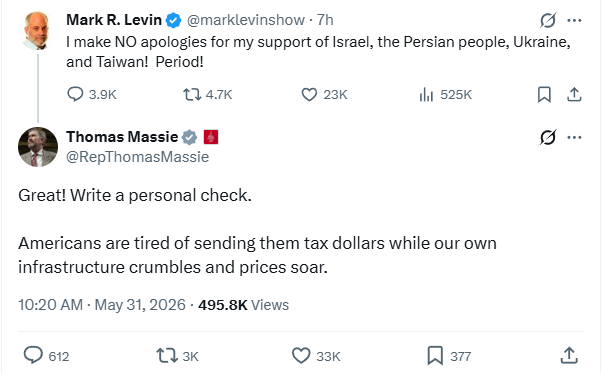
The America First view would be to let Americans decide which foreign causes to support, rather than to centralize their support as a collective and enforce it outwardly as though its all one cause.
To every medical resident and physician looking for a place to plant roots: New Mexico is calling. Free child care. Tuition-free college for your kids. And now up to $300,000 in student loan repayment for physicians. We’re working to make New Mexico The best place in America to practice medicine and build a life.
Applications for student loan forgiveness open June 1. Link in the first comment.
#NewMexico #Physicians #LoanForgiveness #NMHealth
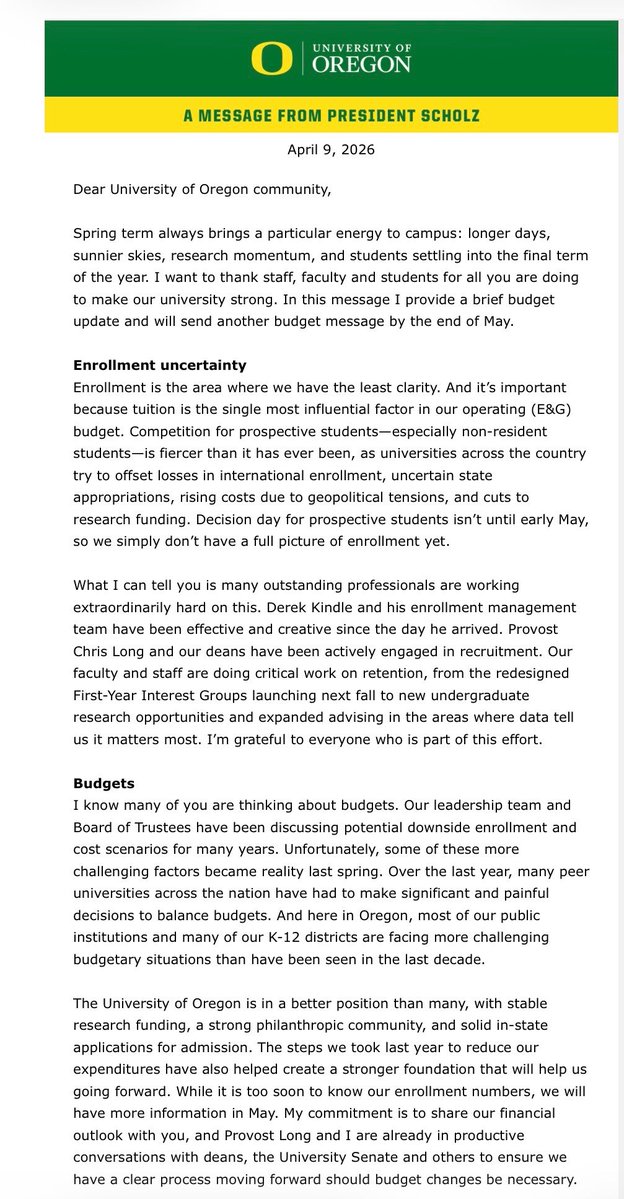
Universities had 17 years of warning. They responded by doing the opposite of what the math demanded.
In 2008, American birth rates fell off a cliff. The Great Recession made people stop having kids. Those never-born children would be turning 18 right now. The number of U.S. high school graduates peaked at roughly 3.9 million in 2025. By 2029, that number drops 15%. By 2041, it drops by nearly half a million students per year.
Every school in this tweet had access to the same Census data. They all saw the same curve.
Administrative positions at U.S. colleges grew 60% between 1993 and 2009, ten times the rate of tenured faculty growth. Non-instructional spending (student services, administration) grew 29% from 2010 to 2018. Instructional spending grew 17%. Average tuition at public four-year schools went from $3,500 in 2000 to $10,560 in 2023. Yale now has more administrators than undergraduate students. 5,460 administrators for fewer than 5,000 undergrads.
They built the cost structure of a growth company on top of a customer base that was mathematically guaranteed to shrink.
The split in this data tells you everything. Clemson, Syracuse, Duke, UNC, and Indiana are all cutting because the model broke. Alabama, Ole Miss, and the University of Florida are turning away more applicants than ever. Harvard gets five applications for every spot. The middle is where the cliff hits. Elite schools absorb demand. Everyone between elite and community college fights over a shrinking pool. The Fed published a study in December 2024 predicting 80 colleges will close in the next five years. Since 2016, over 100 already have. In 2024 alone, 28 shut down. One per week.
These program cuts and layoffs are a decade late. The birth rate data was sitting in Census spreadsheets the entire time. Everyone in higher education administration saw the enrollment cliff coming. They hired more administrators anyway.
I wonder how much of the ire directed at AI is (a) jobs vs. (b) fears of surveillance vs. (c) annoyance at how AI was shoved down our throats without consent
Like we didn’t ask for our kettle bells and toaster ovens to connect to WiFi for app subscriptions and now AI feels like the same thing.
Basically the whole 'internet of things" (IoT) craze made products and every day living WORSE and even more expensive because too many things required apps, subscriptions and cloud dependency.
It was sold as “smart” and convenient, but mostly it just locked us into ecosystems and created new failure points. Now AI is conjuring up the same sense of deja vu - suddenly it’s in your search bar, your photo editor, your writing tools, your customer service, your car, and even your light bulbs.
The public never really opted in. It was opt-out at best, and often not even that. So I think some of the ire is Luddite rejection and exhaustion because all this was sold as inevitable progress but it's created instead, nostalgia for the old products and appliances.
The birth-rate collapse isn’t just about money, housing, or women choosing careers. The sharper diagnosis: fewer couples. Across the world, young people still say they want kids. But they socialize less, partner less, commit less – and become parents less. Smartphones didn’t make us infertile. They may have made us lonelier. The fertility crisis is really a bonding crisis. https://t.co/DSi1emv0HU
No smoking gun, but the preponderance of evidence points to smartphones, not economics, as the culprit for the global drop in fertility:
• In the US and UK, births fell first and fastest in areas that got 4G earliest
• Birth rates were stable in the US, UK and Australia until 2007; in France and Poland until 2009; in Mexico and Indonesia until 2012; in Ghana, Nigeria and Senegal until 2013-15
Each of these inflection points matches local smartphone adoption (see picture).
• The younger the age group, the sharper the drop.
• in-person socialising among young adults is dropping. In SK, by 50% in 20 years
• Sexual dysfunction is higher among heavy social media user
• Effect is largest in culturally traditional societies — Middle East, Latin America, sub-Saharan Africa
• Decline holds across countries hit hard by GFC 2008 and those not hit, fast-growing and not growing.
Excellent again @jburnmurdoch.
https://t.co/RYEMXD2bRM
⚡️Higher education is entering its liquidation phase as a mass middle-class belief system.
The demographic cliff is only the visible trigger. The deeper break is that the entire college model was built on three assumptions: there would always be more students, families would always treat college as mandatory, and employers would always reward the credential enough to justify the cost. All three are now weakening at the same time.
That is why this matters.
A fertility decline from 2007 shows up in college admissions with an 18-year delay, but the enrollment shock lands inside a system already overbuilt. Colleges expanded staff, facilities, administrative layers, debt loads, athletic budgets, student-life amenities, DEI bureaucracies, marketing machines, and low-ROI programs during an era when the college-going population was bigger and the credential premium felt unquestioned. Now the customer base is shrinking while the product is being repriced.
That creates a financial vise.
The elite tier survives because it sells scarcity, network, status, marriage markets, recruiting access, and proximity to power. A Harvard or Stanford degree is not mainly a classroom product. It is a social-routing asset. Those schools can keep demand even if people lose faith in “college” broadly.
The practical tier survives because it has obvious economic utility. Engineering, nursing, accounting, skilled health fields, hard technical programs, logistics, applied AI, defense-adjacent disciplines, and high-placement public universities can still justify themselves. Cheap public options also survive because affordability becomes a weapon.
The exposed layer is the bloated middle: expensive private colleges without elite status, regional schools with weak draw, generic master’s programs, low-placement liberal arts degrees, weak online MBAs, tuition-dependent institutions, and universities that confuse branding with value. Those schools are going to face the hardest truth: students were not loyal to them. Students were loyal to the belief that the system required them.
That belief is cracking.
AI makes the break sharper because it attacks the bottom rung of the white-collar ladder. College made sense when the degree bought access to entry-level knowledge work. If entry-level knowledge work gets compressed by AI, the bridge weakens. Families will not pay unlimited tuition for a credential that leads into a shrinking first rung. They will ask harder questions: what job, what network, what income, what debt, what skill, what proof?
The cultural layer is even bigger. College used to be the default coming-of-age institution for the American middle class. It replaced church, apprenticeship, local adulthood, early marriage, and family formation as the official bridge from youth into adult status. Now that bridge is expensive, delayed, ideologically contested, economically uncertain, and increasingly detached from real capability.
So the enrollment cliff is really a legitimacy cliff.
The schools will respond by discounting tuition, poaching students, merging departments, cutting humanities programs, chasing international enrollment, adding AI buzzwords, expanding career services, begging donors, leaning harder into athletics, and selling “community” because the economic case is weaker. Some will survive. Many will shrink. Some will close. The sector will consolidate because the old demand curve is not coming back.
The brutal truth: higher education became a credential factory priced like a luxury good, staffed like a bureaucracy, and justified by an employment ladder AI is now destabilizing.
Demography lit the fuse.
AI removes the escape route.
The next decade is going to separate institutions that actually create human capital from institutions that merely certify participation in a fading social ritual.
I know the fights over algebra will never be resolved.
I took it in 7th grade at a public school. My high school offered differential equations and linear algebra. This was all in the 1980s in Omaha. Maybe I was just lucky, but I thought it was like that everywhere.
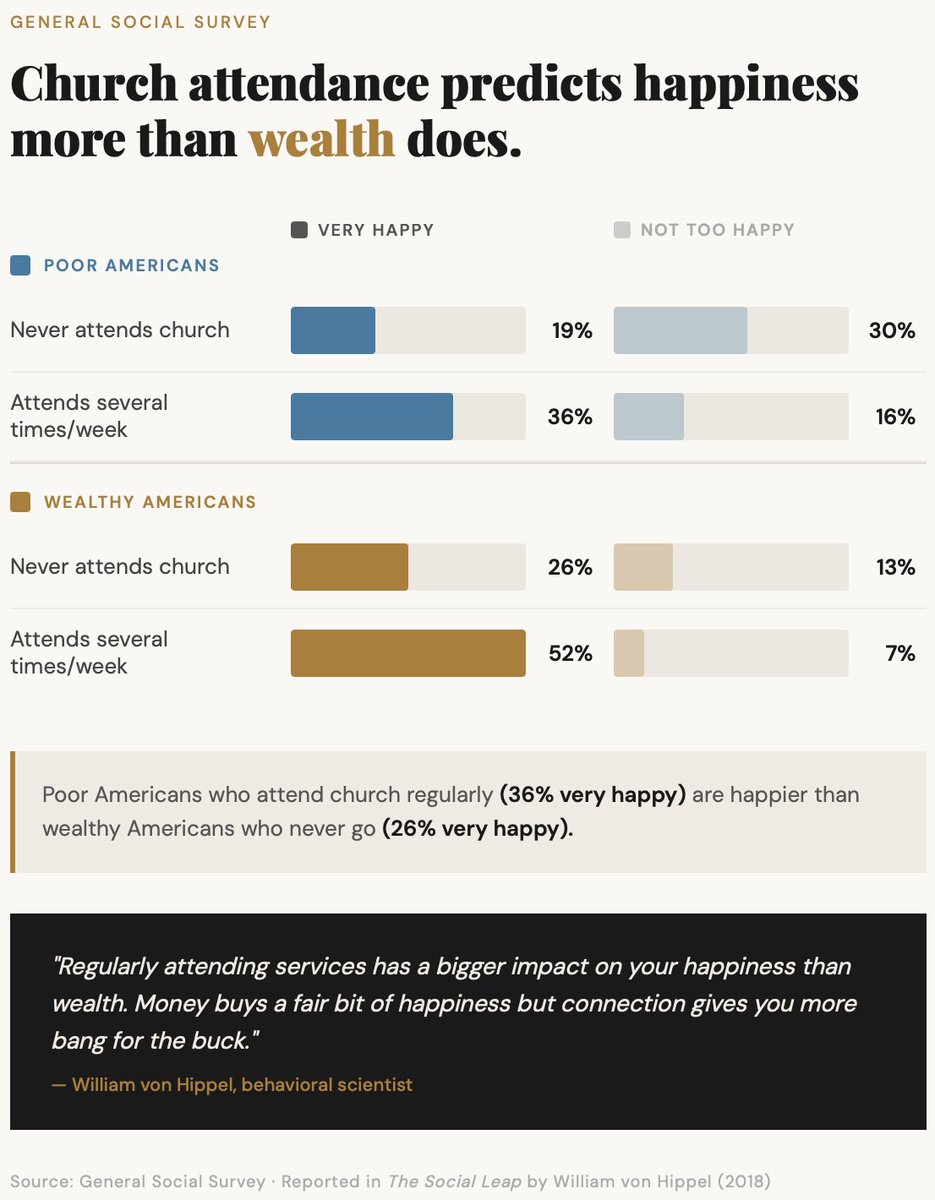
Poor Americans who attend church regularly are happier than rich Americans who never go.
Behavioral scientist William von Hippel thought he'd made a coding error. He hadn't.
"Regularly attending services has a bigger impact on your happiness than wealth," he writes. "Money buys a fair bit of happiness but connection gives you more bang for the buck."
What's happening? Rich people already have most of what money buys. What they lack is what churches provide for free: weekly, repeated contact with people who know your name.
Von Hippel is direct about the cost: "I suspect that wealthy, educated urbanites are paying a steeper price for their lifestyle than they realize. Many of us have paid too great a price in connection for our increased autonomy."
Not teaching students math facts because they can use calculators, spelling rules because they have spell check, historical dates because they can google it, or writing skills because they have Al is a travesty. Depriving students of these things enslaves them to technology rather than freeing them to flourish as human beings.
When simulation becomes the norm, it weakens the human capacity for discernment. As a result, our social bonds close in upon themselves, forming self-referential circuits that no longer expose us to reality. We thus come to live within bubbles, impermeable to one another. Feeling threatened by anyone who is different, we grow unaccustomed to encounter and dialogue. In this way, polarization, conflict, fear and violence spread. What is at stake is not merely the risk of error, but a transformation in our very relationship with truth.
“Jo Boaler is a professor of education at the Stanford Graduate School of Education, with an enormously influential body of work …. Her work got Algebra removed from middle schools across the Bay Area.
It is some of the most incompetently or dishonestly conducted research I have seen in a decade as a journalist.”