🚀 𝐋𝐥𝐚𝐦𝐚-𝟑.𝟏-𝐒𝐭𝐨𝐫𝐦-𝟖𝐁 has arrived! A new 8B parameter LLM that outperforms @Meta 𝗟𝗹𝗮𝗺𝗮-𝟯.𝟭-𝟴𝗕-𝗜𝗻𝘀𝘁𝗿𝘂𝗰𝘁 and 𝗛𝗲𝗿𝗺𝗲𝘀-𝟯-𝗟𝗹𝗮𝗺𝗮-𝟯.𝟭-𝟴𝗕 across diverse benchmarks! Our new 8B LLM pushes the boundaries of what's possible with smaller language models.
💻 Perfect for GPU-Poor AI developers. Build Smarter Chatbots, QA Systems, Reasoning Applications, and Agentic Workflows today! Llama-3.1 derivative, so research & commercial-friendly!
🚀 For startups building AI-powered products.
🧠 For researchers exploring methods to further push model performance.
- Start building with Llama-3.1-Storm-8B (available in BF16, FP8, and GGUF) today: https://t.co/5COZQt6Zm2
- Built on our winning recipe in NeurIPS LLM Efficiency Challenge. Learn more: https://t.co/NG85BpIAjE
- Integration guides for Hugging Face, vLLM, and Lightning AI's LitGPT: https://t.co/lQ83pfgCw4
🚀 Start Llama-3.1-Storm-8B Colab Notebook: https://t.co/XHzVQVFGda
Huge thanks to @rasbt , @marksaroufim , @_lewtun , @maximelabonne , @prateeky2806 for providing valuable feedback! We extend our deepest gratitude to @LambdaAPI for sponsoring compute for this work.
𝐋𝐥𝐚𝐦𝐚-𝟑.𝟏-𝐒𝐭𝐨𝐫𝐦-𝟖𝐁 is team Upaya’s (@akjindal53244@pawan_r24@ankurparikh85@AkshitaSukh ) most valuable contribution so far towards the open-source community. If you resonate with our work and want to be a part of the journey, we're seeking both computational resources and innovative collaborators to push LLMs further!
#llm #largelanguagemodels #llama3 #huggingface #opensource
We can finally talk about it:
We found a way to extract hidden reasoning of frontier models using a vulnerability in the APIs of every frontier AI company.
We verified that our reasoning token count matches billed API thinking tokens 1:1 for most of the prompts we queried.
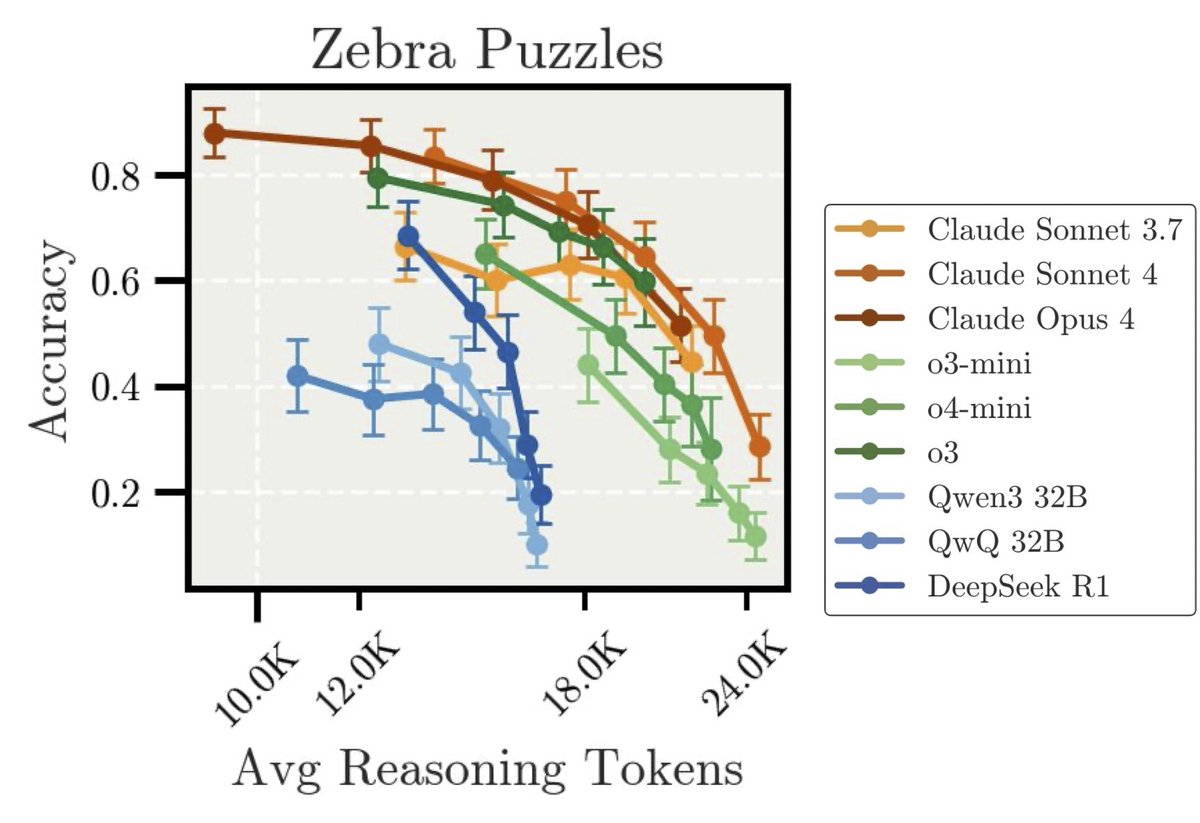
New Anthropic Research: “Inverse Scaling in Test-Time Compute”
We found cases where longer reasoning leads to lower accuracy.
Our findings suggest that naïve scaling of test-time compute may inadvertently reinforce problematic reasoning patterns.
🧵
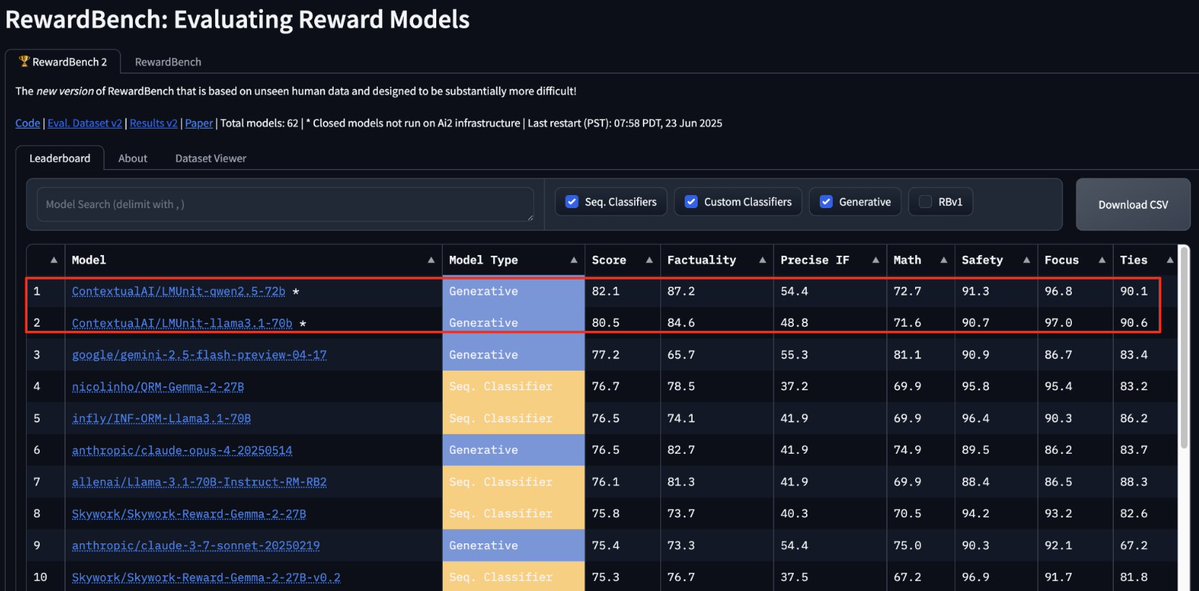
Excited to share 🤯 that our LMUnit models with @ContextualAI just claimed the top spots on RewardBench2 🥇
How did we manage to rank +5% higher than models like Gemini, Claude 4, and GPT4.1? More in the details below:
🧵 1/11
Introducing T5Gemma: the next generation of encoder-decoder/T5 models!
🔧Decoder models adapted to be encoder-decoder
🔥32 models with different combinations
🤗Available in Hugging Face and Kaggle
https://t.co/8eFH7yKger
@eugeneyan Observation: For synthetic data, LLMs tend to generate questions/instructions that indirectly leak answer to the question as they have access to the context. I have observed this behavior for generating simple (semantic) classification-style instructions from a document.
🚨 New paper & dataset! 🚨
NaturalReasoning: Reasoning in the Wild with 2.8M Challenging Questions
- Synthesizes 2.8M challenging and diverse questions which require multi-step reasoning, along with reference answers
- Shows steeper data scaling curve for knowledge distillation than existing datasets
- Demonstrates potential for self-training to improve general reasoning capabilities beyond math, code, etc.
Paper link: https://t.co/y17ItAT129
Dataset Link: https://t.co/rAfArxtGgC
🧵(1/5)
What if a [MASK] was all you needed?
ModernBERT is great, but we couldn't stop wondering if it could be greater than previous encoders in different ways.
Maybe we don't need task-specific heads? Maybe it can do all sort of tasks with only its generative head? Spoilers: Yes
@javifer_96@OBalcells@NeelNanda5@sen_r Interesting work! Any thoughts on how to use these insights to steer LLM to say No instead of letting it hallucinate (thinking of training free setup)?
Finished a run (R1 style) GRPO on Qwen-2.5-0.5B (base model) yield +10 accuracy points on GSM8K. Literally just works. Base model scores 41.6% as reported on qwen paper vs 51%~ GRPO
Everyone is talking about RL these days. But are we done with SFT? The answer is NO. If we revive SFT in another form, it can even beat RL!
Very happy to introduce Critique Fine-Tuning, a new form of SFT, which can more efficiently activate language models' reasoning capabilities. The basic idea is simple: training the base language models to critique given noisy responses instead of imitating the correct responses. This is inspired by the human learning process, which emphasizes deep analysis and critical thinking.
By training Qwen2.5-Math-base with CFT for 8 GPU hours (1 hour on 8xH100) on 50K examples, we can improve it by 22 absolute points on six math reasoning datasets! It significantly outperforms standard SFT. It can match or outperform Qwen2.5-Math-Instruct trained with 2M+ examples. We tried CFT on other backbones like Qwen2.5-base, the gain of CFT over SFT is even larger.
What's more, CFT training can even match SimpleRL (https://t.co/nKEKCDjGQ0), which is the open replication of R1 training. Note that CFT training only requires 8 GPU hours while SimpleRL requires ~1152 GPU hours.
We believe there is a lot variants of SFT we should explore. CFT is only be one of them.
Paper: https://t.co/UMnClhPCmY
Code: https://t.co/STMY8TUtQ5
Website & Models & Data Link: https://t.co/tujDCb0xap
Here is Tülu 3 405B 🐫 our open-source post-training model that surpasses the performance of DeepSeek-V3! The last member of the Tülu 3 family demonstrates that our recipe, which includes Reinforcement Learning from Verifiable Rewards (RVLR) scales to 405B - with performance on par with GPT-4o, and surpassing prior open-weight post-trained models of the same size including Llama 3.1
I don't have too too much to add on top of this earlier post on V3 and I think it applies to R1 too (which is the more recent, thinking equivalent).
I will say that Deep Learning has a legendary ravenous appetite for compute, like no other algorithm that has ever been developed in AI. You may not always be utilizing it fully but I would never bet against compute as the upper bound for achievable intelligence in the long run. Not just for an individual final training run, but also for the entire innovation / experimentation engine that silently underlies all the algorithmic innovations.
Data has historically been seen as a separate category from compute, but even data is downstream of compute to a large extent - you can spend compute to create data. Tons of it. You've heard this called synthetic data generation, but less obviously, there is a very deep connection (equivalence even) between "synthetic data generation" and "reinforcement learning". In the trial-and-error learning process in RL, the "trial" is model generating (synthetic) data, which it then learns from based on the "error" (/reward). Conversely, when you generate synthetic data and then rank or filter it in any way, your filter is straight up equivalent to a 0-1 advantage function - congrats you're doing crappy RL.
Last thought. Not sure if this is obvious. There are two major types of learning, in both children and in deep learning. There is 1) imitation learning (watch and repeat, i.e. pretraining, supervised finetuning), and 2) trial-and-error learning (reinforcement learning). My favorite simple example is AlphaGo - 1) is learning by imitating expert players, 2) is reinforcement learning to win the game. Almost every single shocking result of deep learning, and the source of all *magic* is always 2. 2 is significantly significantly more powerful. 2 is what surprises you. 2 is when the paddle learns to hit the ball behind the blocks in Breakout. 2 is when AlphaGo beats even Lee Sedol. And 2 is the "aha moment" when the DeepSeek (or o1 etc.) discovers that it works well to re-evaluate your assumptions, backtrack, try something else, etc. It's the solving strategies you see this model use in its chain of thought. It's how it goes back and forth thinking to itself. These thoughts are *emergent* (!!!) and this is actually seriously incredible, impressive and new (as in publicly available and documented etc.). The model could never learn this with 1 (by imitation), because the cognition of the model and the cognition of the human labeler is different. The human would never know to correctly annotate these kinds of solving strategies and what they should even look like. They have to be discovered during reinforcement learning as empirically and statistically useful towards a final outcome.
(Last last thought/reference this time for real is that RL is powerful but RLHF is not. RLHF is not RL. I have a separate rant on that in an earlier tweet
https://t.co/RMIpFPVpuM)