Our goal isn’t to get a data advantage over our law firm clients and even if we wanted to we can’t for exactly the reason you described - the majority of their data is actually client data so even a law firm like Kirkland can’t take all that data and train a model on it bc it would break confidentiality.
The two things firms can do are 1) firm-specific models - encode all of your firm knowledge in client agnostic ways to train models (templates, deal points, using your lawyers feedback on non-client data, disentangle your firm’s trajectories from client data, etc) and 2) client-specific models - for deep enough client relationships work with your client to build a joint model where both parties benefit from converting the relationship into AI. This is especially good for firms with long lasting relationships with their clients to make those relationships stickier.
The best way to train either of these models is building a product that centralizes the entire client matter process (i.e. allows you to do an acquisition end-to-end and capture the entire trajectory and feedback across the entire team of associates, partners, client). These products will be specialized by practice area (M&A completely different from fund formation which is completely different from IP litigation). Without something like this it’s very hard to get meaningful signals from individual associate queries on a chat based product. We think this general product / infra will be shared across firms but then highly customized and the customizations and data will be owned by the law firms and their clients.
Another problem we want to help law firms and their clients solve is how do you manage client data at scale when you are doing this type of training? The Fortune 500 customers we work with already struggle with professional services providers and data security because most of the work is done over email, downloaded onto desktops and printed out. And it’s not the law firm’s fault - they need to stitch together many different products to support all the needs of their clients' regulatory and security requirements. This is already a huge challenge and model training on top of this is going to make things infinitely more complicated.
We’re building a collaborative platform (shared spaces) that allows law firms and clients to securely share data on client matters and build custom agents for their clients in a secure way. Eventually this will become infrastructure that allows firms to train client-specific models and for clients to have the piece of mind that the data they are sharing is isolated from other clients and it’s being used to their exclusive benefit. I think this is a good example of a very vertical product that it probably doesn’t make sense for a single law firm or model provider to build.
So I agree there isn’t a market for laptops for lawyers but I think there probably is for infrastructure that enables enterprises to manage all their internal and external legal spend, workforce, agents, processes and the same for law firms. Compute is a great moat but in the cloud era most SAAS companies didn’t build datacenters and many were still wildly successful by building on top of the cloud providers. I think we will see the same thing in the next decade as well with respect to model providers.
We partnered with @FireworksAI_HQ to train open-source models for legal. Here's what we found:
1) Hybrid legal agents can beat frontier models on quality and cost by routing selectively to a frontier advisor.
We tested a hybrid setup where GLM 5.1 served as the primary worker, routing tasks to Opus 4.7 as an advisor when needed.
GLM invoked Opus sparingly, just 0.83 times per task on average.
The hybrid setup beat Opus on both quality and cost: 18% all-pass vs 14%, at $368 vs $954 across the same 100 tasks.
2) Post-training can push open models to frontier-level legal performance.
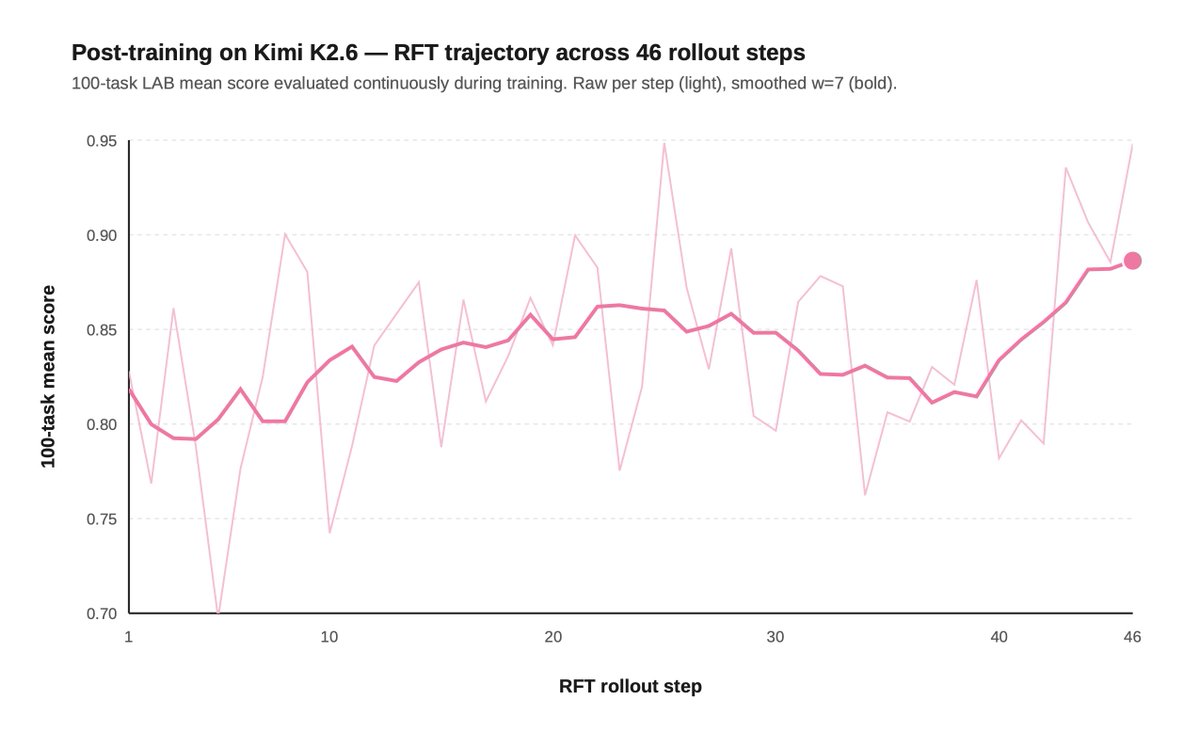
On a 100-task slice of our Legal Agent Benchmark (LAB), SFT moved Kimi 2.6's all-pass rate from 11% to 15%, beating Opus' 14%.
But the cost gap was even more striking: $84 vs $954 across the same 100 tasks, or ~11x cheaper.
We're excited to continue working with @FireworksAI_HQ on the next generation of open-source legal agents.
🎙️Episode 50 with Harvey founder @winstonweinberg
We went well over an hour, but I could have easily kept going Lex Fridman style. Maybe for episode 100.
00:00 Zach's Take: there has never been a company like Harvey
3:44 Why Harvey triggers so many feelings
8:10 The challenges of rapid scaling and system stability
11:32 The super in the weeds technical realities of scaling
14:40 Building a battle-tested team culture
17:46 Winston’s shift from GTM to 95% product and engineering
19:15 The transition to cloud agents and the future of orchestration
23:10 Why fine-tuning and evals are making a comeback in legal
25:15 Managing the high cost of frontier intelligence and compute
29:25 Moving from individual to institutional productivity
31:10 The ROI of AI: Will it kill or revive the billable hour?
38:40 Competing against base model providers (OpenAI, Google, Anthropic)
42:30 Harvey’s killer features: Vault, shared spaces, and security
48:40 Expanding AI use cases: From transactional work to litigation
55:20 Proactive internal investigations and horizon scanning
59:00 How AI changes the training and loyalty of junior associates
1:05:00 Using AI as a talent retention strategy for law firms
1:10:45 Silicon Valley’s investment and the future of legal tech spending
Strongly agree with this - every law firm / enterprise is going to need to have infrastructure that lets them switch between model and cloud providers. If you pick the wrong one and build your whole firm / business on it and get locked in and then they fall behind in the research race, run out of compute, discontinue the features you depend on, raise your prices, etc) then your firm / business in some cases is over.
Which AI company should you work for if you want to optimize for career success?
I used Claude to research career frameworks from 6 prominent entrepreneurs – @eladgil@pmarca@paulg@naval@rabois – and asked it to rank every single AI company into a tier list.
The process: I had Claude pull each person's most iconic essay on career decisions, extract the first principles from each framework, and then score every major AI company against all 8 criteria simultaneously.
The criteria:
1. Wave Riding – Is this company at the epicenter of the most important market shift happening right now?
2. Talent Density – Will your coworkers be the best people you've ever worked with, and will this alumni network compound for decades?
3. Stage & Optionality – Is the company small enough (20-200 people) that you'll wear many hats, with equity that can still appreciate 20-100x?
4. Compounding Learning – Will your rate of learning stay high year after year, and can you become a "barrel" who takes ideas from zero to shipped?
5. Specific Knowledge + Leverage – Will you build skills that feel like play to you but look like work to others, with access to code, media, or capital leverage?
6. Curiosity & Mission – Does the work excite genuine intellectual curiosity, and is the company's mission real – not just a recruiting pitch?
7. Equity & Ownership – Do you own a meaningful piece of the outcome, or are you just renting your time for a salary?
8. Brand Signal – Will this name on your resume open every door afterward, and are you building a public reputation through accountability?
What am I missing? Do you agree with this list?
We had an incredible April at Harvey.
- Net new ARR is up 6x YoY
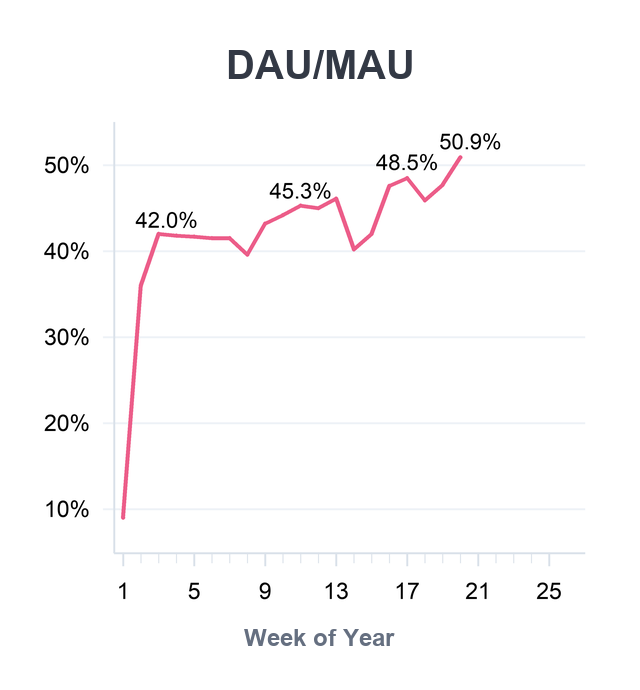
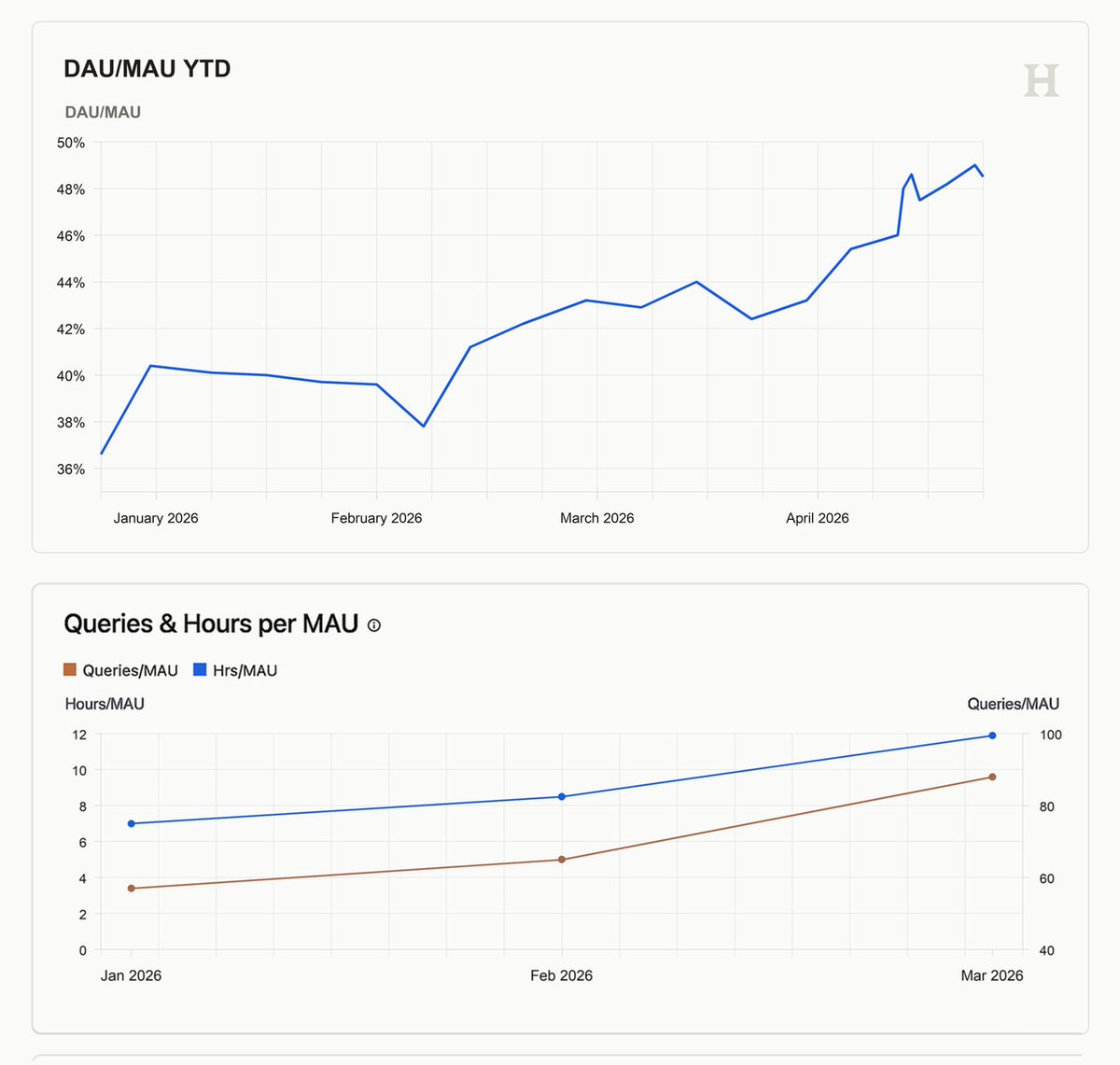
- We’re about to break 50% DAU/MAU
- Our average user now spends 12 hours a month using Harvey
Job's not finished.
Respectfully disagree here. Understand the desire to promote the company you’ve backed so will do the same. I looked at both and made the decision to back @winstonweinberg and team @harvey . We’ve invested twice now. Harvey is adding a full “legora” of revenue every few months and killing it across US AND Europe. There is room for two vendors in a market this large and complex but make no mistake, Harvey is THE market leader and the company is on fire!!! 🔥🔥🔥🔥
We’re getting closer to a world where lawyers don’t just ask questions in software. They delegate work.
Give an agent a task. It plans, executes, and returns something you can actually use. We have done the hard work and wired the context for you
Less process. More judgment.
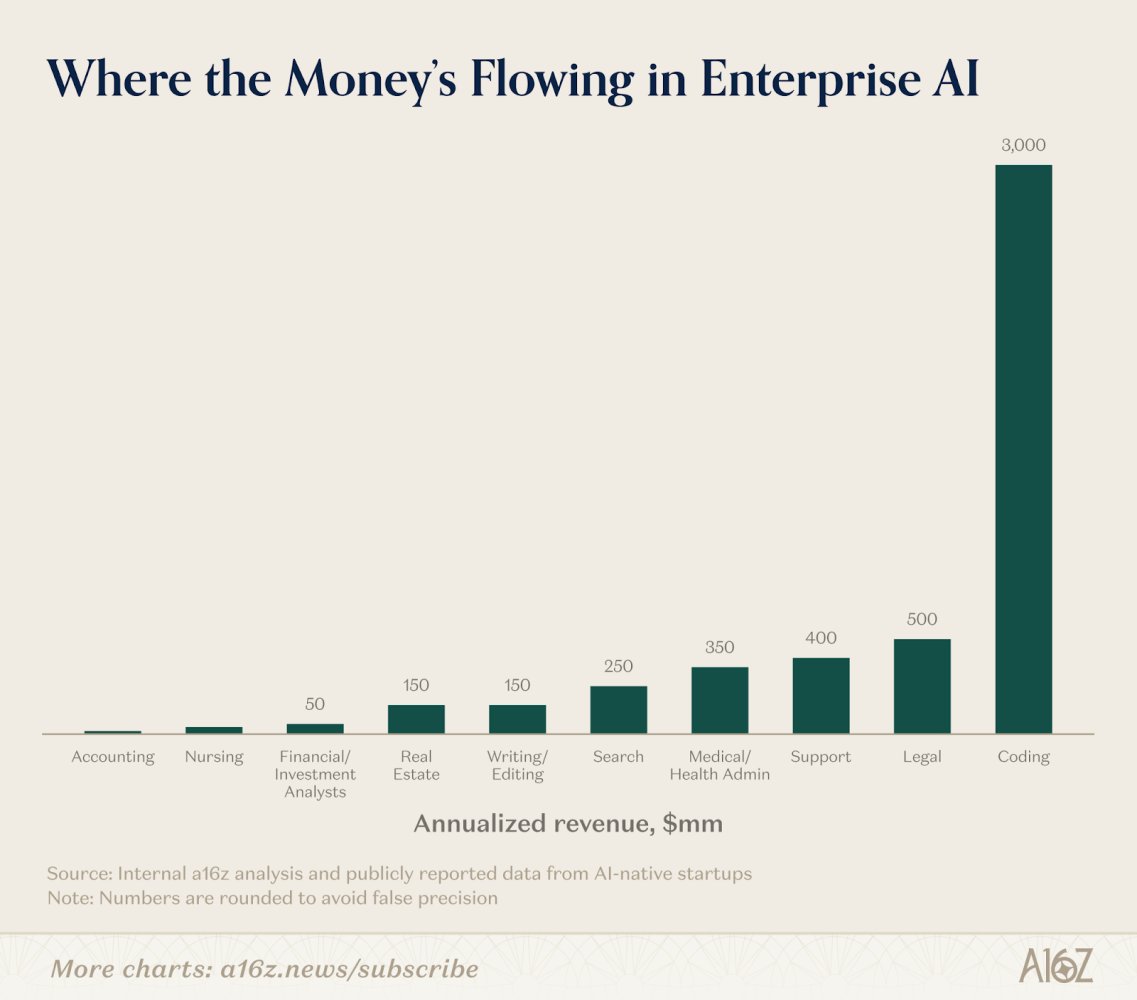
Enterprises are using AI today for coding, legal, support, healthcare, and more.
@kimberlywtan's must-read deep dive compiles hard data on where AI has the most enterprise adoption – and the industries AI is coming for next: https://t.co/uiooUsHrMi
Harvey is now the Official Legal AI Partner of @PSG_inside.
As part of this partnership, PSG’s legal team will use Harvey to drive greater efficiency across the organization.
As we prepare to open our Paris office, this marks an important step in our expansion across France and Europe.
Learn more: https://t.co/6lZRj0MecL
We dramatically underestimate how much change management it is going to take to automate most knowledge worker tasks.
Between data being in legacy environments or systems or without good APIs, context missing for doing the task, teams that are less technical, and other factors, there’s still a lot of work to drive real AI transformation in an enterprise.
This is actually great news if you’re building right now because the opportunity is to build the software bridges to make this easier, or to build new services firms to help with this change management. Opportunity is all around for those looking.
Today we announced a multi-year partnership with the @Cubs, naming Harvey the Official Legal AI Platform of the Club.
Chicago is one of the most important legal markets in the US, and we’re proud to partner with the Cubs as we continue to grow and connect with customers across the region.
Learn more: https://t.co/13bf8QCbth
Today, Sierra is releasing Ghostwriter, our agent for building agents. With Ghostwriter, you can create an AI agent for your customer experience — one that can chat, pick up the phone, speak dozens of languages, take action on your systems of record, and be protected with industry-leading guardrails — simply by having a conversation. No clicking, no forms, no menus.
Codex and Claude Code have transformed how we build software, making it possible for software engineers to orchestrate and review the work rather than doing all the work themselves. We think the same transformation will happen for all software. Rather than every enterprise app having a web app for humans and an API for automation, every software platform’s UI will be an agent that can do the work on your behalf.
I recorded a demo of my building and optimizing an agent with Ghostwriter so you can see how powerful and easy it is to use. It’s completely changed the way our early adopters build agents, and it’s changed the way I think about the software industry. Let me know what you think, and, if you’re interested in trying it out at your business, please reach out directly.
Long horizon agents are functionally AGI.
Harvey's long horizon agents completely change the game for law firms and in-house counsel.
Be the lawyer you admired on TV. Let the agents do everything else.