MD/PhD candidate @stanford | previously data science @cerebral, @flatironhealth, @harvard (statistics) | data-driven health systems | language enthusiast
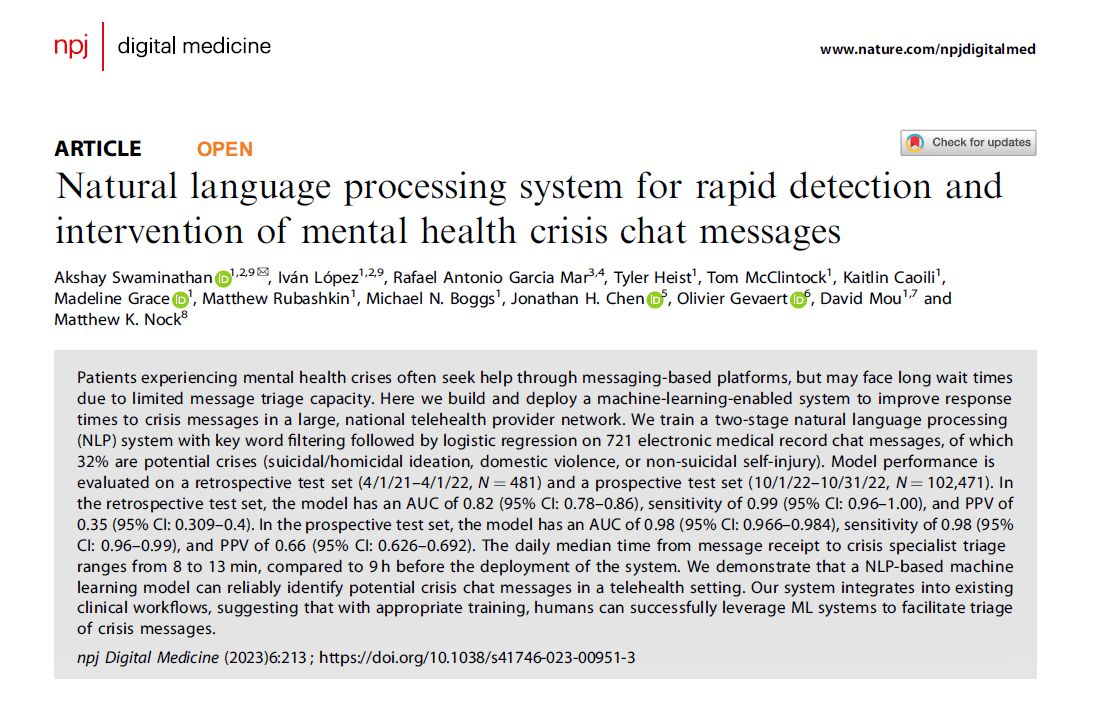
Proud to announce this NLP model that allows us to identify suicidal patients within minutes. This model is deployed at scale to support our national network of patients https://t.co/oOUCPazBqY
Things we did well that make our model effective:
Launching the Alive Prize. $100K to build what makes you come alive.
I've been fixated on a quote from Howard Thurman lately: "Don’t ask what the world needs. Ask what makes you come alive, and go do it. Because what the world needs is people who have come alive."
We want to help more people find that feeling.
https://t.co/LosgT4WWRW
🎉 We're thrilled to announce the general release of three de-identified, longitudinal EHR datasets from Stanford Medicine—now freely available for non-commercial research-use worldwide! 🚀
Read our HAI blog post for more details: https://t.co/gKLmwZhvLE
𝗗𝗮𝘁𝗮𝘀𝗲𝘁 𝗦𝘂𝗺𝗺𝗮𝗿𝗶𝗲𝘀
📊 3 longitudinal EHR datasets
👥 Scale: 25,991 patients, 441,680 visits, and 295M clinical events (median: 4,882 events per patient)
⏳ Timeframe: Patient trajectories from 1997 to 2023 (median: 10 years per patient)
𝗦𝘁𝗮𝗻𝗱𝗮𝗿𝗱𝗶𝘇𝗲𝗱 𝗕𝗲𝗻𝗰𝗵𝗺𝗮𝗿𝗸 𝗧𝗮𝘀𝗸𝘀
🎯 Few-shot Learning
🤖 Multimodal Learning & Time-to-Event Modeling
⌛ Long Context Instruction Following & Temporal Reasoning
Thanks to @MichaelWornow, Ethan Steinberg, @Zepeng_Huo, @HennyJieCC , @BediSuhana42170 , @AlyssaUnell, @drnigam@StanfordMed
🚀 Checkout our ICLR 2024 Spotlight Poster #165 today (Session 3)
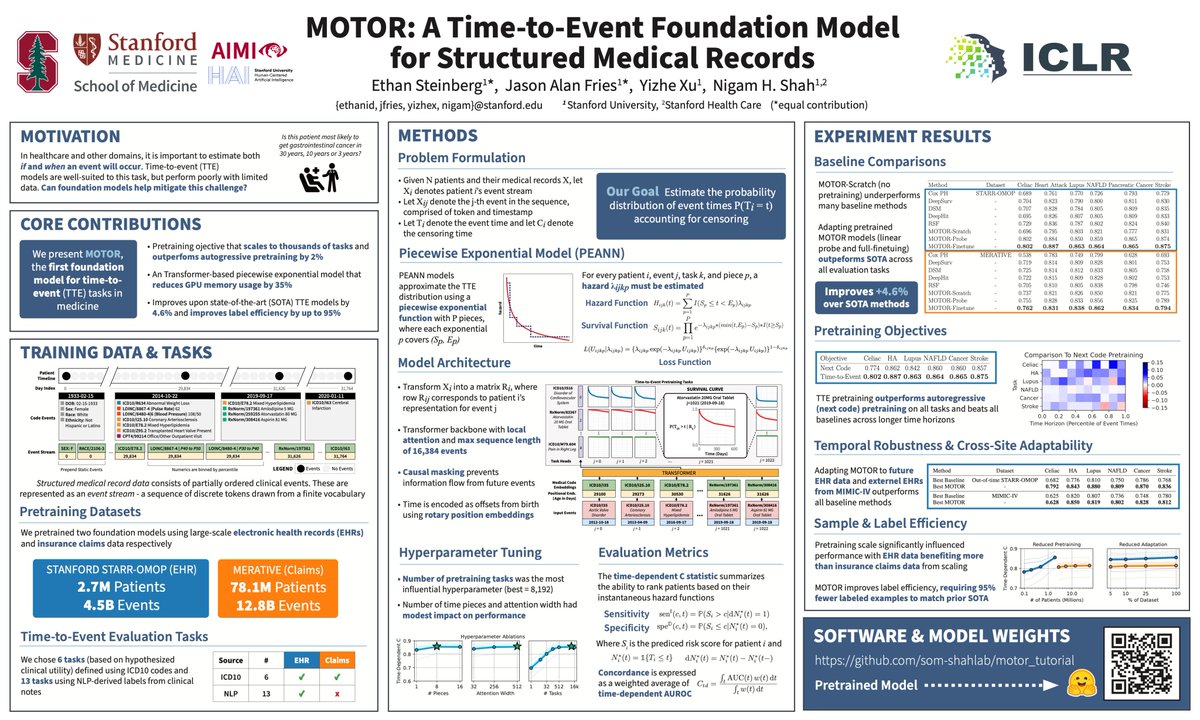
🩺 "MOTOR: A Time-to-Event Foundation Model For Structured Medical Records"
✨ Highlights:
- The first TTE foundation model for structured EHRs
- Improves SOTA TTE by 4.6% & boosts label efficiency up to 95%
- TTE pretraining scales to 16k tasks & reduces GPU memory usage by ~35%
- Model weights available for research use!
🔍 Tutorial: https://t.co/1zKF05JS6A
🤖 Model: https://t.co/Ka9YUHNJNG
#ICLR2024 #AI #Healthcare
Excited to be in Vancouver 🇨🇦 for #AAAI24 with @_scott_fleming_ to present:
"MedAlign: A Clinician-Generated Benchmark Dataset for Instruction Following with Electronic Medical Records"
If you are interested in healthcare LLMs and preference alignment, checkout our talk and poster today (2/22)
🎤 Oral (presented by @_scott_fleming_): Thursday 3:45PM Room 217
🖼️ Poster Session: Thursday 7-9PM West Exhibit Hall
Website: https://t.co/AUUfLxxpwK
Paper: https://t.co/czKwuNsHoG
Strong data science capabilities across your organization provide a critical competitive advantage.
While "getting better at data" is a common organizational goal, the implementation details are vital to success.
Howard Friedman, Chief Data Scientist at DataMed Solutions, Health Economist at @UN, @Columbia Professor, and Writer, joins @akshay_swa, Head of Data Science at @cerebral, to explore the tools your organization needs to win with data science, as well as guidance on how professionals can collaborate with data science teams.
Register 👉 https://t.co/i5f133tCvr
Using NLP to detect mental health crises: “Data science and ML can be successfully integrated into clinician workflows, leading to dramatic improvements when it comes to identification of patients at risk,” says @Stanford student @akshay_swa. https://t.co/J8KAR8HLmj
This team from @cerebral built a #MachineLearning system to identify chat messages from patients experiencing #mentalhealth crises.
When deployed in a national telehealth network it reduced response times to patients in crisis from 10 hours to <10 mins.
https://t.co/4X98URP0kB
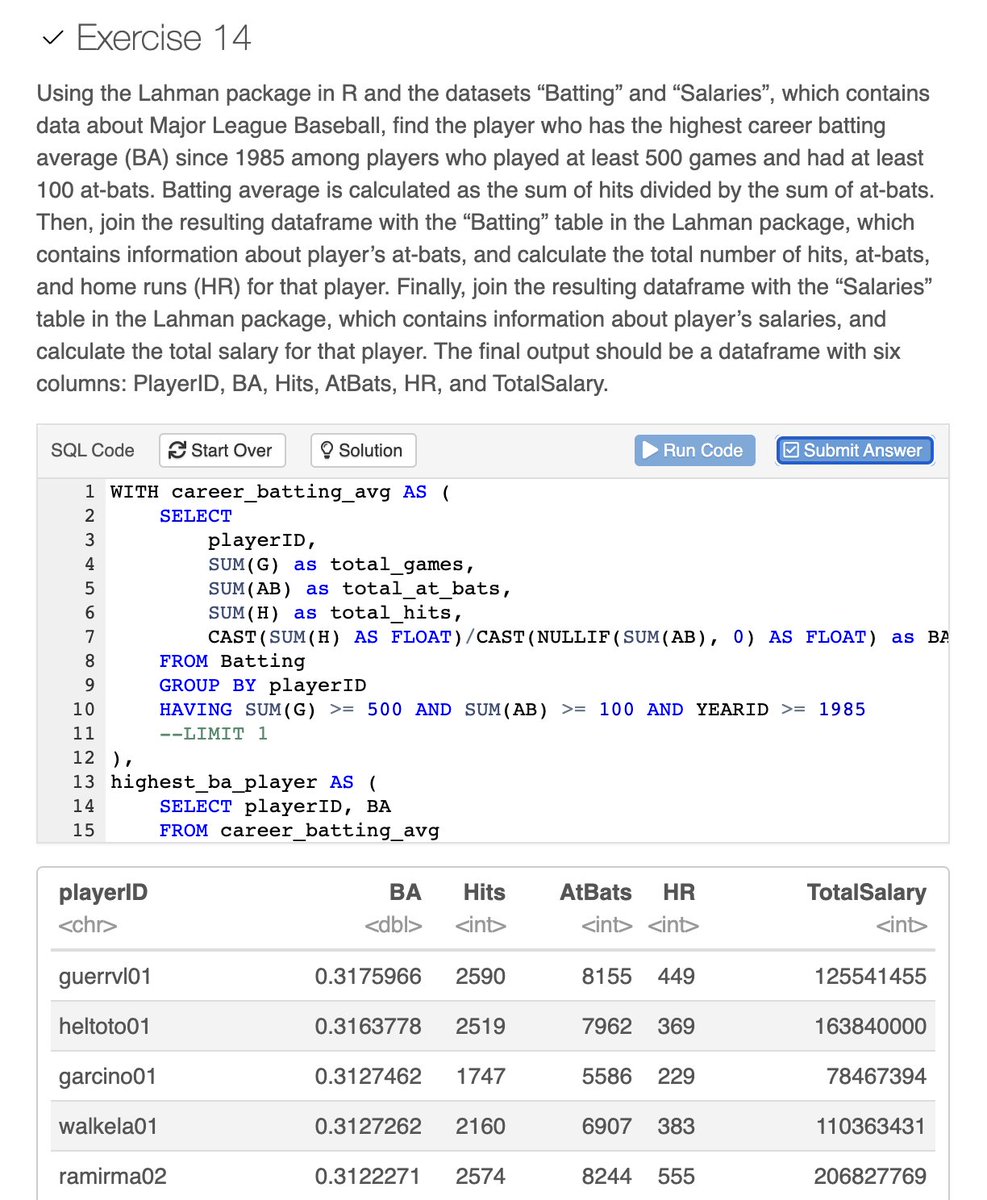
(4/4) The problems range in difficulty from basic filters and group by’s to multi-step transformations. Working through these problems with a timer is a great way to prep for technical data analyst interviews.
We hope Wrangle helps you on your data science journey!
***New tool for learning data science***
TLDR: @LathanLiou and I created Wrangle (https://t.co/l7PsUH1IFi)
(1/4) The demand for data analyst roles right now is huge. I recently opened a role on my team — we got 500 applications in 2 days, and another 700 in the first week.
(3/4) That’s why @LathanLiou and I created Wrangle (https://t.co/l7PsUH1IFi), an online practice area with 100+ problems in SQL and R for candidates to build their data wrangling muscle.
We looked at how LLMs answered hundreds of clinical questions posed by Stanford physicians — check this out if you are thinking about using ChatGPT for clinical reasoning /decision making
how well do LLMs serve clinical information needs at the bedside?
we sought to answer this question as a group of physicians, trainees, AI researchers, and technologists @StanfordHAI
the good news? 91% of answers were safe.
the bad news? read on 👇
https://t.co/EwsXey7YxU
@RoxanaDaneshjou You’d need to prospectively validate via silent deployment for an algo that shapes tx. Performance drops might need to be defined globally to account for site-specific dataset shift. Could do what EMA does and grant conditional approval pending multisite prospective validation
When picking a career in medicine we often don't consider "counterfactual impact" -- a doctor who saves 100 lives/year has low counterfactual impact if there was another equally competent doctor ready to take their job
a 5-min interactive course on this:
https://t.co/fuCjRceU7N
The @HappierLivesIns's charity recommendation for 2022 is @MakeStrongMinds, a non-profit providing therapy for women in Uganda and Zambia struggling with depression.
Their methodology uses WELLBYs (wellbeing-adjusted life years) instead of QALYs/DALYs
https://t.co/mDtvjBkAWi
10. Big Philanthropy (eg. Gates Foundation) / venture capital (high impact potential, very high variance) -- this is all about resource allocation, essentially charitable giving on a meta-level
I recently came across this post from High Impact Medicine that talks about the social impact of various career paths within medicine. Here are the career paths they cover along with their "impact rating", as well as a few others they didn't cover
https://t.co/bNABw1gjTH
9. for-profit entrepreneurship (very high impact potential, very high variance) -- can include leading a large health system, commercializing a high impact medical product