$IREN In a new research note, Canaccord analyst Joseph Vafi raised his price target from $70 to $79.
Vafi, who ranks among the top 3% of Street stock experts, maintained a Buy rating on the shares.
“IREN continuing to trailblaze even against an industry backdrop that is moving pretty fast in its own right,” the 5-star analyst effusively said.
Vafi’s praise comes in the wake of Monday’s announcement that IREN had secured a $3.65 billion investment-grade financing facility, which will fund the remaining capital expenditures needed to support its $9.7 billion multi-year AI Cloud Services agreement with Microsoft.
Notably, says the analyst, although financing conditions for AI-related infrastructure investments have become increasingly favorable, IREN is the first company in the space to achieve investment-grade status, earning ratings of A from Fitch and A(low) from DBRS. While Vafi points out that those ratings were undoubtedly supported by its Microsoft contract, the significance for future fundraising efforts should not be sniffed at.
Investment-grade status gives IREN access to a much larger pool of capital than is typically available through high-yield debt or convertible equity financing. “We believe the rating agencies analyzed a number of factors here, including not only the creditworthiness of MSFT as an offtake partner, but also IREN’s track record to date in delivering AI cloud services” Vafi sent on to say. “We also believe the forecasted cash flows from this project also support this rating.”
With financing for the Microsoft project now secured, Vafi revised his return analysis upward, reflecting stronger-than-expected economics. IREN secured up to $3.65 billion in funding at SOFR (Secured Overnight Financing Rate) + about 2.2%, which was below his prior cost of capital assumptions and improved the project’s return profile. SOFR is a US benchmark interest rate that reflects the cost of short-term borrowing secured by US Treasury securities.
As such, he estimates "the project could generate an IRR (internal rate of return) of about 32% over the life of the Microsoft contract (5 years). If the GPUs remain useful for an additional two years beyond the contract and retain roughly half their original value, the seven-year IRR increases to about 36%. While the difference appears small in percentage points, IRR is a compounding measure, so even modest increases can translate into meaningfully higher total returns over time."
[PS Personally disagree on the IRR stuff ... but hey, I'm not a 3% top analyst !!]
IREN has announced a planned 800MW data center campus in Bundey, South Australia.
This marks IREN’s first announced Australian data center project and one of the largest in the Asia-Pacific region announced to date.
Learn more: https://t.co/3bOYCUG3pk
Cowen had a AI data center & power panel at their TMT conference in NYC. From the summary notes (Elias):
Demand
-Current demand described as "unprecedented" in size/scale; one operator already surpassed its aggressive 2026 leasing targets set in January
-Geographic broadening: Europe showing incremental strength, Asia seeing GW-scale deals (India specifically cited)
-Customer conversations shifting from near-term capacity to 5+ year horizon planning — structural, not cyclical demand
-No signs of speculative leasing: hyperscaler leases don't include power ramps, and sites reach full utilization shortly after delivery
Power — Primary Bottleneck
-Grid interconnection queues remain flooded with large load requests, many speculative
-Utilities responding with large deposits, letters of credit, and take-or-pay contracts to filter credible projects
-BTM and on-site generation increasingly treated as a requirement - either permanent or bridge to grid power
-Nuclear viewed positively but commercial deployment timeline remains distant
-Most projects today being architected around natural gas reciprocating engines or turbines, creating incremental pressure on gas pipeline access
-Battery systems, fuel cells, and solid-state transformers gaining traction - potential supply chain pressure building there too
Construction Costs & Labor
-Build costs now $13–19MM/MW depending on geography and scope, up from ~$12MM/MW pre-2H25
-Labor shortage acute: electricians, HVAC techs, general contractors, and sub-contractors all in short supply
-Industry shifting toward modular/prefabricated solutions to reduce on-site labor dependency and compress deployment timelines
-Operators have raised pricing to reflect higher construction costs and cost of capital but development spreads held stable, prioritizing long-term customer relationships over near-term margin
NEWMARK: AI DATA CENTER DEMAND COULD REQUIRE 250 GW OF INFERENCE CAPACITY
Data center capex projections nearly doubled among the 14 largest publicly owned data center operators to $800B as of Feb 2026
$NBIS $CRWV $IREN are listed in the in the report
New Era Energy & Digital ($NUAI): A bull case for an AI-infrastructure story the market is still underestimating
NUAI is a re-rating in progress. A former Permian Basin E&P that has pivoted into large-scale AI/HPC data-center development, the company is systematically retiring the legal and capital-structure overhangs that have kept institutional capital on the sidelines — while the equity still trades closer to the baggage than to the platform underneath it. The setup is the familiar small-cap asymmetry: a genuinely scarce underlying asset priced at a discount to its de-risked value because the market has not yet marked the clean-up to par.
The asset is Texas Critical Data Centers (TCDC), a ~492-acre campus in Ector County, Texas, with ~650 MW of capacity secured and a design that scales toward 1.4 GW. The thesis in one line: management is clearing overhangs faster than the stock has repriced, while assembling the financing, operating, and commercial partnerships needed to convert powered land into contracted, project-financed cash flow. The sections below lay out the de-risking, the platform being built against it, the capital-markets catalysts, the Street's early valuation work — and, in fairness, what has to go right for the gap to close.
The defense: clearing the overhangs
Sharon AI is gone — and paid in cash. The single largest structural overhang was NUAI's partnership obligation to Sharon AI in the TCDC joint venture. That chapter is now closed. NUAI consolidated full ownership of TCDC, and on April 24, 2026 it repaid the remaining $50 million senior secured convertible note to Sharon AI entirely in cash, plus accrued interest — eliminating the conversion-driven dilution that had been hanging over the share count. Total consideration on the buyout came in around $74 million, and crucially, Sharon AI retains no ownership, governance, or control rights in the campus. A messy, two-headed JV became a clean, wholly owned flagship.
The ATW structure has been de-risked. Earlier in the year the company scrapped a planned convertible preferred issuance — exactly the kind of variable-priced instrument that tends to grind small-cap charts lower — in favor of an amended waiver with ATW AI Infrastructure II that reset warrant exercise prices to a fixed $2.00. That converted a potentially toxic, open-ended dilution mechanism into a known, fixed-strike overhang that is now being worked down as warrants are exercised. It is not fully retired — there remain unexercised warrants on the books — but the shape of the dilution is dramatically friendlier than it was, and the worst-case path is off the table.
The New Mexico lawsuit is being settled. On May 28, 2026, the company announced a pending agreement that would dismiss every State of New Mexico claim against New Era — five claims in total — for a $1 million payment to the bankruptcy trustee, subject to court approval. The stock moved double digits in after-hours trading on the news, a sign of just how much the litigation cloud had been weighing on sentiment. This removes the corporate legal overhang that had made many institutions reluctant to underwrite the story.
The offense: building a platform that can execute
Removing overhangs only matters if there's something worth de-risking. Since March, the moves on the offensive side have arguably been more important than the defensive ones:
A real CFO for a capital-intensive business. In March, NUAI brought on Ted Warner as Chief Financial Officer. This is not a generalist hire — Warner ran Northland Capital Markets' Energy, Power and Digital Infrastructure practice, which since 2023 has structured more than $7 billion of financing for large-scale data-center development. For a company whose entire value-creation path runs through project finance and capital partnerships, hiring a banker who has actually closed this exact type of deal is a tell.
Macquarie validated the asset. Also closed in early April: a multi-tranche senior secured term loan credit facility of up to $290 million with Macquarie Group, earmarked for the TCDC flagship. A blue-chip infrastructure lender does not extend a facility of that size against a project it hasn't diligenced. Combined with a $115 million registered equity offering, management reported $80 million-plus in cash as of April 30 — runway to actually execute rather than survive.
The bench is now stacked with hyperscaler-native talent. What had been a thin team is being built out quickly. On June 1, NUAI named Evan Pierce as Chief Development Officer and Michael Johnson as General Counsel and Chief Compliance Officer — and the pedigrees matter as much as the titles. Pierce spent two decades on the customer-and-infrastructure side of this exact business: most recently leading data-center site and energy development for the Americas at EdgeConneX, and before that in energy, utility-engagement and capacity roles at Amazon/AWS and ByteDance, with a hand in planning more than 5 GW of data-center and power infrastructure. NUAI effectively just hired someone who has sat in the hyperscaler's seat and knows exactly how these tenants evaluate sites and procure power.
Johnson, the new GC, arrives from CoreWeave and, before that, Switch — two of the most relevant names in the industry — bringing three decades of data-center leasing, powered-land acquisition, construction and financing experience. Pairing a heavyweight GC with a dedicated compliance mandate also signals a deliberate institutionalization of governance, which is precisely what an investor base wary of the litigation overhang wants to see. You don't recruit people like this to sit idle; you recruit them to paper a lease and build.
A Tier-1 operator and institutional capital are circling — and a hyperscaler appears to be steering. On April 1, NUAI signed a non-binding LOI to form a development-and-financing joint venture for TCDC with Stream Data Centers, a top-tier U.S. data-center operator, alongside an institutional capital partner. New Era contributes site control and local execution, Stream serves as developer and operator, and the institutional partner provides equity and arranges the bulk of project-level debt. Two details elevate this above a routine LOI. First, Northland's research describes the pairing as effectively brokered by the prospective hyperscaler tenant itself — the customer pointing NUAI toward the partners it wanted building and financing the site, which is a meaningful tell on intent. Second, Stream was acquired by Apollo Global Management in late 2025 at a valuation of roughly $40 billion, and the institutional partner is believed (per Northland) to be Apollo — putting some of the most credible capital in infrastructure behind the structure. It is still an LOI, not a signed definitive, but the roster is what turns a development concept into a financeable platform.
The power story is validated. What differentiates TCDC is not the dirt — it's the power. NUAI's "behind-the-meter" (BTM) thesis received concrete substantiation through a 450 MW behind-the-meter generation plan at TCDC developed with named partners Thunderhead Energy and TURBINE-X Energy. In a market where the binding constraint on AI buildout is increasingly electrons, not acres, a credible path to nearly half a gigawatt of on-site generation is the asset.
The hyperscaler is in advanced negotiations — over secured capacity, not a concept. The event that would re-rate the whole equity is a hyperscale lease. Management has described advanced commercial discussions with a top-tier, credit-worthy hyperscaler — realistically one of the big four cloud builders (Alphabet, Amazon, Meta, Microsoft) — for a campus with roughly 650 MW already secured and a path beyond 1 GW. The acquisition of an additional 54-acre corridor adjacent to Vistra and Calpine power plants was itself a milestone within those lease discussions. Timing is framed conservatively around fall 2026, and conservatism here is a feature given how the market punishes overpromising. The backdrop is favorable: recent hyperscale leases in the sector have printed in roughly the $140–190 per kW per month range (at least one recent deal involving Google reportedly reached ~$188), while the big four are guiding to historic 2026 capex — Alphabet to about $175–185 billion and Amazon to around $200 billion — as demand outruns deliverable power. In that environment, a power-secured, near-shovel-ready site is exactly what is scarce.
The invisible bid: a capital-markets function, finally resourced
Not every driver of a stock is a press release. For most of its life, NUAI was too small and too underfunded to run the kind of investor-relations program that institutional money expects — sustained institutional outreach, non-deal roadshows, analyst targeting, the steady cadence of being in front of the right funds. Those functions weren't broken; they were simply never staffed. That is changing, and the upgrade is visible in the hires themselves.
The company's investor relations now runs through OG Advisory Group, where the engagement is led by Lincoln Tan — who previously ran investor relations and marketing at IREN through precisely the kind of transition NUAI is now attempting (a power-and-mining story re-rating into an AI data-center story), and who came to IR from Macquarie Capital. Pair that with CFO Ted Warner, whose career was built structuring data-center financings on Wall Street, and the company has, arguably for the first time, a team explicitly equipped to court institutional capital rather than simply collect retail attention.
The practical implication is the kind of "invisible" activity that rarely makes headlines but steadily changes a stock's character: institutional meetings, conference presence (B. Riley in May, Datacloud in June), and the normal rhythm of roadshows and analyst engagement that turns a thinly followed micro-cap into a name long-only funds can actually own. As the shareholder base broadens and deepens, two things tend to follow — a higher-quality register and lower volatility — as price discovery shifts away from fast retail money toward investors underwriting a multi-year build.
This compounds with the de-risking. Every overhang removed — the lawsuit, the dilutive structures — is one less reason for a fundamental investor to pass and one less piece of "hair" on the story. The explicit catalysts get the headlines; this quieter professionalization of the capital-markets function is part of what lets them stick.
What the Street is starting to see
Sell-side coverage is one of the clearest signs the professionalization is working. In April, Northland Capital Markets initiated coverage with an Outperform rating and an $11 price target — against a share price barely above $5 at the time, implying roughly 2x upside. The logic is a staged, project-finance valuation: Northland credits only ~283 MW of TCDC capacity (Phase 1 plus half of Phase 2), assumes NUAI retains ~45% of the JV, applies a ~19x EV/EBITDA multiple in line with listed data-center peers, and discounts back on a ~125 million fully-diluted share count. Notably, that target deliberately excludes the back half of secured capacity, all of Phase 3, and NUAI's entire ~7 GW wholly-owned New Mexico pipeline (a ~3,500-acre Lea County site with a small-modular-reactor angle via a Last Energy partnership) — meaning the bull case carries option value the published target doesn't pay for.
NUAI now has its first real institutional research footprint, and a company running a proper IR program with a clean-up story to tell typically attracts more coverage over time. Additional analysts picking up the name through year-end — plausibly several — would broaden the buy-side audience and is exactly the kind of slow, compounding tailwind the "invisible bid" is built on.
The catalysts ahead
The next few weeks and months offer a dense sequence of potential catalysts:
Datacloud Global Congress, June 2–4, Cannes. President & COO Charlie Nelson is scheduled to speak at the industry's marquee gathering — the kind of room where hyperscalers, Tier-1 operators, and institutional capital allocators are all present (in fact, the hyperscalers, Stream, and Apollo are all present). For a company in active lease and JV negotiations, the value of being on that stage, at that moment, is hard to overstate.
A Stream JV definitive agreement converting the LOI into something binding.
A hyperscaler lease, the single highest-impact event in the story.
Expanding analyst coverage. With one Outperform initiation on the board, additional firms picking up the name — potentially several by year-end — would deepen the institutional audience.
A still-growing team. The June 1 additions of a chief development officer and general counsel are likely an opening move, not the finish; further senior hires would keep signaling that management is staffing for execution and often front-run bigger announcements.
The picture
Step back and the pattern is consistent: every quarter, if not every month, a structural negative has come off the board and a structural positive has gone on. Sharon AI — cleared. The toxic-preferred path — scrapped. The state lawsuit — settling. In their place: a Macquarie facility, a Tier-1 operating partner, a validated power plan, a CFO and now a development chief and general counsel drawn straight from the hyperscaler and data-center world, and an $80 million-plus cash cushion. The market tends to discount a stock for its overhangs right up until the moment they're gone — and then re-rate it for the platform underneath. With the first sell-side target sitting at roughly double the recent price and explicitly excluding most of the pipeline, the gap between where NUAI trades and what a leased, financed platform could be worth is the heart of the opportunity. NUAI is converting overhangs into catalysts on a remarkably steady cadence.
$NUAI announced the appointments of Evan Pierce as Chief Development Officer and Michael Johnson as General Counsel and Chief Compliance Officer.
Together, they bring leadership experience from EdgeConneX, AWS, CoreWeave and Switch, further strengthening New Era's capabilities as it advances its digital infrastructure and power development platform.
Read More: https://t.co/qTC8W7oC0T
IREN has closed a $3.65bn investment-grade GPU financing facility to support the delivery of its AI Cloud contract with Microsoft. This represents the highest publicly rated investment‑grade GPU financing and the first in the U.S. private placement market.
@danroberts0101, Co-Founder and Co-CEO of IREN, said:
“Securing investment-grade financing on these terms reflects both the quality of our customer contracts and the fact that we own the data center infrastructure these GPUs run in. That combination broadens our access to institutional capital and lowers our cost of capital as we scale.”
Learn more: https://t.co/TYepQTBXSQ
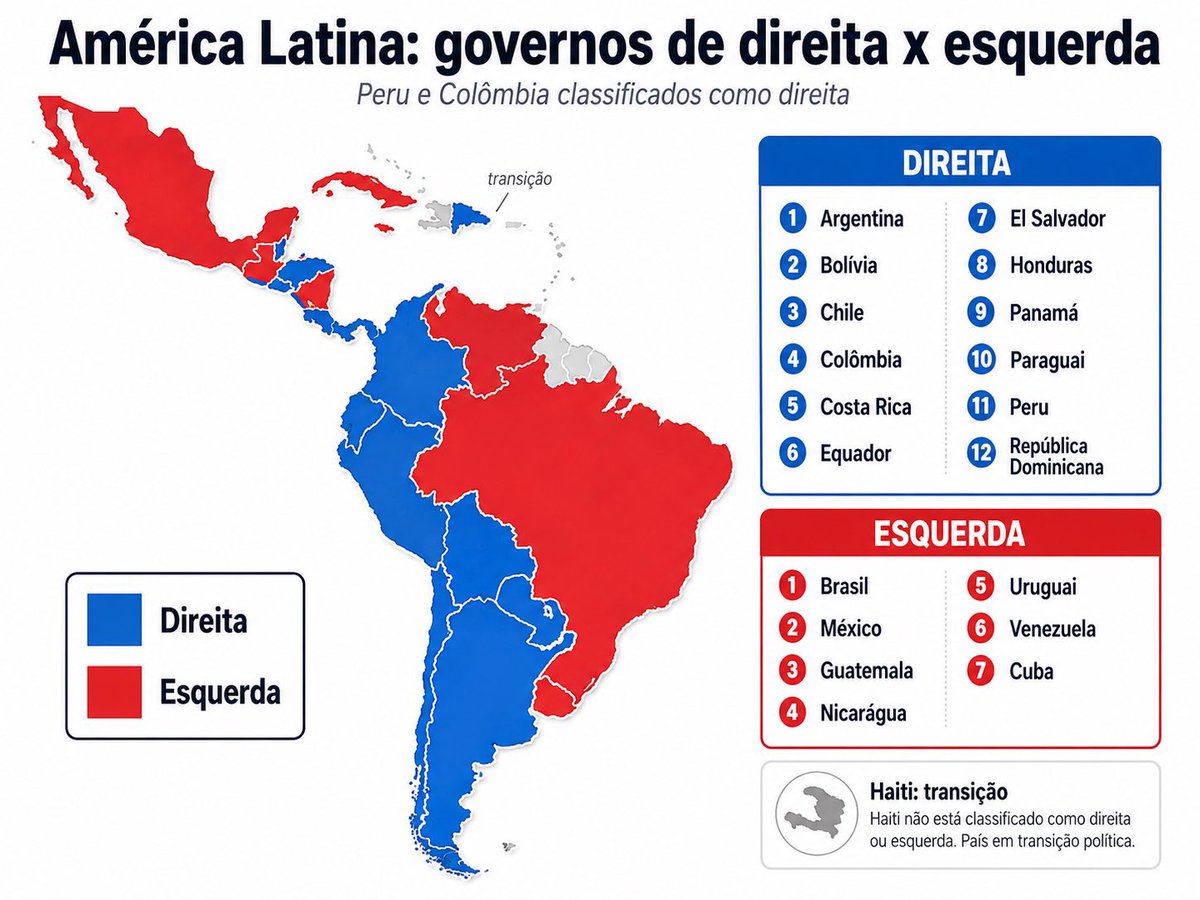
Colombia was next.
A watershed moment for Latin America’s political and economic landscape.
Latam will likely be one of the defining investment opportunities of the next decade, in my view.
https://t.co/Is7jpMcuj7
El Financial Times cuenta hoy que en Bruselas preocupa la base industrial que China está levantando en Marruecos. Tiene sentido que preocupe. Marruecos está a un ferry de España y está vendiendo algo que Europa ya no sabe vender: energía competitiva, puertos, permisos, suelo, mano de obra y ganas de fabricar. China no necesita conquistar Europa con tanques. Le alcanza con construir las fábricas que Europa no deja construir. Baterías, coches, componentes, química, logística. Todo lo que sostiene la prosperidad real. Luego el producto cruza el Estrecho y entra al mercado europeo mientras Bruselas celebra otra directiva sobre soberanía industrial. La industria no se instala donde hay mejores discursos. Se instala donde producir es posible. España podría estar capturando una parte enorme de esa ola. Tenemos sol, gas, puertos, talento, cercanía a África y acceso al mercado europeo. Pero entre impuestos, permisos, política energética errática y odio al empresario, regalamos la oportunidad. Marruecos no está esperando a que Europa despierte. China tampoco.
Model Release: AI Cloud & Colocation
We just released the in-house developed infrastructure model behind our $IREN work.
It lets you replicate any AI cloud or colocation lease and gives you exceptional insights into the economics of your favorite AI/HPC stock.
We have been developing and refining this model for well over 6 months, and we genuinely believe it is one of the most powerful tools out there for breaking down the economics of any AI cloud or colocation deal.
In this thread I'll walk you through everything there is to know. 🧵
$IREN’s new Innovation Officer
A few months ago, $IREN appointed John Gross as their new Chief Innovation Officer, a role in which he'll be pivotal to the development of the company's AI data centers.
The Wall Street Journal recently ran a piece on him that I think is worth commenting on.
Gross specializes in high-density & liquid cooling infrastructure, with over 20 years of experience in the space. That makes him a critical hire for $IREN, given their emphasis on designing & developing all data center infrastructure in-house.
What I particularly found interesting about the WSJ article is that it goes into Gross's approach and philosophy.
He comes across as a very hands-on guy and not some office dweller. He likes being on the ground where the actual liquid cooling tech is being installed and tested, working together with construction crews to fix problems that can't always be foreseen months in advance.
Great to see $IREN's CIO with this kind of attitude. Getting his hands dirty when he needs to and leaving his ego at the door. He's clearly all about pushing $IREN forward and getting things done.
He also pushes back pretty directly against the industry default, which has historically been very risk-averse.
He says the industry “loves innovation as long as it’s 10 years old”, which is pretty funny.
That risk-averse, slow mindset clearly doesn’t work in AI, where chip generations turn over every 12-18 months and thermal envelopes keep climbing.
This kind of attitude combined with $IREN's broader culture is what makes them a disruptive force in the industry that can really challenge the status quo.
Gross also called AI data center tech a bit of a poker game. You can't sit on the sideline waiting for the chip roadmap to be 100% clear, you have to read what's coming and place your bets early.
$IREN has clearly been great at this. Horizon was designed early last year to be future-proof for next-gen chips, more than a year before the official Rubin specs came out. Back then estimates were that Rubin would require densities of ~300 kW per rack, so $IREN's 200 kW design may have looked inadequate initially.
They were obviously proven right...
I know $IREN execs had a very tight relationship with $NVDA well before the official partnership was made public.
That kind of access gives you early visibility into where the industry is heading years in advance, and that's exactly where close ties to $NVDA pays dividends as it relates to developing next-gen infrastructure.
Gross also commented on $IREN's iterative improvement loop, where lessons from each build feed back into the next design cycle.
This reminds me very much of what David Shaw, $IREN's Chief Operating Officer, told me about a year ago when I visited the Childress site with @FransBakker9812 and a few other friends.
Shaw and the other ops execs really emphasized the same design and development philosophy of replication and continuous improvement.
Every individual new build is slightly different from the last as the team implements lessons learned from the previous one. That will mean Horizon 2 will have improvements over Horizon 1, Horizon 3 over Horizon 2, and so on.
The advantage of that approach is that it directly leads to faster, cheaper, and more robust builds, which is a critical trait when you're developing a gigawatt-scale data center portfolio.
This isn't something they started doing recently either. It has been part of the company's DNA since day one.
It only works because of $IREN's very flat hierarchy and very healthy work culture, which encourages every construction crew member to spot flaws or find better ways of doing things.
This is also how they managed to bring the development cost per MW of their air-cooled data center shells down from $750k/MW to $600k/MW.
Going forward this is going to be one of the key competitive differentiators.
While other neo-clouds heavily rely on a patchwork of developers across their data center pipeline, $IREN is the head contractor on 100% of their projects.
The amount of operational experience they'll accumulate as they rapidly scale will become unmatched and very difficult to catch up to.
I also must say, this WSJ article is a real win for $IREN on the IR and marketing front, and they deserve credit for setting it up.
The company's comms had undoubtedly been pretty weak leading up to the recent earnings call, but over the past 3 weeks they've gotten noticeably better imo.
From the CEO’s mega thread here on X that cleared up a lot of confusion to now this WSJ collab… these are real positive moves from the team and they're worth praising.
Overall the WSJ piece does a great job giving us good visibility into Gross himself and his role at $IREN, as well as the company's broader strategic positioning.
I really enjoyed going through it. Definitely worth a read.
https://t.co/l64Kd3IVIC
SITUATION EXPLAINED: Is Peter Thiel moving to Argentina?
• He recently attended River Plate vs Boca Juniors, Argentina's most storied soccer match
• Hired a local art dealer to furnish his home
• Hosted intellectuals and economists at his mansion to discuss "Argentina and the Antichrist"
• Argentine government is exploring offering him permanent residency or citizenship
• Also bought land near Punta del Este, Uruguay
Peter Thiel is a citizen of Germany (by birth), then the US and New Zealand. Argentina would be the fourth.
My conversation with @DanielSLoeb1, his first ever podcast and one I've been wanting to do for years.
Dan started Third Point in 1995 with $3 million. Today the firm manages over $24 billion across equities, credit, venture, and insurance.
Along the way he wrote some of the most iconic activist letters.
We discuss:
- Why deep value stopped working
- The power of writing
- The Twitter and XAI credit trades
- Lessons from FTX and Danaher
- The Sony and Sotheby's stories
- What makes a great analyst today
- The importance of kindness
I feel lucky we all get to learn from one of the greats.
Enjoy!
Timestamps:
0:00 Intro
2:48 Macro Views and Tech Trends
5:13 The Roots of Third Point
10:30 Evolving to Quality and Thematic Investing
19:07 Market Psychology and Inefficiencies
24:10 Good and Bad Corporate Governance
29:19 Activism
31:23 Sotheby's
41:37 AI
44:28 Sony
52:50 Danaher's Operating System
56:31 Building an Insurance Business
59:25 FTX
1:05:17 What Makes a Great Analyst Today
1:07:24 The Next Decade
1:10:00 Kindest Thing
$NUAI
This has been one of my larger positions all year but I boosted further AH when I saw this PR. Unless you have done a lot of homework on this company, you have no idea how much value resolution of this legal matter with New Mexico can release. It’s VERY significant imo.
And as I’ve said before, @FuzzyPandaShort gonna look like an idiot by the time the fall rolls around!
This remains an event driven investment with the next catalyst hopefully being an executed lease sometime this summer 🤞.
Next $APLD in the making right here but with a very unique capital light model that will allow them to scale beyond TCDC rapidly.
https://t.co/5uMnF35kFS
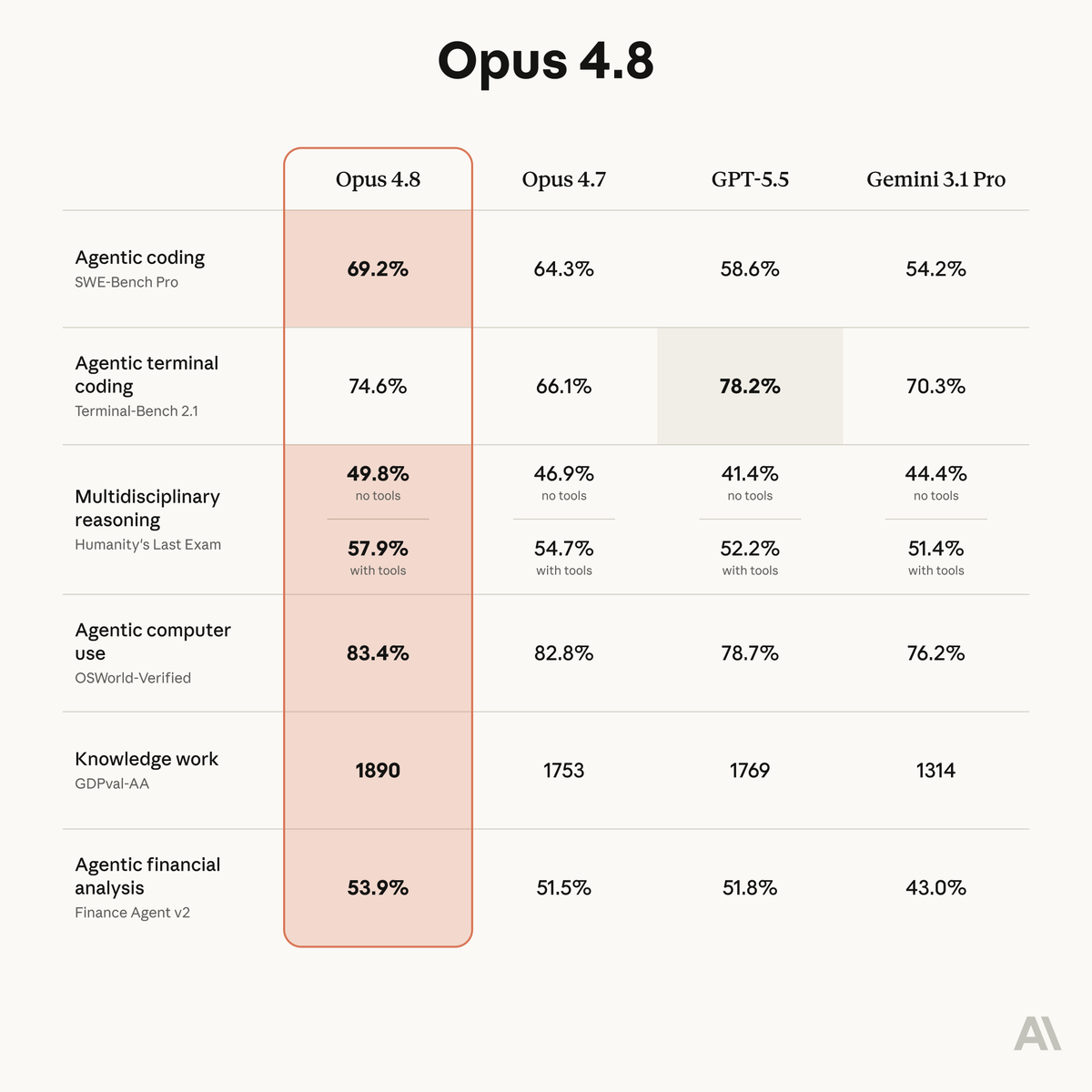
Introducing Claude Opus 4.8: it builds on Opus 4.7 with sharper judgment, more honesty about its own progress, and the ability to work independently for longer than its predecessors.
Available today at the same price.