Changes in a blood marker called NfL may offer important clues about how ALS is progressing and whether a treatment is providing clinical benefit: https://t.co/2uXVxdMDLj
New analyses found that people whose NfL levels declined or remained stable tended to have better survival and functional outcomes, while rising NfL levels were not linked to the same benefit. Researchers also found a similar relationship between NfL changes and survival in more than 2,000 people with ALS who had not received the experimental treatment.
The findings add to growing interest in NfL as a potential biomarker that could help researchers better understand disease progression and evaluate whether treatments are making a meaningful difference.
#ALS #ALSResearch #NeurofilamentLightChain #ALSNewsToday #Bionews
Novel tx for Myositis : After IVIG (ProDERM by Octapharma) & Brepocitinib (Valor by Priovant) in DM, for the first time we have highly positive phase 3 trial for IMNM & DM. Efgartogimod SQ (anti-FcRN) showed significant improvement in IMNM & DM vs. PBO.
https://t.co/LbiCC7YBzf
A three-step method to evaluate a patient presenting with a wrist drop:
1. Arm position. Before assessing strength, place the patient's forearm and hand on their lap or another surface. The dropped wrist position (wrist hyperflexion) creates a biomechanical disadvantage for the forearm flexors and intrinsic hand muscles, often leading to an exaggerated perception of muscle weakness.
2. Identify which muscles are weak. In a central wrist drop, both the forearm flexors and intrinsic hand muscles are also weak. In a peripheral wrist drop, muscle strength of these muscles is usually normal, as radial mononeuropathy is the most common cause.
3. Make a fist. With the wrist dropping, instruct the patient to make a fist. If the wrist extends during this movement, it confirms a central lesion. In peripheral wrist drop, wrist extension either worsens or remains unchanged; it never extends. Wrist extension occurring with finger flexion is a synkinesia and hallmark of central wrist drop (video).
https://t.co/Vpu43hfcnT
The preliminary results of the open-label phase of the Efgartigimod (FcRN inhibitor) trial (ADHERE+) for Chronic Inflammatory Demyelinating Polyradiculoneuropathy (CIDP) have been published. https://t.co/CTfUgMDG3e
The primary findings are that, when patients initially respond to Efgartigimod, their response is maintained and the drug is safe.
During this phase of the trial, it was permitted to extend the intervals between injections if patients remained stable for more than twelve weeks, initially to every two weeks and subsequently to every three weeks. A detailed analysis of the dose spacing has not been published, which is disappointing.
However, based on pharmacokinetic data, we know that immunoglobulin G suppression with Efgartigimod is approximately equivalent when administered weekly or every two weeks, and I have not had any problems with the patients I have done that with. You can find a detailed analysis of the ADHERE trial 👇👇
I often observe residents and fellows practicing medicine as if “anything is possible” rather than focusing on what is most likely. The fear of missing something is common among them, and I believe artificial intelligence is making this worse.
We must continue to rely on our greatest strength: clinical reasoning. Every diagnosis should be based on the time course (tempo), clinical syndromes, and key associated features (for neuropathy: autonomic dysfunction, family history, medication list and systemic signs).
AI should be used to narrow the differential diagnosis and guide appropriate tests for the most likely conditions, but not to test every possible cause.
It is July, I’m staffing the PN clinic and once again, it is essential to emphasize to the new PN/NM fellows the critical role of the clinical phenotype in diagnosing peripheral neuropathies.
NCS/EMG are valuable, but the neurological exam is the most important (as it should be in neurology but many have forgotten).
This is the neuropathy clinical phenotype classification I find the most helpful:
1-Isolated small fiber neuropathy
2-Length-dependent peripheral neuropathy (or distal symmetric polyneuropathy)
3-Multiple mononeuropathies
4-Mononeuropathy
5-Asymmetric neuropathy
6-Polyradiculoneuropathy
7-Plexopathy (brachial or lumbosacral, many times a radiculoplexus neuropathy)
8-Sensory neuronopathy
9-Motor neuronopathy
I always tell my trainees they don’t have to memorize the causes of each phenotype. If you define the syndrome correctly, you can ask a Chatbot what are the most likely causes. If you add the time course (tempo), presence of autonomic dysfunction, presence of systemic features (weight loss, rashes, fever, night sweats, or anasarca), comordities and response to immunotherapy, the chatbot will provide you an expert level discussion and differential.
1- Isolated Small Fiber Neuropathy
-Pure small fiber neuropathy.
-Only temperature and pinprick dysfunction on exam.
-Ankle reflexes must be normal in patients < 60 yo.
-NCS must be normal for age.
2- Length-dependent peripheral neuropathy (or distal symmetric polyneuropathy)
-Sensory predominant neuropathy, can also have motor involvement, distal predominant, worsens in an ascending length-dependent fashion: foot->leg-> hands/knee->elbow/anterior abdomen.
3- Multiple Mononeuropathies
Involvement of two or more non-contiguous (separate) motor, sensory or sensorimotor peripheral nerves.
4- Mononeuropathy
Involvement of a single sensory, motor or sensorimotor peripheral nerve.
5-Asymmetric neuropathy
It’s the pattern of overlapping multiple mononeuropathies.
Length-dependent polyneuropathy (distal predominant) involving bilateral extremities in an asymmetric fashion demonstrated by at least one grade of motor power difference by the Medical Research Council strength scale, more than 50% difference in sensory testing and involved individual nerves could not be identified separately.
6-Polyradiculoneuropathy
Proximal and distal weakness and sensory loss in the four limbs.
Can be distal>proximal; distal=proximal or distal<proximal.
7- Plexopathy
-Proximal and distal weakness in a single limb with decreased/absent reflexes and sensation loss (can be only proximal or only distal in brachial plexopathies; and of course can be bilateral).
- On exam can look like a radiculopathy or multiple radiculopathies.
-Plexopathies usually have more dense sensation loss than radiculopathies and may cause alodynea (pain caused by non-painful stimulus) which is rarer in radiculopathies.
8- Sensory Neuronopathy or Ganglionopathy
-The cell body of the sensory neurons are affected, usually asymmetric and affecting distal and proximal limbs, patchy, can affect the face or whole body, must have sensory ataxia and preserved strength.
- Can be accompanied by pseudoathetosis.
9- Motor neuronopathy
-Pure motor syndromes.
-The body of the motor neurons are affected.
-Usually asymmetric and distal predominant, accompanied by atrophy, fasciculations, decreased/absent reflexes (can also have upper motor neuron signs) and normal sensory exam.
Great thread. I agree. My take-away is TTR stabilizers are really good, especially for early disease. We do the trials for a reason. Ever since the ATTR-ACT results (which surprised many), the redesign of the planned silencer trials has been problematic.
In a new review in @ANAneurology’s Annals of Neurology, we propose a new term, “stocking-glove-hat,” to highlight the risk of cognitive problems and potentially dementia in people with diabetes who have peripheral neuropathy.
@TheSciGency
https://t.co/1BB73JhaMm
نعتني بصحة المرأة في جميع مراحلها، برؤية طبية متكاملة تجمع بين الخبرة والدقة في التشخيص والعلاج، مع نخبة من أفضل أطباء أمراض النساء والولادة وطب العقم وأطفال الأنابيب في مستشفى د. سليمان فقيه بالرياضنعتني بصحة المرأة في جميع مراحلها، برؤية طبية متكاملة تجمع بين الخبرة والدقة في التشخيص والعلاج، مع نخبة من أفضل أطباء أمراض النساء والولادة وطب العقم وأطفال الأنابيب في مستشفى د. سليمان فقيه بالرياضنعتني بصحة المرأة في جميع مراحلها، برؤية طبية متكاملة تجمع بين الخبرة والدقة في التشخيص والعلاج، مع نخبة من أفضل أطباء أمراض النساء والولادة وطب العقم وأطفال الأنابيب في مستشفى د. سليمان فقيه بالرياضنعتني بصحة المرأة في جميع مراحلها، برؤية طبية متكاملة تجمع بين الخبرة والدقة في التشخيص والعلاج، مع نخبة من أفضل أطباء أمراض النساء والولادة وطب العقم وأطفال الأنابيب في مستشفى د. سليمان فقيه بالرياض.
Introducing our Plenary Lecture Speakers!
We are excited to welcome these inspiring voices who will share their expertise, insights, and vision for the future of our field.
Introducing our Education Course Speakers!
Join leading experts as they discuss the broader concepts, challenges, and advances shaping the peripheral neuropathy field.
We hope you are as excited as we are!
The @Neurodiab_eu Youth Committee continues to make remarkable strides. Don't miss their innovative review article, born from a lively debate on whether diabetic neuropathy can be reversed. It’s open access! https://t.co/bMOWYS6nrE
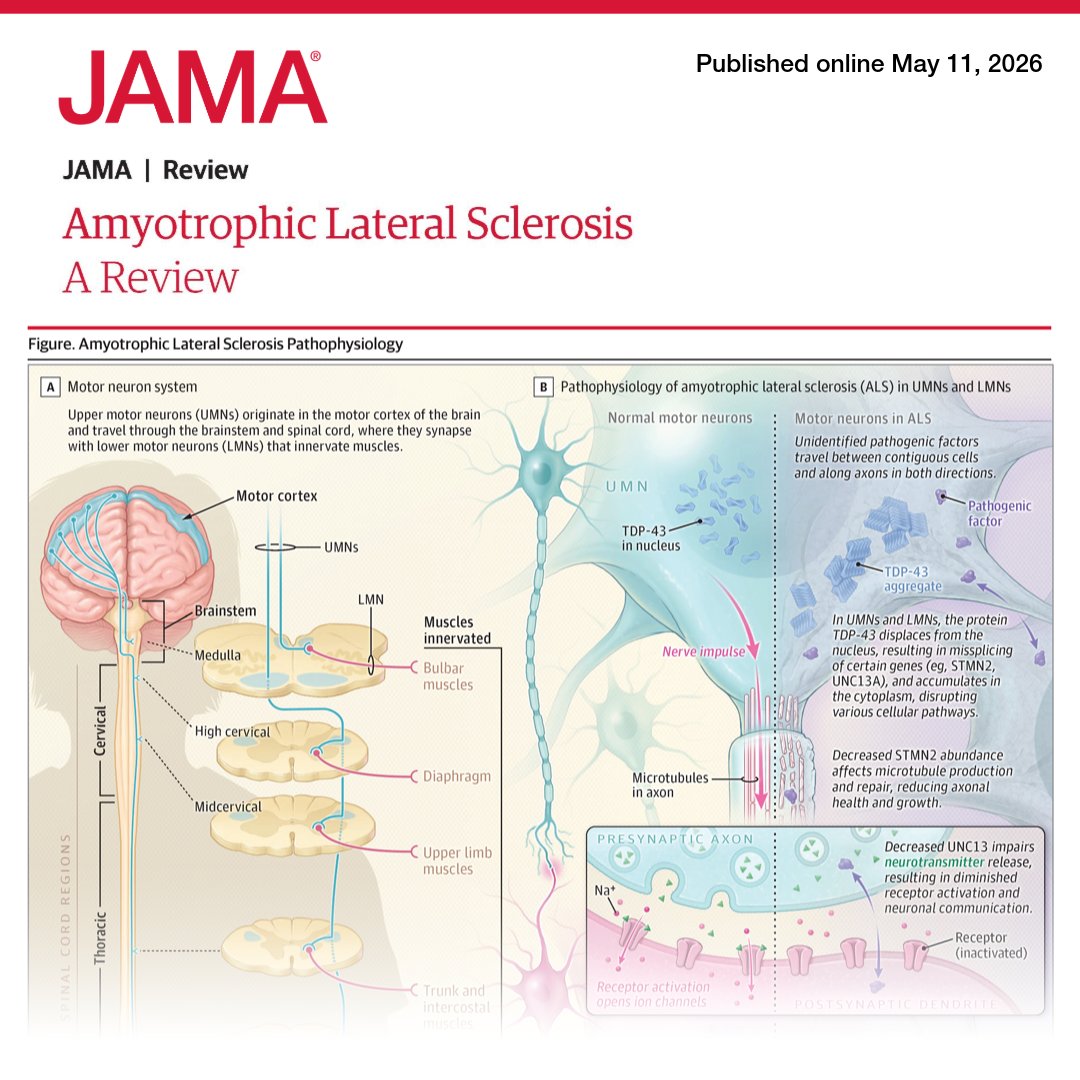
La revisión de hoy de Esclerosis Lateral Amiotrófica (ELA), una interesante y fatal enfermedad en la que hemos avanzado... casi nada. De JAMA (2026). Puntos clave:
🔴 La sospecha inicial debe enfocarse en la coexistencia progresiva e indolora de signos de motoneurona superior (espasticidad, hiperreflexia, reflejos patológicos) y motoneurona inferior (atrofia, debilidad, fasciculaciones, hiporreflexia). Primero suele ser focal, pero se disemina con el tiempo.
🔴El diagnóstico sigue siendo predominantemente clínico. La electromiografía es la herramienta de apoyo principal para demostrar denervación activa y reinervación crónica, pero sobre todo, es vital para excluir diagnósticos diferenciales (miopatías, neuropatías, miastenia). No existe ningún biomarcador diagnóstico definitivo.
🔴 Idealmente incluir paneles genéticos a todos los pacientes diagnosticados con ELA, no solo a los que tienen historia familiar. Aunque el 85% de los casos son esporádicos, identificar variantes genéticas es importante. El gen SOD1 tiene una diana terapéutica ya.
🔴 Hay +60 genes asociados a la ELA, pero el hallazgo neuropatológico en 97% es la mislocalización nuclear y la agregación citoplasmática de la proteína TDP-43
🔴 Sigue siendo fatal con una supervivencia de 3-5 años. Los fármacos orales aprobados (Riluzol y Edaravona) ofrecen un beneficio clínico apenas marginal. El manejo sintomático mediante equipos multidisciplinarios impacta más en la supervivencia. Tofersén es prometedor, una terapia antisentido intratecal que disminuye la progresión exclusivamente en el subgrupo de pacientes con mutación SOD1.
Pueden leerlo completo en el canal (https://t.co/3O93s10Td0).
From JAMA: Amyotrophic lateral sclerosis (#ALS) is an adult-onset neurodegenerative disorder characterized by progressive muscle weakness due to degeneration of upper motor neurons in the brain and lower motor neurons in the brainstem and spinal cord.
https://t.co/VvFlo5RKbX
هل تعلمون انه فيه ملفات طبية للأمراض الوراثية في مستشفى معين بأسماء عائلات محددة تنتشر فيها الأمراض الوراثية المتنحية بسبب زواج الاقارب وتسمى حالاتهم بالأثر المؤسس لانها نتاج الزواج الداخلي ؟؟ طيب هل تعلمون ان حالات اضطرابات النمو في زواج الاقارب تصل إلى 75% مقارنة بنسبة 4% في المجتمعات التي لايوجد بها زواج أقارب ؟؟
*ملاحظة مهمة : الأمراض الوراثية المتنحية الأخرى الناتجة عن زواج الأقارب كثيرة جداً ولا تُكشف بتحليل الزواج .
في أسبوع تجربة المرضى لعام 2026، #التخصصي يواصل جهوده لتعزيز جودة الرعاية الصحية وتقديم تجربة إنسانية متكاملة ترتكز على احتياجات المرضى وعائلاتهم، من خلال تمكين الكوادر وتطوير بيئة عمل داعمة تعزز التميز.
Hot off the press! Nerve biopsy is more sensitive than fat aspirate and skin biopsy for amyloid diagnosis in symptomatic ATTRv peripheral neuropathy (95% vs 48% and 53%). Great @MayoClinicNeuro enterprise collaboration and strong work from Mayo MS4 and incoming @UVANeurology star resident @APanrudkevich . @GreenJournal https://t.co/689eniGuQh