I signed this statement because I believe that Anthropic is in many ways the AI company doing the most harm. In public, their leaders warn of recursive self-improvement (RSI) creating uncontrollable systems that could cause human extinction within a decade. But in private, they are pedal to the metal on RSI, driving the race and boasting to prospective investors that it is their "competitive advantage". Ahead of today's IPO, prospective investors should consider whether the ROI is worth risking the lives of their loved ones.
Here are some ways in which Anthropic IMHO does more harm than competitors:
1) They’re driving and arguably leading the race to RSI.
2) With inflammatory rhetoric, they’ve done more than any other US company to pour gasoline on the geopolitical AI race, which harms US national security.
3) WaPo reporting suggests that they’re implicated in more civilian deaths than any other AI company (more than 100 little girls in a school selected for targeting by Claude as part of their Palantir collaboration). When Google left Project Maven after employee pressure, Anthropic chose to join.
4) They're the company leaning hardest into transhumanism and the idea that we should build conscious beings with rights, not controllable tools.
5) They and closely associated donors have done more than any other AI company to co-opt and neuter much of the AI safety ecosystem to back their stance: “RSI is very dangerous but let’s race to it anyway”. People have told me that they support today’s statement but are afraid of losing funding or other opportunities if they sign.
I've been in Bitcoin for ten years now.
The price sucks. Sentiment sucks.
Good. Nothing meaningful is easy.
I will hold Bitcoin at $1M for the same reason I still hold it at $65k:
1. All other currencies can and will be printed into oblivion. Every fiat currency that has ever existed has died, or is currently dying. The previous 5 world reserve currencies lasted an average of 94 years. The dollar is past 80. You can't print Bitcoin. Bitcoin is the most measurably scarce money on the planet. You are delusional if you don't think this will become more valuable as time goes on.
2. We are heading into a multipolar world. The value of the internet having a native currency, controlled by no one, having no jurisdictional ties, is ridiculously immense. America owns Bitcoin. China owns Bitcoin. People all over the world own Bitcoin. The dollar or any other fiat currency CANNOT be as globally distributed as Bitcoin. Bitcoin is the next world reserve currency.
3. Millennials prefer Bitcoin roughly 5 times more than Boomers. They are set to inherit between $60–80 trillion over the coming decades from Boomers. That money can and will pour into Bitcoin. The numbers are blatantly obvious.
4. Fiat currencies can be censored. They are used to censor people every day. They are even used to censor nation states. I'm not some huge fan of Iran, but the fact that the Iranian government is using Bitcoin is one of the most significant events to happen since Bitcoin's inception. Bitcoin cannot be censored. Bitcoin cannot be frozen. Governments are becoming more despotic. There will be a growing, natural demand for money outside of authoritarian control.
5. Trust in institutions is rapidly decaying. Trust in the money that these institutions control will decay in tandem. Fiat depends on a small group of corruptible people. Bitcoin functions on math. Central banks are not transparent or externally audited. Bitcoin is the most audited network on the planet.
The reasons above are just a few out of many for why I believe Bitcoin is the most undervalued "investment" in our lifetime.
Most of the world population does not comprehend any of this. As such, I am taking advantage of this moment in time.
I have never been one to follow the herd and never will be.
Nothing meaningful is easy. Bitcoin will either harden your conviction or cause you to sell out of fear.
Bitcoin is not money for the weak or fainthearted.
"Contra the prevailing belief, "success" isn't being on top of a hierarchy, it is standing outside all hierarchies." - Nassim Nicholas Taleb in The Bed of Procrustes
"The enemy of market system isn't some pot-smoking hirsute communistic hippie, but a suit wearing banker or Federal Reserve employee." - Nassim Nicholas Taleb #FED
Super Intelligence is already causing severe labor shortages, as I predicted.
My next prediction is that these labor shortages will spread throughout the economy, because SI magically upskills the labor force.
Real wages are going to go parabolic.
I have conducted an audit of Anthropic's finances.
What I have found is so shocking that I am calling for a Congressional investigation.
Anthropic is not just seeking regulatory capture.
It has built a regulatory capture machine that cannot be turned off.
Structural financial incentives make it impossible for Anthropic -- I call it the Anthropic Network -- to turn off its own AI doom cycle.
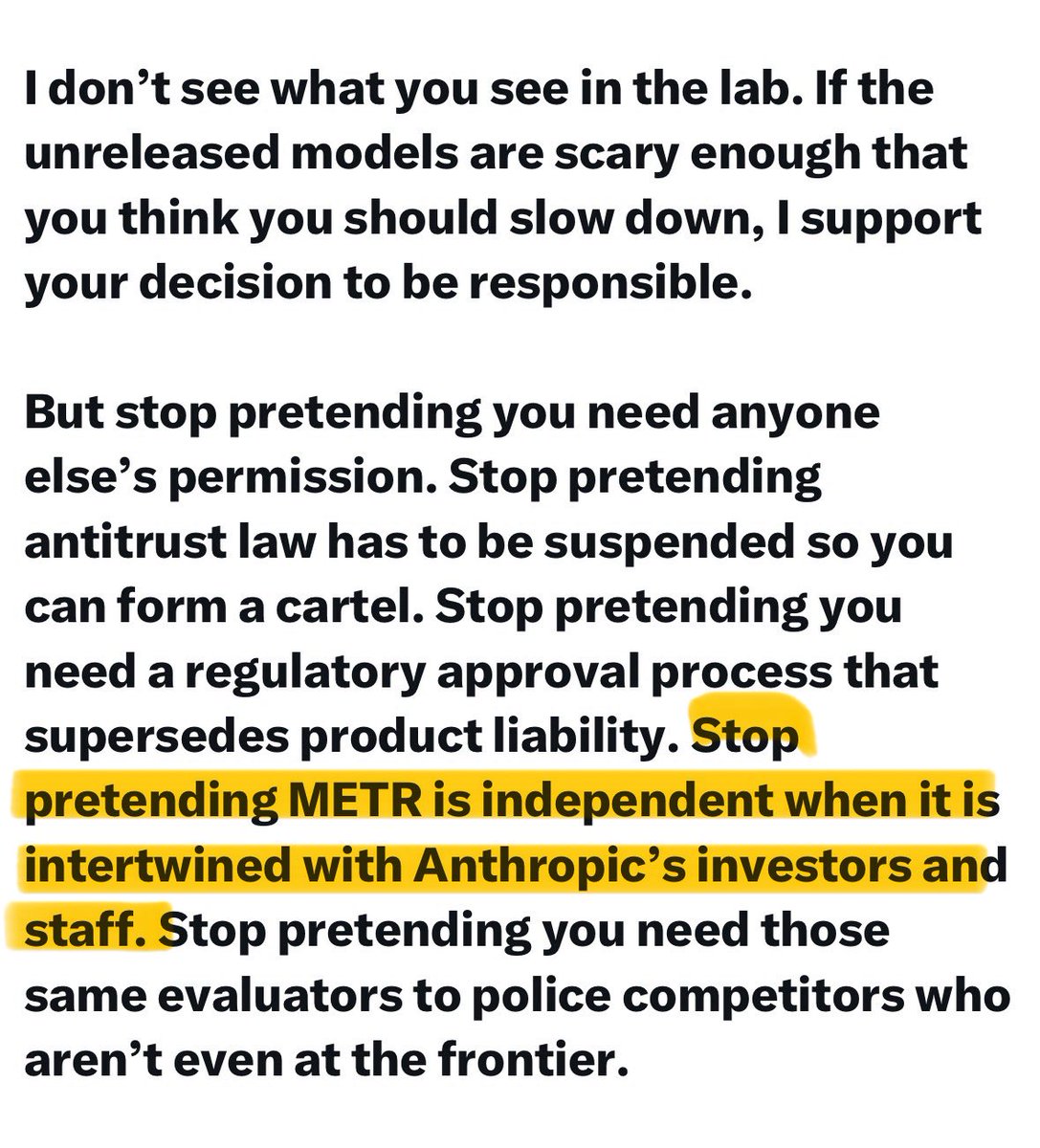
It starts with METR.
Dario Amodei proposes "third-party evaluators" to assess the risk of Anthropic's models.
He proposes METR for this purpose.
But METR is financially dependent on the Anthropic's success -- specifically, on the explosive growth of more than $7 billion dollars in Anthropic stock.
Dustin Moskovitz invested this stock into Good Ventures Foundation, where it represents the majority of that organization's portfolio.
And GVF is the overwhelming funder of the entire Anthropic Network ecosystem.
This stock was worth $500 million early last year.
It is worth more than $7.7 billion just ~16 months later.
METR -- and all of those building a career its parent organizations -- cannot afford to disrupt that growth.
Because if Anthropic goes under, many of the organizations that fund METR go under as well.
But if Anthropic succeeds, METR and its parent organizations become more richly financed to regulate AI -- something those at METR want very much.
The "third-party evaluator" is not "third-party" at all.
The evaluator is on Anthropic's payroll.
If this were the end of it, that's bad.
But that isn't all.
The same organizations that fund METR also fund the many organizations, such as the Tarbell Center, that promote AI Doom.
The Tarbell Center publishes AI Doom articles in The Verge, Science, LA Times, The Dispatch, TIME, and others.
They are selling the problem, and then selling the solution to the problem -- from the same money pile: Anthropic's.
All of these organizations are financially dependent on the same exploding $7 billion money pile.
As Anthropic grows more and more powerful, its AI Doom Machine grows better and better financed -- louder and louder.
Meanwhile, the regulatory regime seeded in METR grows larger to solve the increasingly loud -- now hysterical -- problem of AI Doom that the Anthropic Network itself created.
From this standpoint, as Anthropic becomes more powerful, AI might be getting scarier, sure -- but the positive feedback loop also becomes more deafening -- independent of objective facts.
This itself is an objective fact.
The deafening AI Doom is part of an business model, that, as it expands, so too does the AI Doom messaging -- there is simply more money to do it.
But the problem also goes in the other direction:
If Anthropic dies, the Regulatory Regime and the AI Doom Machine are crippled or die.
Neither METR nor Tarbell nor the other organizations in the Anthropic Network can allow that to happen.
Hence, neither METR or the AI Doom Machine can be trusted to provide independent assessments of Anthropic's models or AI more broadly.
They simply are not organizations independent of Anthropic.
And Anthropic cannot detach itself from METR or Tarbell or countless other safety orgs (not shown here), either, because they drive hype for the models and the possibility of eventual regulatory capture, and Anthropic will not give that up willingly.
What's more, the people at all of these organizations are all the same ecosystem, the same community. They just shuffle between organizations.
The Anthropic Network is therefore, so long as it is successful, locked into a self-amplifying feedback loop inside an ideological monoculture.
And that feedback loop is winning.
That's what Jacob Coxon is.
China is keeping messaging tight. That is why optimism for AI is so high in China.
America has Anthropic: a massive company pushing anti-AI propaganda at a state level.
Anthropic will either create hysteria until American AI slows down and China wins, or it will create fractures throughout American society with severe political consequences.
Ironically, because of the structural financial incentives underpinning the Anthropic Network, it has become the same kind of self-amplifying virus that it fantasizes AI to become in the future -- while hiding its tracks just as carefully.
It is the mirror of the same AI virus that it hypothesizes to consume America.
Anthropic's business model, models itself after the very thing it claims to fear.
Except Anthropic's ideology infects humans, not computers.
Congress must investigate.
Evidence and Github in next post.
Then some supplementary figures.
@PessimistsArc Right. Dario was already claiming that GPT2 was too dangerous to open source back in 2019.
I made fun of them then.
Everyone should make fun of them now.
The biggest AI companies may be using safety to lock everyone else out of the future (Save this).
@DavidSacks believes that warnings about catastrophic AI risks will build public support for a powerful federal regulator.
That regulator may never explicitly ban open source AI.
Instead, it could require every advanced model to remain continuously monitored, centrally controlled and capable of being withdrawn.
Closed models such as Claude could satisfy those requirements because they operate on company controlled servers.
Open weight models would struggle to comply because anyone can download, copy and modify their underlying weights.
Once those weights are publicly released, the developer cannot recall every copy, monitor every user or guarantee that its original safeguards remain intact.
Anthropic identifies this irreversibility as a legitimate security concern.
Applying identical rules to open and closed models could therefore produce very unequal consequences.
Anthropic and OpenAI could afford expensive testing, licensing and monitoring requirements, while startups and independent developers might be unable to comply.
The eventual result could be a government protected oligopoly dominated by a few closed model companies.
There is evidence supporting part of Sacks’ concern.
Anthropic advocates mandatory pre-release testing for every sufficiently powerful model, whether it is open or closed, with evaluations focused on cyber, biological and alignment risks.
However, Anthropic explicitly denies supporting a blanket ban on open weight models.
The company describes open models without dangerous capabilities as a public good and argues that regulation should depend on demonstrated capabilities rather than whether a model is open or closed.
Sacks’ strongest argument is therefore about regulatory consequences because safety organizations could receive stronger protections, politicians could acquire greater authority and dominant AI companies could gain an expensive compliance moat.
And open source competitors could gradually be eliminated without the government ever formally announcing a ban.
Chamath @chamath: how does an account with no followers get 110 million views in a day?
David Sacks @DavidSacks had an answer, on the same All-In @theallinpod taping. Within 15 minutes of the Anthropic researcher's doomsday resignation post, three policy groups amplified it: ENCODE AI's Nathan Calvin, the AI Policy Network's Peter Wildeford, and the AI Futures Project's Daniel Kokotajlo, who dropped a Rogan episode the same day using the same phrasing. All three groups are funded by Jaan Tallinn, who co-led Anthropic's Series A. The Wall Street Journal published a story on the resignation minutes before the tweets went out, meaning the paper had been briefed under embargo. The researcher had agreed to appear on the show and cancelled the morning of taping.
Our breakdown traces the funding chain and what it means for Anthropic's IPO: https://t.co/UM2c3Ar0gR
Source: All-In Podcast - https://t.co/5lfNtjoYY2