Kids can be mean. As an adult, if somebody's a jerk, I simply don't hang out with them. Problem solved. In school, you're stuck in the cage with the other rats. They eat each other's tails. You can't leave. You can't choose your company. You just endure.
Adults have forgotten what this feels like. We've built lives where we control who we spend time with. Children have no such option. We trap them with peers they didn't choose and call it socialization. Then we wonder why they're miserable.
I like to say that "motivation is a solved problem"
Just look at slot machines or video games if you doubt this.
The basic formula for motivating humans is straightforward:
1) give a small, tangible, immediate reward each time they perform a desired action
The better the reward and the smaller the action, the more effective this formula is.
Slot machines ask you to perform a small action (push a button / pull a lever) for a reward that never gets old (money / chance of money)
Video games ask you to perform small actions and can escalate the size of the reward over time to keep it meaningful.
Part of the reason poker is more fun then work is the tangibility and immediacy of the chips piling up in front of you. Imagine how much more you would work if someone came by and dropped a dollar bill on your desk every minute.
So: why haven't we solved diet/exercise/chores/learning/work/etc?
In general, the answer is either:
a) it's too difficult to specify the actions that need to be taken
b) it's too difficult/expensive to reward each action
For example, a personal trainer 4x a week provides the motivation necessary to solve exercise, but that's too expensive for most people.
Most people are unmotivated at work because there's no direct link between the effort they put in and the pay they receive. (At a small startup, it's much easier to see the link between the quality of your work and the value of your equity, so people tend to work harder and enjoy it more.)
What makes Mentava's early literacy software work is that (a) learning to read can be broken down into a series of very small, incremental steps, and (b) we can use software to create visually and emotionally rewarding experiences to immediately reward each step the student takes.
Some people worry that external reward systems decrease peoples' intrinsic motivation, but this only happens if the reward systems are designed poorly.
Mastery is one of the most powerful human motivators, and a good motivation system makes progress visible and tangible, allowing intrinsic motivation to take over from external motivation over time.
In short, to motivate someone towards a goal:
1) break the journey down into a long series of tiny steps
2) reward each step
The theory isn't hard, but doing it well and cost-effectively is.
@thesamparr "Carnegie became a billionaire working only 2 hours a day" is a oversimplification.
His low daily work hours came during the wealth preservation and scaling phase, not the initial wealth creation phase.
By the time he adopted that lifestyle:
· He was already a multi-millionaire.
The moment I realized how many “unmotivated” kids were actually over-managed by school systems was the moment everything clicked. Kids who seemed lazy suddenly lit up when the environment stopped treating them like problems to be contained. The pain isn’t a lack of discipline, but a lack of agency. And the transformation you see when they finally get room to think is night-and-day.
⚽️ 4 goals
🅰️ 2 assists
No Arsenal player has ever registered more goal involvements in their first five Premier League home games than Eberechi Eze 👑
Meant to be.
rich people don't give advice they give instructions
broke mf: "you should maybe consider looking into real estate"
millionaire: "buy a duplex in zip code 33139, use DSCR loan, call mike at [number], do it tuesday, here's the exact numbers"
the difference is specificity
vague advice = either they don't know or they're hiding the game
every rich person i know speaks in exact steps
every broke person speaks in "concepts" and "mindset"
"diversify your income" = useless
"sell a $27 pdf to your email list on the 15th of every month" = useful
"build your network" = useless
"dm 10 people bigger than you daily, compliment something specific, ask nothing" = useful
"create content" = useless
"post 8x daily, 3 dark methods, 2 lifestyle, 2 engagement bait, 1 flex" = useful
if someone can't tell you EXACTLY what to do
step by step
with numbers
they don't actually know
they're just larping as someone who figured it out
hate people who speak in fortune cookies
study the yegor method
Here are 5 cognitive biases that quietly drive most of your conversions:
1. Loss Aversion:
People fight harder to avoid pain than gain pleasure.
2. Mere Exposure Effect:
The more often someone sees you, the more they trust you.
3. Authority Bias:
If it sounds like expertise, people treat it as truth.
4. Anchoring:
The first number people see shapes how they judge every other number.
5. Social Proof:
We copy what looks safe.
Once tou understand what makes people tick, click, and buy, marketing feels easier.
Less guessing. Less hoping.
You just have to design for how the brain already works.
"You are the average of your 5 closest friends"
*Expand this out to "5 podcasts you listen to" or "5 accounts you follow" or "5 musical artists you listen to"
You are what you consume.
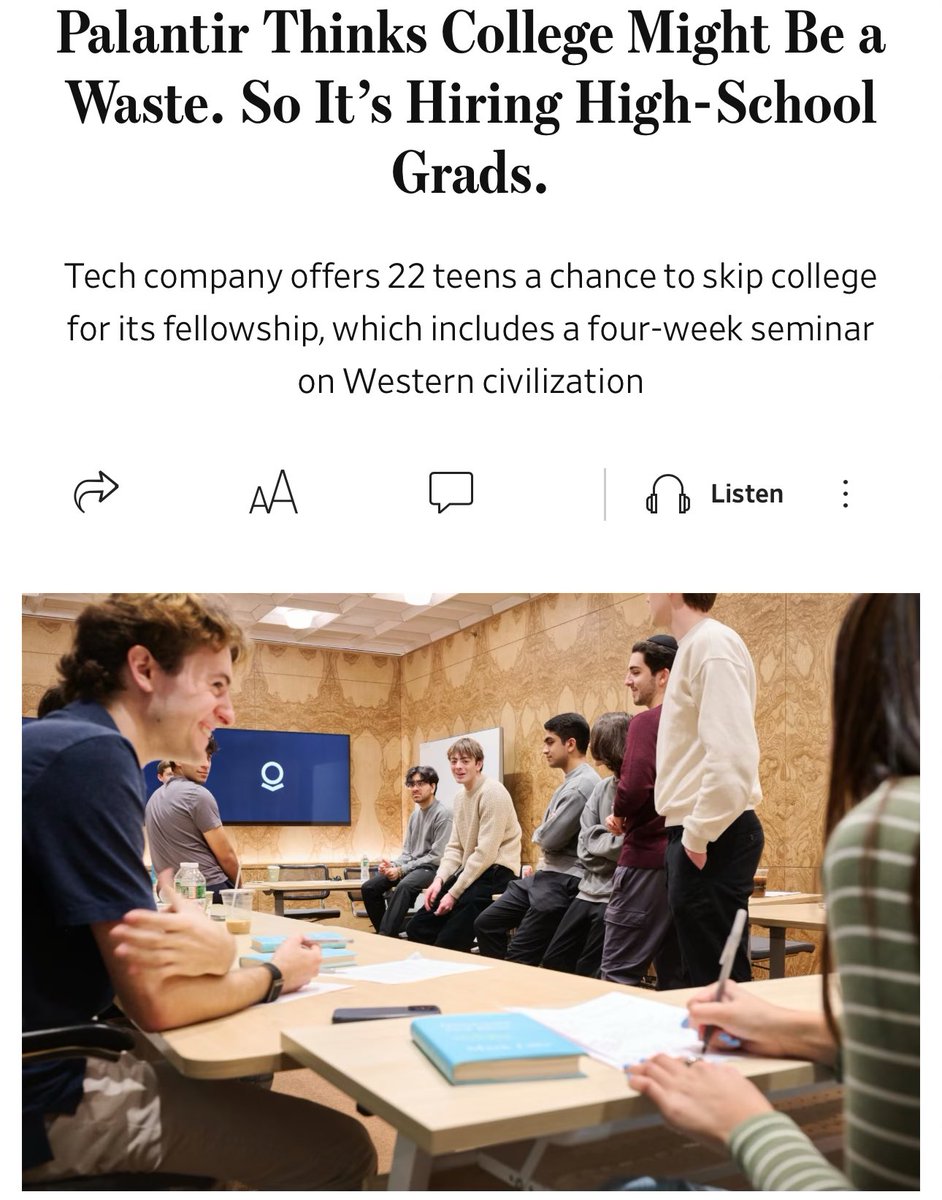
What happens to a society when its smartest teenagers decide college isn’t worth the time and companies start agreeing with them?
Palantir just tried something most people thought was unthinkable. It told high school students to skip college, walk past the gatekeepers, and start working on real-world national-security and tech problems at eighteen.
Five hundred teens applied. Twenty-two got in. Some turned down places at Ivy League schools. One even walked away from a full-ride scholarship backed by the Department of Defense.
Why?
Because the message hit a nerve: the belief that college has stopped rewarding merit and started rewarding compliance.
These fellows were thrown into seminars on Western civilization, leadership, and U.S. history. They took notes for the first time in their lives. They visited Gettysburg. They debated whether the West is still worth defending. Then they were dropped into live product teams handling hospitals, defense clients, government agencies — real stakes, real pressure.
And something happened that no university can replicate.
They saw what it feels like when a company trusts them on day three more than a college would trust them in year three.
Parents panicked. Counselors discouraged them. Friends told them they were insane.
But every generation has a moment where the ground shifts. This might be one of those moments.
So here’s the real question behind the question:
If elite companies start grooming talent straight out of high school, and young people start choosing mastery over lectures, how long until the traditional college path stops being the default and becomes the backup plan?
People search for competitive advantages while ignoring the one hiding in plain sight:
Doing what you said you'd do.
People are inconsistent. They don't follow through. They don't follow up...
This means the simple act of being reliable sets you apart.
It's not talent or genius or connections, it's the boring stuff. Reliability is rare.
When I taught students in the sciences, I often told them to unlearn much of the writing they’d been taught in humanities courses since high school. That style is built to signal erudition - flaunting obscure vocabulary, esoteric Latin phrases, and unusual word orders to make the writer sound impressive.
Scientific communication is the opposite. It demands clarity of thought, precision, and rigorous meaning.
The two styles couldn’t be more different. Fortunately, smart students usually adapt quickly once they realize that good science writing is about being understood, not performing sophistication.
@SamuelVimes10@FayeGriffiths8@ktibus@SwailesRuth Proprioception is important for low achievers mostly.
So, if a child struggles with reading, it makes sense to address this issue first and then return to learning how to read.
For normal children the proprioception problem doesn't exist.
@SteveM26120431@SamuelVimes10 A lot of features could be included in the app, but:
- At what cost?
- When? (It could take years.)
- Should it really be in the app, or would it be better to create a separate app?
Ruth specializes in low achievers, but the app isn’t designed for that group.
A lot of kids get nothing from staying in school 2-4 extra years. It used to be very normal for people to stop going to school after 8th grade. I’m glad kids don’t have to work, but now high school is middle school, college is high school, and PhD programs are barely college.
“Project based learning” as takes place in schools where projects are assigned is absolute garbage much of the time.
Teens creating serious businesses or doing serious writing is terrific.
Almost all education research is garbage because it is based on what happens in schools. But schools are hopeless.
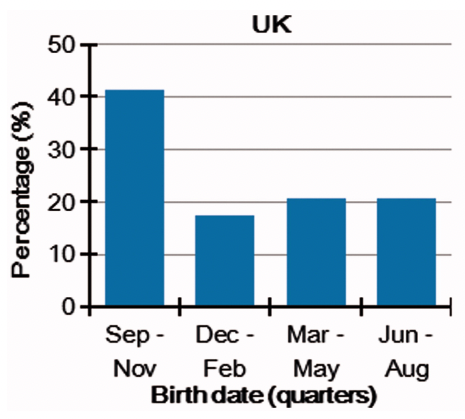
In the UK, the academic year runs from September to August. A child born in September is, on their first day of school, nearly a full year older than a classmate born the following August. At age 4 or 5, that's a 20% difference in life experience and development.
3. Small advantages compound. This is why UK Nobel Prize winners are 2x as likely to be born in September. It's not the genes - just the small headstart of being developmentally a bit ahead is very potent academically.