🚨 NEW @FraticelliLab PREPRINT JUST WENT LIVE
https://t.co/cauXJei5Ji
Here, we describe PLSTCs, Soluplus-based expansion cultures of primary mouse *Acute Myeloid Leukemia* Stem Cells. And then we use LARRY barcoding to identify drivers of leukemogenicity and drug resistance!
How does leukaemia develop? 🩸 How long does it take? ⏳
🌟 Our paper, started back when I was a PhD student in @jrblundell’s lab, is out today in @Nature 🌟
Yearly blood samples from women who developed AML in later life let us trace it back decades 👇
https://t.co/fqyOpc5OKH
🧬 A new study in @Nature, co-led by IJC Director Ari Melnick, shows how mutations in the BAF complex alter the 3D organisation of DNA and can contribute to B-cell lymphoma development in experimental models.
🔗 https://t.co/lrkHWENRKf
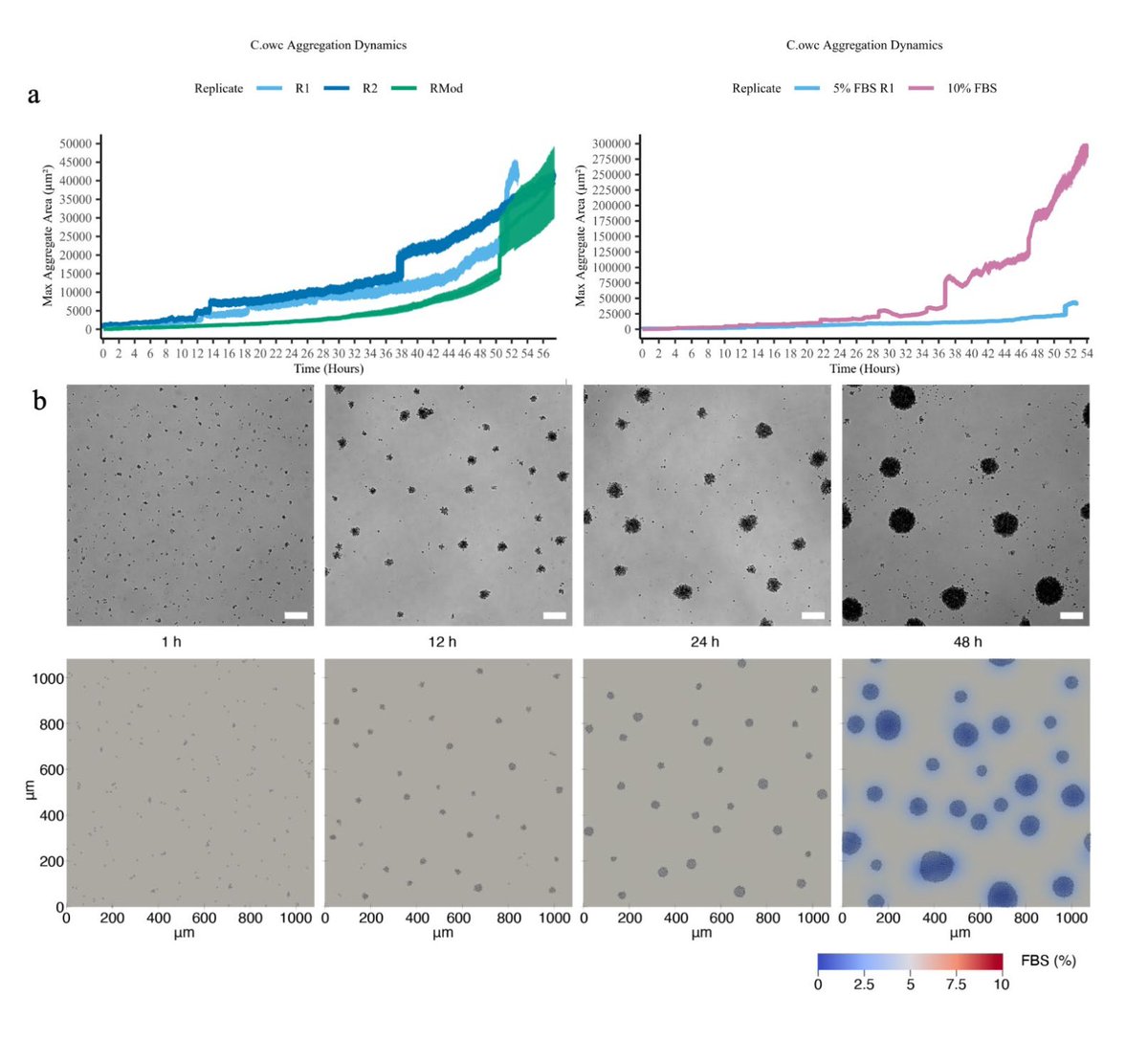
How do cells aggregate and then separate again?
In our updated preprint, we combine experiments & mathematical modelling in a unicellul relative of animals, to provide a framework to ask how genes shared with animals contribute to collective cell behaviour
https://t.co/CCOU4QxZ2Z
Más allá del titular clickbait, una buena conversación con la periodista Paka Diaz sobre los esfuerzos de mi labo para entender y targetear el metabolismo del cáncer de hígado. @criscancer@CNIOStopCancer https://t.co/6FhhED56nt
Extremely excited to share our lab's latest findings, now published in Blood 👏🏻🥳 @BloodPortfolio !
We show that young MPP6 is a long-term, lymphoid-biased population with HSC-like properties. Strikingly, upon aging.. 1/5
https://t.co/7UGOcVZS2z
Our new story is published in Blood! 🩸
Research on blood aging has mainly focused on hematopoietic stem cells (HSCs), while the multipotent progenitors downstream of them, especially the CD150⁻ MPP6, have remained largely overlooked.
https://t.co/YjFLmztIXx
Can a photo tell how old a mouse is? 📸🐭
We trained a model on 2,846 photos of 1,292 mice from 7 facilities. Mice that look older than their age are frailer and die sooner, and telomerase-deficient G4 mice look ~5 months older.
Preprint ⬇️
It’s been a few days and I still can’t fully cope with this pain. I’ve been having panic attacks just thinking of what her family must be going through right now.
Marta Shabazi was much more to me than a classmate, or a colleague. She was in many ways what I always hoped to become. She made it look easy to balance family and science in a calm and joyful way that I had never seen before, and I have admired her for as long as I remember (and of course she knew it, as I told her more than a few times). She had a positive and optimistic attitude towards everything that was contagious to the extreme.
Whenever I think an experiment is impossible, or another play date is throwing my week off… I can still imagine her looking at me telling me that you gotta throw at it all you’ve got.
I will miss you Marta.
🚨We're recruiting! Calling all bold & original thinkers! Folks with imagination, drive & the (rare) ability to find the thin seam where the fantastical and real meet. Come join a thriving science community, in, beyond a shadow of a doubt, the greatest city in the 🌎 @nyknicks
Today in @Nature we present the development and characterisation of the first-in-class catalytic inhibitor of METTL1 as a new therapeutic strategy against solid and blood cancers.
Another flagship collaboration between my lab @SCICambridge@Cambridge_Haem (@Cambridge_Uni) and @storm_tx, co-led by my brilliant colleague @OliverRausch and driven by Eliza Yankova, Alexandra Sapetschnig and Beth Thomas.
A big thank you to the long list of authors who participated in this study and provided their critical input and diverse expertise. I am also very thankful and lucky to have the continuous support of @wellcometrust, @LeukUK and @CR_UK.
https://t.co/jODFOc9kDq
Our latest, sent on behalf of the outstanding but X-less Aidan Keith: OPTIMuS PRIME-Del uses paired prime editing to program targeted deletions at candidate enhancers, while concurrently replacing them w/ a molecular tag to verify & quantify deletions 1/7
https://t.co/iq41mejHGG
Thrilled to share our latest publication in @NatureComms !
Can the intestine remember a previous injury?
We show that intestinal injury leaves a lasting transcriptional and epigenetic imprint that primes the tissue for enhanced regeneration.
https://t.co/7EGJCwRpWo